
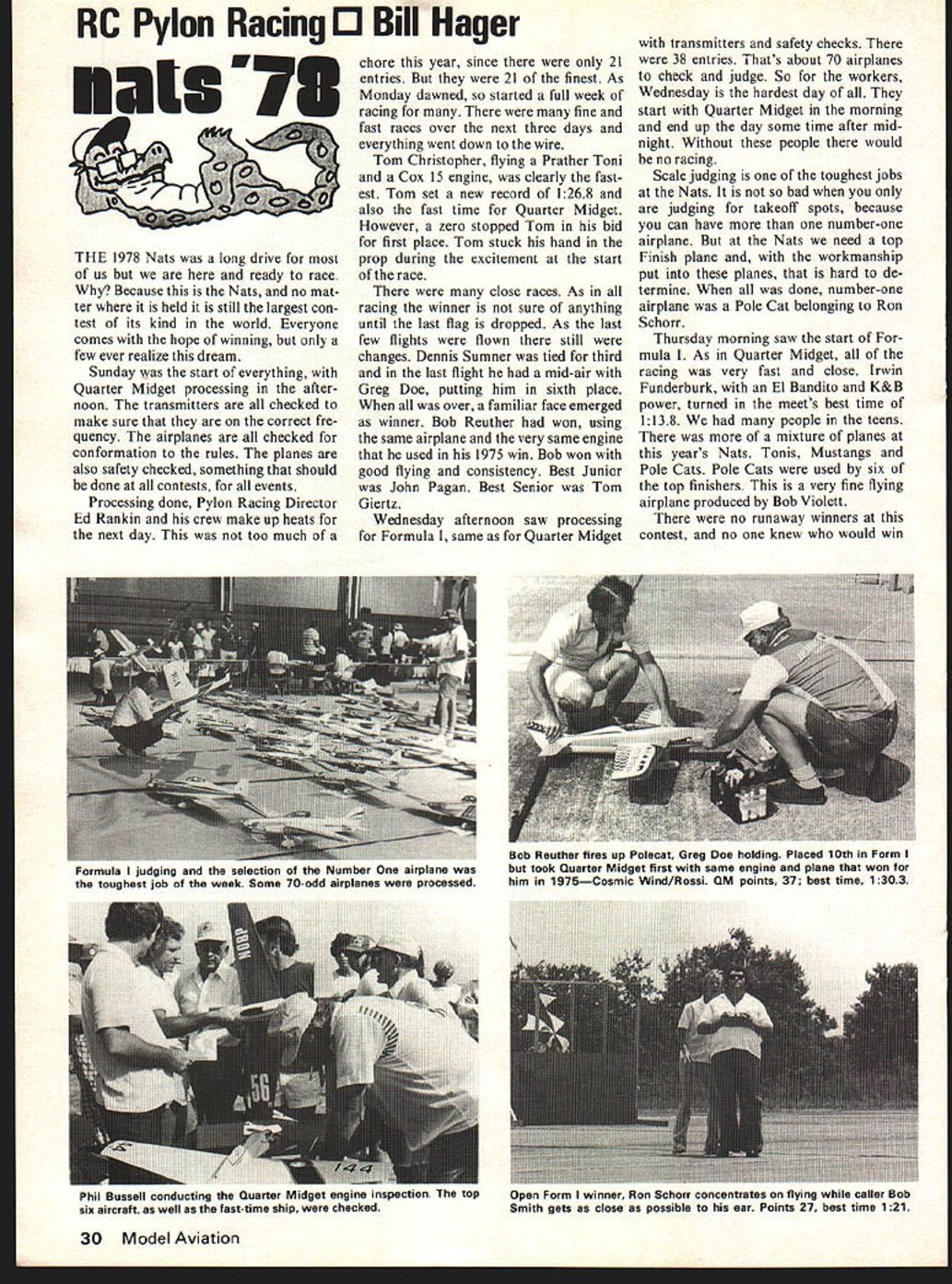
NATS '78: RC Pylon Racing
Bill Hager
The 1978 Nats was a long drive for most of us, but we are here and ready to race. Why? Because this is the Nats, and no matter where it is held it is still the largest contest of its kind in the world. Everyone comes with the hope of winning, but only a few ever realize this dream.
Quarter Midget
Sunday was the start of everything, with Quarter Midget processing in the afternoon. Transmitters were all checked to make sure they were on the correct frequency. The airplanes were checked for conformance to the rules and were given safety inspections — something that should be done at all contests for all events.
With processing done, Pylon Racing Director Ed Rankin and his crew made up heats for the next day. This was not too much of a chore this year, since there were only 21 entries — but they were 21 of the finest. As Monday dawned, a full week of racing began for many. There were many fine and fast races over the next three days and everything went down to the wire.
Tom Christopher, flying a Prather Toni with a Cox .15 engine, was clearly the fastest. Tom set a new record of 1:26.8 and also recorded the fastest time for Quarter Midget. However, a zero stopped Tom in his bid for first place when he stuck his hand in the prop during the excitement at the start of the race.
There were many close races. As in all racing, the winner is not sure of anything until the last flag is dropped. As the last few flights were flown there still were changes. Dennis Sumner was tied for third and in the last flight he had a mid-air with Greg Doe, putting him in sixth place. When all was over, a familiar face emerged as winner. Bob Reuther won, using the same airplane and the very same engine that he used in his 1975 win. Bob won with good flying and consistency.
Quarter Midget awards:
- Winner: Bob Reuther
- Best Junior: John Pagan
- Best Senior: Tom Giertz
Formula I
Wednesday afternoon saw processing for Formula I, with the same transmitter and safety checks as for Quarter Midget. There were 38 entries — that's about 70 airplanes to check and judge — so for the workers Wednesday is the hardest day of all. They started with Quarter Midget in the morning and finished sometime after midnight. Without these people there would be no racing.
Scale judging is one of the toughest jobs at the Nats. It's not so bad when you only are judging for takeoff spots, because you can have more than one number-one airplane. But at the Nats we need a top-finish plane and, with the workmanship put into these planes, that is hard to determine. When all was done, the number-one airplane was a Pole Cat belonging to Ron Schorr.
Thursday morning saw the start of Formula I. As in Quarter Midget, much of the racing was very fast and close. Irwin Funderburk, flying an El Bandito with K&B power, turned in the meet's best time of 1:13.8. We had many people in the teens. There was more of a mixture of planes at this year's Nats — Tonis, Mustangs and Pole Cats. Pole Cats were used by six of the top finishers. This is a very fine flying airplane produced by Bob Violett.
Until the last few races Dave Shadel was on top, but he had a mid-air with Tom Christopher. Tom lost two planes at this Nats. It was a race to the wire. Ron Schorr won his last race, which could have gone either way. This put Ron one point ahead of Bob Smith and Dave Shadel, giving Ron first place. Bob Smith and Dave Shadel were tied for second at 26 points; Dave had the faster time of 1:15.3, which placed Dave second and Bob third. There were fly-offs for fourth through eighth place. All the rest were determined by best time and points.
Formula I awards and notes:
- First: Ron Schorr (Pole Cat)
- Second: Dave Shadel
- Third: Bob Smith
- Meet's best time: Irwin Funderburk — 1:13.8
- Best Junior: Drew Telford
- Best Senior: Steve Barrett
All of us wanted to see how the new Pole Cat would do, and we were not disappointed. There were 11 Pole Cats entered. These airplanes even look fast. I don't know that they are any faster than the Toni, but they sure aren't any slower, and it is always nice to see something new and different.
The turnout was a little off in Pylon this year. I am not sure why. Those that came had a good time. I have gone to several Nats, and no matter where they are held, I will continue to go — and so will the rest of the true competitors.
Transcribed from original scans by AI. Minor OCR errors may remain.

