
Nats CL: Aerobatics
Wynn Paul
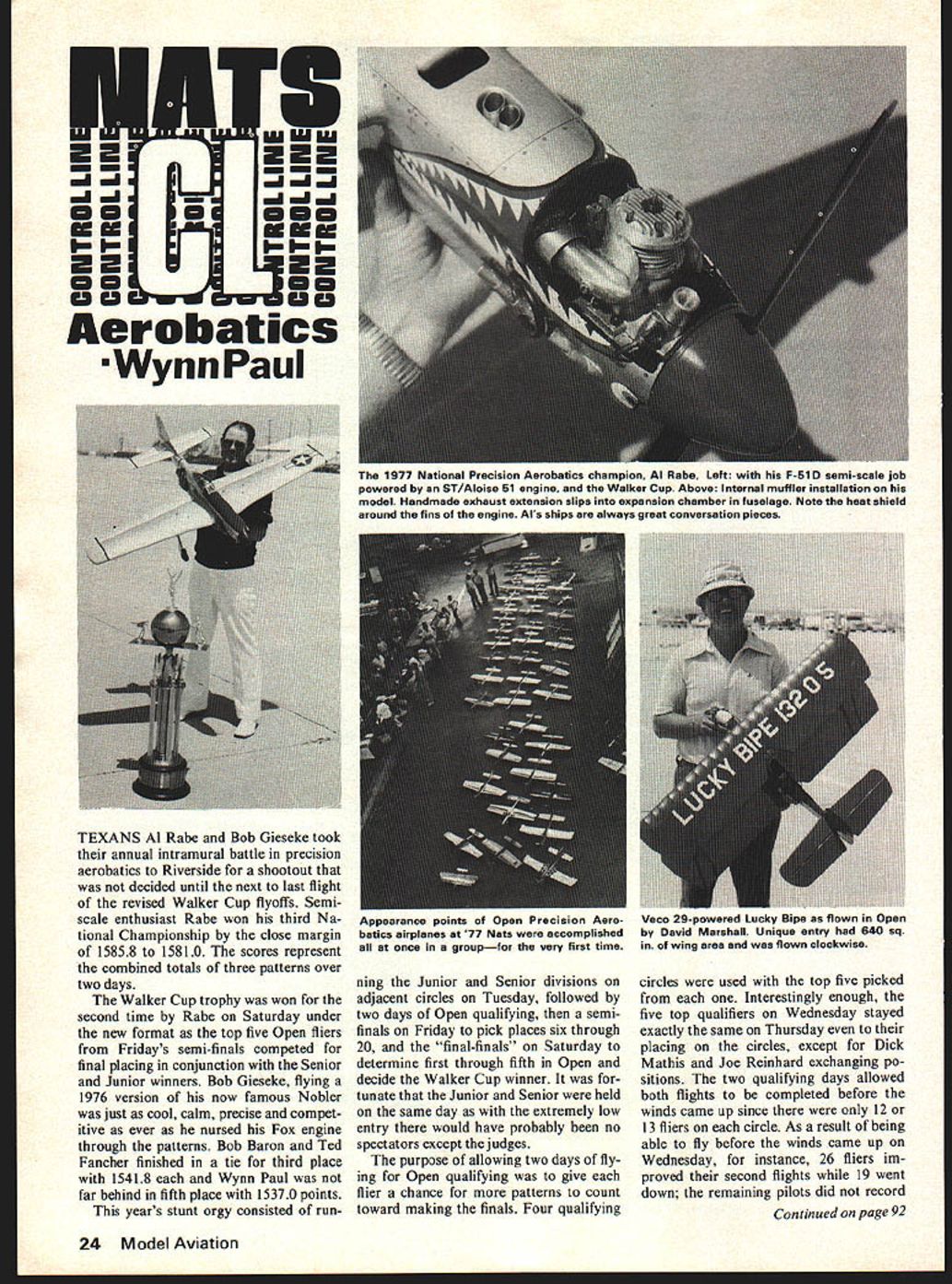
TEXANS Al Rabe and Bob Gieseke took their annual intramural battle in precision aerobatics to Riverside for a shootout that was not decided until the next-to-last flight of the revised Walker Cup flyoffs. Semiscale enthusiast Rabe won his third National Championship by the close margin of 1585.8 to 1581.0. The scores represent the combined totals of three patterns over two days.
The Walker Cup trophy was won for the second time by Rabe on Saturday under the new format as the top five Open fliers from Friday's semi-finals competed for final placing in conjunction with the Senior and Junior winners. Bob Gieseke, flying a 1976 version of his now famous Nobler, was just as cool, calm, precise and competitive as ever as he nursed his Fox engine through the patterns. Bob Baron and Ted Fancher finished in a tie for third place with 1541.8 each and Wynn Paul was not far behind in fifth place with 1537.0 points.
This year's stunt orgy consisted of running the Junior and Senior divisions on adjacent circles on Tuesday, followed by two days of Open qualifying, then a semi-finals on Friday to pick places six through 20, and the "final-finals" on Saturday to determine first through fifth in Open and decide the Walker Cup winner. It was fortunate that the Junior and Senior were held on the same day as with the extremely low entry there would have probably been no spectators except the judges.
The purpose of allowing two days of flying for Open qualifying was to give each flier a chance for more patterns to count toward making the finals. Four qualifying circles were used with the top five picked from each one. Interestingly enough, the five top qualifiers on Wednesday stayed exactly the same on Thursday even to their placing on the circles, except for Dick Mathis and Joe Reinhard exchanging positions. The two qualifying days allowed both flights to be completed before the winds came up since there were only 12 or 13 fliers on each circle. As a result of being able to fly before the winds came up on Wednesday, for instance, 26 fliers improved their second flights while 19 went down; the remaining pilots did not record Two scores due to crashes or passing. All 12 seeded fliers qualified as expected. The seeding procedure as promoted by Keith Trostle and PAMPA has proved a fair way to spread out the recognized pilots.
It is difficult to put into words the success of the administration of the event as performed by Arlie Preszler and Lanny Shorts. Pre-Nats planning and logistical support rivaled that of any World Championships. Probably the only disappointing part of the entire show was the low number of entries with only 51 in Open, six in Junior and eight in Senior. However, the entire Nationals entry was low.
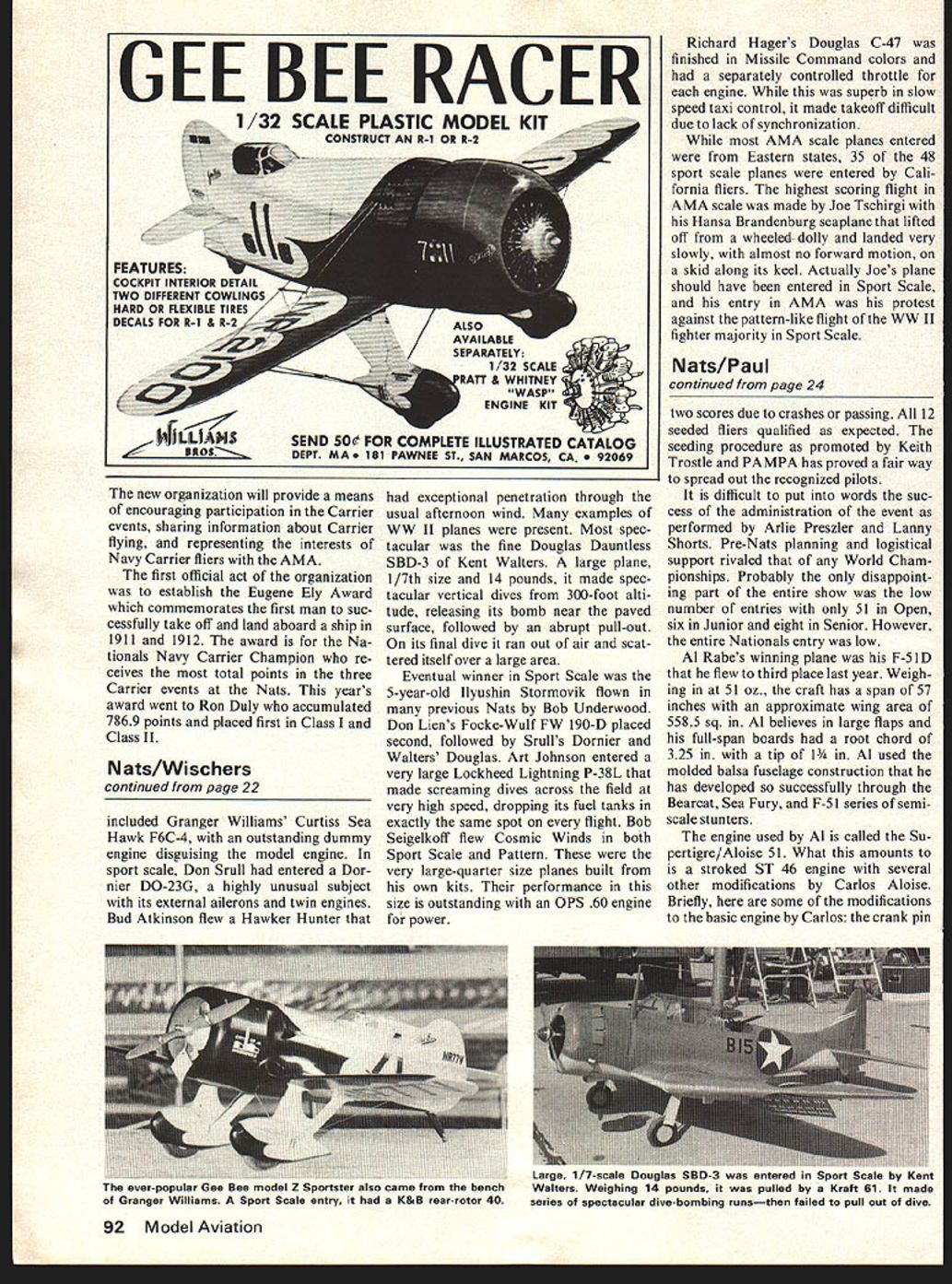
Al Rabe's winning plane was his F-51D that he flew to third place last year. Weighing in at 51 oz., the craft has a span of 57 inches with an approximate wing area of 558.5 sq. in. Al believes in large flaps and his full-span boards had a root chord of 3.25 in. with a tip of 1 1/2 in. Al used the molded balsa fuselage construction that he has developed so successfully through the Bearcat, Sea Fury, and F-51 series of semi-scale stunts.
The engine used by Al is called the Supertigre/Aloise 51. What this amounts to is a stroked ST 46 engine with several other modifications by Carlos Aloise. Briefly, here are some of the modifications to the basic engine by Carlos: the crank pin was repositioned .040 in from the stock position to stroke the engine to .51 cu. in.; the crank is rebalanced by adding weight to the counterbalance in the form of 99.9 percent pure tungsten. The sleeve is lowered to restrict the timing. Bypass timing is 100 degrees, exhaust timing 108 degrees. A new lighter connecting rod was machined from stock with a phosphorus-bronze bushed bottom end. The piston was altered by heli-arcing metal to the exhaust side to reduce sub-piston induction. A new head chamber (machined from old head) with increased volume and reduced compression was used. This necessitates using short-reach plugs or long-plugs with three washers. Carlos also machined a new piston ring of high quality steel and Al ended up using a ring gap of .012, which is considerably more than most ST 46 users, but seemed to work with this particular engine. Carlos stated that he was able to clock the rpm of the engine in level flight at 7800 and when the engine broke into two-cycle during maneuvers it registered 9300 rpm. Al's lap times using 64-ft. lines were usually 5.6 or 5.7 during the early parts of the pattern. This is slower than the usual lap times of such top fliers as Les McDonald and Bob Hunt (5.2-5.3). Al also carves his own props starting with a Top-Flite 14/6 Super M which is then whittled down to 13/5 to 13/7.
Senior stunt is getting to be one of the most hotly contested events at the Nats. Last year's Junior Champion, David Fitzgerald, outpointed a determined Joe Musumeci, Jr. (second last year in Senior) 452 to 439.75. Both of these fliers show many hours of practice in their patterns as they rival many of the Open fliers. David flew the same modified Sig Chipmunk he had last year with a Max 35 engine. He used a Zinger 10/6 prop, Sig 10 percent nitro fuel, a Fox plug, and an E-Z Just handle. The Chip is covered with Monokote on the wing and tail and has K&B Superpoxy on the fuselage.
Joe Musumeci switched this year to a blue Olympus which, to this writer, just didn't look as impressive in the air as his former red Gieseke Nobler. Third place went to Greg Brown with a Sig Acrobat with a unique internal muffler designed by his father.
Junior stunt was Karl Hiesl all the way, flying a Miss Poppy kit with a ST 46 engine. He had replaced the plastic top block and cowl with wood to save about five ounces of weight. Karl has been flying stunt for only about six months. Dan McClellan moved up from sixth place last year to finish a good second place flying another Chipmunk. Gordon Marshall finished third with a modified Sig Banshee with a Max 35 engine.
Half-A stunt this year had a poor turnout of only 13 entries. Cox Manufacturing graciously supplied the trophies for the event, but we all missed Larry Renger's presence to supervise the event. David McClellan won the Junior division over Gordon Marshall.
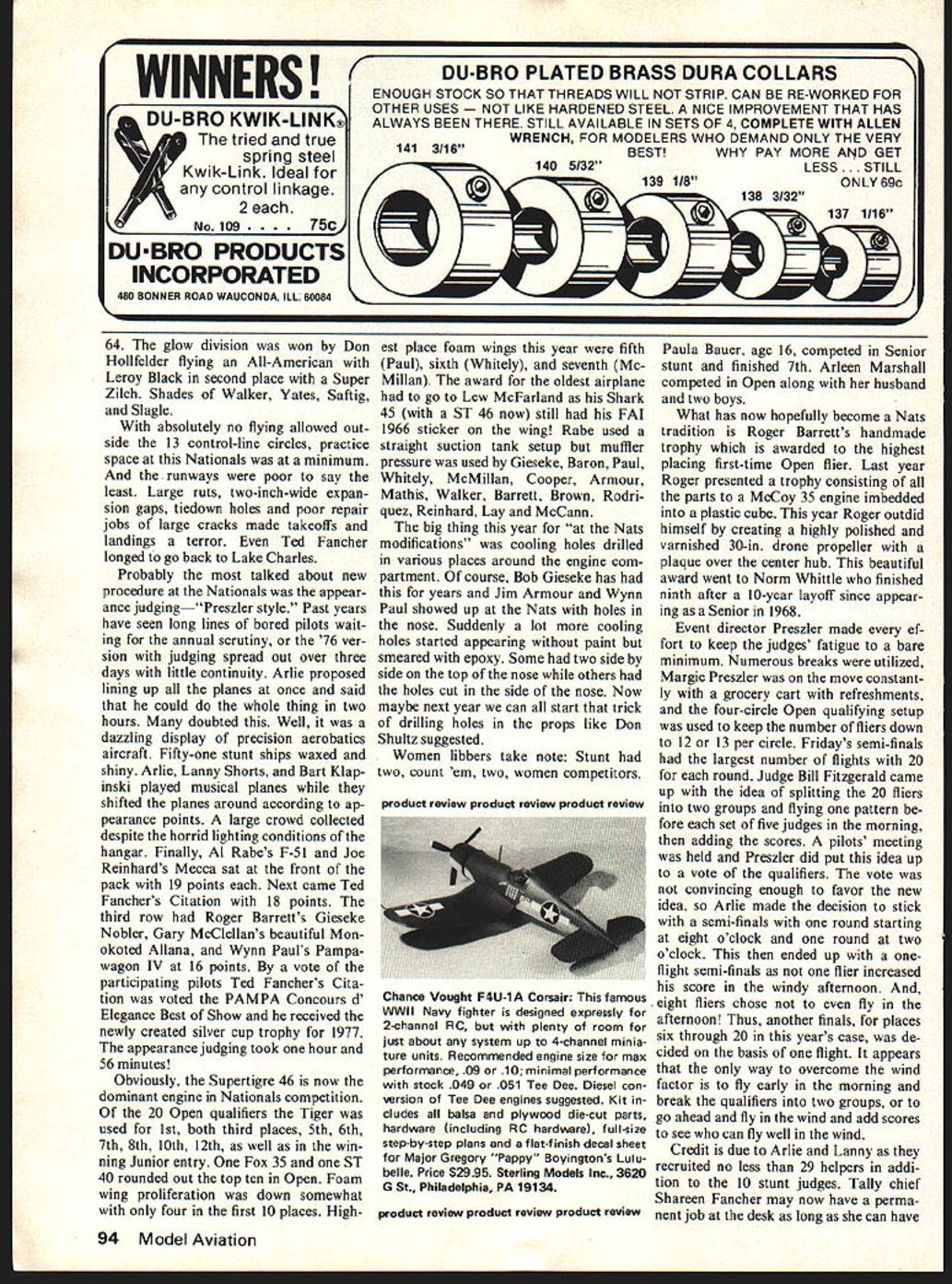
David Fitzgerald became a double National Champion again as in 1976, as he won Senior this year over defending champion Leonardo Silva of Mexico. Bob Whitely successfully defended his title with a miniature Miss Kell over the gregarious and buoyant Rick Porter flying his now famous Voo Doo stunter with tricycle gear in clockwise flight.
A last minute addition to the stunt events this year was Old Time Stunt which was championed by John Pond and Dave Marshall. Two classes were held: ignition and glow. Bart Kapinski won the ignition division flying a Yates Madman belonging to J. C. Yates who was looking on with pride. The engine was a screaming Orwick. The glow division was won by Don Hollfelder flying an All‑American with Leroy Black in second place with a Super Zilch. Shades of Walker, Yates, Saftig, and Slagle.
With absolutely no flying allowed outside the 13 control‑line circles, practice space at this Nationals was at a minimum. And the runways were poor to say the least. Large ruts, two‑inch‑wide expansion gaps, tiedown holes and poor repair jobs of large cracks made takeoffs and landings a terror. Even Ted Fancher longed to go back to Lake Charles.
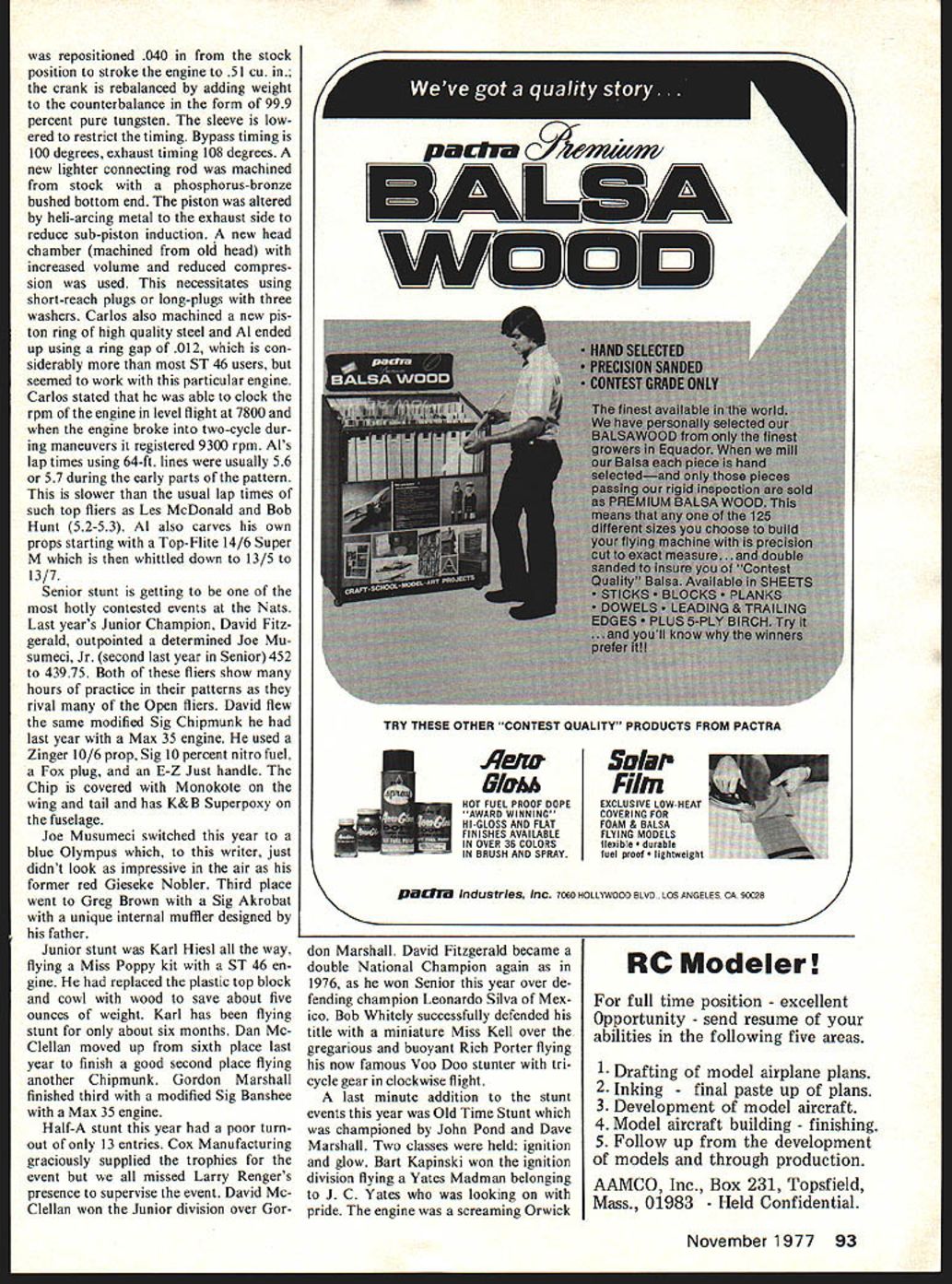
Probably the most talked about new procedure at the Nationals was the appearance judging—"Preszler style." Past years have seen long lines of bored pilots waiting for the annual scrutiny, or the '76 version with judging spread out over three days with little continuity. Arlie proposed lining up all the planes at once and said that he could do the whole thing in two hours. Many doubted this. Well, it was a dazzling display of precision aerobatics aircraft. Fifty‑one stunt ships waxed and shiny. Arlie, Lanny Shorts, and Bart Klapinski played musical planes while they shifted the planes around according to appearance points. A large crowd collected despite the horrid lighting conditions of the hangar. Finally, Al Rabe's F‑51 and Joe Reinhard's Mecca sat at the front of the pack with 19 points each. Next came Ted Fancher's Citation with 18 points. The third row had Roger Barrett's Gieseke Nobler, Gary McClellan's beautiful Monokoted Allana, and Wynn Paul's Pampawagon IV at 16 points. By a vote of the participating pilots Ted Fancher's Citation was noted the PAMPA Concours d'Elegance Best of Show and he received the newly created silver cup trophy for 1977. The appearance judging took one hour and 56 minutes.
Obviously, the Supertigre 46 is now the dominant engine in Nationals competition. Ten of the 20 Open qualifiers the Tiger was used for 1st, both third places, 5th, 6th, 7th, 8th, 10th, 12th, as well as in the winning Junior entry. One Fox 35 and one ST 40 rounded out the top ten in Open. Foam wing proliferation was down somewhat with only four in the first 10 places. Highest place foam wings this year were fifth (Paul), sixth (Whitely), and seventh (McMillan). The award for the oldest airplane had to go to Lew McFarland as his Shark 45 (with a ST 46 now) still had his FAI 1966 sticker on the wing! Rabe used a straight suction tank setup but muffler pressure was used by Gieseke, Baron, Paul, Whitely, McMillan, Cooper, Armour, Mathis, Walker, Barrett, Brown, Rodriguez, Reinhard, Lay and McCann.
The big thing this year for "at the Nats modifications" was cooling holes drilled in various places around the engine compartment. Of course, Bob Gieseke has had this for years and Jim Armour and Wynn Paul showed up at the Nats with holes in the nose. Suddenly a lot more cooling holes started appearing without paint but smeared with epoxy. Some had two side by side on the top of the nose while others had the holes cut in the side of the nose. Now maybe next year we can all start that trick of drilling holes in the props like Don Shultz suggested.
Women libbers take note: Stunt had two, count 'em, two, women competitors. Paula Bauer, age 16, competed in Senior stunt and finished 7th. Arleen Marshall competed in Open along with her husband and two boys.
What has now hopefully become a Nats tradition is Roger Barrett's handmade trophy which is awarded to the highest placing first‑time Open flier. Last year Roger presented a trophy consisting of all the parts to a McCoy 35 engine embedded into a plastic cube. This year Roger outdid himself by creating a highly polished and varnished 30‑in. chrome propeller with a plaque over the center hub. This beautiful award went to Norm Whitely who finished ninth after a 10‑year layoff since appearing as a Senior in 1968.
Event director Preszler made every effort to keep the judges' fatigue to a bare minimum. Numerous breaks were utilized. Margie Preszler was on the move constantly with a grocery cart with refreshments, and the four‑circle Open qualifying setup was used to keep the number of fliers down to 12 or 13 per circle. Friday's semi‑finals had the largest number of flights with 28 for each round. Judge Bill Fitzgerald came up with the idea of splitting the 20 fliers into two groups and flying one pattern before each set of five judges in the morning, then adding the scores. A pilots' meeting was held and Preszler did put this idea up to a vote of the qualifiers. The vote was not convincing enough to favor the new idea, so Arlie made the decision to stick with a semi‑finals with one round starting at eight o'clock and one round at two o'clock. This then ended up with a one‑flight semi‑finals as not one flier increased his score in the windy afternoon. And, eight fliers chose not to even fly in the afternoon! Thus, another finals, for places six through 20 in this year's case, was decided on the basis of one flight. It appears that the only way to overcome the wind factor is to fly early in the morning and break the qualifiers into two groups, or to go ahead and fly in the wind and add scores to see who can fly well in the wind.
Credit is due to Arlie and Lanny as they recruited no less than 29 helpers in addition to the 10 stunt judges. Tally chief Sharen Fancher may now have a permanent job at the desk as long as she can have a direct view of the circle when Ted is flying—woe be to the person who gets into the line of sight at that time! Margie Preszler and Joyce Shorts were present every minute of every day to assist at the desk. Pit boss Dick Schaper kept things well ahead in the ready area. Many thanks are due to the judges who suffered the five day ordeal: Bill Fitzgerald, Bob Foster, Dave Gardner, Bill Howe, Tom Johnson, Don Jorda, Bill Kipp, John Laws, Bryant Thompson, Tom Warden. Bill Bradford and Arlie Preszler judged the Half-A event when a shortage of personnel cropped up on Saturday.
To editorialize, it is the age-old problem of obtaining judges that is still the number one headache for running stunt at the Nationals or FAI tryouts. What precision aerobatics needs is a large group (one or two dozen) people who want to be full time judges for the Nationals, FAI tryouts and for traditionally large local contests. The event needs leadership in this area. RC pattern has its own Judges Association with cute shirts emblazoned with USPJA on the back. Stunt needs this sort of esprit de corps for a group of competent judges.
The Nationals was capped off with the fourth annual PAMPA banquet at the local Ramada Inn. Approximately ninety attended and one of the honored guests was Mr. Stunt himself, Bob Palmer. With PAMPA vice‑president Frank McMillan presiding a short business meeting was held with nominations for officers for the coming term, and the trophies were presented for the various events. The final presentation was the Walker Cup to the 1977 National Precision Aerobatics Champion Al Rabe.
Transcribed from original scans by AI. Minor OCR errors may remain.

