
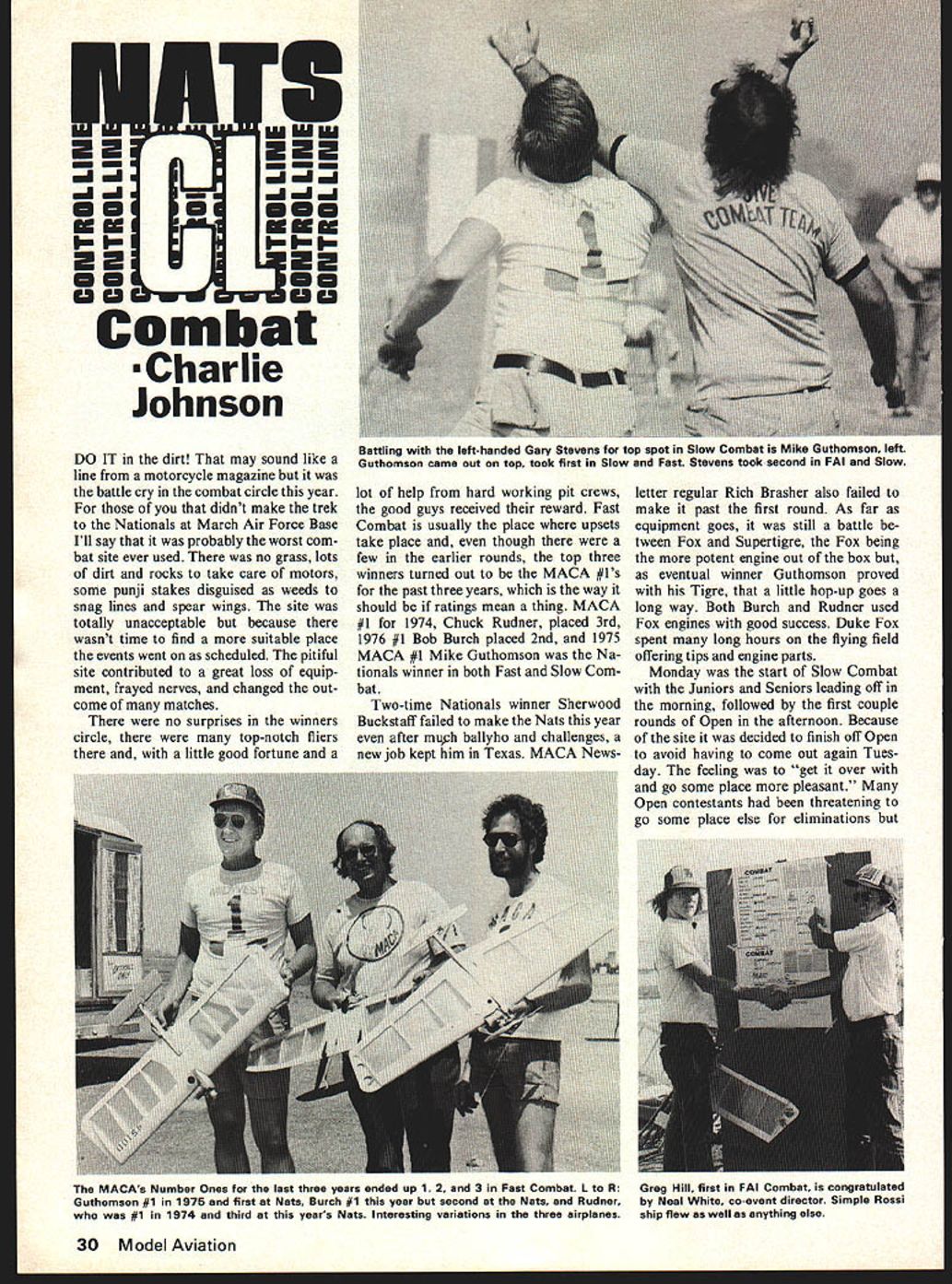
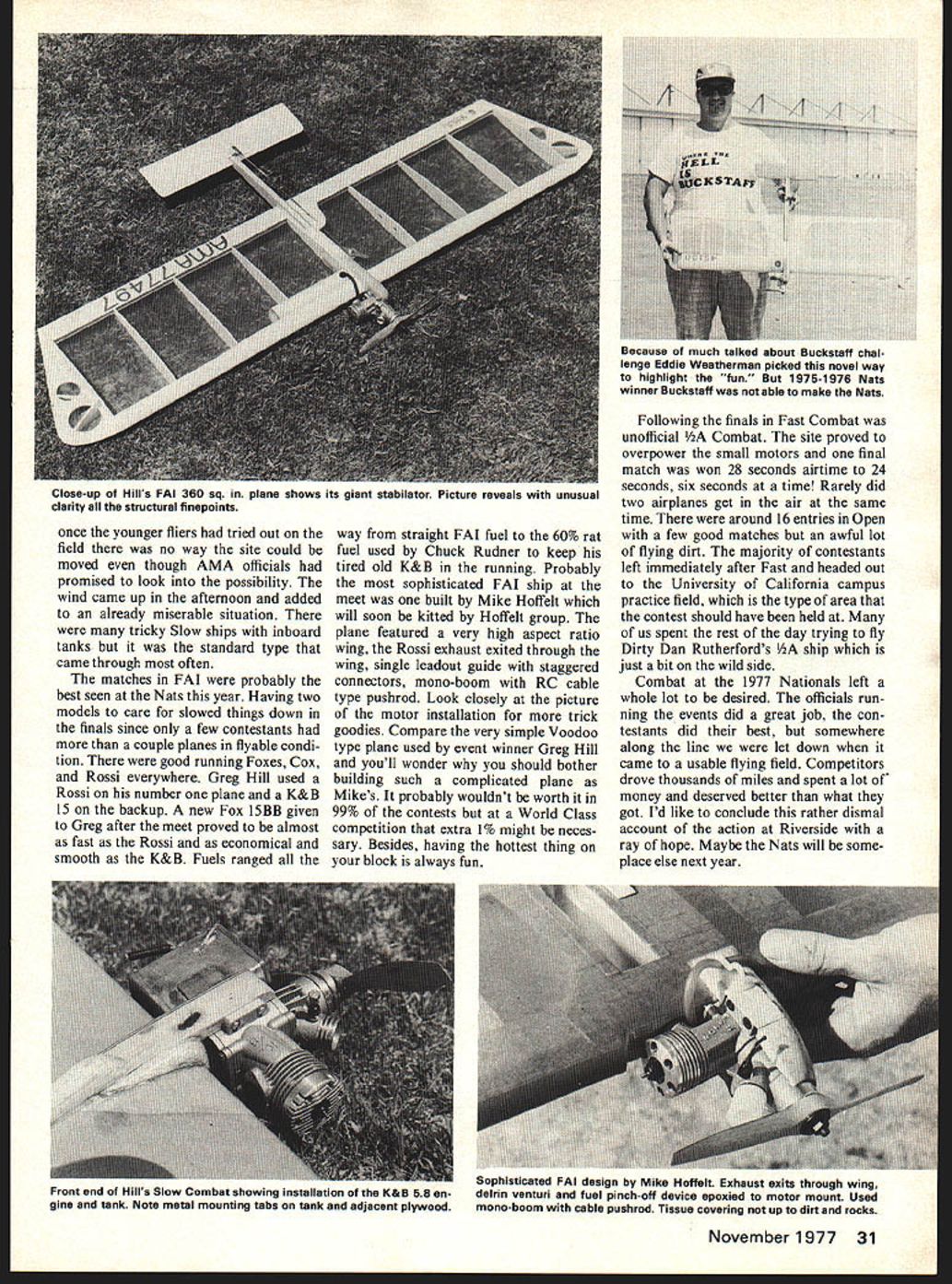
Nats CL: Combat
Charlie Johnson
DO IT in the dirt! That may sound like a line from a motorcycle magazine but it was the battle cry in the combat circle this year. For those of you that didn't make the trek to the Nationals at March Air Force Base I'll say that it was probably the worst combat site ever used. There was no grass, lots of dirt and rocks to take care of motors, some punji stakes disguised as weeds to snag lines and spear wings. The site was totally unacceptable but because there wasn't time to find a more suitable place the events went on as scheduled. The pitiful site contributed to a great loss of equipment, frayed nerves, and changed the outcome of many matches.
There were no surprises in the winners circle, there were many top-notch fliers there and, with a little good fortune and a lot of help from hard-working pit crews, the good guys received their reward. Fast Combat is usually the place where upsets take place and, even though there were a few in the earlier rounds, the top three winners turned out to be the MACA #1's for the past three years, which is the way it should be if ratings mean a thing. MACA #1 for 1974, Chuck Rudner, placed 3rd; 1976 #1 Bob Burch placed 2nd; and 1975 MACA #1 Mike Guthomson was the Nationals winner in both Fast and Slow Combat.
Two-time Nationals winner Sherwood Buckstaff failed to make the Nats this year even after much ballyhoo and challenges; a new job kept him in Texas. MACA Newsletter regular Rich Brasher also failed to make it past the first round. As far as equipment goes, it was still a battle between Fox and Supertigre, the Fox being the more potent engine out of the box but, as eventual winner Guthomson proved with his Tigre, a little hop-up goes a long way. Both Burch and Rudner used Fox engines with good success. Duke Fox spent many long hours on the flying field offering tips and engine parts.
Monday was the start of Slow Combat with the Juniors and Seniors leading off in the morning, followed by the first couple rounds of Open in the afternoon. Because of the site it was decided to finish off Open to avoid having to come out again Tuesday. The feeling was to "get it over with and go some place more pleasant." Many Open contestants had been threatening to go some place else for eliminations but the majority stayed.
Slow ships with inboard tanks of the standard type came through in many matches. FAT probably was best seen at the Nats this year. Having two models to care for slowed things down in the finals since few contestants had a couple planes in flyable condition. Good running Foxes, Cox and Rossi engines were everywhere. Greg Hill used a Rossi as his number one plane with a K&B 15 as backup; a new Fox 15BB given Greg after the meet proved almost as fast. Rossi was economical and smooth.
K&B fuels ranged widely; straight FAT fuel and 60% ratio fuels were used. Chuck Rudner kept his tired old K&B running. Probably the most sophisticated FAT ship at the meet was built by Mike Hoffelt and will soon be kitted. Hoffelt group's plane featured a very high aspect-ratio wing; the Rossi exhaust exited through the wing. Single leadout guide, staggered connectors, mono-boom, RC-cable-type pushrod — look closely at the picture for the motor installation trick goodies. Compare the very simple Voodoo-type plane used by event winner Greg Hill and you'll wonder why bother building such a complicated ship. Mike's probably wouldn't be worth it in 99% of contests; world-class competition, that extra 1%, might necessitate it. Besides, having the hottest thing on the block is always fun.
Following the finals, Fast Combat and unofficial 1/2A Combat showed how overpowering the site was for small motors. Final matches often had very short air times. Rarely did two airplanes stay up at the same time in many rounds. With around 16 entries in Open there were a few good matches but a lot of awful flying because of the dirt; the majority of contestants left immediately after Fast.
The contest should have been held at a pleasant practice-field-type area such as the University of California campus; we spent the rest of the day trying to fly wherever we could. Dirty Dan Rutherford's ship showed just a bit of the wild side. The 1977 Combat Nationals left a whole lot to be desired in terms of a usable flying field. The officials did a great job running the events and the contestants did their best, but somewhere along the line we were let down by the choice of field. Competitors drove thousands of miles and spent a lot of money and deserved better than what they got. I'd like to conclude rather pointedly that next year the flying site should be given as much consideration as anything else in the planning. Once the younger fliers had tried out on the field there was no way the site could be moved even though AMA officials had promised to look into the possibility. The wind came up in the afternoon and added to an already miserable situation. There were many tricky Slow ships with inboard tanks but it was the standard type that came through most often.
The matches in FAI were probably the best seen at the Nats this year. Having two models to care for slowed things down in the finals since only a few contestants had more than a couple planes in flyable condition. There were good running Foxes, Cox, and Rossi everywhere. Greg Hill used a Rossi on his number one plane and a K&B 15 on the backup. A new Fox 15BB given to Greg after the meet proved to be almost as fast as the Rossi and as economical and smooth as the K&B. Fuels ranged all the way from straight FAI fuel to the 60% rat fuel used by Chuck Rudner to keep his tired old K&B in the running. Probably the most sophisticated FAI ship at the meet was one built by Mike Hoffelt which will soon be kitted by Hoffelt Group. The plane featured a very high aspect-ratio wing. The Rossi exhaust exited through the wing, single leadout guide with staggered connectors, mono-boom with RC cable-type pushrod. Look closely at the picture of the motor installation for more trick goodies. Compare the very simple Voodoo-type plane used by event winner Greg Hill and you'll wonder why you should bother building such a complicated plane as Mike's. It probably wouldn't be worth it in 99% of the contests but at a World Class competition that extra 1% might be necessary.
Maybe the Nats will be someplace else next year.
Transcribed from original scans by AI. Minor OCR errors may remain.

