
Nats CL: Navy Carrier
- Dick Perry
WITH THE Nats back in California, many were expecting a heavy turnout in the Navy Carrier events as the West Coast modelers had their first chance in ten years to compete in a “backyard” Nats. Two decks were set up, and the events were scheduled over three days to ensure smooth-running events with no waiting to fly. Entries were up from previous years in the Junior and Senior age categories, but Open participation was disappointing.
The weather throughout the three days of Carrier competition was quite consistent. Mornings were cool and calm with 12-15 mph winds developing around noon. Because of the low number of entries, the wind created no problems for those who were ready to fly. The modelers who had equipment problems or scheduling conflicts with other events were the only ones who had to struggle with the wind.
Ed Hagerlin served as event director with Ed Jacoby monitoring the deck for Class I, Frank Kelly for Class II, and Roland Baltes for Profile. Only one deck was used for official flights, allowing the same officials to judge all of the flights in each event. As a result, the judging decisions were very consistent throughout each event.
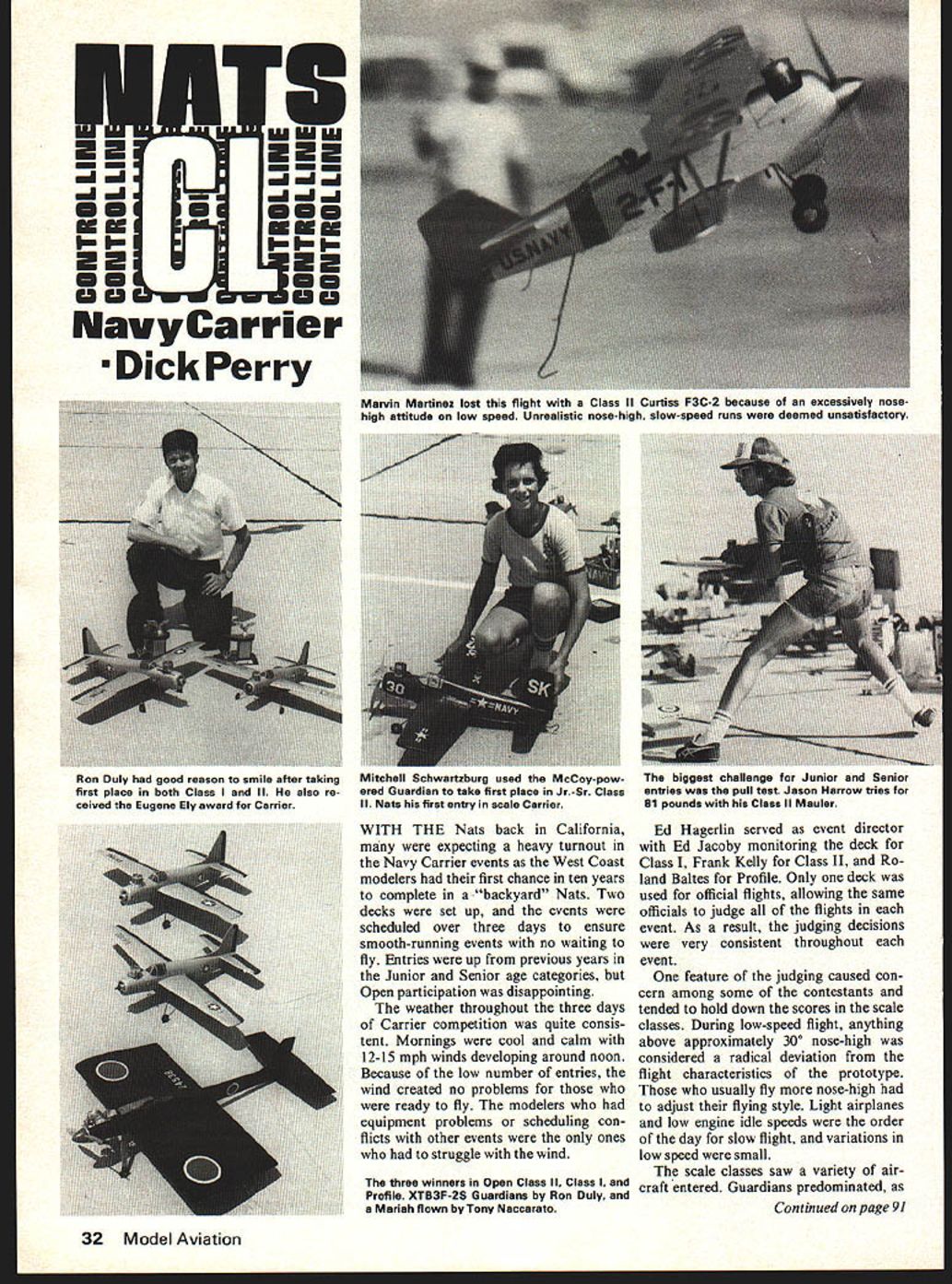
One feature of the judging caused concern among some of the contestants and tended to hold down the scores in the scale classes. During low-speed flight, anything above approximately 30° nose-high was considered a radical deviation from the flight characteristics of the prototype. Those who usually fly more nose-high had to adjust their flying style. Light airplanes and low engine idle speeds were the order of the day for slow flight, and variations in low speed were small.
The scale classes saw a variety of aircraft entered. Guardians predominated, as usual, with the MO-1 as the next most popular choice. Also seen were Douglas Skyraiders and Skysharks, Short Seamews, Martin Maulers, a Curtiss F6C-2 biplane, a Miles M20Mk2, and a Corsair.
In Class I, K&B engines were the most popular, although the top three places went to a variety of engine/airplane combinations. Ron Duly's prototype Guardian XTB3F-2S finished first at 116.1/278 mph with an OS 40 and a Johnson fuel meter and exhaust slide. Peter Mazur was second with speeds of 113.4/269 mph using a K&B 40S with a Wallick throttle in an MO-1. Dick Perry was third at 108.8/299 mph flying a Short Seamew with Supertigre G40, Supertigre carb, and a penbladder fuel system.
In Class II, the high scores went to Rossi-powered Guardians using Johnson-type meters and exhaust slides. Ron Duly was first in this event, also, with speeds of 118.7/325.2 mph followed by Roland Baltes at 103.6/263 mph. Peter Mazur finished third with 97.0/240 mph using a Webra Speed 60 in a 36-in. Gerber MO-1.
If this Nats is any indication, Class II still offers the most options as far as equipment is concerned. Among the 12 models processed to fly, there were no more than two examples of any engine make and at least eight different throttle/fuel system combinations.
There were four entries in Jr.-Sr. Class II this year which is encouraging for the future of scale Carrier on the West Coast. Mitchell Schwartzburg, a Junior, finished in first place. The Nats was Mitchell's first contest in the scale Carrier classes, so he should be quite a competitor with a little more experience.
Profile Carrier had 20 models processed to fly — 14 Open, two Senior, four Junior. The Supertigre ST 35 was the preferred engine for 70% of the entries with plain-bearing conversions of the K&B 5.8 engine next on the list. The Vulture design, kitted by Ed Jacoby (Ed's Garage), was flown by six of the entries.
The Juniors were the only ones to take advantage of the calm morning air. Richard Aloise's first flight of 87.4/148.8 mph bettered his Junior Profile record by 1/10 point. His 246.6 put him solidly in first place. Richard's airplane was a Condor 76 with flaps, ailerons, and line rake. The 380 sq. in. wing had only 26 ounces to hold up during slow flight, and an ST 35 provided the motivation for the high speed.
Tony Naccarato flew his Mariah to first place in Open Profile at 94.5/133.3 mph. Tony used a K&B 5.8 conversion with an Addie Naccarato throttle system and was the only K&B user who was able to put together a good flight. In fact, he was the only Open flier with a really good score as engine problems, wind, and landing mishaps took their toll among the other entries.
After the competition had ended, about 30 Carrier enthusiasts gathered at a local restaurant to hold the first official meeting of a national Navy Carrier organization. The new organization will provide a means of encouraging participation in the Carrier events, sharing information about Carrier flying, and representing the interests of Navy Carrier fliers with the AMA.
The first official act of the organization was to establish the Eugene Ely Award which commemorates the first man to successfully take off and land aboard a ship in 1911 and 1912. The award is for the Nationals Navy Carrier Champion who receives the most total points in the three Carrier events at the Nats.
This year's award went to Ron Duly who accumulated 786.9 points and placed first in Class I and Class II.
Transcribed from original scans by AI. Minor OCR errors may remain.

