
Nats CL: Speed
Jim Wade
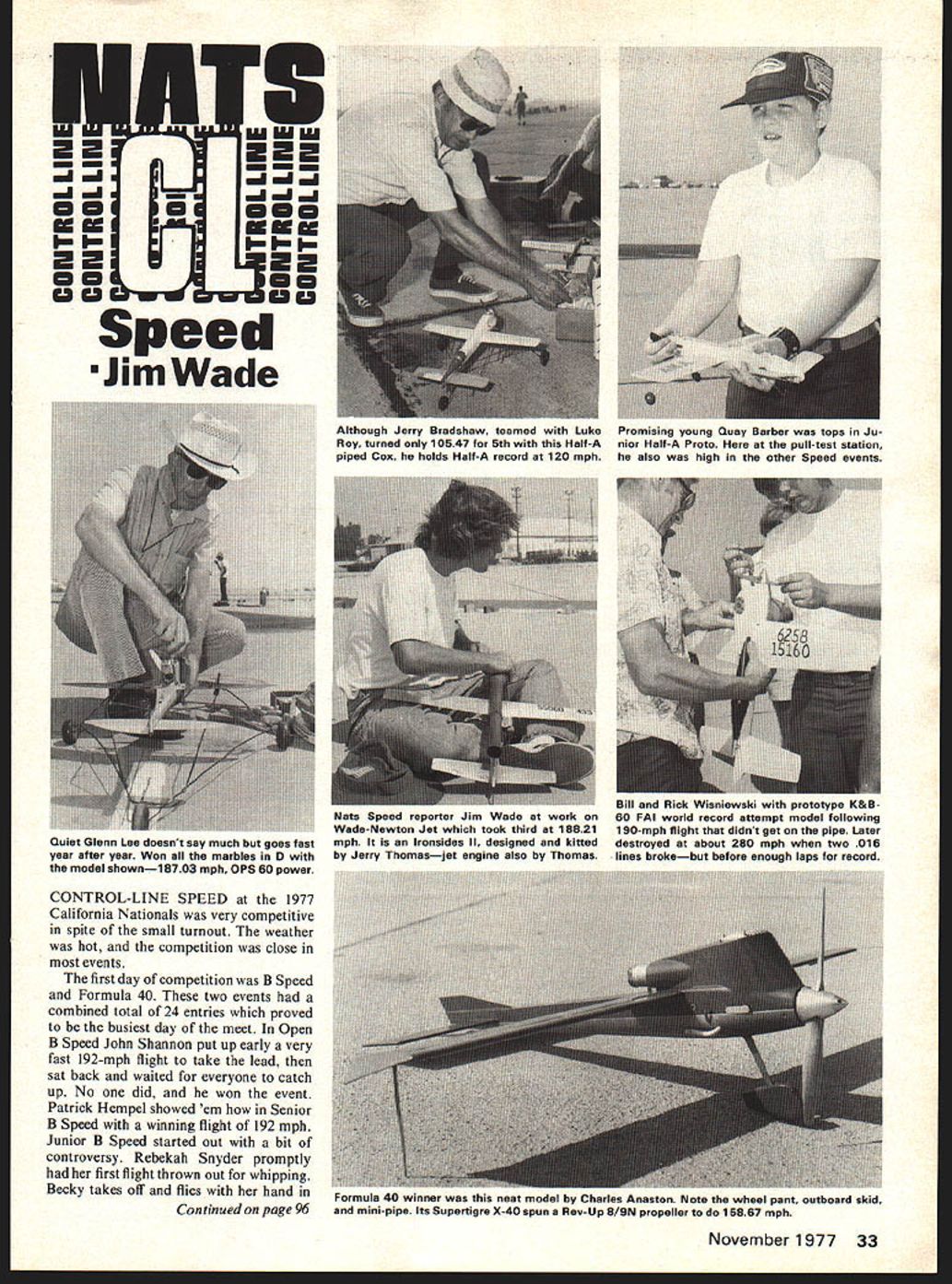
CONTROL-LINE SPEED at the 1977 California Nationals was very competitive in spite of the small turnout. The weather was hot, and the competition was close in most events.
The first day of competition was B Speed and Formula 40. These two events had a combined total of 24 entries which proved to be the busiest day of the meet. In Open B Speed John Shannon put up an early very fast 192-mph flight to take the lead, then sat back and waited for everyone to catch up. No one did, and he won the event. Patrick Hempel showed 'em how in Senior B Speed with a winning flight of 192 mph. Junior B Speed started out with a bit of controversy. Rebekah Snyder promptly had her first flight thrown out for whipping. Becky takes off and flies with her hand in
Continued on page 96 the pylon. She was thrown out for "leading the model to get it safely airborne" (while in the pylon). This situation was cleared up, and she went on to fly a very professional 157-mph flight for the win.
Formula 40 was very competitive and popular with 12 entries. Charles Anaston came out on top with a 158-mph flight, followed closely by the Jett-Bussell team at 154 mph.
The second day dawned clear and hot for Jet, C and D Speed. Fred Margarido put up a very smooth and easy 186-mph flight in D to take the early lead. Everyone tried to catch up for a good part of the day, and Glenn Lee finally slipped by with 187 mph to win. In Senior C Speed Patrick Hempel won with 182 mph followed by Okubayashi Hiromitsu (of Japan) with 168 mph. Junior C saw Joseph Kall win at 164 mph, with Rebekah Snyder close behind at 160 mph.
Jet Speed was a close duel between three of Jerry Thomas' kit model, Ironsides Too. Jerry went up early with a 190-mph flight, but right behind him was the Newton-Wade team which was promptly thrown out for "bending the Monoline handle." They came back with a new pilot (Luke Roy) to turn a slightly lean 188-mph flight. Frank Hunt was up after lunch break, and he blew us all off with 194 mph. The Newton-Wade team tried a come back but still were slightly lean and could not improve. Jerry Thomas spent the day testing his new Mr. Clean asymmetric sidewinder, but nothing came of this as flying problems destroyed the airplane.
The weather for A Speed day must have been to the liking of the Texans. They had the contest almost to themselves. Carl Layman led the way with a 177-mph flight. The only change he made from home ground was to slightly open the needle valve (not even a test flight!). During the lunch break the Bussell-Jett team turned 180 in practice, but the weather changed by the time official flying resumed, and they could manage only 173 mph. Dub Jett by himself snuck in for third spot with 172 mph. Fred Margarido (finally, a Californian!) put up an early 168-mph flight which put him in fourth when it was all over. Only one Senior flier (and no Juniors!) managed an official flight—Phillip Bussell burned 159 mph for the uncontested win in Senior A Speed.
The 1/2A Speed class was flown on Friday, and most of the fliers put up their flights early—before noon—as the wind typically was rather strong later in the day. The Bussell-Jett team went 114 mph with a tuned-pipe airplane for first place, but Warren Kurth followed closely at 113 mph with his unpiped airplane. The current record holder, Jerry Bradshaw, found the weather, altitude, and test circle unfavorable and the Bradshaw-Roy team could do no better than fifth (105 mph). The Newton-Wade team turned 107 with a 1/2A Proto design for fourth. Senior 1/2A Speed saw Phillip Bussell on top with 104 mph, while in Junior the Barber brothers, Quay and David, cleaned up by taking first and second.
Saturday, the last day of Speed flying, was for 1/2A Proto which produced relatively quick times and proved to have the most competitive flying of the whole week. First up was the Bradshaw-Roy team for a 92-mph flight to set the pace. Then Bussell-Jett went up for a no-time on their piped Proto. The Wade-Newton team was up next with their open exhaust Cox .049 airplane; they coasted to 98 mph with two bad laps. Warren Kurth and Quay Barber both put in 96-mph flights to move close to the lead. Bussell-Jett turned in another no-time and retired to the test circle. Wade-Newton came back and put in a lean 98-mph time, and then proceeded to blow their engine during the last attempt. Finally, Bussell-Jett came back for their last attempt, which was perfect for 99 mph and the win.
Senior 1/2A Proto Speed saw a record time by Phillip Bussell at 89.74 mph, but he wasn't able to back it up because a broken airplane caused him to quit. Mary Kirn followed closely with a very calm 84.99 mph and second place. Junior, again, was a runaway for the Barber brothers as they wrapped up first and second places.
During Nats week another happening in Speed was a World Record attempt by the Wisniewskis (Bill and Rick) in the "60" class. They had a model specially sized for FAI wing loadings, which was powered by a prototype K&B .60. They had a flight going of about 250-280 mph when, unfortunately, a line broke which resulted in a flyaway. The Wisniewskis will rebuild and try again, they say.
The organization and running of the Speed circles was smooth and professional the entire week, with only a few minor complaints. It was a job well done under the leadership of Bev Wisniewski.
Transcribed from original scans by AI. Minor OCR errors may remain.

