
Aerobatics — Wynn Paul
MEL BROOKS' movie "Blazing Saddles" could have been the inspiration for the 1976 control-line Precision Aerobatics event at Dayton, Ohio as pilots renowned for their "blazing corners" finished one-two. Bob Hunt, from Middlesex, N.J., became the Bicentennial champion on the next-to-last flight of finals day and Gene Schaffer, New City, N.Y., finished a scant 1.67 points behind for his fourth time as runner-up (also in '71, '73, '74). Al Rabe, Irving, Tex., finished third for the third straight year with a brand-new F-5 semiscale. Hunt went on to win the Walker Trophy on Saturday, beating Senior champion Pierre Morel and Junior winner David Fitzgerald. Bob later received a dunking in the pool at the PAMPA motel headquarters for his victory.
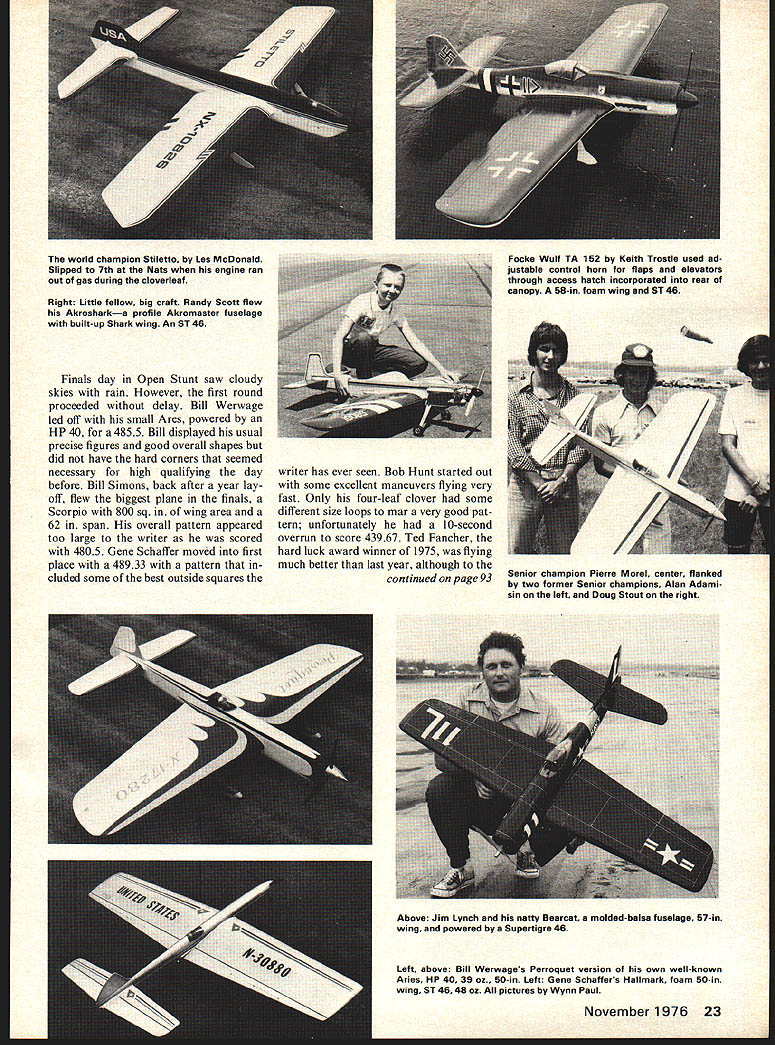
Senior Stunt attracted 12 entrants and a very tight battle emerged between two-time American Junior champion Joe Musumeci ('74 and '75) and two-time Canadian Junior champion Pierre Morel from Quebec. Pierre's L'Oiseau (The Bird) had one of the sweetest sounding Max 35s the writer can remember and the plane featured an excellent finish on the 54-in.-wing, 49-oz. machine. Joe led after the first round, 452.50 to Pierre's 447.25. Pierre came back in the second round to post a 464.50, and Joe, flying his 1976 version of the Gieseke Nobler, fell to 441.50 on the second flight and had to settle for runner-up. Third went to newcomer Tad Chichester, Columbus, Ohio, who had a flap come loose during his second flight which totaled his plane.
Junior Stunt belonged to David Fitzgerald all the way as his first-round score of 418.25 held up to give runner-up Mike Dubes 386.50. David was flying a very stock Sig Chipmunk with a Max 35; the plane had a slightly modified landing-gear location, was almost all kit wood and weighed in at a very good 44 ounces. Eleven entries in Junior Stunt was the best in several years. Third place went to diminutive Randy Scott, Cincinnati, Ohio, flying a profile Akroshark with an ST .46. Akroshark originates from a Shark wing with a profile Akromaster fuselage. Down in tenth place was ten-year-old Matt Dube, Mike's brother; the whole Dube family from Merrimack, N.H., were at their first Nationals.
Once again the weather proved to be a determining factor for both qualifications and finals day in Open Stunt. Thursday, August 5, qualifications started off with light winds but they picked up to the 10- to 20-mile-an-hour category toward noon. Pilots with early flights had an advantage. Event director Bart Klapinski set the number of qualifiers at five from each of four circles, based upon an entry of 76 processed airplanes the night before. Most of the top five qualifiers were able to pass the second round and watch the efforts of those trying to make the top five. Good efforts were put up by Lin Smith, Roger Barrett, Mike Ditrich, Chris Lella, Dan Shafer, Dennis Duvall, John Davis, Lee Uberbacher and Jim Armour to move up to the top five in their circles, but they lost out. Perhaps the tensest battle to qualify came in circle number two when Tom Hartvigsen, Tullahoma, Tenn., moved into fifth place on his second flight, 426.00, over Californian Gary McClellan. Gary had put up a very good flight in the wind with a score of 425.00, but a recount of the scores gave Gary 426.25 and a first-time qualifying spot.
Finals day Open Stunt saw cloudy skies and rain. However, the first round proceeded without delay. Bill Werwage led off flying a small Aries-powered HP 40 and displayed his usual precise figures and good overall shapes, though his corners were hard — perhaps the price of qualifying high the day before. Bill Simons, back after a year layoff, flew the biggest plane in the finals — a Scorpio with about 800 sq. in. wing area and a 62-in. span — and the overall pattern appeared too large; the writer scored it 480.5. Gene Schaffer moved into first place with a 489.33; his pattern included some of the best outside squares seen that day.
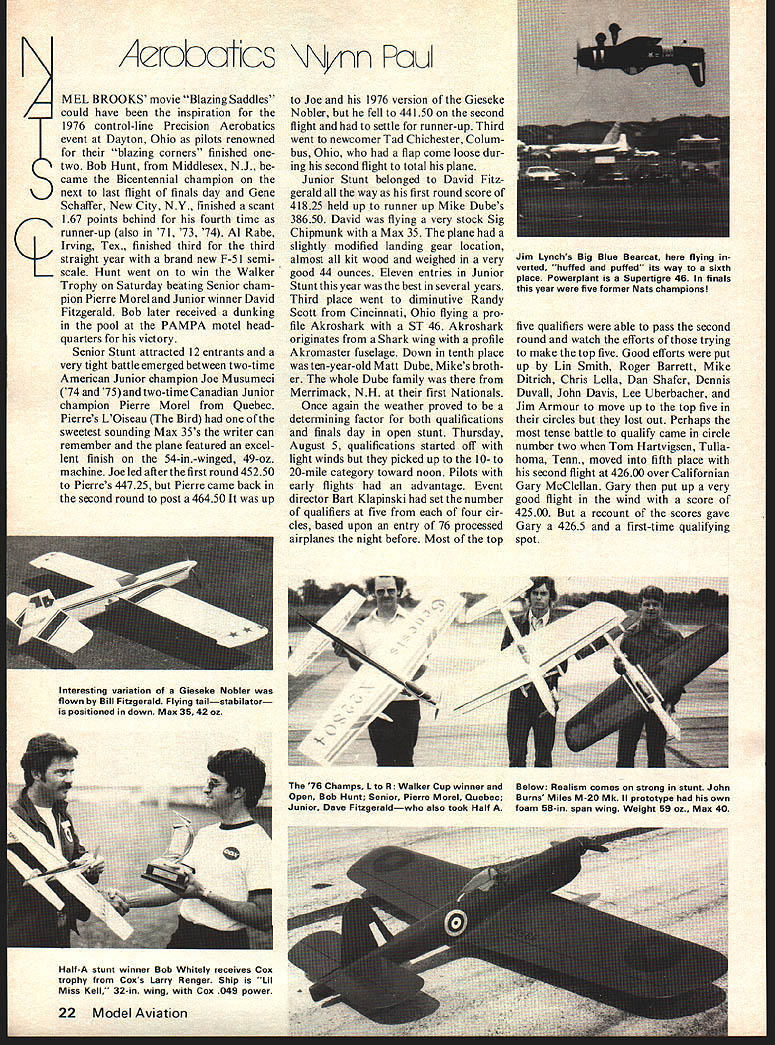
Jim Lynch's Big Blue Bearcat, flying inverted, "huffed and puffed" its way to sixth place; its powerplant was a Supertigre .46. This year's finals field included five former Nats champions, making the competition especially strong and tightly contested. Bob Hunt started out with some excellent maneuvers flying very fast. Only his four-leaf clover had some different size loops to mar a very good pattern; unfortunately he had a 10-second overrun to score 439.67. Ted Fancher, the hard luck award winner of 1975, was flying much better than last year, although to the writer felt the pattern appeared slightly large. Ted's well done plane is always a pleasure to see—he should help keep the west coast fliers improving. First-time qualifier Bill Eybers (N.J.) and Gary McClellan both gave good accounts for themselves followed by the ever improving Fred Miles who flies the traditional New York style with small figures and tight corners. It was Fred's first time to qualify also.
Bob Gieseke, flying in the number nine spot, moved into the lead with his very slow-flying Nobler at 495.33. His smaller pattern size was a definite asset but he seemed to be having some line tension problems. The new World Champion Les McDonald flew in a driving rain and scored 508.6 with a pattern that had very good round figures and an excellent hourglass. Bob Whitely had trouble with his landing gear after a good pattern and Keith Trostle, back in competition after directing the last two Nationals, flew his F.W.T.A. 152 semi-scale to a 459.17. Another year back in competition and Keith could give the leaders some trouble. Al Rabe moved into second position with a new F-51 that had been totaled a month before. A new fuselage forward of the trailing edge of the wing and a new wing center section had to be grafted on to the remains of his plane after a rag caught in the prop while running on a stooge. Wynn Paul moved into seventh with a new white Pampawam III which evidently showed up better in the air than the blue ones, although he was having troubles with pullouts.
Big Jim Lynch and his year old Big Blue Bearcat with an unmuffled ST .46 huffed and puffed to a 487.50 to move into fifth place. An intense Rich LeRoy (Calif.) put his yellow Miss Poppy, now powered by a ST .46, up for a 473.0 to move into tenth spot. No less than five former National Champions were in the finals this year (Werwage, Rabe, Gieseke, Trostle, McFarland).
The final round started off with a bang as Gieseke (512.33), Gene (516.00), and Gene Schaffer (519.50) set the standard for the entire round. Rabe's new F-51 is probably the best flying of his F-51 series, turning a much better corner, but still yawed on some maneuvers. The rain continued and head judge Bob Galanti cut a fine figure outfitted in his sailing wet weather gear. Meanwhile, back in Roger Barrett's camp, Bob Hunt was putting the finishing touches on repairs to his Genesis after backing over the front end with his station wagon! Bob Whitely improved his score by 15 points but seemed to have trouble with the vertical figures. Bill Werwage also improved to settle into fourth spot; he just couldn't seem to impress the judges with the little white airplane. A disagreement between the judges over Dave Hemstrought's completion of the pattern led to a second flight with the PT-19 which put him in 14th spot. Veteran Lew McFarland, flying an 11-year-old giant Shark with a ST .46, had to settle for 18th position after burning more fuel during Nationals week than anyone else.
Floridian Remmel Cooper, with a nicely finished Stiletto and Max .35, moved up from his 1975 14th place to finish 12th place this year. His flying has improved a great deal in a year's time and he is one to be reckoned with in the future. Flight number 17 was World Champion Les McDonald with the ST .46-powered Stiletto. Les had a good flight going until the first loop of the four-leaf-clover when the engine sputtered, quit, and there went his hopes for the grand slam in Stunt. Now it's back to Miami and time to await the arrival of a new member of the family, and it's not another Stiletto. Frank McMillan, back in competition after working the Nationals, showed that he can still fly well as he finished tenth with a good flying foam-wing airplane. Wynn Paul caught his flying hand in the prop of his ST .46 and called an attempt which put Bob Hunt up for his last flight. It was certainly good enough as the judges awarded 521.17 for the new "King of the Corners." Wynn then put into the last flight of the day with a good engine run which put him in eighth place. Then it stopped raining.
Nats Control Line: Aerobatics
Bob Hunt's winning airplane is the 1976 version of the Genesis with a Control Specialties Company foam wing, the first foam wing to win since Bob Lampione back in 1969. This Genesis had a 60-in. wingspan with 720 sq. in. of wing area and an 18-percent airfoil. It used equal panels, with 1-1/2 oz. of tipweight, and had a two-inch leading edge sweep. Hunt used 3-1/2-span flaps that had a root chord of 2-1/2 in. and a tip chord of 1 in. He had a large stabilizer with a 29-in. span and the elevators had a root chord of 3/4 in. and a tip chord of 2-1/2 in. The front moment arm (back plate to leading edge) was 10 in. and the rear moment arm (hinge line to hinge line) was 16 in. The wing-root chord was 11.5 in. The ST .46 had been slightly reworked by Rich Tower, used an Adams-type muffler with the pressure, a Fox idle-bar plug, a Rev-Up 12-6 prop, his own 5-percent nitro fuel, .018 stranded lines 61.5 feet in length, a Control Specialties In-Flight Adjustable Handle. The plane weighed in at 54 oz.
Foam wings were used by 12 of the 24 qualifiers including first, second, eighth and tenth. And note the choice of engines: Super Tigre .46s took first, second, third and were used by 10 other places of the 20 qualifiers. There were five Max .35s and one each of a Fox .35 and an HP .40. John Davis, Florissant, Mo., had a set of working retracts that he used on the first official flight during qualifications, but decided to leave them down during the second flight in the wind, probably for added drag. This is the first set of retracts that actually worked during flying since the early '60s.
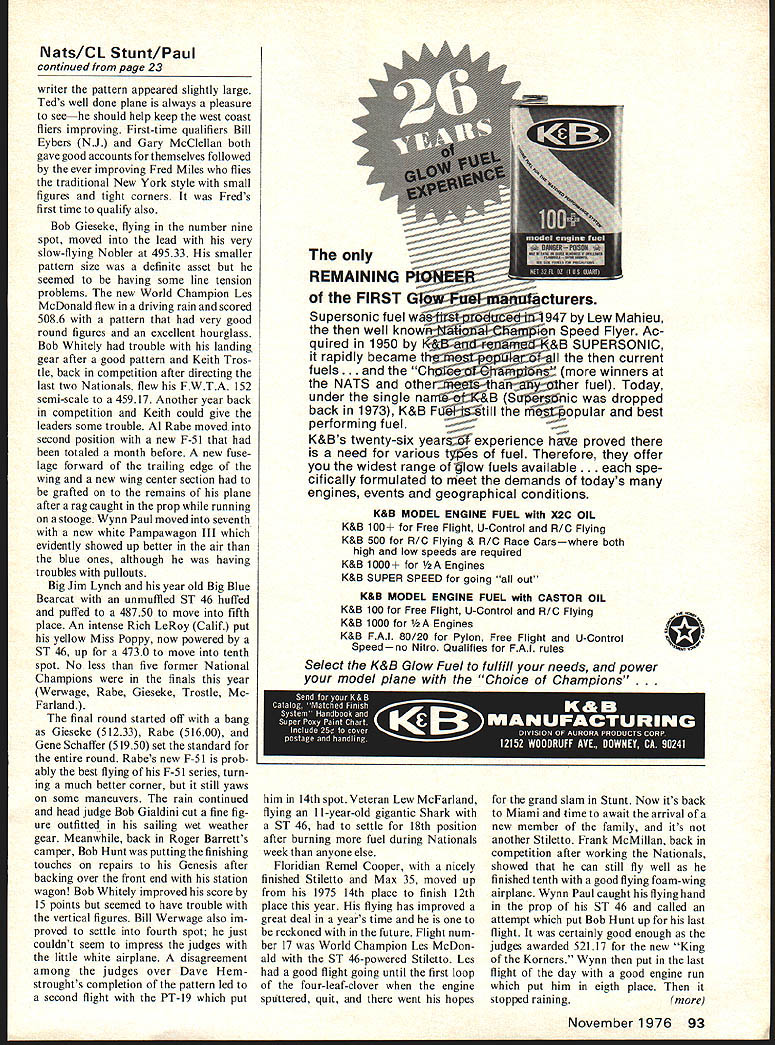
The L.M. Cox Manufacturing Co. Half-A Stunt Championships attracted a total of 25 entries this year and, like every other event in miniature airplanes, it is becoming more sophisticated each year. High winds and cold temperatures marred an otherwise light-hearted day of flying with spectators cheering when a maneuver was completed without smacking the runway. Bob Whitely, Fountain Valley, Calif., won the open division with an exact replica of his full-size stunter Miss Kell. The Lil Miss Kell flies with all the class of the big stunt fliers and Bob piled up 776.5 points to dethrone defending champion Keith Trostle who finished third with 686.5. Second place went to Rich Porter, Temple Terrace, Fla., flying a Little Satan Half-A Combat ship. Keith was using his Tercel design plane that was featured in the September, 1976 issue of Model Aviation.
Senior division in the Half-A event went to Leonardo Silva all the way from Mexico with 332.0. And the Junior crown went to California's David Fitzgerald, the defending champion, who became a double national champion after winning the junior division in the full-size Stunt class. Larry Renger of Cox Mfg. Co. was especially pleased to see the very good turnout for the open and Half-A championships were held on Saturday before and after the Walker Cup flyoffs, which certainly led to greater attendance at the Walker flyoffs than in the past.
Bart Klapinski and Jim Fasimpour ran a very good event this year which had a large number of 93 entries. The weather was smooth with a very relaxed atmosphere for both competitors and officials. Head judge Bob Gildin led a corps of judges which included Bernie Ash, Joyce and Roger Greene, Don Jordan, John Laws, Bob Pharr, Jon Ramsden and Doug Stout. Open processing was made a good deal easier this year by judging 25 Open airplanes each night after processing Junior and Senior entries. This eliminated the usual Wednesday night avalanche of Open processing. Les McDonald and Dave Rees tied for honors in appearance points with 17 each.
The usual bull sessions produced more talk about engines this year than the writer had heard before. The topics of trimming, foam wings versus built-up, airplane size, wing loading and pattern appearance were, of course, there, but engines seemed to be the big topic this year. With the largest number of finalists in a long time (20) there was a lot of talk about the judges tiring after viewing 40 patterns in one day. In fact, during the second round, 17 of the patterns improved a total of from 14.5 to 33.83 points; this excludes Hunt (overrun), McDonald (ran out of gas) and McFarland (up a full 65 points) patterns. This amounts to one to two points per maneuver raises on the average which, for a point spread of 10 to 40, seems acceptable. In addition, the weather was a little bit better during the second round of finals this year than during the first.
Several of the finalists conceived the idea of having a semi-finals and finals next year in Open Stunt. A semi-finals composed of 40 percent of the total processed planes, to be followed by a finals day with the top 20 aircraft, would allow the inclusion of more entries. A two-hour break would follow the finals and then the Walker trophy flyoff would follow with the keep Open fliers and the Open judges for the same amount of days (three) as in the past. A "Nationals Competition Committee" composed of the first ten finishers, plus PAMPA President Keith Trostle, will review this proposal during the coming year.
The third annual PAMPA banquet was held Saturday night with approximately 130 in attendance. PAMPA President Keith Trostle and Secretary-Treasurer Wynn Paul presided over the combination dinner, business meeting, and awards presentation. Newly crowned World Champion Les McDonald and second-place finisher Bill Werwage were given a standing ovation (team members Bob Gieseke and Gene Schaffer were unable to attend the banquet). Five former National Champions were recognized (George Aldrich, Gialdi, Doug Stout, Trostle and Werwage). The culmination of the banquet came as President Trostle presented the Walker Cup to 1976 Precision Aerobatics Champion Bob Hunt.
Transcribed from original scans by AI. Minor OCR errors may remain.

