
Combat Gary Frost
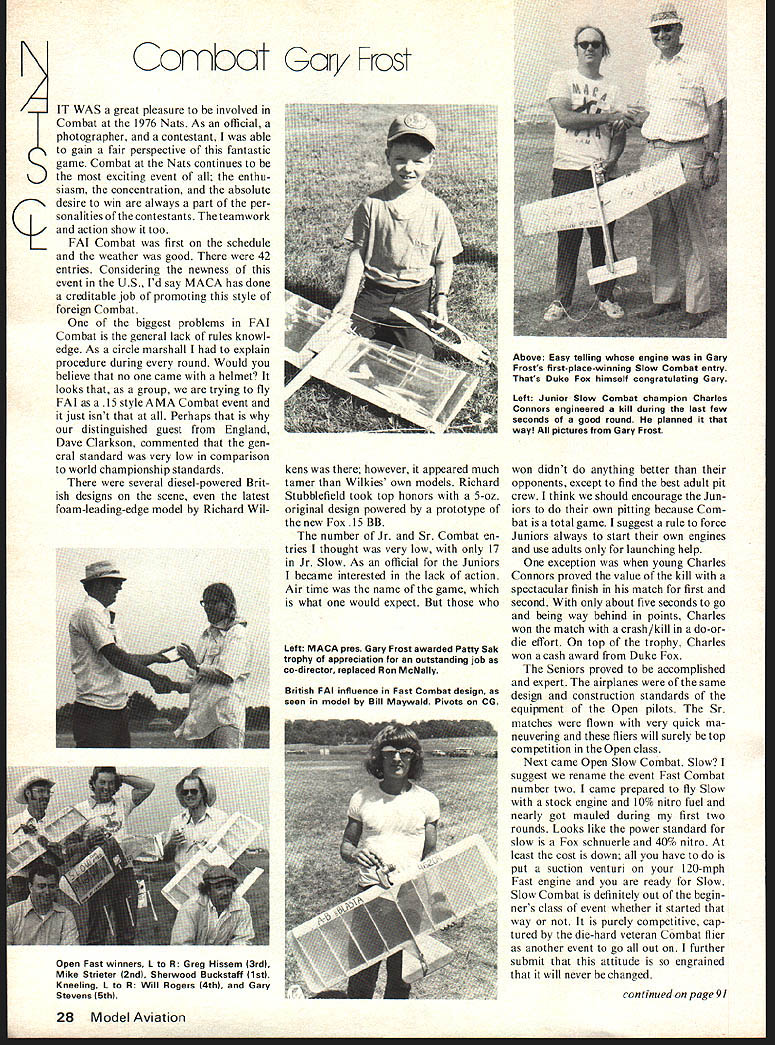
IT WAS a great pleasure to be involved in Combat at the 1976 Nats. As an official, a photographer, and a contestant, I was able to gain a fair perspective of this fantastic game. Combat at the Nats continues to be the most exciting event of all; the enthusiasm, the concentration, and the absolute desire to win are always a part of the personalities of the contestants. The teamwork and action show it, too.
FAI Combat was first on the schedule and the weather was good. There were 42 entries. Considering the newness of this event in the U.S., I'd say MACA has done a creditable job of promoting this style of foreign Combat.
One of the biggest problems in FAI Combat is the general lack of rules knowledge. As a circle marshall I had to explain procedure during every round. Would you believe that no one came with a helmet? It looks that, as a group, we are trying to fly FAI as a .15-style AMA Combat event and it just isn't that at all. Perhaps that is why our distinguished guest from England, Dave Clarkson, commented that the general standard was very low in comparison to world championship standards.
There were several diesel-powered British designs on the scene, even the latest foam-leading-edge model by Richard Wilkens was there; however, it appeared much tamer than Wilkies' own models. Richard Stubblefield took top honors with a 5-oz. original design powered by a prototype of the new Fox .15 BB.
The number of Jr. and Sr. Combat entries I thought was very low, with only 17 in Jr. Slow. As an official for the Juniors I became interested in the lack of action. Air time was the name of the game, which is what one would expect. But those who didn't do anything better than their opponents, except to find the best adult pit crew, didn't do anything better than their opponents, except to find the best adult pit crew. I think we should encourage the Juniors to do their own pitting because Combat is a total game. I suggest a rule to force Juniors always to start their own engines and use adults only for launching help.
One exception was when young Charles Connors proved the value of the kill with a spectacular finish in his match for first and second. With only about five seconds to go and being way behind in points, Charles won the match with a crash/kill in a do-or-die effort. On top of the trophy, Charles won a cash award from Duke Fox.
The Seniors proved to be accomplished and expert. The airplanes were of the same design and construction standards of the equipment of the Open pilots. The Sr. matches were flown with very quick maneuvering and these fliers will surely be top competition in the Open class.
Next came Open Slow Combat. Slow? I suggest we rename the event Fast Combat number two. I came prepared to fly Slow with a stock engine and 10% nitro fuel and nearly got mauled during my first two rounds. Looks like the power standard for Slow is a Fox schnuerle and 40% nitro. At least the cost is down; all you have to do is put a suction venturi on your 120-mph Fast engine and you are ready for Slow. Slow Combat is definitely out of the beginner's class of event whether it started that way or not. It is purely competitive, captured by the die-hard veteran Combat flier as another event to go all out on. I further submit that this attitude is so engrained that it will never be changed. Next came Fast Combat and the rain. We had to tape the entire length of the streamers to keep them together. The pilots were continuously slipping in the center circle mud. And I'd say there were more than the usual number of kills in these early rounds. The speeds of the Fast Combat planes under rainy conditions were about equal to the Slow planes with good weather.
We've got to do something about these Texas Combat fliers; I understand that they have won Combat at the Nats for the last four years. This year Sherwood Buckstaff won Fast Combat for his second year in a row! And he used a Fox. With only a few months' advance introduction, the Fox has captured the Combat power title from Supertigre, previously unchallenged.
I think the entire crew of Combat officials at the Nats deserves a big pat on the back. I don't think a lot of us realize all the time these hard workers put in. When the Combat event was over there was still officials' work to be done. I wished to mention their names here, but there are just too many. And yet with all the help, we still needed more.
Co-director Pat Wilcox feels the subjectiveness of the line entanglement rule is a big judging headache. At the MACA meeting we voted three to get rid of it, but please keep in mind that no action is a cure-all. In the absence of this rule you may see yanking contests and subsequently more fly-aways.
Patty Sak, co-director, gets a particular pat on the back for her ability to keep things running smoothly in the absence of Ron McNally who was not able to attend the Nats. He was missed at the circle. We hope that he feels better knowing Patty did such a good job for him.
Neal White deserves a big hand for really doing his homework with the rules and their application. As the circle marshal we noticed that his swift, accurate and steadfast decisions prevented many arguments and helped keep the pace.
For the CLCB we found a flaw in the third-watch system. When a plane leaves the circle but continues flying, you need a watch to measure the time from the circle. You also need another extra watch to measure flying time of the plane still in the circle, unless you think both planes will just happen to land together. Right? With each judge having two watches, the problem is solved.
And I have to admit we did have cut-and-out judging problems. First, the circles were not properly marked; there was no 75-foot circle. Second, the center circle was not plain to see and, third, frequently no judge was watching the center circle anyway. And we did have problems with center-circle complaints. We got so lax that some pilots just took off standing right in the pilots' circle and combat started at launch — which is just the unsafe practice the rules seek to avoid.
Right now we should start planning how to run Combat for the '77 Nats and, for those brave souls who will have to run the event, I submit the following three directives instead of two: judges made up of competition fliers or a pre-judge practice session with situational Combat; an extra judge each match, or don't use the third-watch system; short discussion after each problem and corrective action plan implemented; judges not working in pairs, but with one judge for each 90 degrees of the circle; pilots meeting at least once; streamers in two colors only; made and inspected in advance (colors should be bright but not light — such as orange or gold); and re-matches only when absolutely no other alternative exists.
Pit technology has definitely improved. It will be harder to call a plane unflyable with the use of the new cyanoacrylate glues for quick repair. When the tail comes off, is the plane unflyable, or is the pit crew unprepared?
Mike Tallman gets the sportsmanship award for the contest. With the extreme desire to win in all of us, Mike gave Richard Stubblefield a rematch when Mike was defeated on an original win because of a torn streamer on Richard's plane. The quick pilot work of Dan Rutherford and Mike Tallman was soon obvious. In one smooth motion you could see these guys flip the prop, remove the leads and get out of the race.
The match between Bob Burch and Rick Lopez was combat on the ground as well as in the air. And a few words were exchanged. If I had a tape recorder, I could be selling tickets. Will Rogers tried unsuccessfully to use psychology against Buckstaff by deliberately taking his time in getting airborne. With all the nerves in this contest, it is really something to see Will just calmly walk over to his handle, right in the middle of the match.
And the final match for first and second between Mike Strieter and Sherwood Buckstaff was quite physical. With all the fast action it is hard to watch both the planes and the pilots, but I thought I saw a head-lock out there at one point.
Nats Combat is where the action is. You have to see it to believe it. Hope you can make it next year.
Transcribed from original scans by AI. Minor OCR errors may remain.

