
Navy Carrier Richard L. Perry
CARRIER participation was considerably improved over what it was at Lake Charles. Dayton is closer to the centers of CL Navy Carrier activity in the northern and eastern U.S. The number of entries did not match the outstanding participation of the 1972 Glenview Nats, but there was plenty of competition. Many familiar faces from last year made it back again along with some new contestants and many of the older names in Carrier flying who did not compete at Lake Charles.
The AMA's carrier decks spent some time in dry-dock undergoing repairs and modifications. After much work by the Cleveland Prop Busters, the decks were launched with a new coat of paint, new guides and bags for the arresting cables, and an additional 2½ feet of length (bringing them up to the required 44 feet for the first time). The changes were so significant that the decks were re-christened USS Wright.
Lu Baker, Carrier Event Director, and her crew ran a tight ship. Scheduling, with two decks, was not rushed and waiting periods between flights were short. The flights were carefully watched for whipping and high flying. Processing was thorough and included verification of scale dimensions in Class I and II and wing area in Profile. Engine displacement was checked on all trophy-winning models.
Carrier was flown on Tuesday and Wednesday with the Scale classes starting the activity and the Profile event the following day. The weather was favorable both days with just a light breeze and moderate temperatures. There were no serious crashes this year, but quite a few airplanes ended up in the drink as engines failed to idle properly for slow flight.
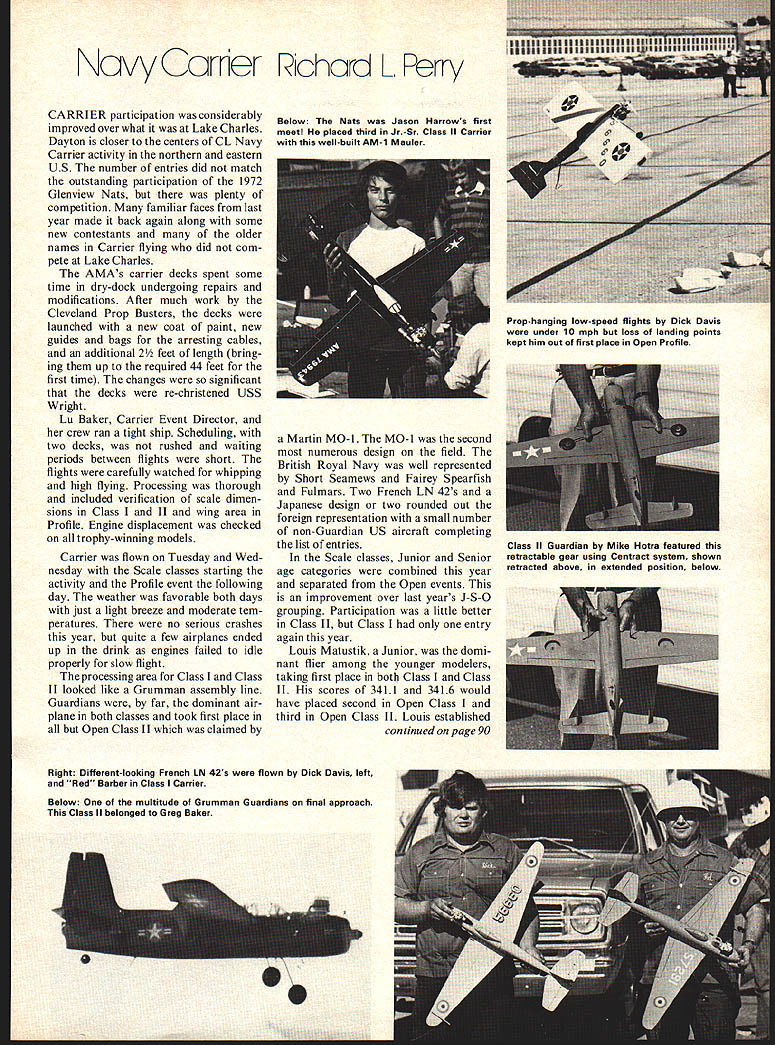
The processing area for Class I and Class II looked like a Grumman assembly line. Guardians were, by far, the dominant airplane in both classes and took first place in all but Open Class II which was claimed by a Martin MO-1. The MO-1 was the second most numerous design on the field. The British Royal Navy was well represented by Short Seamews and Fairey Spearfish and Fulmars. Two French LN 42s and a Japanese design or two rounded out the foreign representation with a small number of non-Guardian US aircraft completing the list of entries.
In the Scale classes, Junior and Senior age categories were combined this year and separated from the Open events. This is an improvement over last year's J-S-O grouping. Participation was a little better in Class II, but Class I had only one entry again this year.
Louis Matusik, a Junior, was the dominant flier among the younger modelers, taking first place in both Class I and Class II. His scores of 341.1 and 341.6 would have placed second in Open Class I and third in Open Class II. Louis established a new Junior record of 341.1 in winning Class I. Jim Potocnik's second-place score of 336.3 was also high enough to have placed in the Open class. These two Juniors are experienced competitors and should have many years of successful Carrier flying ahead of them.
Open Class I was won by Bill Boss at 345.5 with a Guardian. Competition was keen in Class I with places changing throughout the day. When it was all over, only 10 points separated first and fifth place. Dick Perry was first in Class II with a 205 sq. in. MO-1.
In Class II, the winners were ranked by high-speed scores because of relatively small variations in low speed (4 mph in second through fifth place). In Class I, the increased emphasis on low speed under the new scoring system, and a greater spread of low speed scores, made high speed less dominant in determining placings. The speeds recorded by the trophy winners in Class I and II ranged from 95 mph to 120 mph for high and 23.7 to 34 mph for low with one speed of 41.7 in Class I.
In Profile Carrier, the Aloise family took the honors again with Carlos Aloise (Senior winner in 1975) winning in Open and Richard winning Junior again this year. Carlos E., the 1975 Open champ, entered, but did not fly. Senior Profile Carrier was won by Otto Graff.
Two topics of debate surfaced in Profile Carrier this year—the cost of engines and the procedure for slow flight. The newer engines being developed for Profile Carrier are rather expensive compared to the standard engines of a few years ago. There is some concern that the increasing cost of the newer specialty engines and the increasing number of modified racing 40 engines appearing in Profile Carrier will be bad for the event. While there were some of these engines present at the Nats, many of the contestants who brought them didn't use them, choosing instead to run more conventional engines.
The excitement over slow flight centered around Dick Davis and his modified Mongoose. Dick has become quite good at hanging his Mongoose on the prop at altitudes greater than 60° nose high. The resulting low speeds on three attempts were under 10 mph. Dick lost forward motion on the first attempt and missed his landings on the two official flights, preventing him from winning first place and setting a new record.
Dick's slow flight technique is quite legal, and he is to be admired for his piloting skill, but one must wonder what adverse effect such a development could have on the event. Many opinions were expressed for and against, but the predominant feeling seemed to be that the flight portion of the speed/need flight should be emphasized.
There were many old and well-used models in all classes. "Wait until next year," was the dominant theme whenever anyone was asked about their plans for new aircraft. If all the plans become reality, next year's Carrier events should be full of surprises.
Transcribed from original scans by AI. Minor OCR errors may remain.

