
Racing Phil Bussell
DAYTON, OHIO is obviously a good place to be in the hottest part of summer. Wright-Patterson Air Force Base is a beautiful facility and just the right size for a Control Line and Radio Control Nationals. Dayton is closer to the center of our population than Lake Charles and the 1976 Nationals was the biggest I have seen since the Navy was co-hosting with us.
It did seem a little strange to pull up to the hangar on Sunday evening and see all the Racing people hard at it, since it is usually Monday or Tuesday before Control Line contestants start to put their game faces on—not so in 1976!
I don't know how we could ask for a better location, better facilities or better weather than we had. I don't think anyone could blame his performance on weather or facilities. But two areas that need improving are (1) standards for interpreting the rules, which should come from AMA's Racing Advisory Committee, and (2) selection of the most qualified officials, no matter where they live—both so important for the size and stature of the National Contest.
Slow Rat
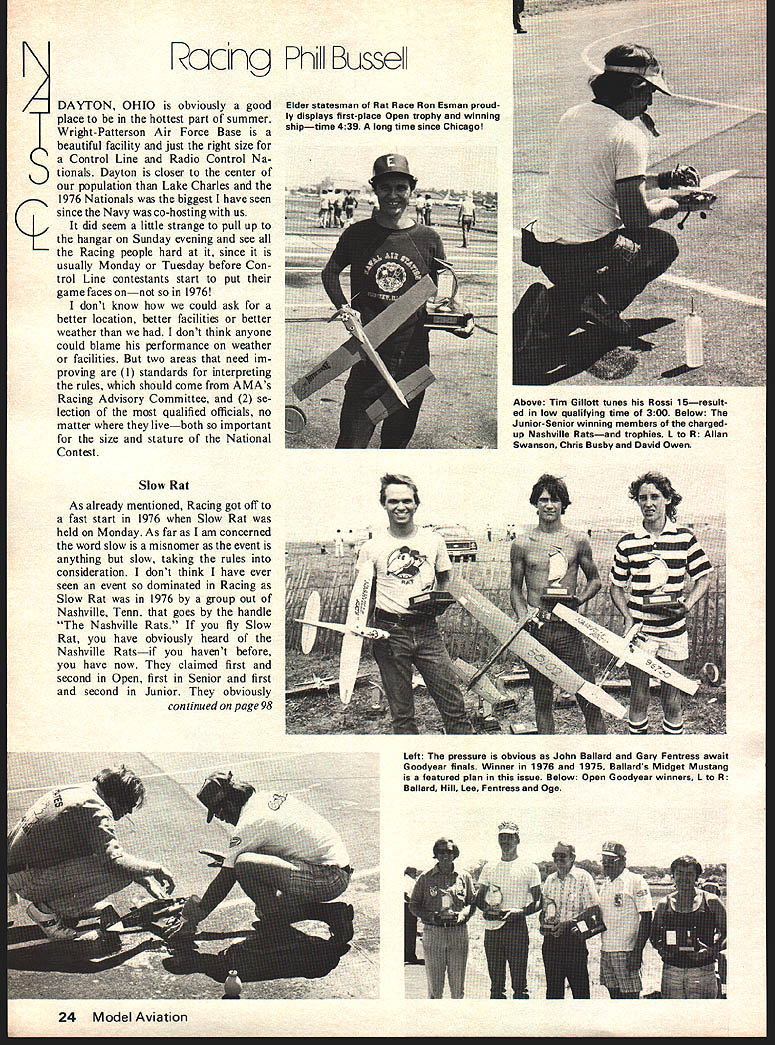
As already mentioned, Racing got off to a fast start in 1976 when Slow Rat was held on Monday. As far as I am concerned the word slow is a misnomer as the event is anything but slow, taking the rules into consideration. I don't think I have ever seen an event so dominated in Racing as Slow Rat was in 1976 by a group out of Nashville, Tenn. that goes by the handle "The Nashville Rats." If you fly Slow Rat, you have obviously heard of the Nashville Rats—if you haven't before, you have now. They claimed first and second in Open, first in Senior and first and second in Junior. They obviously
Nats Control Line: Racing
could have won more, but that is as many entries as they had. Paul Tune, Marshall Busby and Brian Smith are the Open members of the group and Chris Busby and David Owen are the Junior members and Allen Swanson is the Senior member. Paul does most of the engine work and Marshall the airframe designing and building. The group works very well together and just simply went out and blew everyone's doors off!
The key to their domination lies in the engine. Paul has spent many hours developing their powerplant and the results were obvious. Their engine is built around an O.S. Max .40 case with a homebuilt piston and sleeve and L-ring. The sleeve is built from mild steel and the piston is standard 2024-T4 aluminum and the ring is made from centrifugally forged cast iron. The transfer and exhaust timing is stock O.S. Max .40 timing. Their flying prop is worked from an 8 x 8 K & W glass prop and progresses from 6-3/4" pitch at the first station to 8" pitch at the tip station. Their ground rpm on their flying prop and racing fuel is approximately 18,000 rpm. Their standard racing fuel is 30% nitro, 50% alcohol, and 20% Klotz Racing Oil.
Goodyear
All I can say about Goodyear is that the speeds were out of sight. It is obvious thus as long as the rules allow exhaust tuning that it will be necessary to run at least a megaphone-tuned exhaust system on your engine to be competitive in Goodyear. The Fusite GloBee Racing Plug is obviously making its mark in Goodyear, as it is in Open A-Speed (first three places in Open A Speed were all using the plug).
John Ballard, Larry Hill and Bill Lee managed to make it to the finals and all were sporting megaphone-tuned Rossi 15-powered engines. To tell you the truth, all three were, as they should be, very impressive. John Kilsdonk was flying for Hill, Gary Fentress was pitting for John Ballard and Russ Brown was flying for Bill Lee. If this wasn't an all-star lineup, I have never seen one and you could feel the excitement and tension build as it came time to race for all the marbles. The finals were marred by a mid-air collision between Bill Lee and Larry Hill on lap 20 and Big John went on to claim first place without being pushed. Fentress was flawless in the pits and the engine performed beautifully. It would have taken a super effort by Lee or Hill to depose John who was also the 1975 winner. I am sure Hill and Lee, along with many others, can hardly wait until 1977 when they will get another shot at Big John who by now feels the pressure of trying to stay on top after winning two years in a row!
Rat Racing
Rat has obviously matured through the years and claimed its spot as the granddaddy of all the Racing events. It is still more prestigious to win first in Open Rat than any other Racing event and this as it should be. It gives me great pleasure to report that Open Rat in 1976 was claimed by Ron Esman of Houston, Tex. with Dick Stubblefield doing the flying. Ronnie is a true gentleman and one of our elder statesmen in racing. I can't think of anyone I would rather have in the pits than Ron and, for that matter, I can't think of a better pilot than Dick Stubblefield. Together they make an impressive team and one that makes you beat them as they seldom make mistakes. It always makes me feel good to see someone that loves racing as Ron Esman does so good.
Harold and Dick Lambert, the 1975 winners, pushed Esman to his limit as did Paul Tune who took third with his O.S. Max-powered entry. Marshall Busby, who had the low qualifying time, was also O.S. Max powered and took fourth place, while 1975's low qualifying time Larry Newton took fifth. H.P.-powered ships claimed first, second and fifth place. I have talked at length with Tune and Busby and am convinced they were running box-stock O.S. Max .40 engines. Obviously, the O.S. Max is making its presence felt in Racing.
All in all, Racing at Wright-Patterson in 1976 was exciting and sets the stage for 1977. Can anyone challenge the Nashville Rats in Slow Rat? Can anyone dethrone John Ballard in Goodyear? Last but not least, can the O.S. Max do its number in Rat? I say Racing in 1977 will be fun to watch and also great to participate in. I for one can hardly wait.
Transcribed from original scans by AI. Minor OCR errors may remain.

