
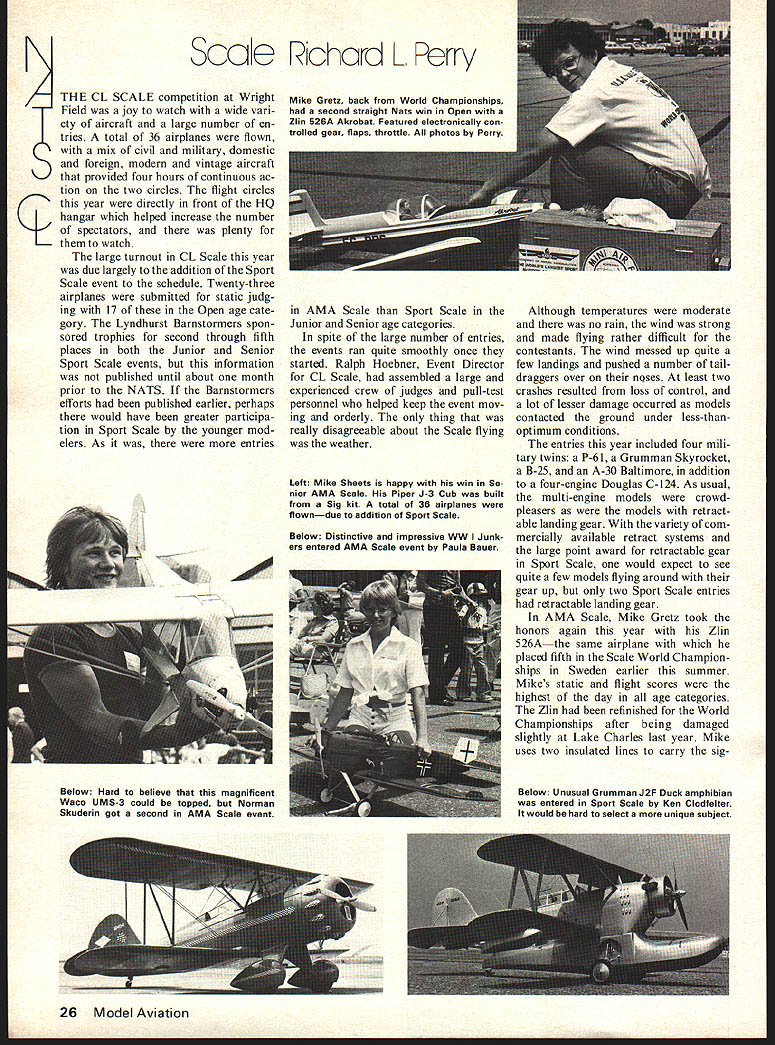
Scale Richard L. Perry
THE CL SCALE competition at Wright Field was a joy to watch with a wide variety of aircraft and a large number of entries. A total of 36 airplanes were flown, with a mix of civil and military, domestic and foreign, modern and vintage aircraft that provided four hours of continuous action on the two circles. The flight circles this year were directly in front of the HQ hangar which helped increase the number of spectators, and there was plenty for them to watch.
The large turnout in CL Scale this year was due largely to the addition of the Sport Scale event to the schedule. Twenty-three airplanes were submitted for static judging with 17 of these in the Open age category. The Lyndhurst Barnstormers sponsored trophies for second through fifth places in both the Junior and Senior Sport Scale events, but this information was not published until about one month prior to the NATS. If the Barnstormers’ efforts had been published earlier, perhaps there would have been greater participation in Sport Scale by the younger modelers. As it was, there were more entries in AMA Scale than Sport Scale in the Junior and Senior age categories.
In spite of the large number of entries, the events ran quite smoothly once they started. Ralph Hoebner, Event Director for CL Scale, had assembled a large and experienced crew of judges and pull-test personnel who helped keep the event moving in an orderly fashion. The only thing that was really disagreeable about the Scale flying was the weather.
Although temperatures were moderate and there was no rain, the wind was strong and made flying rather difficult for the contestants. The wind messed up quite a few landings and pushed a number of taildraggers over on their noses. At least two crashes resulted from loss of control, and a lot of lesser damage occurred as models contacted the ground under less-than-optimum conditions.
The entries this year included four military twins: a P-61, a Grumman Skyrocket, a B-25, and an A-30 Baltimore, in addition to a four-engine Douglas C-124. As usual, the multi-engine models were crowd pleasers, as were the models with retractable landing gear. With the variety of commercially available retract systems and the large point award for retractable gear in Sport Scale, one would expect to see quite a few models flying around with their gear up, but only two Sport Scale entries had retractable landing gear.
In AMA Scale, Mike Gretz took the honors again this year with his Zlin 526A—the same airplane which he placed fifth with in the Scale World Championships in Sweden earlier this summer. Mike’s static and flight scores were the highest of the day in all age categories. The Zlin had been refinished for the World Championships after being damaged slightly at Lake Charles last year. Mike uses two insulated lines to carry the signal.
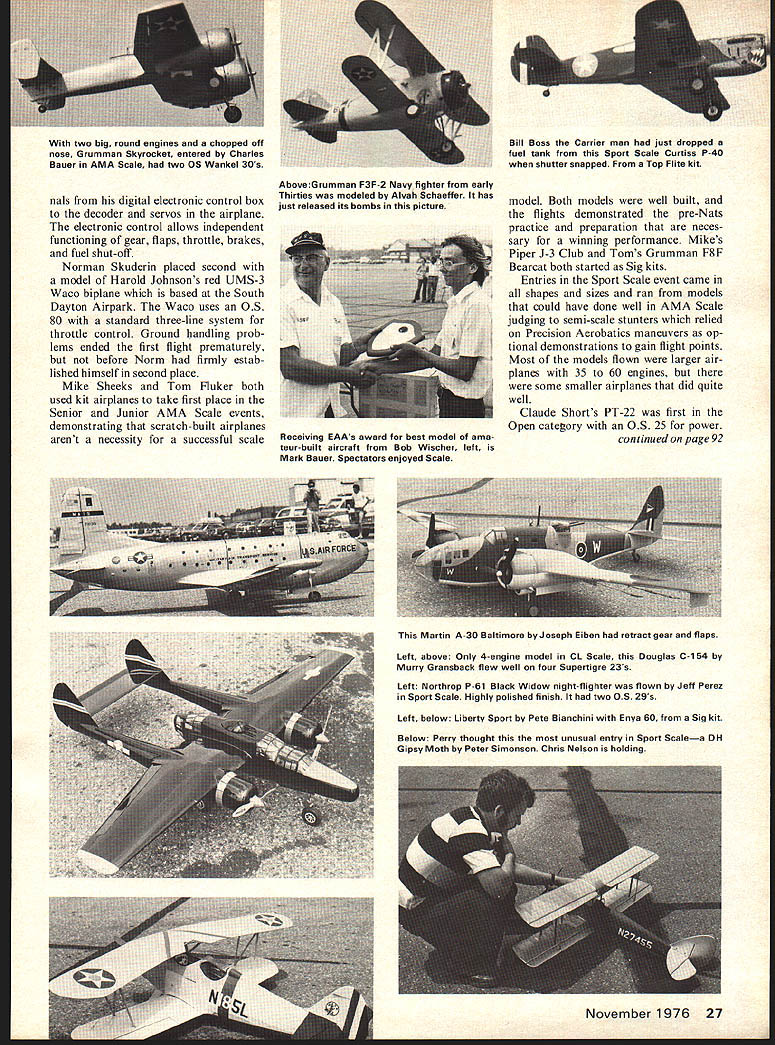
Norman Skuderin placed second in the AMA Scale event with his magnificent Waco UMS-3. Ground handling problems ended the first flight prematurely before Norm firmly established himself in second place. Mike Sheeks and Tom Fluker both used kit airplanes to take first place in the Senior and Junior AMA Scale events, demonstrating scratch-built airplanes aren’t a necessity for successful scale competition.
The Grumman F3F-2 Navy fighter of the early Thirties modeled by Alvah Schaeffer and other well-built entries showed that pre-NATS practice and preparation are necessary for winning performance. Mike’s Piper J-3 Cub and Tom’s Grumman F8F Bearcat both started as Sig kits.
Entries in the Sport Scale event came in all shapes and sizes; many of the models could have done well under AMA Scale judging. Semi-scale stunt entries relied on precision aerobatic maneuvers; optional demonstrations were used to gain flight points. Most models were flown with larger airplanes in the 35–60 engine class, with some smaller powerplants used as well. Claude Short's PT-22 was first in the Open category with an O.S. 25 for power. I had to start home before "C" was finished, but I would bet the winner was Californian Doug Galbraith with his Category I record holder GYSOB sporting a Cox .40. It was the class of the field, but you never know at the Nats. The weather for C was windy and wet and drift was right at the cornfields, so many fliers just packed up and left, since it was the last day anyway. Class C airplanes are getting smaller and smaller and have generally less capability of maxing with no lift.
FAI Power was an excellent event again this year with a high-class field highlighted by the presence of Olofsson, who was sponsored to the Nats through the efforts of Hardy Broderson, Bill Northrop of Model Builder Magazine, and donations from the hobby industry. Olofsson wound up 4th, dropping a little on his seventh and last flight. In a flyoff at 6:30 the next morning were Doug Galbraith and Gil Graunke, with Graunke narrowly edging out by a few seconds. I think the level of flying in FAI power has definitely improved in the last few years. Most ships were well-trimmed and handled. The new Cox .15 is also proving to be a solid device, with Galbraith and quite a few others using them, including Anderson's A-winning FAI.
Finally, the Payload and Cargo events, held at Wright Field in the evening, were a welcome change of pace after the monotony of the regular AMA power events. While original design thought is almost non-existent in the regular Gas classes, originality runs rampant in Cargo. Twin motors, biplanes, canards, exotic landing gears — you name it and someone will be trying to fly it. Especially landing gears! I have to believe everyone who has even had a landing gear fetish was flying Cargo. It's a difficult event and it was well attended by both contestants and spectators, who really had a good time watching these underpowered and overloaded creations try to take off the ground. The most interesting was Doug Joyce's twin .010 canard, which placed second. One problem (not in the case of Joyce) I noticed was the lack of attention to tuning the needle valve for peak output and the use of some decidedly worn out motors. Last year I questioned the validity of Cargo and Payload as national events. I still question whether we need both, but Cargo proved itself (at least to me) this year as a good, fun event for lots of people. I think one attraction these events have is that they are shared with Old Timer in the ROG rule. Real, honest-to-goodness roll-wheels-on-ground-lift-off takeoffs are still fascinating, especially since we don't even have VTO in the regular gas events.
Claude's first flight was sufficient to gain him his first place. The second flight was not so successful as the wind caused loss of line tension during a wingover. The resulting crash destroyed a very nice model.
Mark and Steve Tullis, who placed first and second in Junior Sport Scale, flew models that were quite small by normal standards. Mark's Piper PA-12 Super Cruiser and Steve's Archer II Grace both flew with Cox .049 engines using Cox three-line throttle systems. The wind made flying these small models particularly challenging, but both modelers and models came through the ordeal in good fashion with Steve even demonstrating a touch-and-go with his Grace.
Mark Bauer was the only contestant who entered both AMA and Sport Scale. Flying in the Senior age category, Mark flew a P-47 with Super Tigre 60 power to first place in Sport Scale. Mark's AMA Scale entry, modeled after the red Pitts Special flown by Bonnie Lou Poberezny, received the Experimental Aircraft Association Award as the best scale model of an amateur-built aircraft.
The CL Scale events this year were well attended, indicating a healthy interest in the events. If the trend continues, and competitors transition into the AMA event from Sport Scale, there should be some good competition for the positions on the next U.S. team for the Scale World Championships.
Transcribed from original scans by AI. Minor OCR errors may remain.

