
Speed Phil Bussell
THE 1976 NATIONALS is now part of model aviation history, but I'm sure that everyone able to be in Dayton the first week of August will feel that this "chapter" was indeed an exciting and enjoyable one for many people.
The location was ideal as far as Speed and Racing were concerned. The weather was great, which resulted in several new Speed records and some good low times in Racing and, except for the rains on Friday and resulting cooler weather which caused many to seek shelter, we couldn't have asked for more from Mother Nature!
The base was most adequate as far as facilities available for competition go and the base personnel seemed friendly and apparently quite tolerant of the mass invasion of modelers. We do appreciate their making the site available, as well as their cooperation and understanding, and that nearly 2000 contestants could enjoy themselves.
I do have some observations and suggestions that I feel should be expressed as far as the actual running of Speed is concerned. The Speed Advisory Committee needs to develop some guidelines for the running of Speed at the Nationals which would result in making jobs easier for the Event Director, providing AMA with some personnel requirements both in numbers and qualifications. The end result would be better run events and happier contestants.
Also, a flight procedure format should be developed and given to each contestant at processing, since many newcomers to Speed are not aware of the procedures and terminology used. This format should incorporate safety requirements for ships and pilots, as well as procedure guidelines.
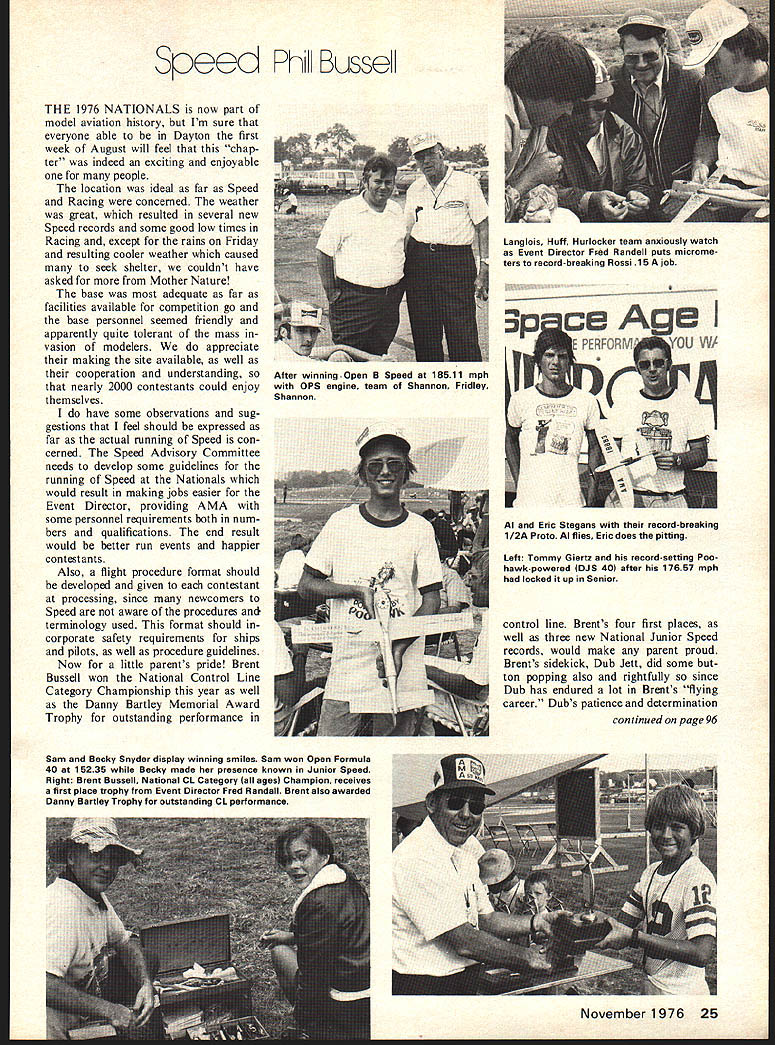
Now for a little parent's pride! Brent Bussell won the National Control Line Category Championship this year as well as the Danny Bartley Memorial Award Trophy for outstanding performance in Speed. Brent's four first places, as well as three new National Junior Speed records, would make any parent proud. Brent's sidekick, Dub Jett, did some button popping also and rightfully so since Dub has endured a lot in Brent's "flying career." Dub's patience and determination continued. Over the past few years can never be measured, but hopefully this year's accomplishments make it worthwhile and rewarding to Dub and myself.
In many respects 1976 was no different from years past. There are so many Speed events flown that it is inevitable that competition in a particular event will vary from year to year. This year competition was keen and speeds fast in Open 1/2A, Open A and Open Formula 40 Speed.
Open Speed
Half A Speed continues to be a popular event. This year we saw 23 contestants making official flights in Open 1/2A Speed. Seventh place was 106.72 mph, which, not many years ago, would have won the event. First through fifth place reads like a Who's Who in 1/2A Speed with first place being claimed by Charlie Legg of Council Bluffs, Iowa with a blistering 120+ mph. Charlie was running his own homebuilt three-port cylinder on a Cox lower end, using a Cox piston and rod assembly. Charlie runs his own full-tuned pipe and runs crankcase pressure with a fuel switch. Charlie's prop was a 4-7/8" one-blade made from a Cox gray 5-4. His pipe length was 8-7/8" measured from the center of the plug to the end of the tail pipe. When tuned properly, this set up runs in the 33,000 to 34,000 rpm range.
Open A Speed saw 20 contestants making official flights. A real battle developed between the teams of Langlois-Huff-Hurlocker, Carl David Layman, and Bussell-Jett. The old A Record fell before 11:00 a.m. and, when the smoke had cleared, Langlois-Huff-Hurlocker walked away with first place and a new Open A record of 175.71 mph. David Layman put out a super effort and won second with 173.64 and Bussell-Jett won third with 170.87. Both Layman and Bussell-Jett were running the new one-piece case Supertigre X-15. I do think Supertigre has at last come up with an engine capable of competing with the Rossi. We were using a Rev-Up 5-1/2-9 Series 200 prop and Layman was running a Rev-Up 6-1/8 Series 400 cut to a 5-1/8. Our fuel was 75% nitro, 5% alcohol and 20% oil. Layman was running 78% nitro, 2% alcohol and 20% oil. Both entries were running their pipes 11-1/8" long measured from the plug to the pipe end. Our engine was set up to have 168° exhaust duration and 128° of transfer timing.
Langlois-Huff-Hurlocker were using a hybrid Rossi set up with an X-15 red head and X-15 lower end. Their prop is a 5-3/4-10 Series 200 Rev-Up and their fuel system used a .290 carburetion bore. Their pipe length varies from 10-1/8" to 11-1/8" measured from plug to pipe end and their timing was set for maximum performance. Their standard fuel was 70% nitro, 20% oil and 10% propylene.
Without a doubt, Formula 40 Speed is filling a void in Speed. There were 40 contestants making official flights in Open Formula 40 Speed and first through fifth place were separated by less than one mile per hour. This is the kind of competition that keeps the troops coming back. Sam Snyder of Fresno, Calif. won first place with a respectable 152.35 mph and was using his own reworked K&B 40. Bob Yturarte won second with his own reworked Supertigre X-40. Yturarte was using a Kelly 8-8 glass prop trimmed and reshaped to increase the rpm. Snyder and Yturarte are both capable of speeds in the upper 150s and I believe in 1977 it will take 160+ mph to win this event.
Senior Speed
As predicted last year, Senior Speed did pick up in 1976. It should continue its upward surge in 1977 as Brent Bussell will move from Junior to Senior and hopefully Mark Seigler of Houston will be able to make the Nationals. B Speed is a fine example of the level of competition in the Senior age group in 1976. First place was won by Patrick Hempel of Garland, Tex., with a speed of 179.57 mph and fifth place was a very respectable 164.32 mph. Max Snyder, Glen Vannatt, Tommy Giertz, and Hiromitsu Okubayashi rounded out the top five.
Senior C Speed was hotly contested when Tommy Giertz of Houston, Tex. broke the existing Senior C Record early in the morning when he turned a scorching 176.57 mph using a Poohawk-powered DJS 40. Patrick Hempel immediately scared the pants off Tommy, but Patrick's best time of 176.05 mph was one-half mile per hour shy of Tommy's. As both these fine young men live in the same area, it is obvious that Patrick will soon get another chance.
Junior Speed
Profile Proto (Junior Only) continues to be one of the most competitive Speed events at the Nationals, both in numbers of contestants (21 making official flights) and the quality of the competitors. Obviously, this event is accomplishing its original purpose of bringing Juniors into the Speed scene and providing them with a look at what Speed is all about. Brent Bussell set a new National 1/2A Profile Proto record of 92.70 mph followed closely with a new 91.38 mph by Edward Fischman of N.Y., who was the current 1/2A Profile Proto record holder when the event started. Edward is a new face on the Junior scene and is being tutored by Frank Garzon. Third place went to Dennis Yturarte with a speed of 87.77 and fourth to Mike Clem at 87.17. Next year should be a real battle between Clem, Yturarte and Fischman.
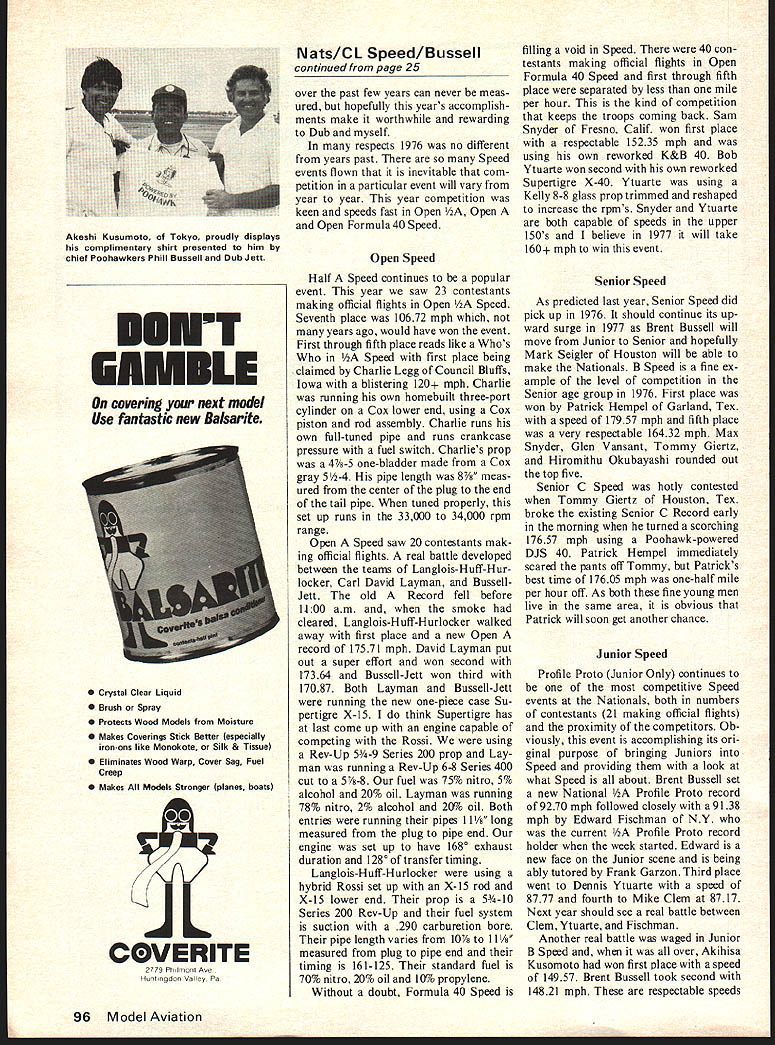
Another real battle was waged in Junior B Speed and, when it was all over, Akeshi Kusumoto had won first place with a speed of 149.57. Brent Bussell took second with 148.21 mph. These are respectable speeds filling a void in Speed. When you remember full-tuned pipes are not legal now in the Junior age group.
Half-A Proto, as 1/2A Profile Proto, was popular in the Junior age category, particularly due to the fact that you can use the same airframe in both events. Brent Bussell won first with a record-breaking 93.49 mph. This is even more impressive when you consider he turned this with his profile proto. Brent was using a 5-4-1/2 one-blade prop and his ground rpm is about 27,000 to 28,000. The prop does make a difference.
All in all, Speed was up in 1976 with records broken in all three age classifications. FAI Speed at long last seems to be coming into its own and I saw more official flights made in FAI than I have ever seen before. The year 1977 should be interesting in many ways.
Transcribed from original scans by AI. Minor OCR errors may remain.

