
Nats FF: Indoor
- Bob Meuser
THE SCENE of the Indoor events was a large aircraft hangar at Norton Air Force Base 12 miles north of the main Nats activity at March AFB. The girdered roof arched to a height of 90 ft. at the center, covering a 150 x 200' area. Lamps, suspended at about 50-ft. intervals, extended to a height of about 60 ft. Angle braces extending from the end walls, combined with the arch of the roof, limited the region for best flying to a rather small area. Traffic was heavy, and mid-air collisions were frequent.
On Saturday, the first day of the two-day Indoor competition, the air was turbulent for several hours after the 9 a.m. starting gun. Afterward, except for an occasional puff when the people-door was left standing open, the air was calm and drift was not severe. Peak mid-afternoon temperatures reached 98 degrees F.
It was old home week for retired Air Force Colonel Bob Randolph. Norton AFB was his last duty station before his retirement. To commemorate the homecoming he placed first in AMA Stick, Cabin, and Peanut Scale and placed third in Paper Stick. His win in Cabin—an event in which he has held the national record for all three ceiling-height categories for many years until recently—gives him a year's possession of the historic Stout Indoor Trophy for the third time. The three wins are the third consecutive major wins for these particular models; perhaps they now deserve an honorable retirement.
In the Junior events, Marnie Meuser, age 10, took first places in AMA Stick, Paper Stick, and Easy B, and she received a plaque for top Junior score in the combined-age-group FAI Stick event. And she did it all with the same model: a Novice Pennyplane version of No Non-Cents featured in the June issue, with a narrower wing used for Easy B. Second place in three of those events was taken by Darryl Stevens. A thing like that could sour a kid on women for life!
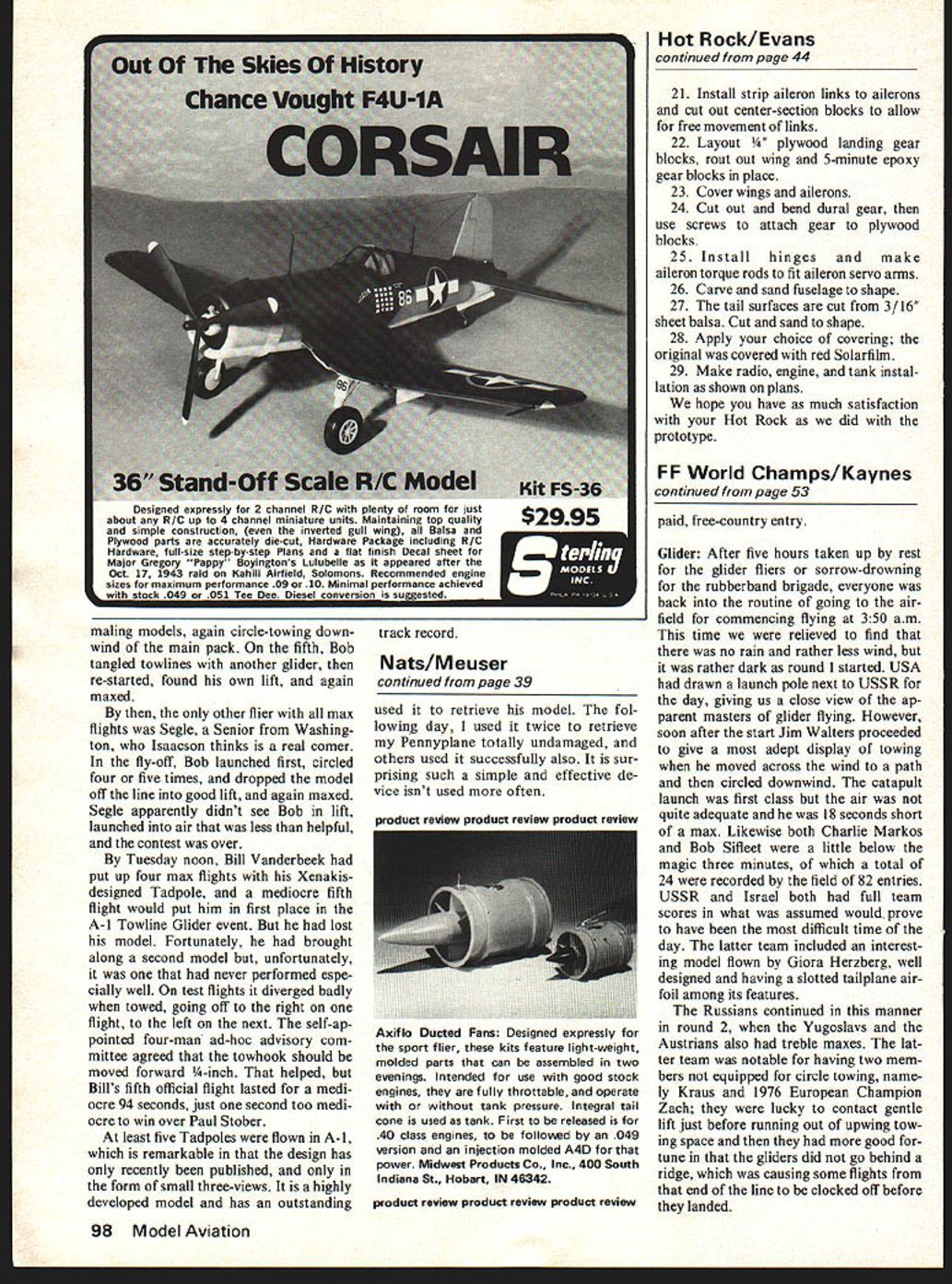
Thirteen-year-old Francisco Barragan and his cousin, Marisol Chavez, age 14, flew in virtually every Rubber-Power Indoor, Outdoor, and Scale event in the book, with Francisco winning the Indoor Cabin event.
In the Senior events, two-times National Champion Ken Bauer took AMA Stick. Gary Stevens topped out in the Paper Stick event, and Chris Clemens won Easy B. Tim Young won Pennyplane.
FAI Stick, which was flown in 1-1/2-hour "rounds," was a cliff-hanger, with the top three positions being determined only in the last few minutes of the last round. Domina's second and fourth flights gave him a best-two-flight total that seemed good enough to win. But with only a half-hour left in the sixth and final round, Banks, Bauer, and Mather, all in contention for first place, still had not flown. Bauer launched, but soon his model hung up on a lamp hanger. Then Banks flew, and also hung up. Finally Mather went up on a beautiful flight, managed to stay clear of the lights, and until the final touch-down it seemed as if he could make it. But he was just 4 sec. short of bumping Domina off the top peg, although he managed to nudge World Champ Romak into the third-place slot. Two weeks later, Domina was to earn a spot on the team to represent the U.S. at the Indoor World Champs.
Earl Hoffman, who has been winning local Pennyplane events with disgusting regularity, posted a winning flight of 11:12 which is quite good for a 90-ft. ceiling, and especially good in light of the fact that his model never got up more than about 60 ft. The only biplane Pennyplane entered was one built by Cezar Banks. About 10 seconds into its first flight it was destroyed by a Scale model.
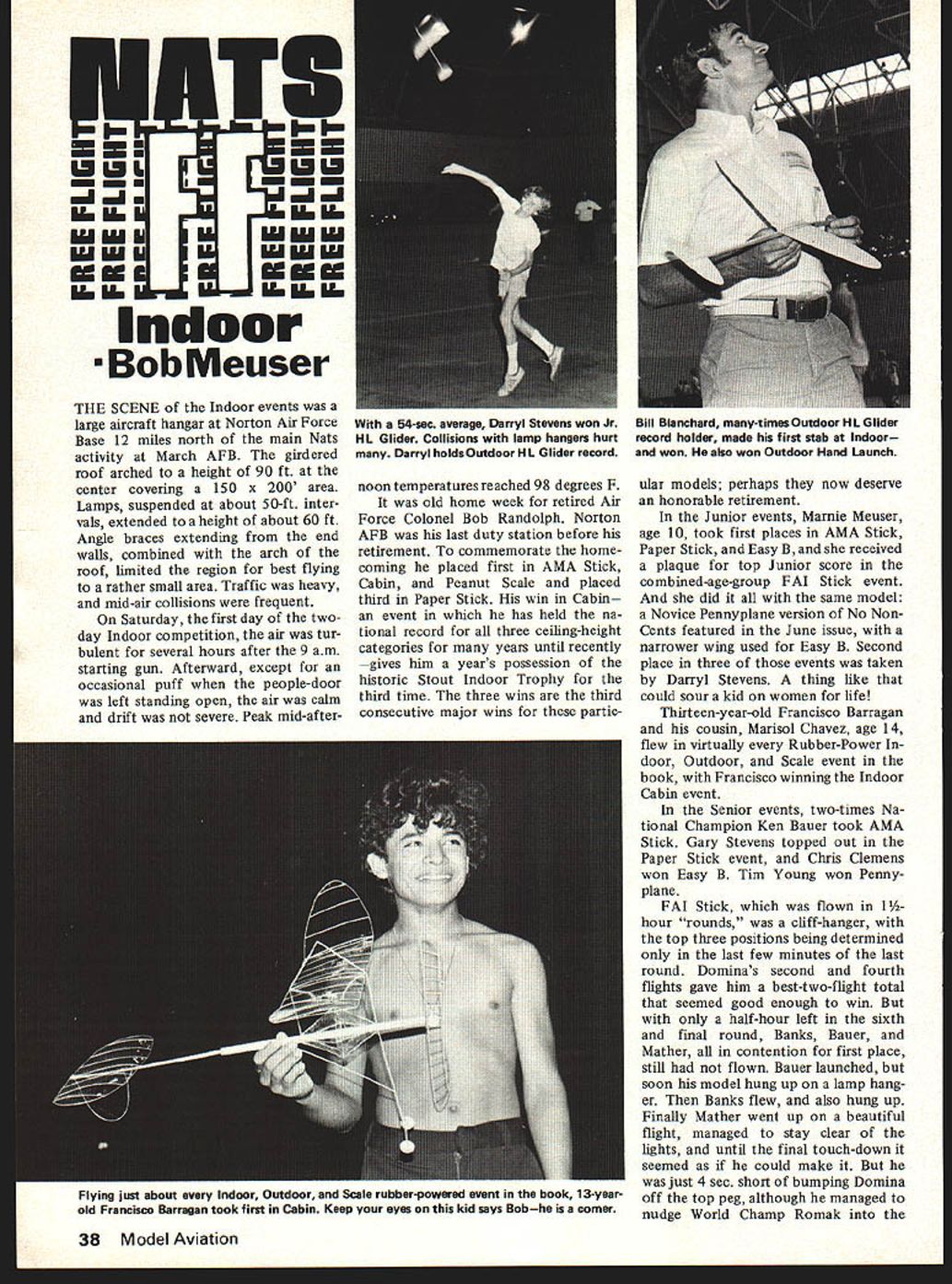
Curt Stevens' name was a familiar one on the H.L. Glider winners lists some 15 years ago. Now his kids carry on the family tradition. Darryl won the Indoor H.L. Glider event even though six of his allowed nine flights hit lamp hangers, and later placed second in the Outdoor event. In the Senior age group, Gary placed second to Greg Sussex, another Southern Californian.
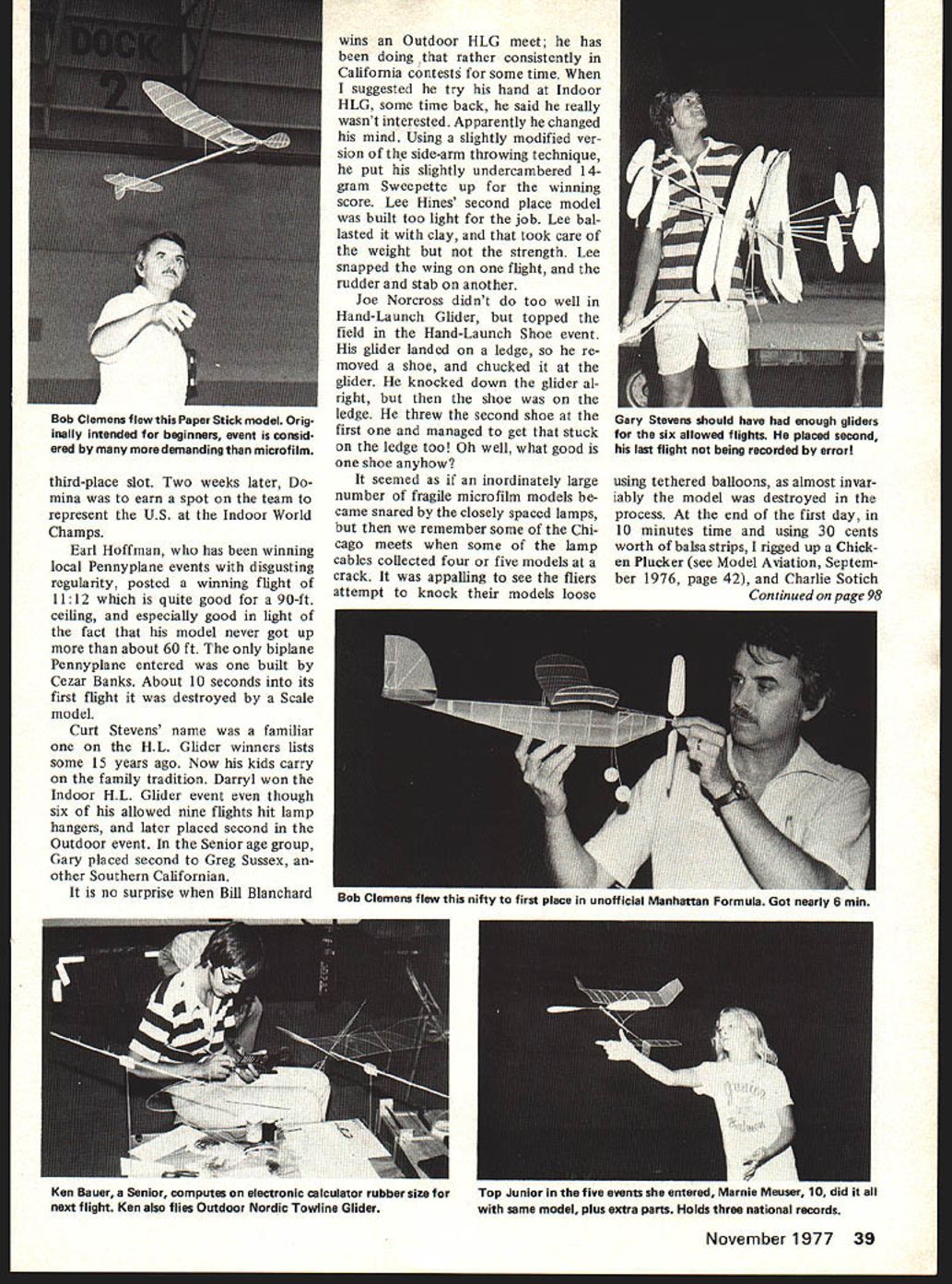
It is no surprise when Bill Blanchard wins an Outdoor HLG meet; he has been doing that rather consistently in California contests for some time. When I suggested he try his hand at Indoor HLG, some time back, he said he really wasn't interested. Apparently he changed his mind. Using a slightly modified version of the side-arm throwing technique, he put his slightly undercambered 14-gram Sweepette up for the winning score. Lee Hines' second place model was built too light for the job. Lee ballasted it with clay, and that took care of the weight but not the strength. Lee snapped the wing on one flight, and the rudder and stab on another.
Joe Norcross didn't do too well in Hand-Launch Glider, but topped the field in the Hand-Launch Shoe event. His glider landed on a ledge, so he removed a shoe, and chucked it at the glider. He knocked down the glider alright, but then the shoe was on the ledge. He threw the second shoe at the first one and managed to get that stuck on the ledge too! Oh well, what good is one shoe anyhow?
It seemed as if an inordinately large number of fragile microfilm models became snared by the closely spaced lamps, but then we remember some of the Chicago meets when some of the lamp cables collected four or five models at a crack. It was appalling to see the fliers attempt to knock their models loose using tethered balloons, as almost invariably the model was destroyed in the process. At the end of the first day, in 10 minutes time and using 30 cents worth of balsa strips, I rigged up a Chicken Plucker (see Model Aviation, September 1976, page 42), and Charlie Sotich.
Transcribed from original scans by AI. Minor OCR errors may remain.

