
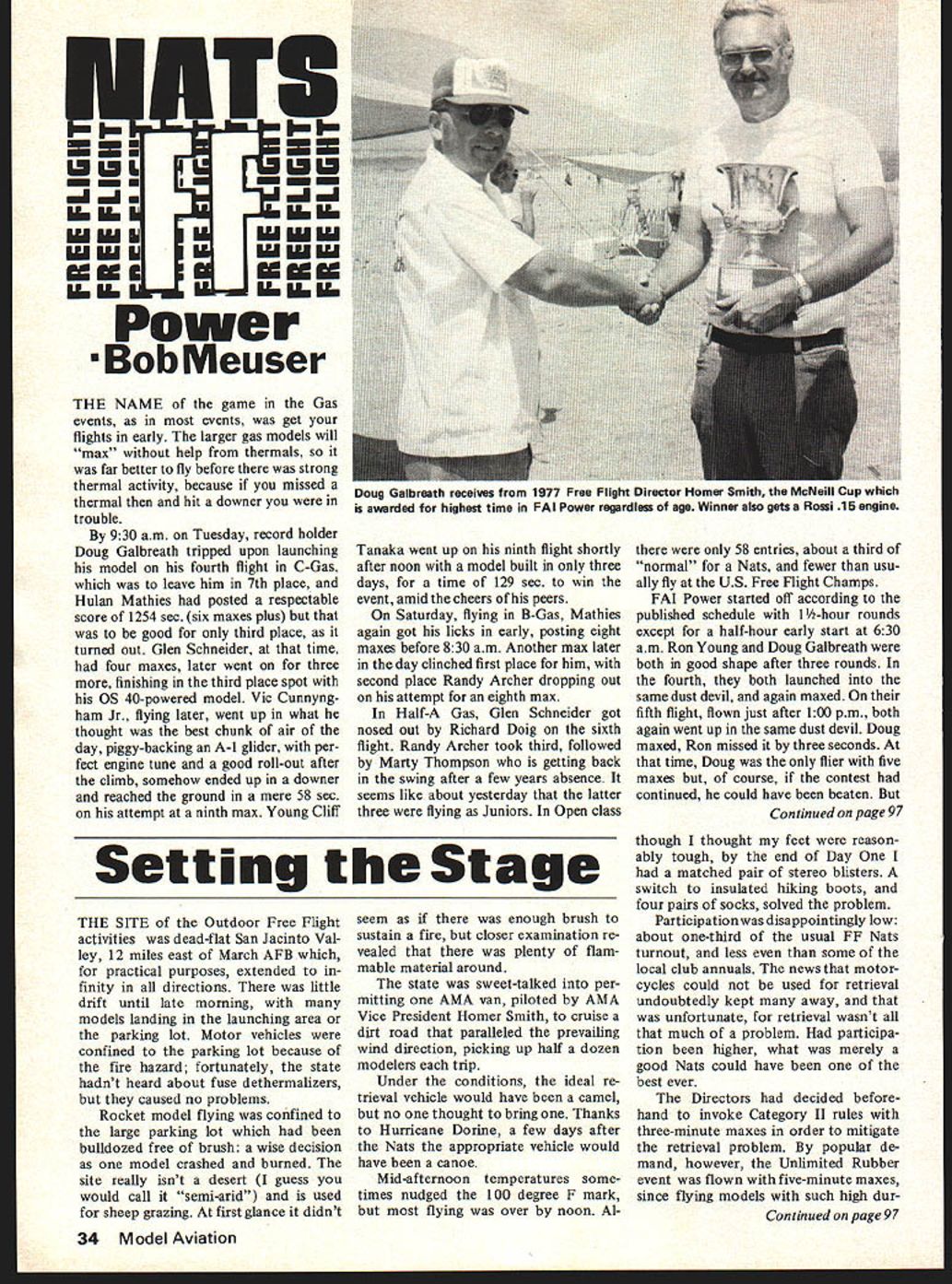
Nats FF: Power - Bob Meuser
THE NAME of the game in the Gas events, as in most events, was get your flights in early. The larger gas models will "max" without help from thermals, so it was far better to fly before there was strong thermal activity, because if you missed a thermal then and hit a downer you were in trouble.
By 9:30 a.m. on Tuesday, record holder Doug Galbreath tripped upon launching his model on his fourth flight in C-Gas, which was to leave him in 7th place, and Hulan Mathies had posted a respectable score of 1254 sec. (six maxes plus) but that was to be good for only third place, as it turned out. Glen Schneider, at that time, had four maxes, later went on for three more, finishing in the third place spot with his OS 40-powered model. Vic Cunnyngham Jr., flying later, went up in what he thought was the best chunk of air of the day, piggy-backing an A-1 glider, with perfect engine tune and a good roll-out after the climb, somehow ended up in a downer and reached the ground in a mere 58 sec. on his attempt at a ninth max. Young Cliff Tanaka went up on his ninth flight shortly after noon with a model built in only three days, for a time of 129 sec., to win the event, amid the cheers of his peers.
On Saturday, flying in B-Gas, Mathies again got his licks in early, posting eight maxes before 8:30 a.m. Another max later in the day clinched first place for him, with second place Randy Archer dropping out on his attempt for an eighth max.
In Half-A Gas, Glen Schneider got nosed out by Richard Doig on the sixth flight. Randy Archer took third, followed by Marty Thompson who is getting back in the swing after a few years absence. It seems like about yesterday that the latter three were flying as Juniors. In Open class there were only 58 entries, about a third of "normal" for a Nats, and fewer than usually fly at the U.S. Free Flight Champs.
FAI Power started off according to the published schedule with 1-1/2-hour rounds except for a half-hour early start at 6:30 a.m. Ron Young and Doug Galbreath were both in good shape after three rounds. In the fourth, they both launched into the same dust devil, and again maxed. On their fifth flight, flown just after 1:00 p.m., both again went up in the same dust devil. Doug maxed, Ron missed it by three seconds. At that time, Doug was the only flier with five maxes but, of course, if the contest had continued, he could have been beaten.
Setting the Stage
THE SITE of the Outdoor Free Flight activities was dead-flat San Jacinto Valley, 12 miles east of March AFB which, for practical purposes, extended to infinity in all directions. There was little drift until late morning, with many models landing in the launching area or the parking lot. Motor vehicles were confined to the parking lot because of the fire hazard; fortunately, the state hadn't heard about fuse dethermalizers, but they caused no problems.
Rocket model flying was confined to the large parking lot which had been bulldozed free of brush: a wise decision as one model crashed and burned. The site really isn't a desert (I guess you would call it "semi-arid") and is used for sheep grazing. At first glance it didn't seem as if there was enough brush to sustain a fire, but closer examination revealed that there was plenty of flammable material around.
The state was sweet-talked into permitting one AMA van, piloted by AMA Vice President Homer Smith, to cruise a dirt road that paralleled the prevailing wind direction, picking up half a dozen modelers each trip.
Under the conditions, the ideal retrieval vehicle would have been a camel, but no one thought to bring one. Thanks to Hurricane Dorine, a few days after the Nats the appropriate vehicle would have been a canoe.
Mid-afternoon temperatures sometimes nudged the 100 degree F mark, but most flying was over by noon. Although I thought my feet were reasonably tough, by the end of Day One I had a matched pair of stereo blisters. A switch to insulated hiking boots, and four pairs of socks, solved the problem.
Participation was disappointingly low: about one-third of the usual FF Nats turnout, and less even than some of the local club annuals. The news that motorcycles could not be used for retrieval undoubtedly kept many away, and that was unfortunate, for retrieval wasn't all that much of a problem. Had participation been higher, what was merely a good Nats could have been one of the best ever.
The Directors had decided beforehand to invoke Category II rules with three-minute maxes in order to mitigate the retrieval problem. By popular demand, however, the Unlimited Rubber event was flown with five-minute maxes, since flying models with such high duration. It didn't continue. By then the wind was strong, and the contestants, with Doug abstaining, voted to call it a day.
Doug flew his 1975 Summerwind model for the first three rounds, and his 1976 Thrashing Machine, which he now considers his Number One model, for the last two. Four of the six top fliers used Cox Conquest 15 engines, a departure from the all‑Rossi situation a few years back.
Payload models are limited to a 36‑in. maximum wing span, a 5‑oz. minimum weight, a .025 cu. in. maximum engine displacement, and must take off from the ground. With those specifications performance is less than flashy, and with a 15‑sec. maximum engine run, making a 3‑minute "max" is not easy. Ron Wittman started flying his 15‑year‑old Payload model late in the morning, was the only entrant to make three successive max flights, so he had first place in the bag. But he was having so much fun maxing he put up max after max until the Event Director talked him into knocking it off. His son Steve, who holds the Junior record, also won.
Transcribed from original scans by AI. Minor OCR errors may remain.

