
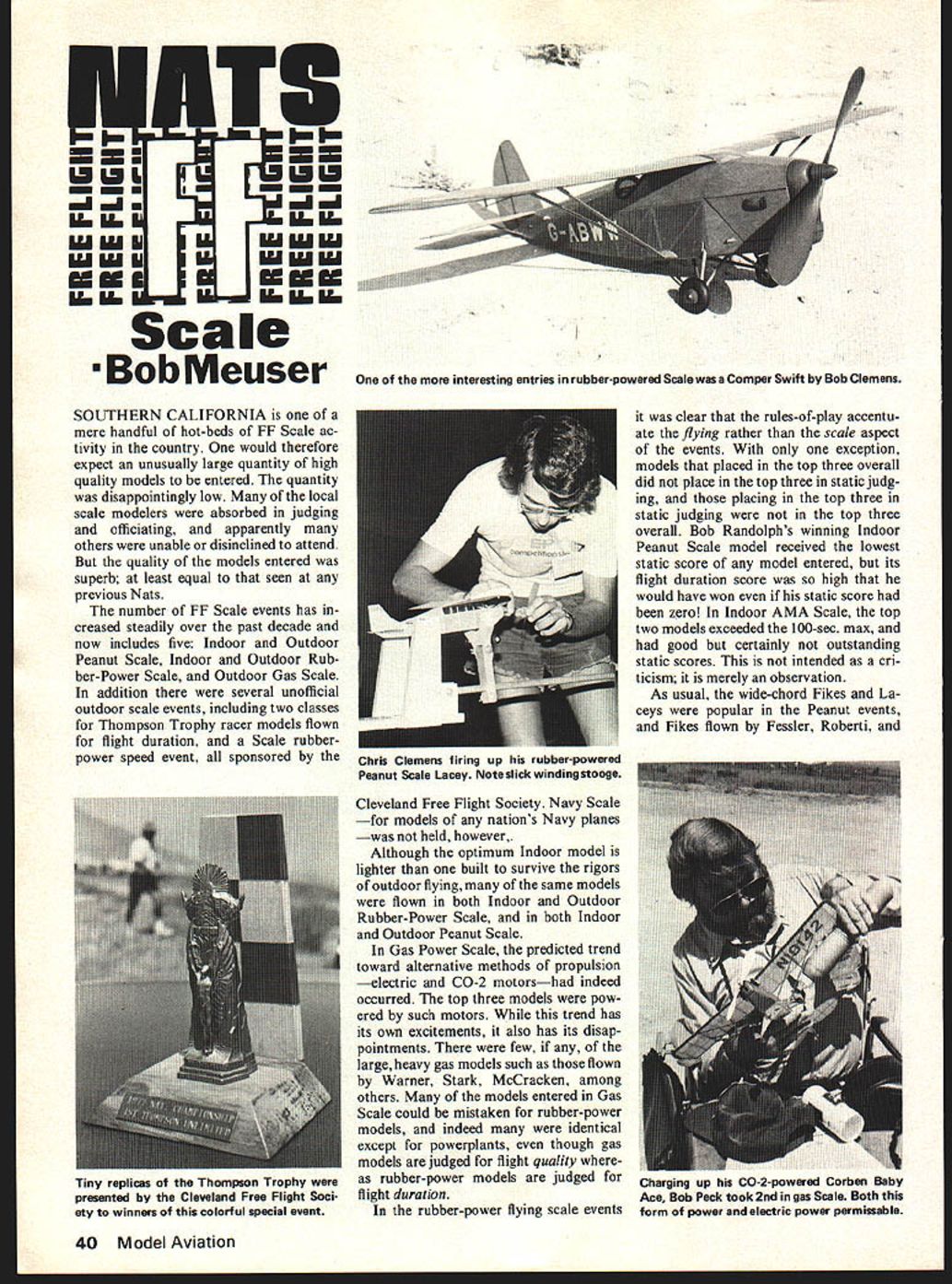
Nats FF: Scale
· Bob Meuser
SOUTHERN CALIFORNIA is one of a mere handful of hot-beds of FF Scale activity in the country. One would therefore expect an unusually large quantity of high quality models to be entered. The quantity was disappointingly low. Many of the local scale modelers were absorbed in judging and officiating, and apparently many others were unable or disinclined to attend. But the quality of the models entered was superb; at least equal to that seen at any previous Nats.
The number of FF Scale events has increased steadily over the past decade and now includes five: Indoor and Outdoor Peanut Scale, Indoor and Outdoor Rubber-Power Scale, and Outdoor Gas Scale. In addition there were several unofficial outdoor scale events, including two classes for Thompson Trophy racer models flown for flight duration, and a Scale rubber-power speed event, all sponsored by the Cleveland Free Flight Society. Navy Scale — for models of any nation's Navy planes — was not held, however.
Although the optimum Indoor model is lighter than one built to survive the rigors of outdoor flying, many of the same models were flown in both Indoor and Outdoor Rubber-Power Scale, and in both Indoor and Outdoor Peanut Scale.
In Gas Power Scale, the predicted trend toward alternative methods of propulsion — electric and CO-2 motors — had indeed occurred. The top three models were powered by such motors. While this trend has its own excitements, it also has its disappointments. There were few, if any, of the large, heavy gas models such as those flown by Warner, Stark, McCracken, among others. Many of the models entered in Gas Scale could be mistaken for rubber-power models, and indeed many were identical except for powerplants, even though gas models are judged for flight quality whereas rubber-power models are judged for flight duration.
In the rubber-power flying scale events it was clear that the rules-of-play accentuate the flying rather than the scale aspect of the events. With only one exception, models that placed in the top three overall did not place in the top three in static judging, and those placing in the top three in static judging were not in the top three overall. Bob Randolph's winning Indoor Peanut Scale model received the lowest static score of any model entered, but its flight duration score was so high that he would have won even if his static score had been zero! In Indoor AMA Scale, the top two models exceeded the 100-sec. max, and had good but certainly not outstanding static scores. This is not intended as a criticism; it is merely an observation.
As usual, the wide-chord Fikes and Laceys were popular in the Peanut events, and Fikes flown by Fessler, Roberti, and others were seen.
Bob Clemens neatly built Aristocrat Outdoor Peanut model received 90 out of a possible 100 in static judging. Bob's hopes for the Aristocrat itself were considerably shattered when a contestant tried to run through Bob's rubber-motor model being wound. Somehow Bob got the shattered remains back in place and took second place overall; average flight time 73 seconds.
Clarence Mather's Davis DA-2A5 topped the event. Mulligan's Wittman Tailwind placed third. Don Srull's fine World War II Heinkel 100D won Outdoor Rubber Scale, barely nosing out Clarence Mather's Fairchild PT-19; Bob Clemens' Comper Swift placed third. Earlier Mather and Srull entered the same models in Indoor Scale, placing first and third respectively. Dan Domina's Piper Cub Special took first place indoors; Srull's indoor flight time of 80 seconds was extremely good for what appeared a rather heavy model in the short 100-sec. maxes.
Bill Stroman's electric-powered ASL Valkyrie, featured in the September issue of Flying Models, was extremely popular with spectators and photographers. Lack of sufficient horsepower for takeoff necessitated hand launching, resulting in poor flight scores and relegation to third place.
In Gas Scale, Hannan's barracks-built CO-2-powered Farman won; the Peck-Pardoe team Corben Baby Ace, also CO-2-powered, took second. Ken Johnson took second, third and fourth places under Randolph's Nesmith Cougar in Indoor events. Otherwise, a good variety of models was seen. Bill Hannan seems to have a Farman Moustique for every occasion; he has built seven so far, the last of which was built in dorms at the Nats. It is not surprising, considering the tremendous amount of research he has done on this aircraft. The Peanut Scale version features a profile cut-out of Fantomette—a sort of French teen-age wonder woman—originated by French author Georges Chaulet who shared the research chores with Bill. Bill's larger rubber- and CO-2-powered models were equipped with a whittled likeness of Lucien Bussoutrot who was Farman's chief pilot at the time the Moustique was built. Detail on the exposed engine was truly superb.
Bob Clemens' neatly built Aristocrat Outdoor Peanut model received 90 out of a possible 100 static judging. But Bob's hopes, and the Aristocrat itself, were considerably shattered when a contestant tried to run through Bob's rubber motor as the model was being wound. Somehow Bob got the shattered remains back into one piece, and took second place overall with an average flight time of 73 seconds. Clarence Mather's Davis DA-2A5 topped the event. Mulligan's Wittman Tailwind placed third.
Don Srull's fine World War II Heinkel 100D won Outdoor Rubber Scale, barely nosing out Clarence Mather's Fairchild PT-19. Bob Clemens' Comper Swift placed third. Earlier, Mather and Srull entered the same models in Indoor Scale, placing first and third, respectively, with Dan Domina's Piper Cub Special taking first place. Srull's indoor flight time of 80 sec. was extremely good for what appeared to be a rather heavy model, but it was short of the 100-sec. maxes achieved by Mather and Domina.
Bill Stroman's electric-powered A.S.L. Valkyrie, featured in the September issue of Flying Models, was extremely popular with spectators and photographers. Lack of sufficient horsepower for takeoff necessitated hand launching, resulting in a poor flight score that relegated it to third place in Gas Scale. Hannan's barracks-built CO-2-powered Farman won, with the Peck-Pardoe team Corbin Baby Ace, also CO-2-powered, taking second.
Ken Johnson took second, third, and fourth places under Randolph's Nesmith Cougar in Indoor. But otherwise the variety of aircraft modeled was refreshing.
Transcribed from original scans by AI. Minor OCR errors may remain.

