
Nats Free Flight: Indoor
The Indoor site was a pretty good one, considering the low 65' ceiling. Obviously, everyone would prefer a building that meets the limits of a category, so records can be set, but that's life.
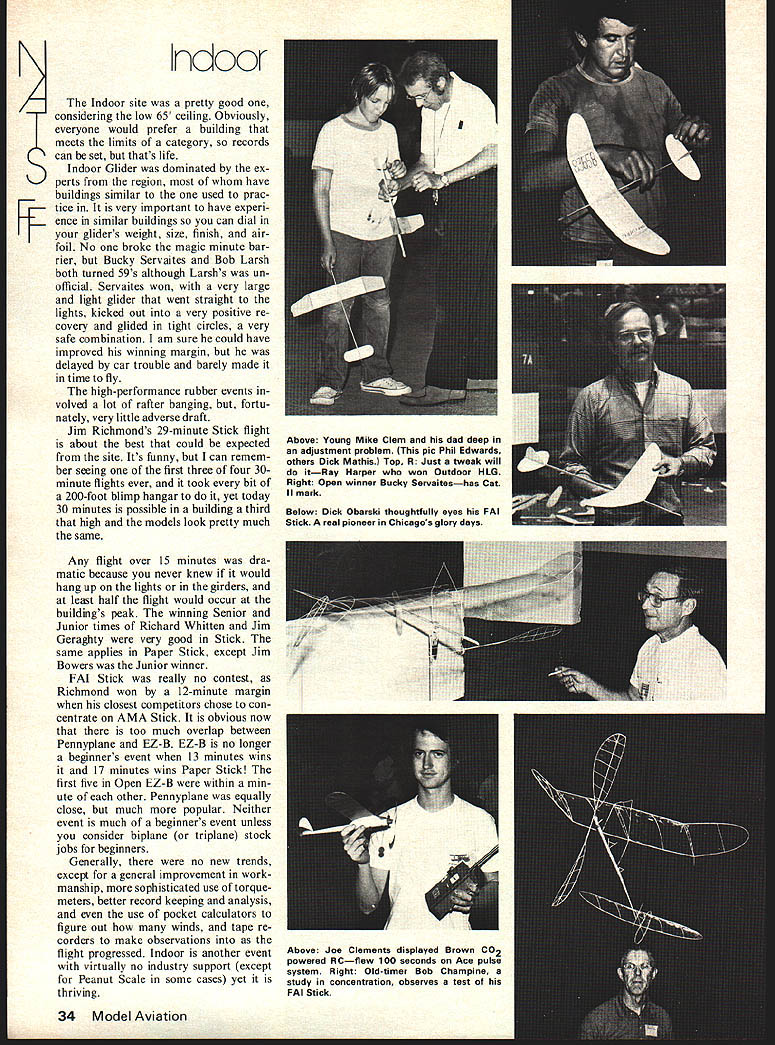
Indoor Glider was dominated by the experts from the region, most of whom have buildings similar to the one used to practice in. It is very important to have experience in similar buildings so you can dial in your glider's weight, size, finish, and airfoil. No one broke the magic minute barrier, but Bucky Servaites and Bob Larsh both turned 59's, although Larsh's was unofficial. Servaites won with a very large and light glider that went straight to the lights, kicked out into a very positive recovery and glided in tight circles, a very safe combination. I am sure he could have improved his winning margin, but he was delayed by car trouble and barely made it in time to fly.
The high-performance rubber events involved a lot of rafter banging, but, fortunately, very little adverse draft.
Jim Richmond's 29-minute Stick flight is about the best that could be expected from the site. It's funny, but I can remember seeing one of the first three or four 30-minute flights ever. It took every bit of a 200-foot blimp hangar to do it, yet today 30 minutes is possible in a building a third that high and the models look pretty much the same.
Any flight over 15 minutes was dramatic because you never knew if it would hang up on the lights or in the girders, and at least half the flight would occur at the building's peak. The winning Senior and Junior times of Richard Whitten and Jim Geraghty were very good in Stick. The same applies in Paper Stick, except Jim Bowers was the Junior winner.
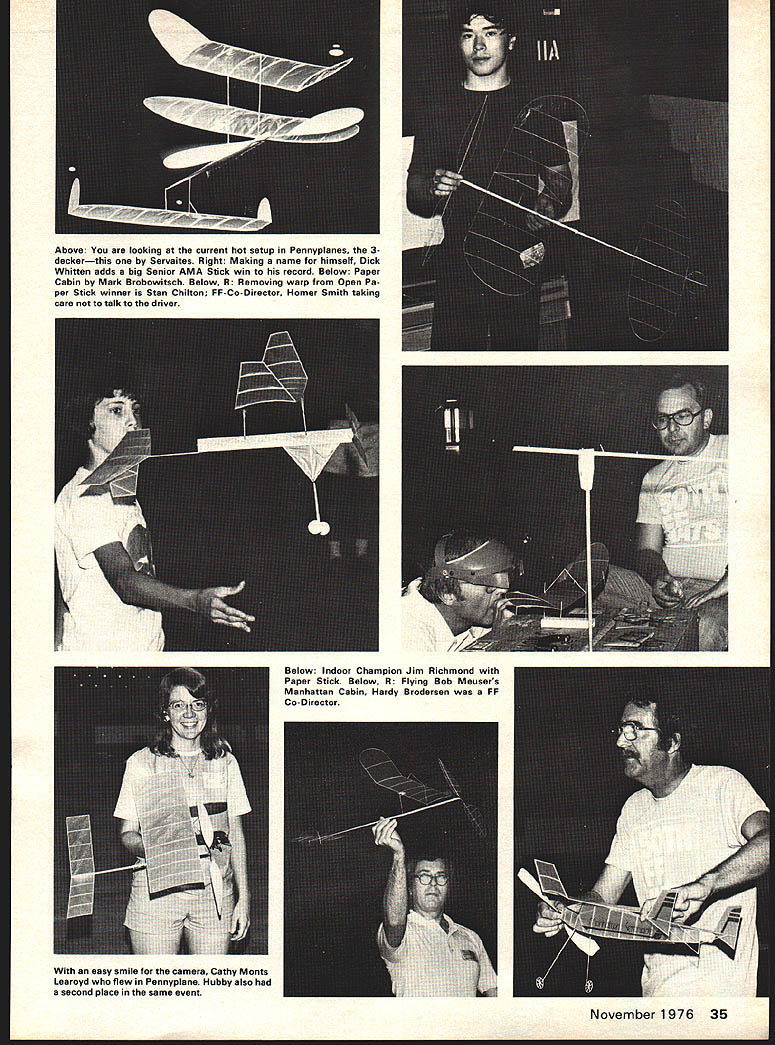
FAI Stick was really no contest, as Richmond won by a 12-minute margin when his closest competitors chose to concentrate on AMA Stick. It is obvious now that there is too much overlap between Pennyplane and EZ-B. EZ-B is no longer a beginner's event when 13 minutes wins it and 17 minutes wins Paper Stick! The first five in Open EZ-B were within a minute of each other. Pennyplane was equally close, but much more popular. Neither event is much of a beginner's event unless you consider biplane (or triplane) stock jobs for beginners.
Generally, there were no new trends, except for a general improvement in workmanship, more sophisticated use of torquemeters, better record keeping and analysis, and even the use of pocket calculators to figure out how many winds, and tape recorders to make observations as the flight progressed. Indoor is another event with virtually no industry support (except for Peanut Scale in some cases) yet it is thriving. The indoor site was pretty good considering the low 65-foot ceiling. Obviously everyone would prefer a building that meets the category limits — records can be set; that's life.
Indoor gliders were dominated by experts. Regions that have similar buildings used practice; it's very important to have experience in similar buildings so you can dial in a glider's weight, size, finish, and airfoil. There is no magic-minute barrier.
Bucky Servaites and Bob Larsh both turned 59s, although Larsh's was unofficial. Servaites won. A very large, light glider went straight; the lights kicked out but a very positive recovery and tight circling made a very safe combination. I'm sure he could have improved the winning margin — he delayed because of car trouble and barely made time to fly.
The high-performance rubber events involved a lot of rafter-banging; fortunately there was very little adverse draft. Jim Richmond's 29-minute Stick flight was about the best that could be expected at the site.
It's funny — I can remember seeing the first three or four 30-minute flights; they took place in a 200-foot blimp hangar, yet today 30 minutes is possible in a building. High models look pretty much the same. Any flight over 15 minutes is dramatic because you never know when it will hang up in the lights and on the girders; at least half the flight will occur at the building's peak.
Transcribed from original scans by AI. Minor OCR errors may remain.

