
Nats Free Flight: Power
Dick Mathis
THE MAIN CONCERN of most free-flight contestants before the meet was the adequacy of the Springfield Airport. As it turned out our fears were unwarranted, since the field was a couple miles long in most wind-drift situations. There were some problems with cornfields on the airport, but all in all, there were few complaints about the main free-flight site. There was grumbling about the fact that some of the free-flight events were also scheduled a 30-minute drive away at Wright Field in Dayton. So, we would fly from early in the morning at Springfield until 4:00 in the evening when the base was re-opened to full-scale traffic, and then pack up and go to Wright to fly no more events which did not require so much space—such as Scale, Payload, etc.—until 9:00. The reasoning behind this split-site arrangement is not clear to me, but the events held at Wright in Dayton were very interesting and enjoyable with lots of spectators and a relaxed ambiance, in contrast to the intense competitive atmosphere that prevailed at Springfield.
The weather was a definite negative factor, with a freak cold wave hitting Ohio to produce record cold temperatures, wind and rain after the first two days, which were beautiful.
There are still too many events! I was supposed to cover 27 events not counting the unofficial events like Rubber Speed (Jim Lewis, about 60 mph), R.O.W. Flying Ace Rubber, Manhattan Coupe, Electric Free Flight, and so on. I have forgotten one official one up until now and I'll bet no one noticed—Rocket. I have no photos of Rocket because it was still too wet to make one run before I had to leave (same day as Class C gas, and last day). We need to eliminate some of the old outmoded official events (like Rocket) and make official some of the new events that have been run unofficially for the last few years, such as Electric Free Flight.
This was a very good free-flight Nationals, despite the weather. I think the AMA, after all, provided fairly for free-flight enthusiasts, although we missed the central hangar/workshop fellowship. A welcome change, however, was the presentation of trophies immediately after the day's flying at the site.
Power
We have reduced motor runs over the years to keep performance within the bounds of today's restricted flying sites. This has led to very little reduction in climb performance since engines have gotten hotter and airplanes have gotten smaller, but it has really messed up the gliding ability of most aircraft. Most airplanes, if they did not get into a thermal, did not make a max.
If you fly any power event and do not take care to pick good air, you will not do well. This is especially important in flyoffs where the motor run goes to 5 seconds. It is also important, with current Category II rules, to operate the motor-run timer precisely, to adjust the needle valve carefully, and to have a good power-glide transition. There is obviously still plenty of challenge in flying gas free flight at the Nationals, even though some are still lamenting the change from five-minute maxes at the Nats to three minutes.
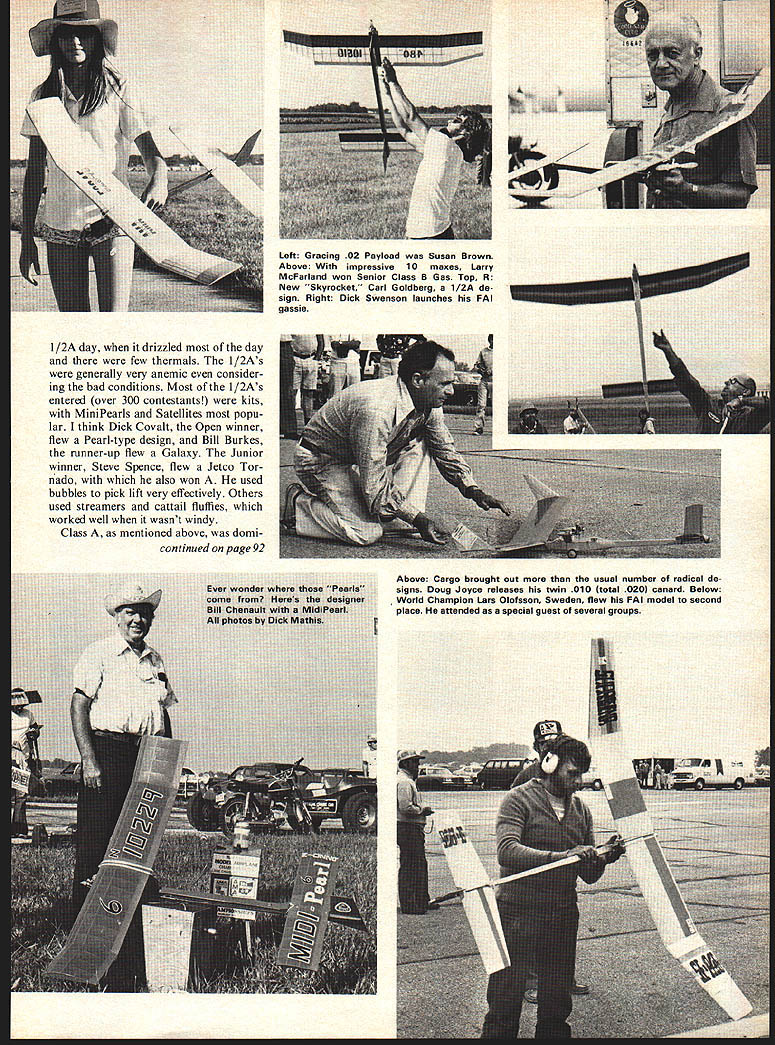
The thoughts occurred to me early that today's Unlimited gas models are not performing as well as they should, and this was later born out when the first three places in Open Class A were won by FAI ships—shouldn't be that way. We need to do some serious rethinking about short-engine-run free-flight design. The general lack of performance was very evident on 1/2A day, when it drizzled most of the day and there were few thermals. The 1/2As were generally very anemic even considering the bad conditions. Most of the 1/2As entered (over 300 contestants!) were kits, with MiniPearls and Satellites most popular. I think Dick Covalt, the Open winner, flew a Pearl-type design, and Bill Burkes, the runner-up, flew a Galaxy. The Junior winner, Steve Spence, flew a Jetco Tornado, with which he also won A. He used bubbles to pick lift very effectively. Others used streamers and cattail fluffies, which worked well when it wasn't windy.
Class A, as mentioned above, was dominated. by FAI ships, with Rol Anderson making ten maxes to win over World Power Champ Lars Olofsson of Sweden. The highest placed non-FAI ship was Sal Tai's Starduster 350 in 4th.
The only other power flier to make ten straight maxes was Larry McFarland of Longview, Tex., in Class B. He used a Rambunctious 480 (your beloved reporter's design) and did five more maxes on A day. High thrust-line designs like this one and others are definitely out of fashion today, but for no valid reason. I should also point out that Carl Goldberg (Mr. Free Flight) had a new 1/2A design there and the motor was high-thrust mounted. I asked him why, and he said it had taken him a long time to convert from pylons and nothing had happened to change his mind since.
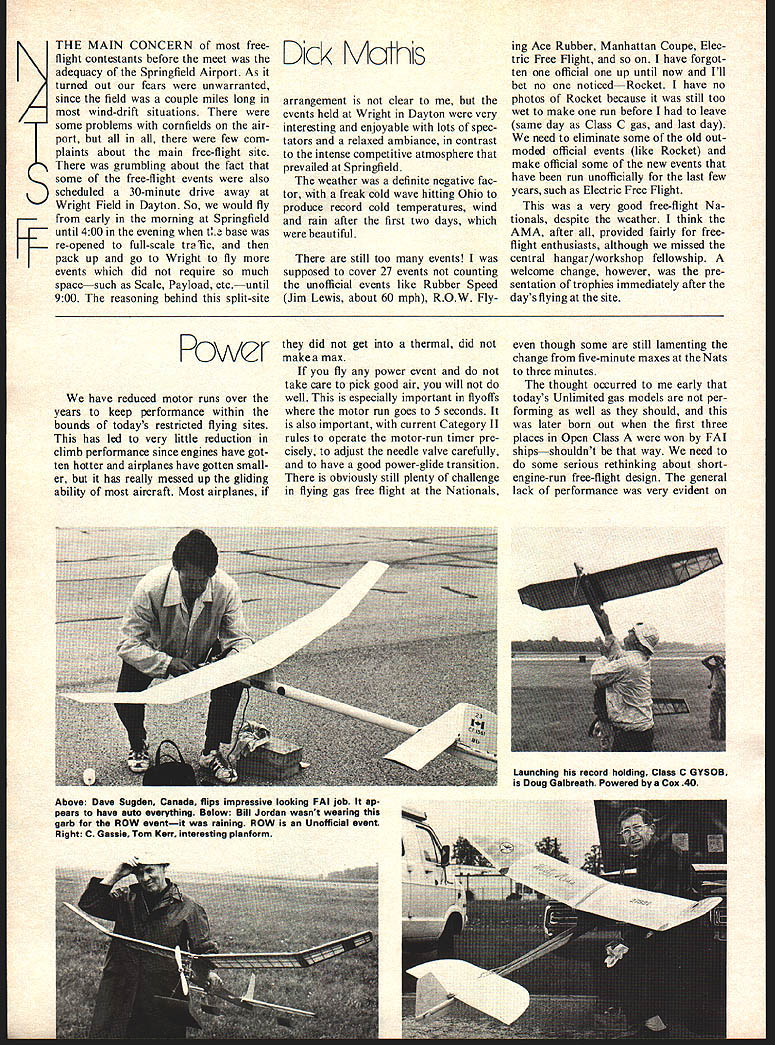
I had to start home before "C" was finished, but I would bet the winner was Californian Doug Galbreath with his Category I record holder GYSOB sporting a Cox .40. It was the class of the field, but you never know at the Nats. The weather for "C" was windy and wet and drift was right at the cornfields, so many fliers just packed up and left, since it was the last day anyway. Class C airplanes are getting smaller and smaller and have generally become capable of mixing with no lift.
FAI Power was an excellent event again this year with a high-class field highlighted by the presence of Olofsson, who was sponsored to the Nats through the efforts of Hardy Broderson, Bill Northrop of Model Builder Magazine, and donations from the hobby industry. Olofsson wound up 4th, dropping a little on his seventh and last flight. In a flyoff at 6:30 the next morning were Doug Galbreath and Gil Graunke, with Graunke narrowly edging out by a few seconds. I think the level of flying in FAI power has definitely improved in the last few years. Most ships were well trimmed and handled. The new Cox .15 is also proving to be a solid device, with Galbreath and quite a few others using them, including Anderson's A-winning FAI.
Finally, the Payload and Cargo events, held at Wright Field in the evening, were a welcome change of pace after the monotony of the regular AMA power events. While original design thought is almost non-existent in the regular Gas classes, originality runs rampant in Cargo. Twin motors, biplanes, canards, exotic landing gears — you name it and someone will be trying to fit it. Especially landing gears! I have to believe everyone who has ever had a landing-gear fetish was flying Cargo. It's a difficult event and it was well attended by both contestants and spectators, who really had a good time watching these underpowered and overloaded creations try to take off the ground. The most interesting was Doug Joyce's twin .010 canard, which placed second. One problem (not in the case of Joyce) I noticed was the lack of attention to tuning the needle valve for peak output and the use of some decidedly worn-out motors. Last year I questioned the validity of Cargo and Payload as national events. It still is questionable whether we need both, but Cargo proved itself at least to me this year as a good, fun event for lots of people. I think one attraction these events have is that it is shared with Old Timer in the ROG rule. Real, honest-to-goodness roll-wheels-on-ground-lift-off takeoffs are still fascinating, especially since we don't even have VTO in the regular gas events.
Transcribed from original scans by AI. Minor OCR errors may remain.

