
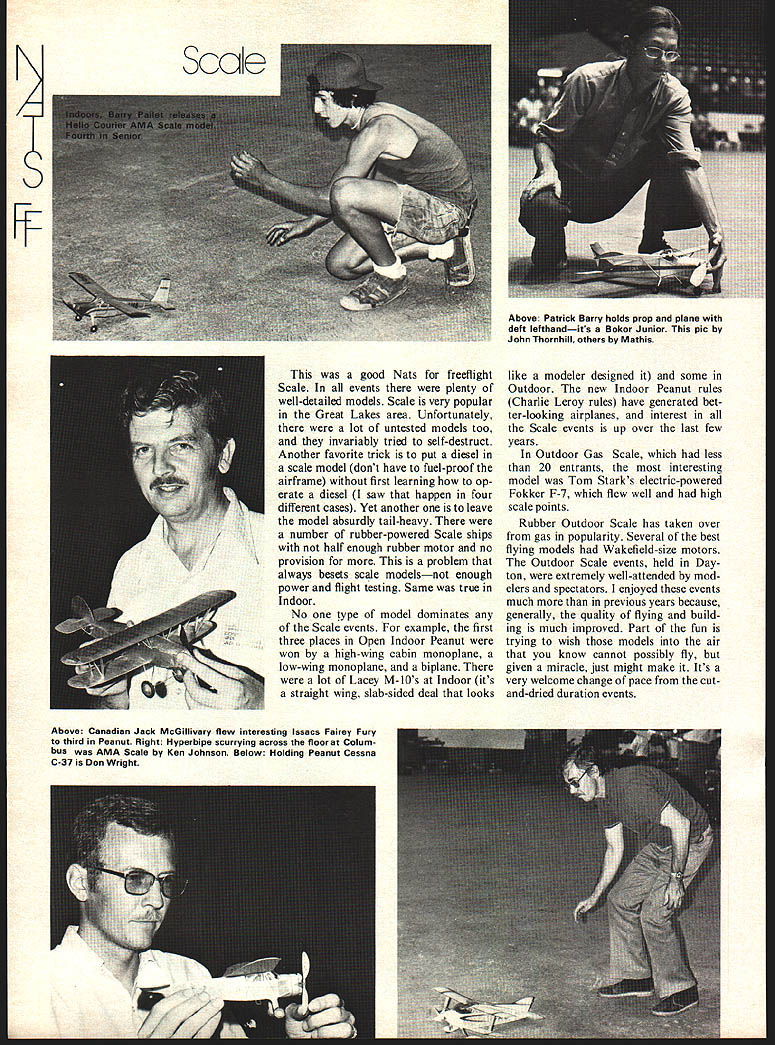
Nats Free Flight: Scale
This was a good Nats for freeflight Scale. In all events there were plenty of well-detailed models. Scale is very popular in the Great Lakes area. Unfortunately, there were a lot of untested models too, and they invariably tried to self-destruct. Another favorite trick is to put a diesel in a scale model (don't have to fuel-proof the airframe) without first learning how to operate a diesel (I saw that happen in four different cases). Yet another one is to leave the model absurdly tail-heavy. There were a number of rubber-powered Scale ships with not half enough rubber motor and no provision for more. This is a problem that always besets scale models—not enough power and flight testing. Same was true in Indoor.
No one type of model dominates any of the Scale events. For example, the first three places in Open Indoor Peanut were won by a high-wing cabin monoplane, a low-wing monoplane, and a biplane. There were a lot of Lacey M-10's at Indoor (it's a straight wing, slab-sided deal that looks like a modeler designed it) and some in Outdoor. The new Indoor Peanut rules (Charlie Leroy rules) have generated better-looking airplanes, and interest in all the Scale events is up over the last few years.
In Outdoor Gas Scale, which had less than 20 entrants, the most interesting model was Tom Stark's electric-powered Fokker F-7, which flew well and had high scale points.
Rubber Outdoor Scale has taken over from gas in popularity. Several of the best flying models had Wakefield-size motors. The Outdoor Scale events, held in Dayton, were extremely well-attended by modelers and spectators. I enjoyed these events much more than in previous years because, generally, the quality of flying and building is much improved. Part of the fun is trying to wish those models into the air that you know cannot possibly fly, but given a miracle, just might make it. It's a very welcome change of pace from the cut-and-dried duration events.
Transcribed from original scans by AI. Minor OCR errors may remain.

