
Nats Overview
John Worth
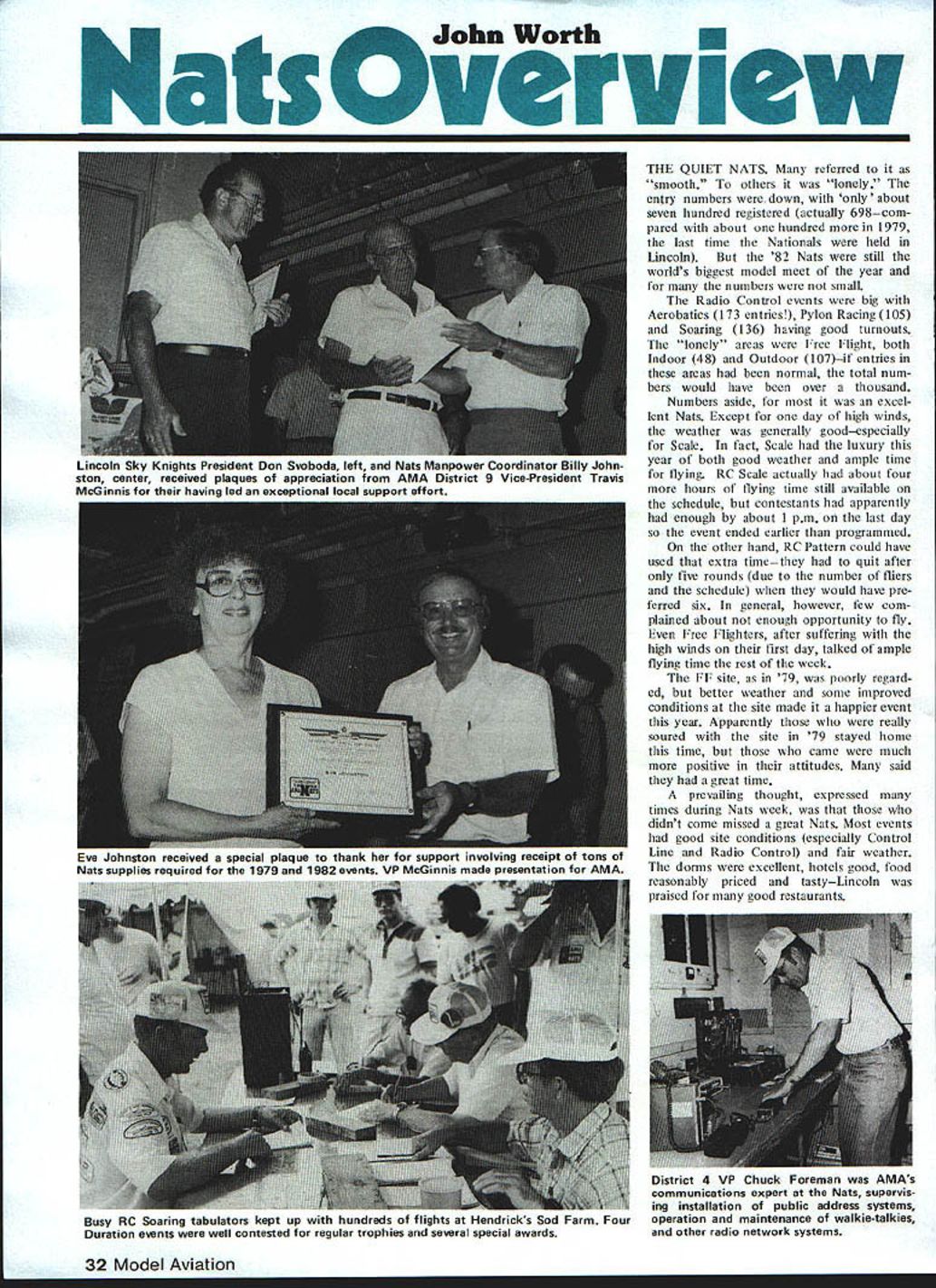
THE QUIET NATS. Many referred to it as "smooth." To others it was "lonely." Entry numbers were down, with "only" about seven hundred registered (actually 698—compared with about one hundred more in 1979, the last time the Nationals were held in Lincoln). But the '82 Nats were still the world's biggest model meet of the year and for many the numbers were not small.
Attendance and event turnout
- Aerobatics (RC): 173 entries
- Pylon Racing (RC): 105 entries
- Soaring (RC): 136 entries
- Free Flight Indoor: 48 entries
- Free Flight Outdoor: 107 entries
The Radio Control events were big. The "lonely" areas were Free Flight; if entries in these areas had been normal, total numbers would have been over a thousand.
Weather, flying time, and sites
Except for one day of high winds, the weather was generally good—especially for Scale. Scale enjoyed both good weather and ample time for flying. RC Scale actually had about four more hours of flying time still available on the schedule, but contestants had apparently had enough by about 1 p.m. on the last day, so the event ended earlier than programmed.
RC Pattern could have used that extra time—they had to quit after only five rounds (due to the number of fliers and the schedule) when they would have preferred six. In general, however, few complained about not having enough opportunity to fly. Even Free Flighters, after suffering high winds on their first day, reported ample flying time for the rest of the week.
The Free Flight site, as in '79, had been poorly regarded, but better weather and some improved conditions made it a happier event this year. Apparently those who were really soured with the site in '79 stayed home this time, and those who came were much more positive in their attitudes. Many said they had a great time.
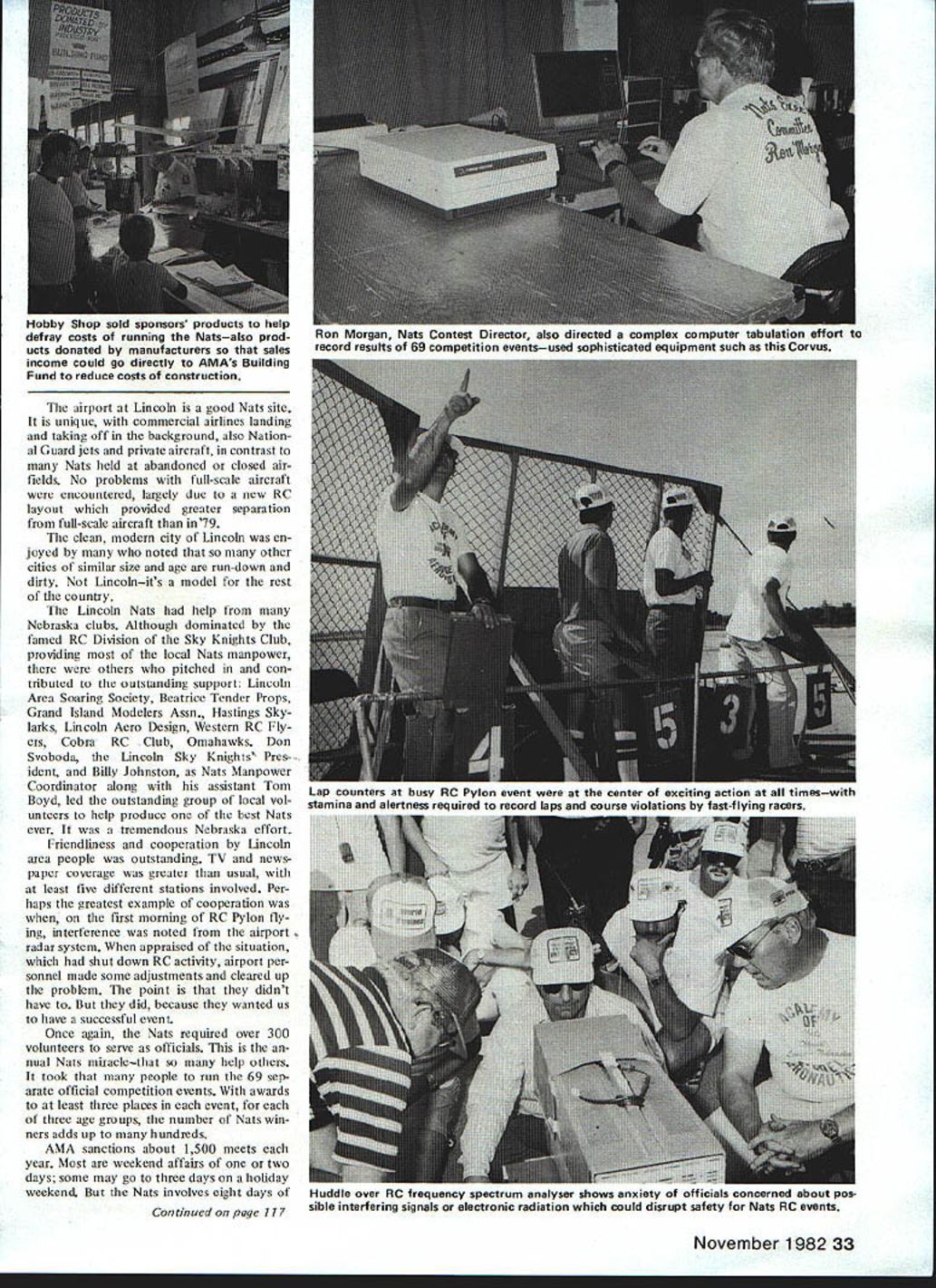
The airport at Lincoln is a good Nats site. It is unique, with commercial airlines, National Guard jets, and private aircraft operating in the background—unlike many Nats held at abandoned or closed airfields. No problems with full-scale aircraft were encountered, largely due to a new RC layout which provided greater separation from full-scale aircraft than in '79.
A notable example of cooperation came the first morning of RC Pylon flying when interference was noted with the airport radar system. Airport personnel appraised the situation, shut down the radar, made some adjustments, and cleared up the problem. They didn't have to do this, but they did because they wanted the event to succeed.
Lincoln and local support
The clean, modern city of Lincoln was enjoyed by many; attendees noted that so many other cities of similar size are run-down and dirty—Lincoln was praised as a model for the rest of the country. The dorms were excellent, hotels good, and food reasonably priced and tasty. Lincoln received outstanding TV and newspaper coverage, with at least five different stations involved.
Many Nebraska clubs helped produce the Nats. Although the event was dominated by the famed RC Division of the Sky Knights Club, others pitched in:
- Lincoln Area Soaring Society
- Beatrice Tender Props
- Grand Island Modelers Assn.
- Hastings Skylarks
- Lincoln Aero Design
- Western RC Flyers
- Cobra RC Club
- Omahawks
Don Svoboda, the Lincoln Sky Knights' president, and Billy Johnston, Nats Manpower Coordinator, along with his assistant Tom Boyd, led the outstanding group of local volunteers. It was a tremendous Nebraska effort.
Volunteers, officials, and administration
Once again the Nats required over 300 volunteers to serve as officials. The annual Nats miracle—the help of others—took people to run 69 separate official competition events, with awards for at least three places in three age groups. The number of Nats winners adds up to hundreds.
AMA sanctions about 1,500 meets a year. Most weekend affairs are two days; some may go three days on a holiday weekend. The Nats involves eight days of competition with some events (such as RC Pattern) running for five consecutive days. Not even World Championships involve as much as a Nats—in number of people, days, or hours.
Consider typical hours: Nats competition can begin at 7 a.m. (RC Pylon) and go on until 8 p.m., or longer (RC Pattern). Indoor flying often goes from 9 a.m. to 9 p.m. The total schedule is incredible. It takes a separate crew for each RC event and for each of the five basic Control Line groups: Racing, Speed, Aerobatics, Combat, Carrier. Scale and Free Flight each have their own teams as well.
Behind the scenes there are administrative workers handling many tasks:
- Registration and communications
- Scoring and public relations
- Souvenir and hobby shop sales, and the daily Nats News
- Signs, security, manpower, and accounting
- Lodging coordination and food concessions
- Toilet servicing, trash pickup, and transportation
- Legal and insurance affairs
- Equipment maintenance, repairs, and supplies
Dozens of those who work at the Nats don't get to see much of the competition. They are holed up in offices, booths, tents, or trailers during the week and often find out what happened by reading later reports.
Judges and recognition
Judging is a difficult, thankless task. It involves sitting day after day, looking for minor differences from one flight to the next while roasting in heat and being rubbed raw by wind. Judges are often criticized for being too hard or too easy. The most amazing judges are those who, after doing five days of RC Pattern, do two more days of RC Scale. All judges deserve more credit than they get—they are a special breed and are insufficiently thanked and inadequately honored. We need to appreciate them more.
The human side and conclusion
The stories of individual heroes who made this Nats memorable would fill a book. Men, women, and kids of all ages and backgrounds took part, and many take them for granted. The Nats, besides being the World's Biggest Model Meet, is a fantastic human experience of people gathering together in an annual contribution to model aviation history.
Those who skip a Nats because they dislike the site, the rules, or the part of the country are missing the most important ingredient—the people, friendships, sharing, and being part of it all. To many, the flying is merely an excuse for participating; in fact, almost as many don't fly as do.
That's the magic of a Nats. In 1982 the locale was Lincoln, Nebraska. If you weren't there, you missed a great one. Over a thousand people (contestants and officials) were there; it's now part of history. Next year there will be another—somewhere—and no matter where, it will be worth going to. It always is.
It has been so for 56 years. Next year will be the 57th Nats. Don't miss it! But also, don't expect it to be perfect. It won't be. But it will be what it has always been—a modeling experience we will talk about for years while rubbing shoulders with the great ones, the modeling legends of our time. The Nats is special, it's different, it's a happening. You really have to be there to understand. Plan now to be there in 1983.
Transcribed from original scans by AI. Minor OCR errors may remain.

