
Nats Radio Control: Scale
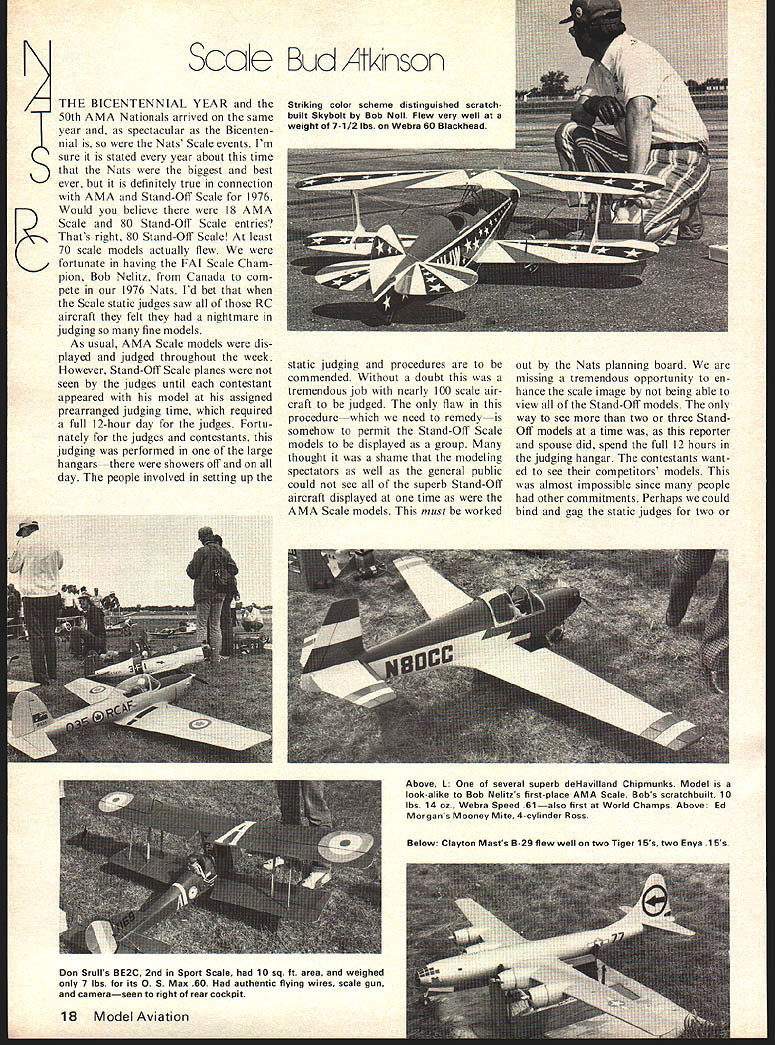
THE BICENTENNIAL YEAR and the 50th AMA Nationals arrived on the same year and, as spectacular as the Bicentennial is, so were the Nats' Scale events. I'm sure it is stated every year about this time that the Nats were the biggest and best ever, but it is definitely true in connection with AMA and Stand-Off Scale for 1976. Would you believe there were 18 AMA Scale and 80 Stand-Off Scale entries? That's right, 80 Stand-Off Scale! At least 70 scale models actually flew. We were fortunate in having the FAI Scale Champion, Bob Nelitz, from Canada, compete in our 1976 Nats. I'd bet that when the Scale static judges saw all of those RC aircraft they felt they had a nightmare in judging so many fine models.
As usual, AMA Scale models were displayed and judged throughout the week. However, Stand-Off Scale planes were not seen by the judges until each contestant appeared with his model at his assigned prearranged judging time, which required a full 12-hour day for the judges. Fortunately for the judges and contestants, this judging was performed in one of the large hangars; there were showers off and on all day. The people involved in setting up the static judging and procedures are to be commended. Without a doubt this was a tremendous job with nearly 100 scale aircraft to be judged. The only flaw in this procedure — which we need to remedy — is somehow to permit the Stand-Off Scale models to be displayed as a group. Many thought it was a shame that the modeling spectators as well as the general public could not see all of the superb Stand-Off aircraft displayed at one time as were the AMA Scale models. This must be worked out by the Nats planning board. We are missing a tremendous opportunity to enhance the scale image by not being able to view all of the Stand-Off models. The only way to see more than two or three Stand-Off models at a time was, as this reporter and spouse did, spend the full 12 hours in the judging hangar. The contestants wanted to see their competitors' models. This was almost impossible since many people had other commitments.
Perhaps we could bind and gag the static judges for two or three days — better yet, honor‑bound them to view the Stand-Off Scale models until time for static judging. Friday night, glued to the local TV forecast, things looked rather dismal for Scale and other events the next day. The weatherman assured us we would have clearing weather the next afternoon. Saturday dawned cold, wet and windy — ducks out. By about four o'clock Saturday afternoon it started to clear, although the wind across the runway subsided to flyable conditions.
Flying ran three flight stations 600 yards apart. Humidity, of course, was high and took its toll on engine adjustments. As late afternoon passed, the first round on three flight lines was completed and fliers set to start the second round, flying under partially overcast skies and in good flying conditions. Now suddenly flying was postponed until Sunday morning.
As luck would have it, Sunday morning broke very cool and damp with brilliant sunlight promising an excellent day — almost a perfect day — for scale flying. There was a very light breeze throughout the entire morning and a brilliant, cloudless sky. We toiled over hot RC scale models; the year seemed right and the gods finally smiled on us. Flight lines and frequency control were set up and well executed. There were few hitches heard. No one dragged their feet; when called three ready boxes were set and there was no delay in turns or missed rounds. Keep in mind the number of aircraft flown, the flying sites and the flight-line personnel — they handled dispatch with professionalism. One can imagine the job was a problem, of course, getting to see excellent models flying. three days or, better yet, honor-bound them not to view the displayed Stand-Off Scale models until the time of static judging.
Friday night (while glued to the local TV forecast) things looked rather dismal for Scale, or any other event the next day. The weatherman assured us we would have clearing weather the next afternoon. Saturday dawned cold, wet and windy. Not even the ducks were out! (This couldn't be August). But, as predicted, by four o'clock Saturday afternoon it started to clear and the wind, although across the runway, subsided to flyable conditions. Flying be- gan on three flight stations 600 yards apart. Humidity, of course, was high and took its toll of engine adjustments. As the late afternoon passed one complete round on all three flight lines was achieved.
All fliers were set to start the second round of flying under partially overcast skies, but with good flying conditions by now, when, suddenly, flying was postponed until Sunday morning. As luck would have it, Sunday morning broke very cool and damp, but with brilliant sunlight and a promise of an excellent day. It was almost a perfect day for scale flying with a very light breeze throughout the entire morn- ing, with brilliant sunlight and not a cloud in the sky. For those of us who had toiled over a "hot" RC scale model all year, it seemed as if the gods had finally smiled on us.
Flight lines and frequency control were set up and well executed with few hitches that I heard of. There was no room for those who dragged their feet. When you were called for the three ready boxes you had to be set with no delay, or your turn was missed for that round. Keep in mind the number of aircraft to be flown at each of the flying sites. The flight-line per- sonnel handled this with dispatch and pro- fessionalism. Can you imagine the job this was? It was a problem, of course, getting to see so many excellent models flying on the flight lines which extended three-quarters of a mile up and down the runway.
I have attended RC Scale events at Nationals for 25 years or so and have yet to experience a more efficiently run flight line. Most contestants cooperated to the fullest, making it possible to operate a smooth flight line. The flying had to be of the finest quality of any scale event for this large number of airplanes. Credit should be given to the modelers and to the many RC manufacturers, because there were few aircraft losses for the number of entries — the best in this respect to date.
Of course, there were the usual minor gripes and complaints common in all competition, be it at the Olympics, the National Scale Championship, or just a local club contest. Some possibly were justified. Most were not! We have all heard it said, "How come Joe Blow got more static points than I did with that dog he built?" One judge gave me a 3 and one judge gave me an 8 for a landing. This human element we always will have to contend with. Improvement can even take place here. In most opinions in 1976, our AMA Scale and Stand-Off Scale rules need many adjustments. In many cases, more explicit definitions are needed. Loop-holes need to be closed. This was probably the most widely discussed subject wherever scale fliers congregated.
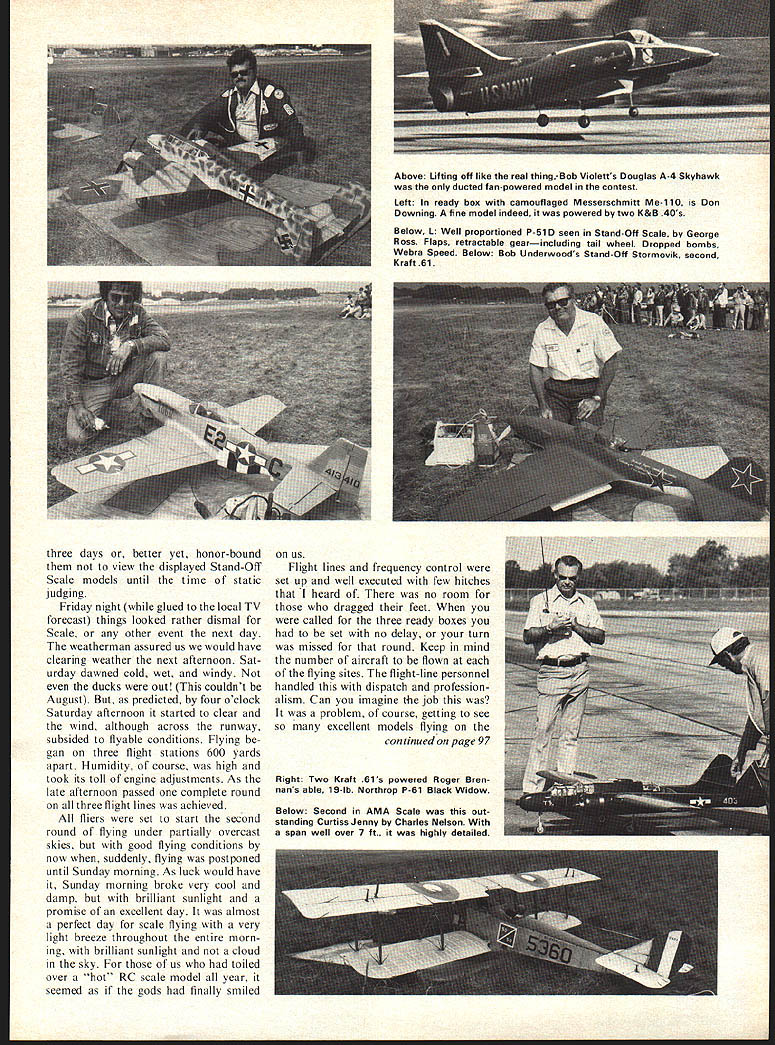
One of the many highlights of this year's Scale Nationals was the many multi-engine Stand-Off models. Several were right up there in the winning circle. One very interesting and beautifully done model was Bob Violett's ducted-fan F-4 done in the Navy's Blue Angel color scheme. It was the only ducted-fan entry this year. As commentator Dave Platt aptly put it, "Folks, you're looking at the type of scale model of the future, using ducted-fan propulsion." On the other end of the scale were some outstandingly well constructed vintage aircraft built from wire, wood and fabric. The weather was excellent for these slow, droning ancestors of the F-4.
World War II probably was the most popular era for a great many Stand-Off scale builders.
In AMA Scale the majority of entries were well-known models from past Nationals. It is amazing how many of these AMA Scale models survive so well from year to year. In the past the Scale event commentary usually described some 20 to 25 subjects. With nearly 100 entries this year an entire magazine would be required to talk about the many fine RC Scale models.
Transcribed from original scans by AI. Minor OCR errors may remain.

