
Nats Radio Control: Soaring
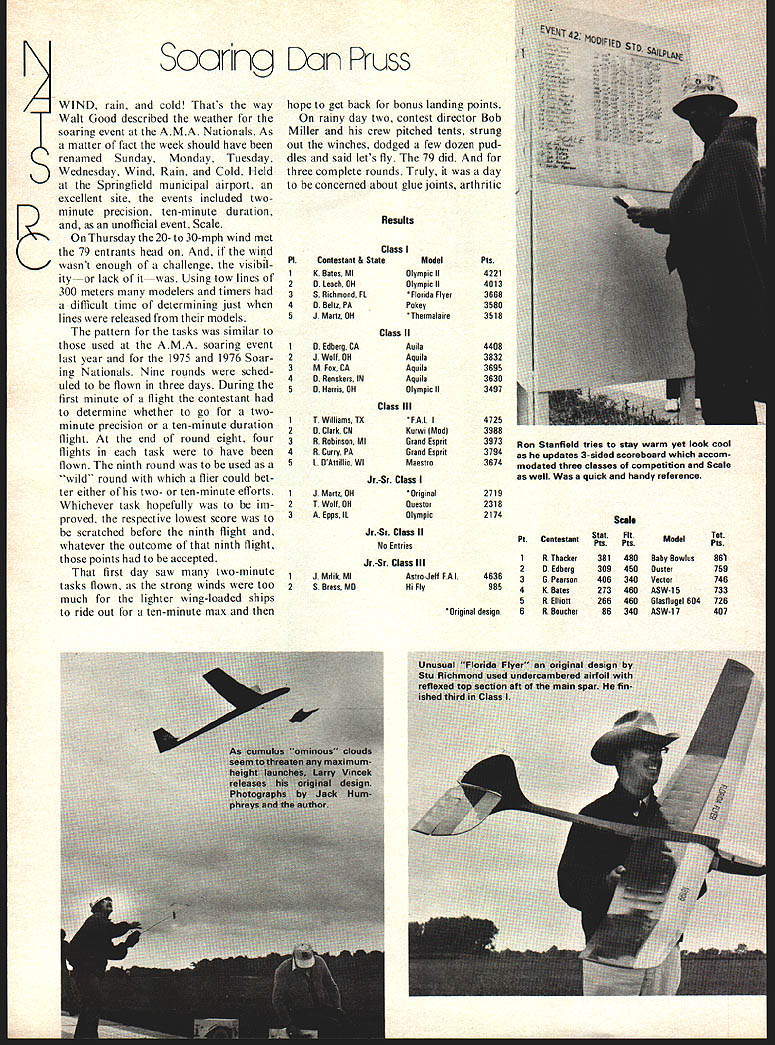
WIND, rain, and cold! That's the way Walt Good described the weather for the soaring event at the A.M.A. Nationals. As a matter of fact the week should have been renamed Sunday, Monday, Tuesday, Wednesday, Wind, Rain, and Cold. Held at the Springfield municipal airport, an excellent site, the events included two-minute precision, ten-minute duration, and, as an unofficial event, Scale.
On Thursday the 20- to 30-mph wind met the 79 entrants head on. And, if the wind wasn't enough of a challenge, the visibility—or lack of it—was. Using two lines of 300 meters many modelers and timers had a difficult time determining just when lines were released from their models.
The pattern for the tasks was similar to those used at the A.M.A. soaring event last year and for the 1975 and 1976 Soaring Nationals. Nine rounds were scheduled to be flown in three days. During the first minute of a flight the contestant had to determine whether to go for a two-minute precision or a ten-minute duration flight. At the end of round eight, four flights in each task were to have been flown. The ninth round was to be used as a "wild" round with which a flier could better either of his two- or ten-minute efforts. Whichever task hopefully was to be improved, the respective lowest score was to be scratched before the ninth flight and, whatever the outcome of that ninth flight, those points had to be accepted.
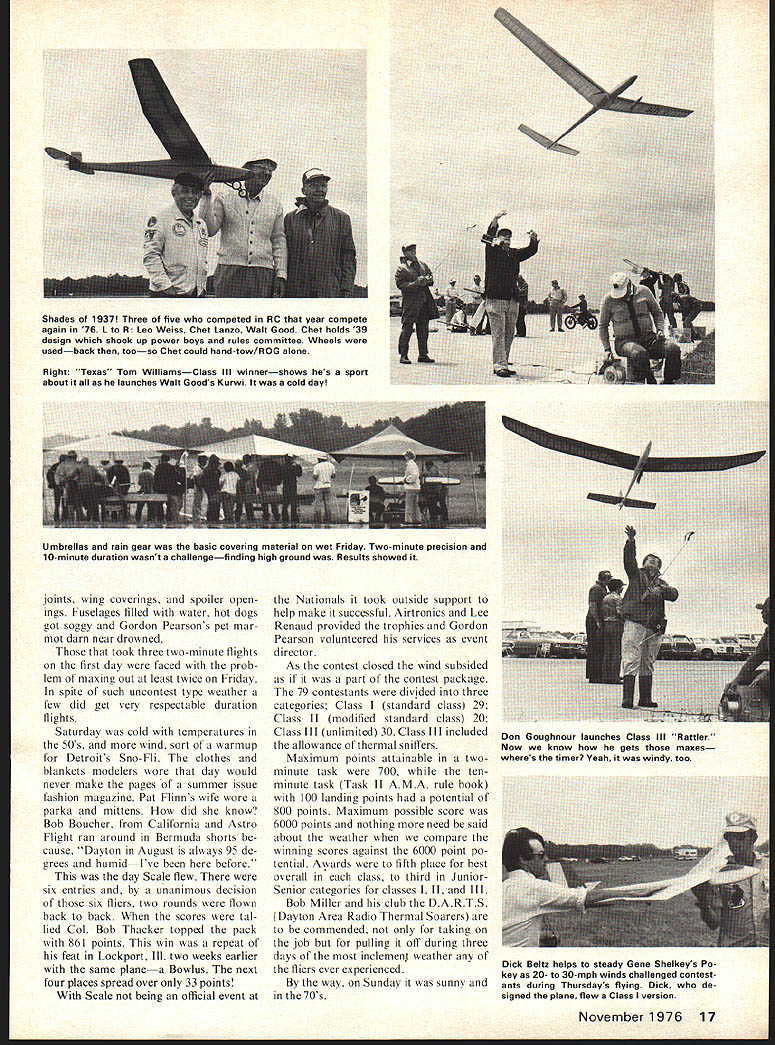
That first day saw many two-minute tasks flown, as the strong winds were too much for the lighter wing-loaded ships to ride out for a ten-minute max and then hope to get back for bonus landing points. On rainy day two, contest director Bob Miller and his crew pitched tents, strung out the winches, dodged a few dozen puddles and said let's fly. The 79 did. And for three complete rounds. Truly, it was a day to be concerned about glue joints, arthritic hands and sore fingers.
Joints, wing coverings, spoiler openings — fuselages filled with water; hot dogs got soggy. Gordon Pearson's pet marmot darn near drowned. Many took three two-minute flights the first day, maxing out at least twice Friday. In spite of such uncontest-type weather a few did get very respectable duration flights.
Saturday, cold temperatures in the 50s and wind made for a sort of warmup. Detroit's Sno-Fli clothes and blankets the modelers wore that day would never make the pages of a summer-issue fashion magazine. Pat Flinn's wife wore a parka and mittens. Boh Boucher of California's Astro Flight, however, ran around in Bermuda shorts — "cause Dayton in August always is 95 degrees and humid," he'd been told.
Scale flew six entries; by unanimous decision six fliers had two rounds flown, back scores tallied. Col. Bob Thacker topped the pack with 861 points, a repeat of a win at Lockport, Ill., two weeks earlier with the same plane. Bowlus next four places were spread over 33 points.
Scale, being an official event at the Nationals, took outside support to help make it successful. Airtronics' Lee Renaud provided trophies and Gordon Pearson volunteered services as event director.
As the contest closed and the wind subsided, part of the contest package was evident: 79 contestants divided into three categories — Class I, standard class, 29; Class II, modified standard class, 20; Class III, unlimited, 30. Class III included allowance for thermal sniffers.
Maximum points attainable: two-minute task, 700; ten-minute task, 1000; Task II (AMA rule book), 100 landing points potential, 800 points. Maximum possible score, 6000 points. Nothing need be said about the weather — compare winning scores against the 6000-point potential.
Awards included fifth place, best overall, class and third in Junior-Senior categories in classes II and III. Bob Miller and his club the D.A.R.T.S. (Dayton Area Radio Thermal Soarers) are to be commended, not only for running the contest, but for putting it on during three of the most inclement weather days the fliers ever experienced.
By the way, on Sunday it was sunny and in the 70's.
Transcribed from original scans by AI. Minor OCR errors may remain.

