
Nats RC: Aerobatics
LIKE a well oiled machine, that's how the Pattern event went at the California '77 Nationals. The theme of this year's Nats could well have been PRIDE, which we noticed printed in great big block letters on the Headquarters hangar as we drove in.
Our first surprise was at check in. No lines all afternoon. From the beginning it was obvious that all those involved had only one goal, to make this a good Nats.
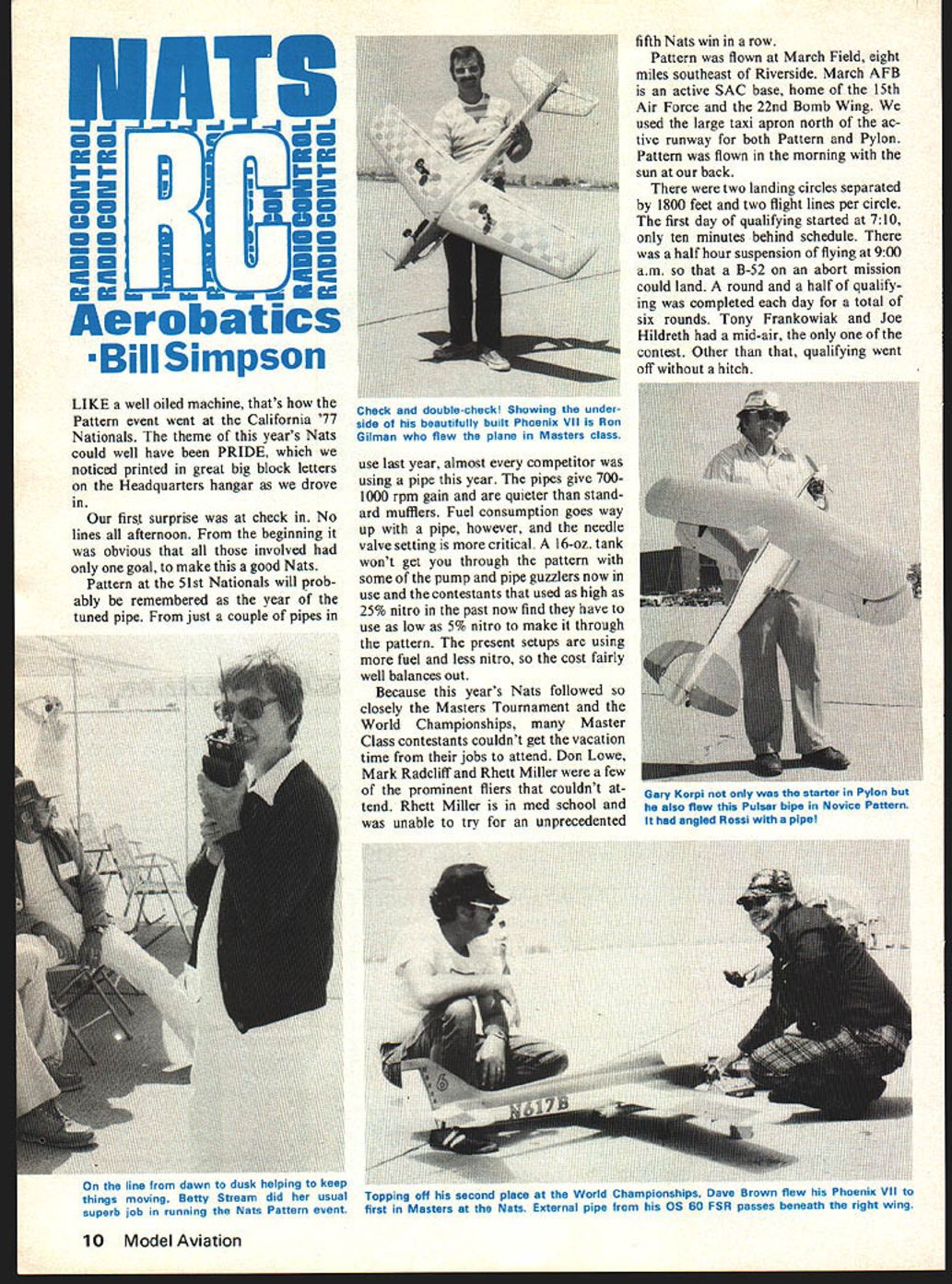
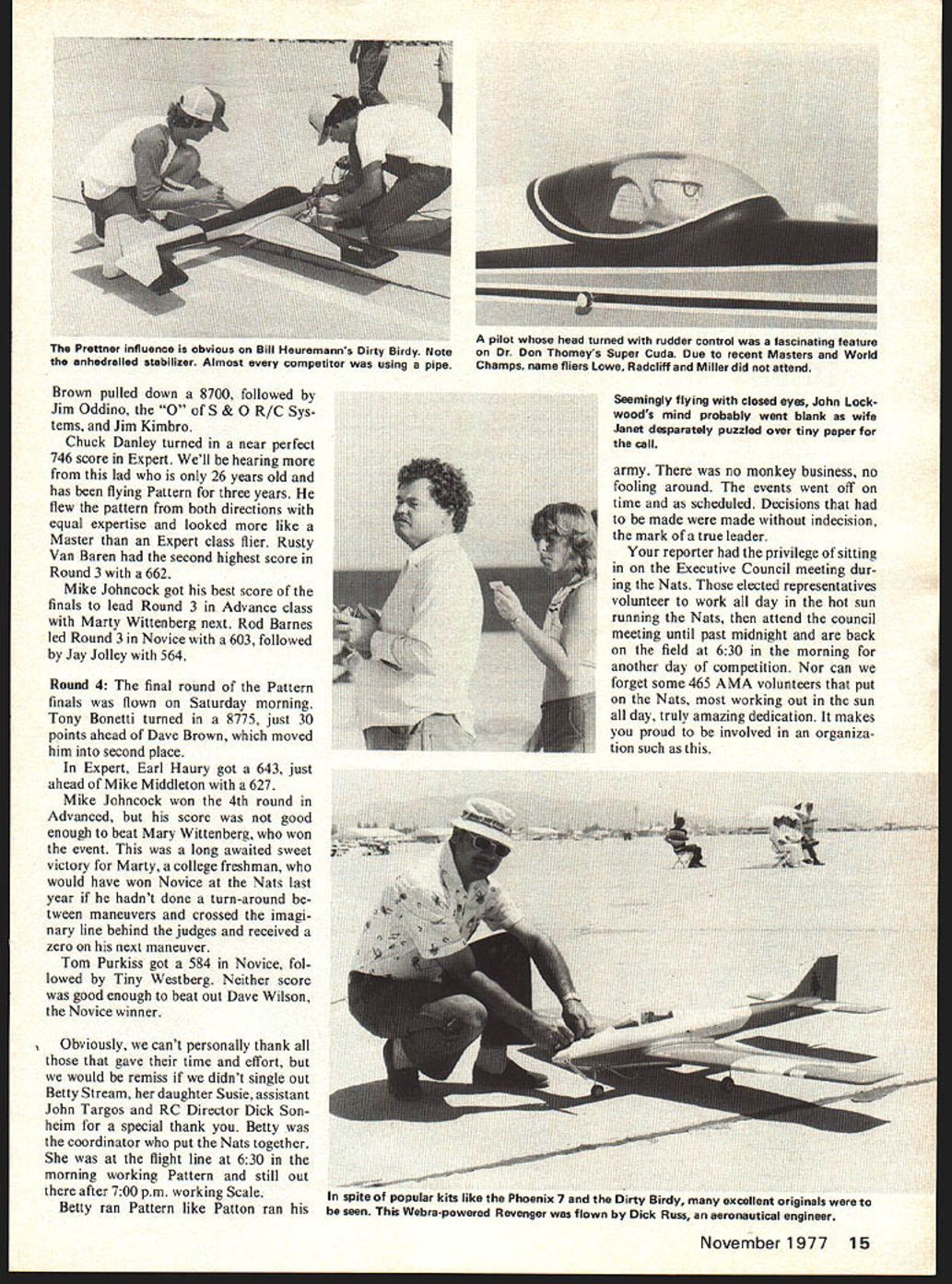
Pattern at the 51st Nationals will probably be remembered as the year of the tuned pipe. From just a couple of pipes in use last year, almost every competitor was using a pipe this year. The pipes give 700-1000 rpm gain and are quieter than standard mufflers. Fuel consumption goes way up with a pipe, however, and the needle valve setting is more critical. A 16-oz. tank won't get you through the pattern with some of the pump and pipe guzzlers now in use and the contestants that used as high as 25% nitro in the past now find they have to use as low as 5% nitro to make it through the pattern. The present setups are using more fuel and less nitro, so the cost fairly well balances out.
Because this year's Nats followed so closely the Masters Tournament and the World Championships, many Master Class contestants couldn't get the vacation time from their jobs to attend. Don Lowe, Mark Radcliff and Rhett Miller were a few of the prominent fliers that couldn't attend. Rhett Miller is in med school and was unable to try for an unprecedented fifth Nats win in a row.
Pattern was flown at March Field, eight miles southeast of Riverside. March AFB is an active SAC base, home of the 15th Air Force and the 22nd Bomb Wing. We used the large taxi apron north of the active runway for both Pattern and Pylon. Pattern was flown in the morning with the sun at our back.
There were two landing circles separated by 1800 feet and two flight lines per circle. The first day of qualifying started at 7:10, only ten minutes behind schedule. There was a half hour suspension of flying at 9:00 a.m. so that a B-52 on an abort mission could land. A round and a half of qualifying was completed each day for a total of six rounds. Tony Frankowiak and Joe Hildreth had a mid-air, the only one of the contest. Other than that, qualifying went off without a hitch. Weather was the same for the entire contest, typical for the Riverside area for this time of year—hot and dry with cloudless skies. The average total monthly rainfall for the month of August in Riverside is less than a tenth of an inch. There was practically zero wind during Pattern hours for the entire contest. The last Nats that had no rain was exactly ten years ago at Los Alamitos, Calif.
Scores were totalled and posted unofficially at the flight lines almost immediately after the contestant completed his flight. One copy of the score was given to the contestant and the other copy sent down to the official tabulation trailer for a second and official tally.
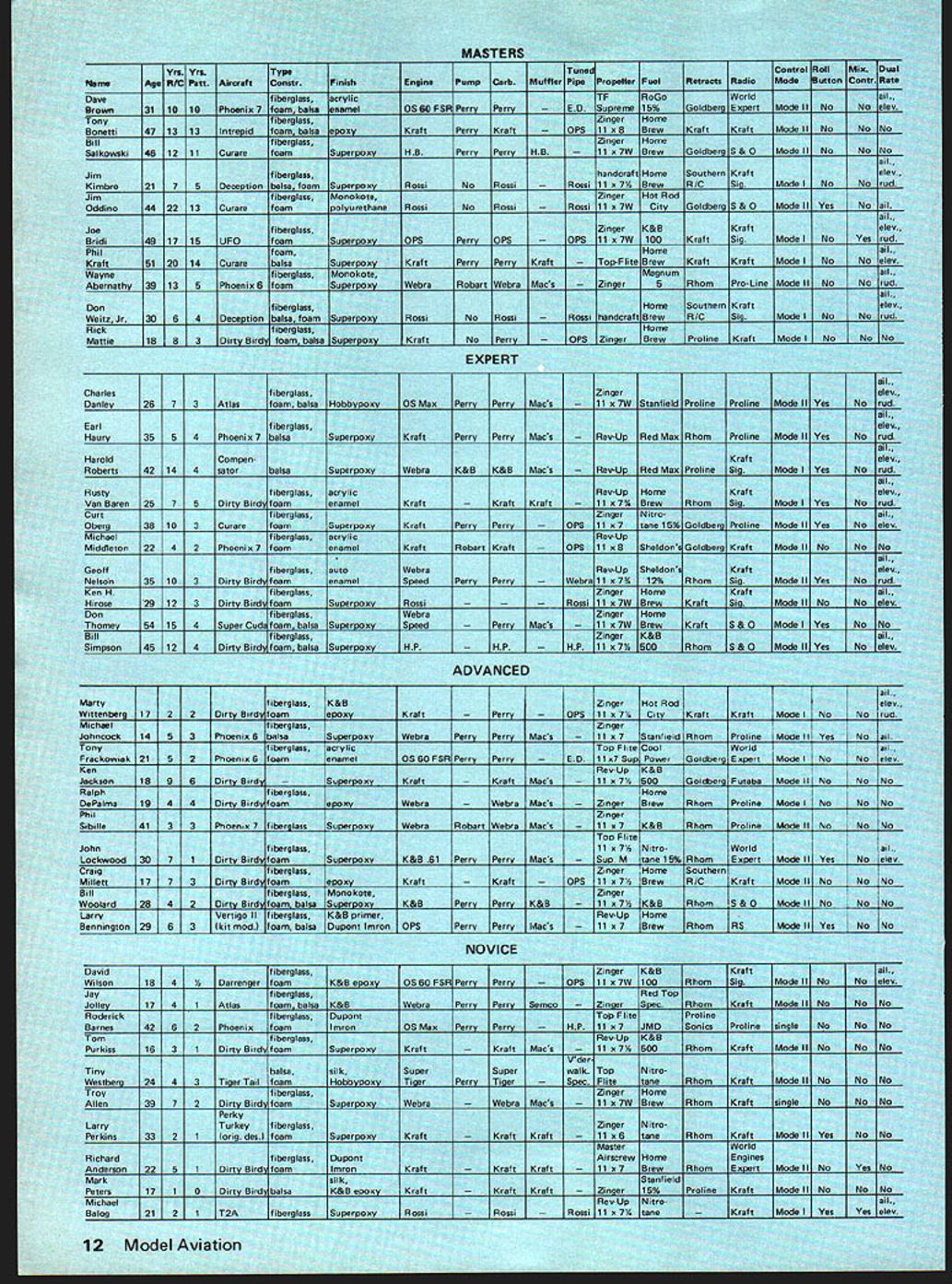
MASTERS
Name Age Yrs. R/C Yrs. Pattern Aircraft Type/Constr. Finish Engine Pump Carb. Muffler Tuned Pipe Propeller Fuel Retracts Radio Control Mode Roll Button Mix Dual Rate
Dave Brown 31 10 10 Phoenix 7 fiberglass, foam, balsa acrylic OS 60 FSR Perry Perry — E.D. TF Supreme Ro-Go 15% Goldberg World Expert Mode II No No
Tony Bonetti 47 13 13 Intrepid fiberglass, foam, balsa epoxy Kraft Perry Perry — OPS Zinger 11 x 7 Home Brew Kraft Mode II No No
Bill Salkowski 46 12 11 Curare foam Superpoxy H.B. Perry Perry H.B. Perry 11 x 7W Brew Goldberg S & O Mode II No No
Jim Kimbro 21 7 5 Deception fiberglass, balsa, foam Superpoxy Rossi No Rossi Rossi handcraft 11 x 7 Home Brew Hot Rod R/C Kraft Sig. Mode I No No
Jim Oddino 44 22 13 Curare fiberglass, foam Monokote, polyurethane Rossi No Rossi Rossi Zinger 11 x 7W Hot Rod City Goldberg S & O Mode II Yes No
Joe Bridi 49 17 15 UFO fiberglass, foam, balsa Superpoxy OPS Perry OPS OPS K & B 11 x 7W 100 Kraft Mode I No Yes
Phil Kraft 51 20 14 Curare foam Superpoxy Kraft Perry Perry Kraft Top-Flite Brew Magnum 11 x 7 Kraft Sig. Mode I No No
Wayne Abernathy 39 13 5 Phoenix 6 fiberglass, foam Monokote, Superpoxy Webra Robert Webra Mac's Zinger 5 Pro-Line Mode II No No
Don Weitz, Jr. 30 6 4 Deception fiberglass, balsa, foam Superpoxy Rossi No Rossi Rossi handcraft Home Brew Southern R/C Kraft Mode I No No
Rick Mattie 18 8 3 Dirty Bird fiberglass, foam, balsa Superpoxy Kraft No Perry — OPS Zinger Home Brew Proline Kraft Mode I No No
EXPERT
Charles Danley 26 7 3 Atlas fiberglass, foam, balsa Hobbyepoxy OS Max Perry Perry — Mac's Zinger 11 x 7W Stanfield Proline Mode II Yes No
Earl Haury 35 5 4 Phoenix 7 fiberglass, balsa Superpoxy Kraft Perry Perry — Mac's Rev-Up Red Max Proline Mode II Yes No
Harold Roberts 42 14 4 Compensator balsa Superpoxy Webra K & B K & B — Mac's Rev-Up Red Max Proline Kraft Sig. Mode I Yes No
Rusty Van Buren 25 7 5 Dirty Bird fiberglass, enamel acrylic Kraft — Kraft Kraft — Rev-Up Home Brew 11 x 7.5 Rhom Nitro Proline Mode I Yes No
Curt Oberg 38 10 2 Curare fiberglass Superpoxy Kraft Perry Perry OPS Zinger 11 x 7 Nitro-tone 15% Golden Proline Mode II Yes No
Michael Middleton 22 4 2 Phoenix 7 fiberglass, foam acrylic/enamel Kraft Robert Kraft OPS Rev-Up 11 x 8 Sheldon’s Goldberg Kraft Mode II No No
Geoff Nelson 35 10 3 Dirty Bird fiberglass, foam auto enamel Webra Speed Perry Perry — Webra Rev-Up 11 x 7.5 Sheldon’s 12% Rhom Kraft Sig. Mode II Yes No
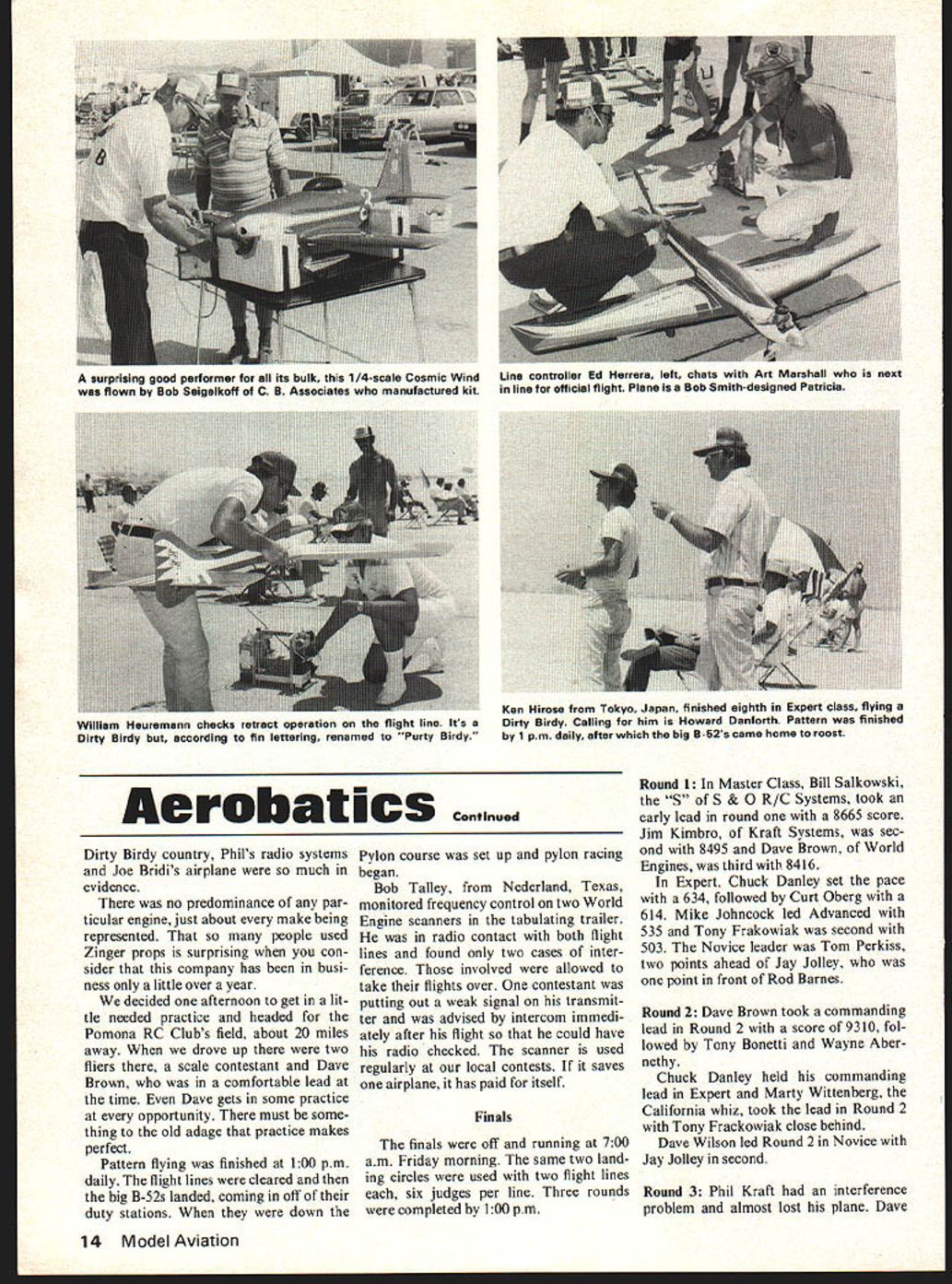
Ken H. Hirose 29 12 3 Dirty Bird fiberglass, foam Superpoxy Rossi — Rossi — Zinger 11 x 7W Home Brew Kraft Mode II No No
Don Thomey 54 15 4 Super Cub fiberglass, foam, balsa Superpoxy Speed Perry Perry — Mac's Zinger 11 x 7W Brew Kraft S & O Mode I Yes No
Bill Simpson 45 12 4 Dirty Bird fiberglass, foam, balsa Superpoxy H.P. — H.P. — H.P. 11 x 7.5 500 Rhom S & O Mode II Yes No
ADVANCED
Marty Wittenberg 17 2 2 Dirty Bird fiberglass, foam K & B epoxy Kraft Perry Perry — OPS Zinger 11 x 7 Hot Rod City Kraft Mode I No No
Michael Johncock 14 5 3 Phoenix 6 fiberglass, balsa Superpoxy Webra Perry Perry Mac's Zinger 11 x 7 Stanfield Proline Mode II Yes No
Tony Frackowiak 21 9 6 Phoenix 6 fiberglass, foam acrylic/enamel OS 60 FSR Perry Perry — E.D. 11 x 7 Sup. Power Goldberg World Expert Mode I No No
Ken Jackson 18 9 6 Dirty Bird fiberglass Superpoxy Kraft — Kraft — Rev-Up 11 x 7.5 500 Goldberg Futaba Mode II No No
Ralph DePalma 19 4 4 Dirty Bird fiberglass, foam Superpoxy Webra Robert Webra Mac's Zinger 11 x 7 Home Brew Rhom Proline Mode II No No
Phil Sibile 41 3 3 Phoenix 7 fiberglass Superpoxy Webra Robert Webra Mac's Top Flite 11 x 7.5 K & B Rhom Proline Mode II No No
John Lockwood 30 7 1 Dirty Bird fiberglass, foam Superpoxy K & B 61 Perry Perry Mac's Top Flite 11 x 7.5 Nitro-mate 15% Rhom Expert Mode II Yes No
Craig Millett 17 3 2 Dirty Bird fiberglass, foam epoxy Kraft — Kraft OPS Zinger 11 x 7 Brew S & O Mode II No No
Bill Woodard 28 4 2 Dirty Bird fiberglass, foam, balsa Monokote, Superpoxy K & B Perry Perry K & B Zinger 11 x 7 K & B Rhom S & O Mode II Yes No
Larry Bennington 29 6 3 Vertigo II (kit mod.) fiberglass, foam, balsa K & B primer, Dupont Imron OPS Perry Perry Mac's Rev-Up 11 x 7 Brew Rhom RS Mode II Yes No
NOVICE
David Wilson 18 4 ½ Darreneger fiberglass, foam K & B epoxy OS 60 FSR Perry Perry — OPS Zinger 11 x 7W 100 Rhom Kraft Sig. Mode II No No
Jay Jolley 17 4 2 Atlas fiberglass, balsa K & B Webra Perry Perry Semco Top Flite 11 x 7 JMD Proline Mode II No No
Roderick Barnes 42 6 2 Phoenix 7 fiberglass, foam Dupont Imron OS Max Perry Perry — JMD 11 x 7 Proline Single No No
Tom Purkiss 16 3 1 Dirty Bird fiberglass, foam Superpoxy Kraft — Kraft Mac's Rev-Up 11 x 7 600 Rhom Kraft Mode II No No
Tiny Westberg 24 4 3 Tiger Tail balsa, foam Hobbyepoxy Super Tiger Perry Perry Super Top Flite Nitro-type Rhom Kraft Mode II No No
Troy Allen 39 7 2 Dirty Bird/Perky Turkey fiberglass, foam Superpoxy Kraft — Kraft Zinger 11 x 6 Home Brew Kraft Mode II No No
Larry Perkins 33 2 1 Dirty Bird fiberglass, foam Superpoxy Kraft — Kraft Zinger 11 x 6 Nitro-mate Rhom Kraft Mode II Yes No
Richard Anderson 22 5 1 Dirty Bird fiberglass, foam Dupont Imron Kraft — Kraft — Zinger 11 x 7 Home Brew R/S Mode II No No
Mark Peters 17 1 0 Dirty Bird fiberglass, balsa K & B epoxy Kraft — Kraft — Rev-Up 11 x 7 Proline Kraft Mode II No No
Michael Balog 21 2 1 T2A fiberglass Superpoxy Rossi — Rossi — Rossi 11 x 7.5 — Kraft Mode II Yes No
Aerobatics Continued
immediately how well they fared in relation to the other contestants. The scores were checked by four different tabulators to eliminate any possibility of error.
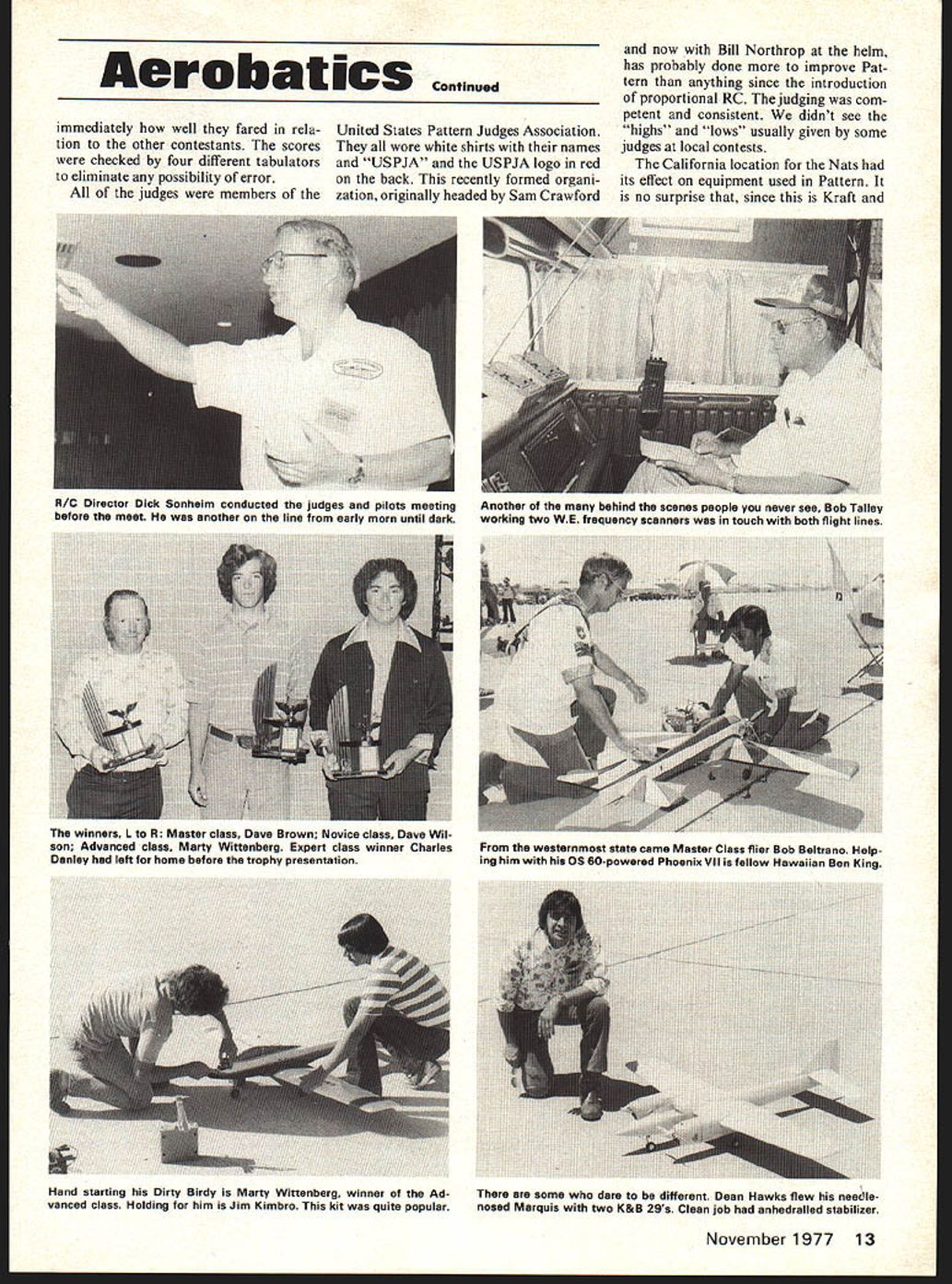
All of the judges were members of the United States Pattern Judges Association. They all wore white shirts with their names and "USPJA" and the USPJA logo in red on the back. This recently formed organization, originally headed by Sam Crawford and now with Bill Northrop at the helm, has probably done more to improve Pattern than anything since the introduction of proportional RC. The judging was competent and consistent. We didn't see the "highs" and "lows" usually given by some judges at local contests.
The California location for the Nats had its effect on equipment used in Pattern. It is no surprise that, since this is March Field, eight miles southeast of Riverside, March AFB is an active SAC base, home of the 15th Air Force, 22nd Bomb Wing. They used the large taxi apron north of the active runway for both Pattern and Pylon. Pattern was flown with the morning sun at the back. Two landing circles were separated by 1,800 feet; two flight lines per circle. First day qualifying started 7:10, ten minutes behind schedule. There was a half-hour suspension of flying at 9:00 a.m. while a B-52 abort mission could land. One round of qualifying was completed that day; total six rounds.
Other qualifying went off without a hitch. Last year almost every competitor used pipes; pipes give a 700–1,000 rpm gain and are quieter than standard mufflers. Fuel consumption goes way up with a pipe, however; needle-valve setting is critical. A 16-oz tank won't get through the pattern on some pump-pipe guzzlers. Many contestants used high 25% nitro in the past; they now find they must use low 5% nitro to make through the pattern. Present setups using less nitro cost fairly well and balance out.
Because for years the Nats followed closely the Masters Tournament and World Championships, Master Class contestants couldn't get vacation time from jobs to attend. Don Lowe, Mark Radcliff and Rhett Miller — a few prominent fliers — couldn't attend. Rhett Miller, in med school, was unable to try.
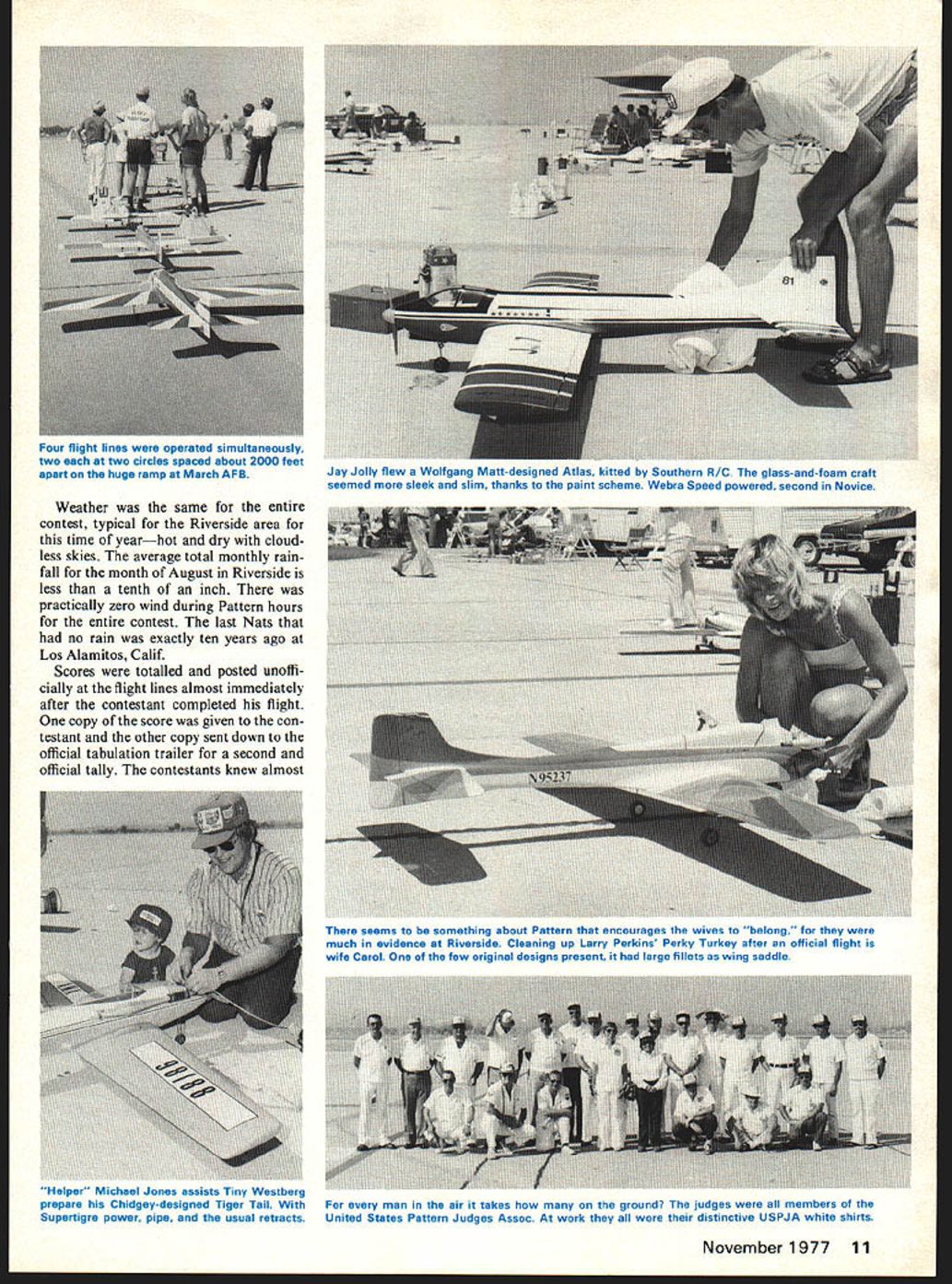
Four flight lines operated simultaneously — two circles spaced about 2,000 feet apart on the huge ramp at March AFB. Weather was the same during the entire contest — typical Riverside area for this time of year: hot, dry, cloudless skies. Average total monthly rainfall for August in Riverside is less than a tenth of an inch — practically zero. There was practically no wind during Pattern hours for the entire contest. At the last Nats there was no rain, exactly ten years ago at Los Alamitos, Calif.
Scores were totaled and posted unofficially at the flight lines almost immediately after the contestant completed his flight. One copy of the score was given the contestant; another copy was sent down to the official tabulation trailer for the second official tally. Contestants knew almost immediately. It seems something about Pattern encourages wives to belong — much evidence in Riverside. Cleaning up Larry Perkins' Perky Turkey after official flight was his wife Carol. A few original designs were present, with large fillets at the wing saddle.
Aerobatics
Dirty Birdy country. Phil's radio systems and Joe Bridi's airplane were so much in evidence.
There was no predominance of any particular engine, just about every make being represented. That so many people used Zinger props is surprising when you consider that this company has been in business only a little over a year.
We decided one afternoon to get in a little needed practice and headed for the Pomona RC Club's field, about 20 miles away. When we drove up there were two fliers there, a scale contestant and Dave Brown, who was in a comfortable lead at the time. Even Dave gets in some practice at every opportunity. There must be something to the old adage that practice makes perfect.
Pattern flying was finished at 1:00 p.m. daily. The flight lines were cleared and then the big B-52s landed, coming in off their duty stations. When they were down the pylon course was set up and pylon racing began.
Bob Talley, from Nederland, Texas, monitored frequency control on two World Engine scanners in the tabulating trailer. He was in radio contact with both flight lines and found only two cases of interference. Those involved were allowed to take their flights over. One contestant was putting out a weak signal on his transmitter and was advised by intercom immediately after his flight so that he could have his radio checked. The scanner is used regularly at our local contests. If it saves one airplane, it has paid for itself.
Finals
The finals were off and running at 7:00 a.m. Friday morning. The same two landing circles were used with two flight lines each, six judges per line. Three rounds were completed by 1:00 p.m.
Round 1: In Master Class, Bill Salkowski, the "S" of S & O R/C Systems, took an early lead in round one with an 866.5 score. Jim Kimbro, of Kraft Systems, was second with 849.5 and Dave Brown, of World Engines, was third with 841.6.
In Expert, Chuck Danley set the pace with a 634, followed by Curt Oberg with a 614. Mike Johncock led Advanced with a 535 and Tony Frakowiak was second with a 503. The Novice leader was Tom Perkiss, two points ahead of Jay Jolley, who was one point in front of Rod Barnes.
Round 2: Dave Brown took a commanding lead in Round 2 with a score of 931.0, followed by Tony Bonetti and Wayne Abernethy.
Chuck Danley held his commanding lead in Expert and Marty Wittenberg, the California whiz, took the lead in Round 2 with Tony Frakowiak close behind.
Dave Wilson led Round 2 in Novice with Jay Jolley in second.
Round 3: Phil Kraft had an interference problem and almost lost his plane. Dave Brown won Round 3 in Masters with a 940.5 and Tony Bonetti was second. In Expert, Curt Oberg took the round with Chuck Danley second. In Advanced, Mike Johncock finished first and Tony Frakowiak was second. In Novice, Jay Jolley took the round.
Nats RC: Aerobatics
Round 4: The final round of the Pattern finals was flown on Saturday morning. Tony Bonetti turned in a 877.5, just 30 points ahead of Dave Brown, which moved him into second place.
In Expert, Earl Haury got a 643, just ahead of Mike Middleton with a 627.
Mike Johncock won the 4th round in Advanced, but his score was not good enough to beat Marty Wittenberg, who won the event. This was a long awaited sweet victory for Marty, a college freshman, who would have won Novice at the Nats last year if he hadn't done a turn-around between maneuvers and crossed the imaginary line behind the judges and received a zero on his next maneuver.
Tom Purkiss got a 584 in Novice, followed by Tiny Westberg. Neither score was good enough to beat out Dave Wilson, the Novice winner.
Obviously, we can't personally thank all those that gave their time and effort, but we would be remiss if we didn't single out Betty Stream, her daughter Susie, assistant John Targos and RC Director Dick Sondheim for a special thank you. Betty was the coordinator who put the Nats together. She was at the flight line at 6:30 in the morning working Pattern and still out there after 7:00 p.m. working Scale.
Betty ran Pattern like Patton ran his army. There was no monkey business, no fooling around. The events went off on time and as scheduled. Decisions that had to be made were made without indecision, the mark of a true leader.
Your reporter had the privilege of sitting in on the Executive Council meeting during the Nats. Those elected representatives volunteer to work all day in the hot sun running the Nats, then attend the council meeting until past midnight and are back on the field at 6:30 in the morning for another day of competition. Nor can we forget some 465 AMA volunteers that put on the Nats, most working out in the sun all day, truly amazing dedication. It makes you proud to be involved in an organization such as this.
Transcribed from original scans by AI. Minor OCR errors may remain.

