
Nats RC: Pylon Racing
Dave Lane
THE 1977 NATIONALS probably will be recorded as one of the hottest on record. The temperature on the concrete at the Pylon site got close to 130 degrees. The air temperature was usually between 95 and 105 degrees for the entire week.
This year RC Pattern got the prime time for flying, 7 a.m. to 1 p.m. Racing was scheduled from 1 p.m. to 8 p.m. By the time Pylon was able to start racing the wind was blowing a good 10 knots and gusting to 15. Fortunately, it was always down the runway.
Only 48 entries showed up for Quarter Midget. That made an easy split for 12 heats of four planes each. Monday, August 8, was the first day for racing. The first heat got off the ground around 2:30 p.m. and the racing continued through three rounds that day. By the end of the third round there had been several crashes and many of the heats were down to three planes as several pilots did not have back-up aircraft.
On the second day the idle check rule was invoked during the fifth round. Better than 50 percent of the contestants got zeros in that round. This was due primarily to the manner in which the idle check was accomplished. All engines were brought back to an idle on the line at the same time. When the last handler let go of the plane, the 10-second clock was started. In some cases the engines were caused to idle for 15 to 25 seconds. Most of the pilots are in agreement that the idle rule needs to be rewritten.
Another interesting thing was brought to my attention during the last day of the Quarter Midget races. A fellow racer showed me some broken props that he had picked up during the three days of racing. According to the rules, only stock props with material removed from one blade for balancing purposes are allowed. The props that I saw had been reshaped, thinned, cut down from 7 inches to 6 1/4 or 6 1/2 inches and then revarnished to hide the rework. I came to the conclusion that we might as well throw out the prop rule. Obviously, many of the people already have.
Several guys were running the new Cox .15 Conquest. Some of them were really going, but the Rossi still seemed to be the one to beat.
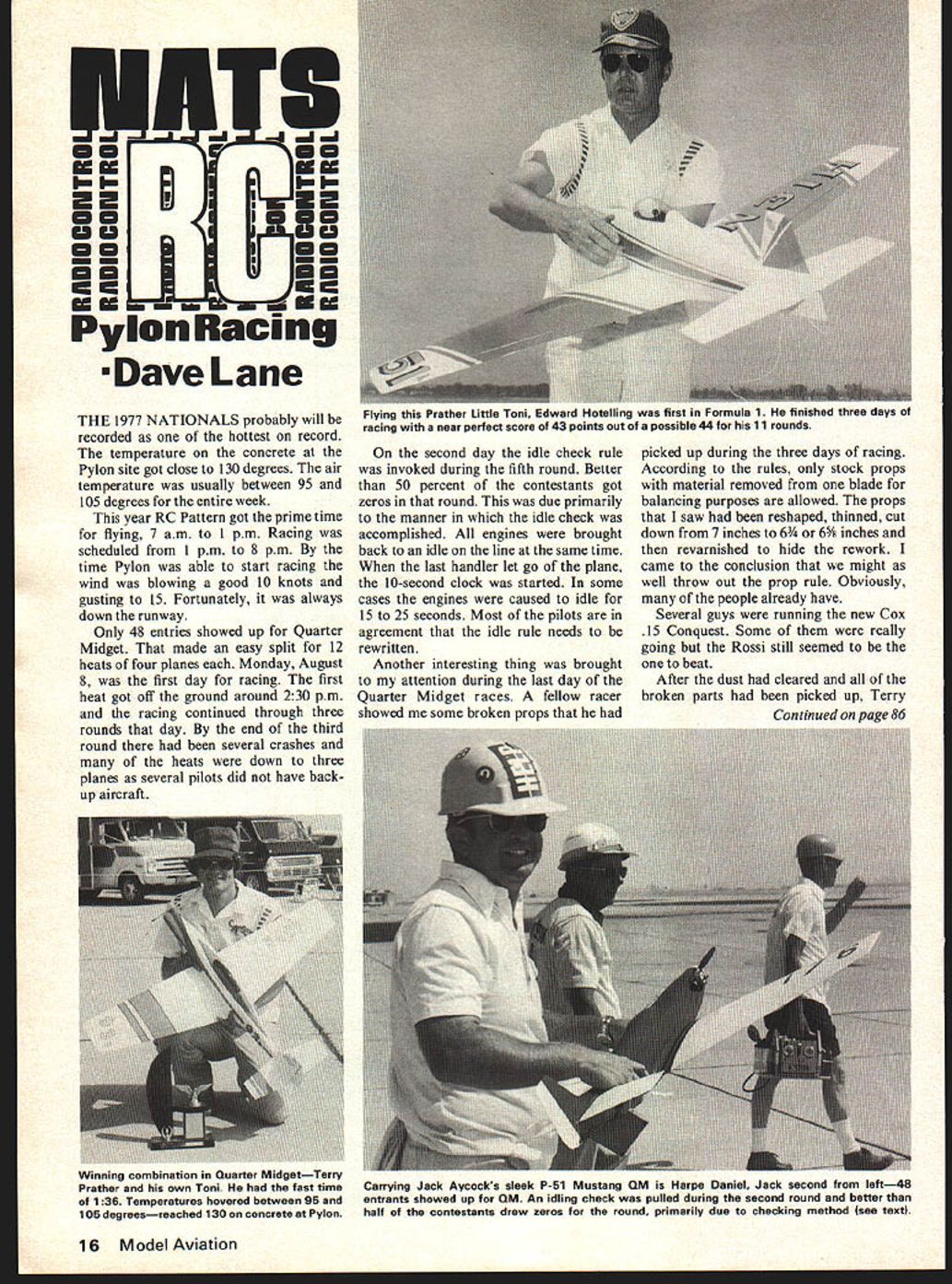
After the dust had cleared and all of the broken parts had been picked up, Terry Prather was the winner and holder of the fast time with a 1:36. Roger Moorhead and George Parks had a fly-off for second and George took those honors. Bob Root was fourth and Bob Nickle was fifth. A total of nine rounds was flown in Quarter Midget.
Formula One started on Thursday at 1:30 p.m. and flew three rounds. A total of 52 entries showed up. Not too many of the fellows were there from the East Coast. We missed them.
The guys seemed to be having trouble sorting out the high temperature and low humidity as the fast time of the meet was only 1:15. Most of the times were in the 1:18s and 1:25s.
Another new method of scale handicapping was tried this year. There were three judges scoring each plane on a basis of one to six points. Their scores were then added and divided by three for an average. Some of the handicaps then came out as 2½, 1¾, etc. It did seem to eliminate the coin tossing to determine the starting position. at the line.
Formula One is still a two-engine event almost evenly split between Super Tigre and K&B. I don't believe there were any front rotor K&B's at the Nats.
The variety of aircraft was down to only about eight different types. The most popular type was Terry Prather's Toni. There were several Jeff Bertken Brown Bag Minnows and Bob Violett's Polecat, and a few Stegal Minnows. The boys from Canada were flying a modified Pellets. Bob Brogdon flies a Funderbuck Bandit with modified wing which makes it look more like a Miss Cosmic Wind. Bob Root was flying his own design Stinger which he is considering kitting. Dan McCann showed up with an old Miss Dara that he flew before he went into the Air Force a couple of years ago. Dan is now flying F-4 Phantoms.
Ed Hotelling finished the three days of F-1 racing with a near perfect score of 43 out of 44 possible points for 11 rounds. Rusty Van Buren was second with 40 points after outlasting Tom Christopher in a fly-off for second place. Gary Hover finished fourth all by his lonesome with 38 points. Bob Smith (5), Dave Pearce (6), Clay Moncrief (7) and Dave Shadel (8) were all tied for fifth spot with 37 points. After the smoke cleared Bob had put it on them and finished fifth. Bill Preis was 9th with 36 points and Whit Stockwell was 10th with 34 points.
I think everyone got in enough racing, especially those who raced both Q-M and F-1. Six days of the heat and smog combined with the noise was enough for the stoutest of heart.
With the exception of some minor problems, I think Mike Atzie, Sr., and his pylon crew did a commendable job in running the Pylon show for '77. It is hard to satisfy all of the people all of the time.
to the winch area. The next heat was called. This rotation went on for all of Thursday and Friday with Rick handing over the bullhorn only long enough to put his Paragon through its paces.
By mid-afternoon thermometers on the field were pegged at 120 degrees! This had to have an effect on some fliers, especially the workers/fliers. It was realized by many that Rick's short landing in round six had to be the result of his eight hours of standing in the middle of the field keeping the contest flowing. Rick earned the respect of all.
And that was the pattern for three grueling days. Heats were highlighted by seeing similar planes in the air, or by different ones that claimed through their ads they were better than others. You had a chance to draw your own opinion. One heat saw three Sailaires, three Legionaires and two Aquila X-Ls. That flight not only brought a smile to Sid Axelrod's face in seeing those acres of Monokote but it was the only shade provided in three days!
By the end of round four some familiar names were in the top 10: Blewett, Miller, Thornburg, Potega. Nolte was near the top as was Singelis and Pearson. By this time it was already evident that if you missed a landing you might just as well pack it up. Mishaps had occurred also. Dr. Stan Pfost had the only lift to be found in the contest's very first heat when someone turned on a transmitter and caused his Aquila to spin in. Entitled to a reflight, his back-up ship was readied and it went in for no apparent reason. It was a heckuva way to start the day after a 2600 mile trip.
This scribe was enjoying a thermal labeled max with one other Aquila when the two collided. Let the record show that two sailplanes with joined wings do not thermal half as well as one plane by itself. Both separated but failed to recover and spun in. Oh well, it's only a hobby.
As the competition was whittled to size, round six had the following fliers in the lead: Class A: Bob Freymuth with 11,609, and Scott Miller, 11,538. Class B: Skip Miller, 11,817, and P. Parszik, Jr., 11,677. Dave Thornburg led Class C with 11,738, a mere 17 points over Pat Potega. By this time it was evident that eight rounds would be flown and not the scheduled nine.
It looked like Skip Miller could win not only his class but be top winner overall. Only a mistake or bad luck would knock him off top spot and it didn't look like it was going to happen. His smoothness and consistency was just an extension of his Pretoria feat four months earlier.
A note about Miller's Aquila. It is modified. That has been no secret and wasn't meant to be. However, rumors did persist and by the time Skip went to California he wouldn't have recognized the model had it been built to the rumored specifications. It did not have a foam wing and the wing does not have a symmetrical airfoil. The modification, which can be done in an evening or two, is as follows. Peel the Monokote off from the bottom of the wing. Glue 1/16" sheeting over the main spar from the main spar forward to the leading edge. This leaves a "step" at the main spar and where the cap strips now begin and, no doubt, leaves the pure aerodynamicists cringing.
From the leading edge and back 3/8 inch sand in a Phillip's entry—that is, a leading edge that is raised when viewed in profile. When re-Monokoting, bridge the step from the sheeting edge to the very rear of the trailing edge. And that dear reader is the modification that has caused the modellers world to rotate in the opposite direction. Incidentally, Skip was handing out sheets that included these changes. The sheets will also be included in upcoming Aquila kits.
Back to the desert.
Scores were not posted after each round
Transcribed from original scans by AI. Minor OCR errors may remain.

