
Nats RC: Scale - Bob & Dolly Wischer
THE EXPECTED large entry at the California Nats did not materialize. Some 48 planes were judged in Sport Scale, with only 10 in the AMA Scale class. The quality, however, was generally better than any previous Nats, with individual standout examples of the very best. The emphasis on high quality was especially noticeable in AMA Scale, where a place on the team to represent the U.S. next year in England was at stake. The first three places at the Nats will constitute our team. Officiating was capably administered by Monty and Patricia Groves.
One of the more exciting entries was a repeat performance by Dave Platt whose new Douglas Dauntless SBD-3 was the center of attention. His 10-year-old original is now in the Navy museum at Pensacola, Florida. The new plane is generally superior, if this is possible. Built to the same scale as his original, 1½" = 1', it uses a modern O.S. .60 Schnuerle engine to improve performance. Its greatest advantage over the previous model is that it weighs one pound less at 10 lbs. Dave's luck at the Nats has not always been the best and this meet was no exception. The plane crashed when it stalled on a landing approach in the second round.
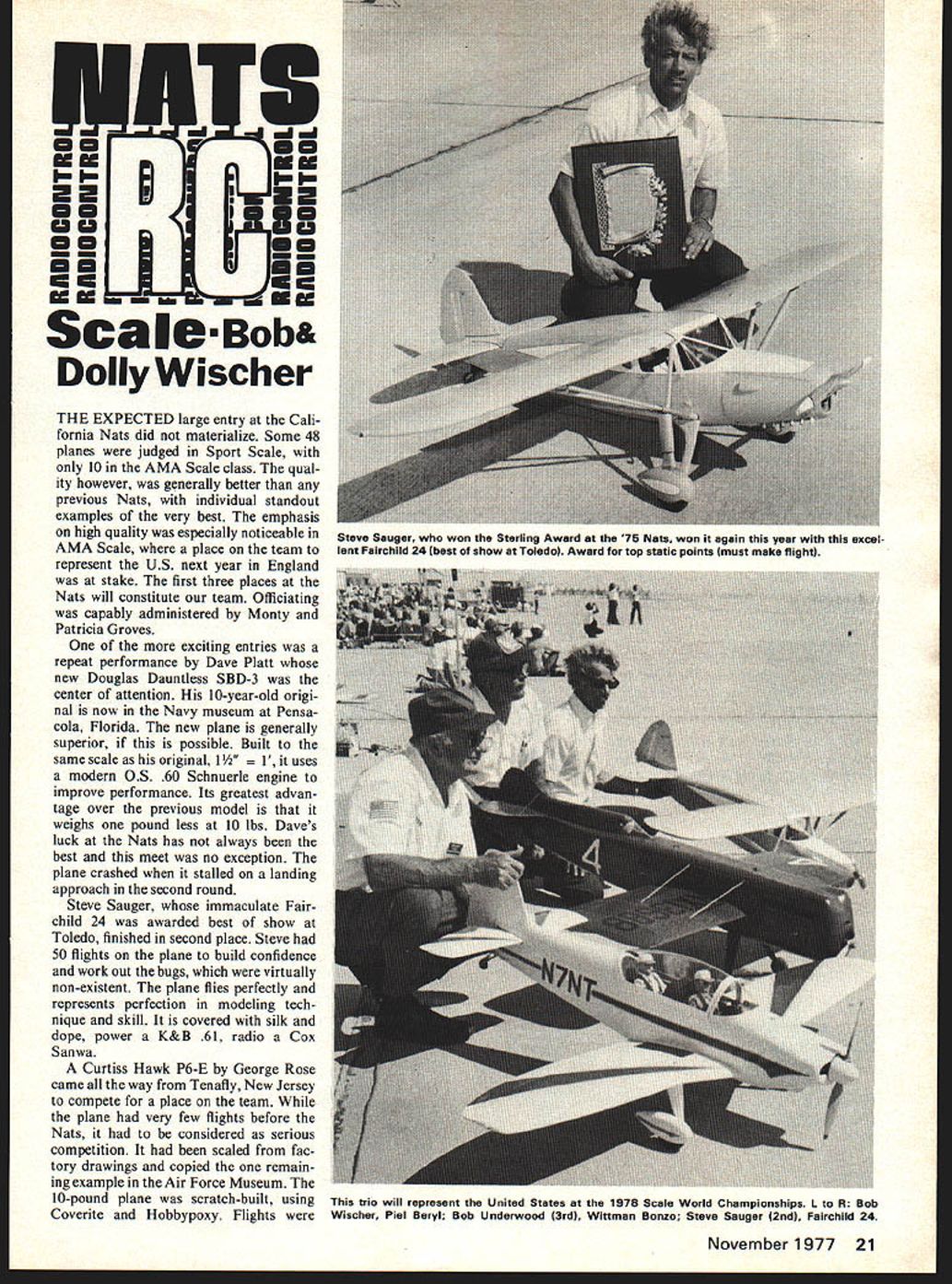
Steve Sauger, whose immaculate Fairchild 24 was awarded best of show at Toledo, finished in second place. Steve had 50 flights on the plane to build confidence and work out the bugs, which were virtually non-existent. The plane flies perfectly and represents perfection in modeling technique and skill. It is covered with silk and dope, powered by a K&B .61, radio a Cox Sanwa.
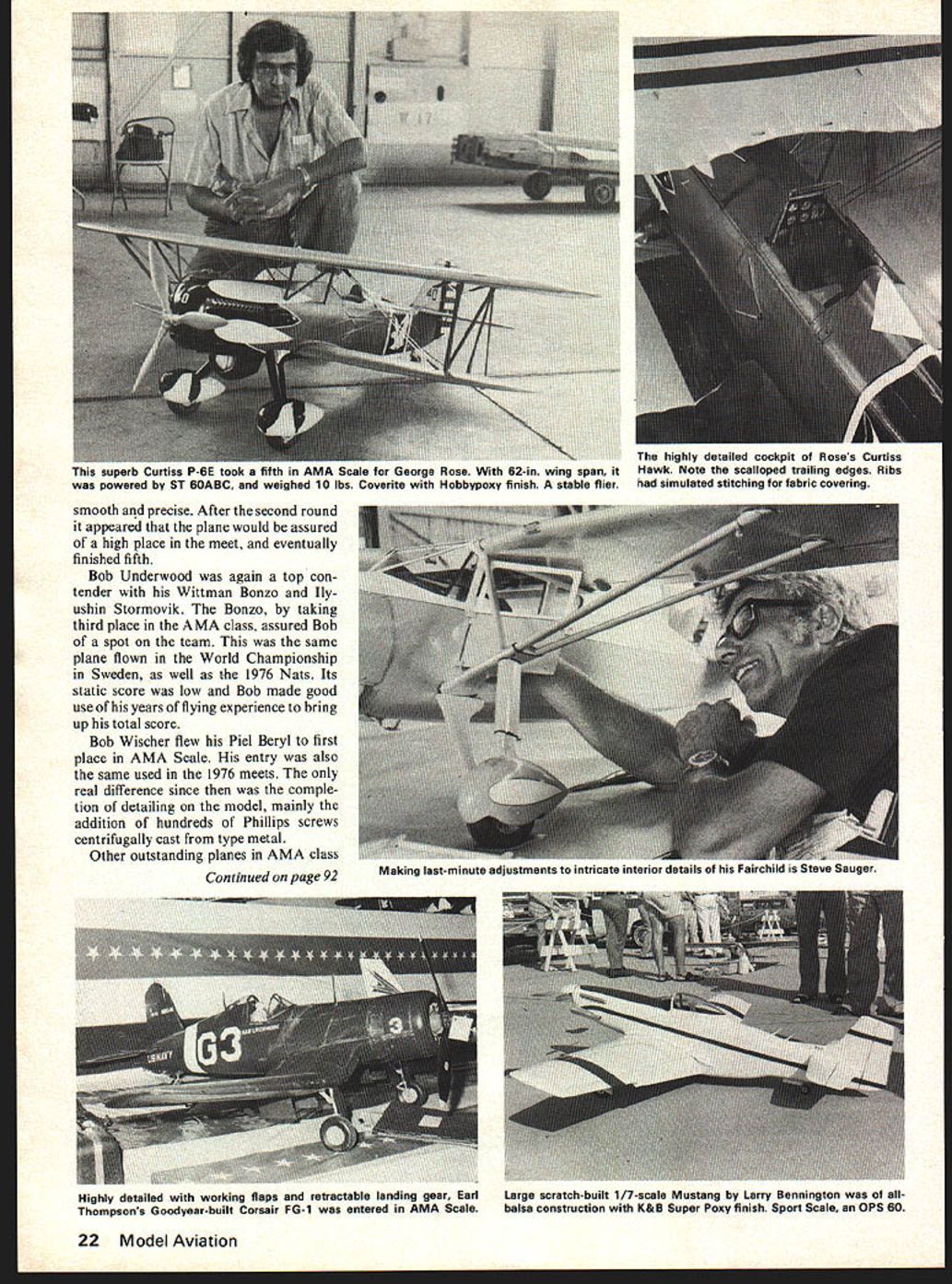
A Curtiss Hawk P6-E by George Rose came all the way from Tenafly, New Jersey to compete for a place on the team. While the plane had very few flights before the Nats, it had to be considered as serious competition. It had been scaled from factory drawings and copied the one remaining example in the Air Force Museum. The 10-pound plane was scratch-built, using Coverite and Hobbypoxy.
After the second round it appeared the plane would be assured a high place in the meet, but it eventually finished fifth. Bob Underwood again was a top contender with his Wittman Bonzo. The Ilyushin Sturmovik (Bonzo) taking third place in AMA class assured Bob a spot on the team; the same plane was flown in the World Championship in Sweden well at the 1976 Nats. Its static score was low; Bob made good use of years of flying experience to bring up the total score.
Bob Wischer flew Piel Beryl, the first place AMA Scale entry, the same used in the 1976 meets. The real difference since completion is the detailing of the model, mainly the addition of hundreds of Phillips screws, centrifugally cast type metal.
Other outstanding planes in AMA class included Granger Williams' Curtiss Sea Hawk F6C-4 with an outstanding dummy engine disguising the model engine; Don Srull entered a Dornier Do-23G, a highly unusual subject with external ailerons and twin engines; Bud Atkinson flew a Hawker Hunter with exceptional penetration through the usual afternoon wind. Examples of WWII planes were present in force.
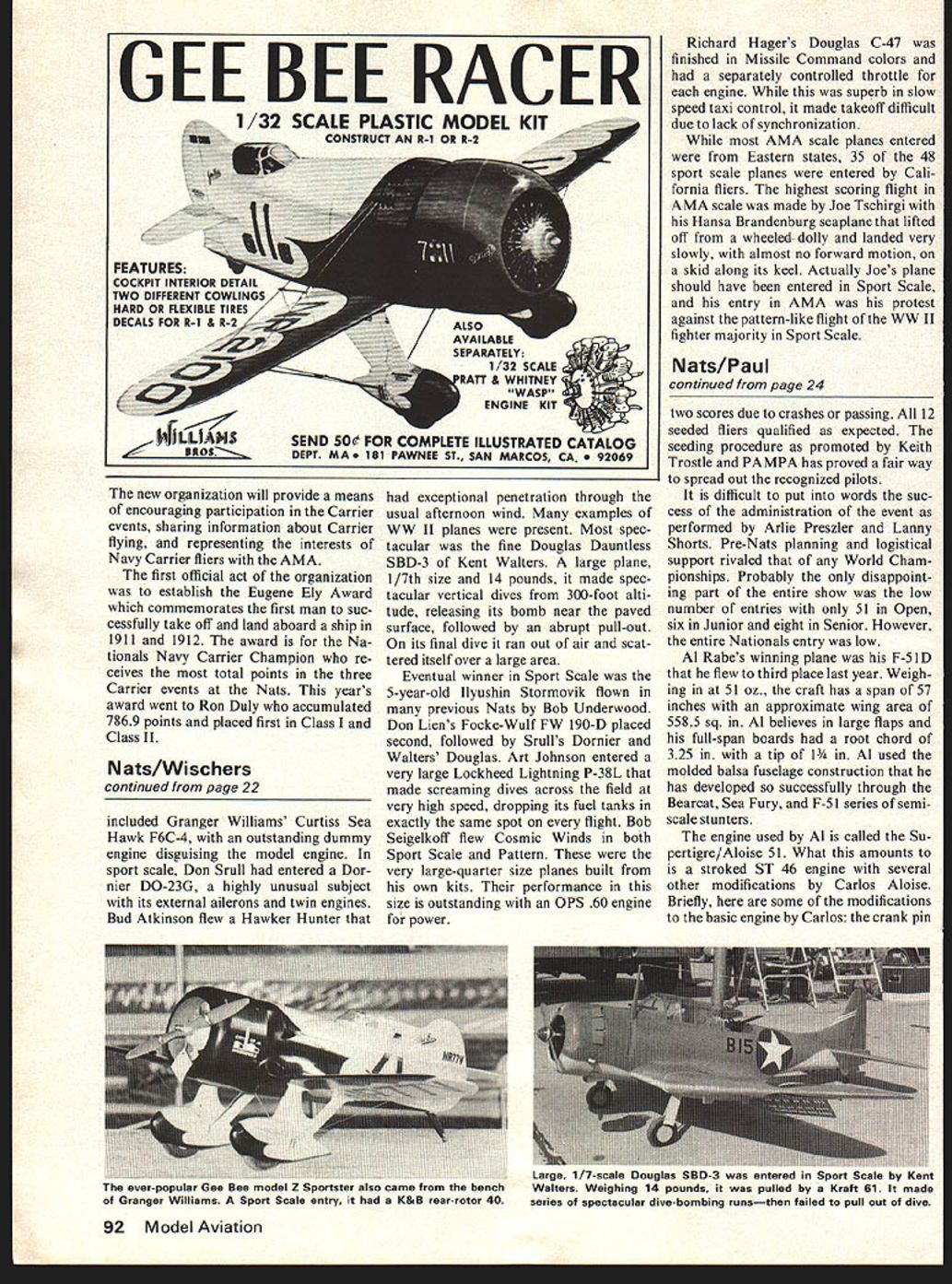
Most spectacular was a fine Douglas Dauntless SBD-3 by Kent Walters. The large plane, 1/7th size and 14 pounds, made spectacular vertical dives from 300-foot altitude, releasing its bomb near the paved surface followed by an abrupt pull-out for its final dive. Smooth and precise. After the second round it appeared that the plane would be assured of a high place in the meet, and eventually finished fifth. Eventual winner in Sport Scale was the 5-year-old Ilyushin Stormovik flown in many previous Nats by Bob Underwood. Don Lien's Focke-Wulf FW 190-D placed second, followed by Srull's Dornier and Walters' Douglas. Art Johnson entered a very large Lockheed Lightning P-38L that made screaming dives across the field at very high speed, dropping its fuel tanks in exactly the same spot on every flight. Bob Seigelkolff flew Cosmic Winds in both Sport Scale and Pattern. These were two very large-quarter size planes built from his own kits. Their performance in this size is outstanding with an OPS .60 engine for power.
Richard Hager's Douglas C-47 was finished in Missile Command colors and had a separately controlled throttle for each engine. While this was superb in slow speed taxi control, it made takeoff difficult due to lack of synchronization.
While most AMA scale planes entered were from Eastern states, 35 of the 48 sport scale planes were entered by California fliers. The highest scoring flight in AMA scale was made by Joe Tschirgi with his Hansa Brandenburg seaplane that lifted off from a wheeled-dolly and landed very slowly, with almost no forward motion, on a skid along its keel. Actually Joe's plane should have been entered in Sport Scale, and his entry in AMA was his protest against the pattern-like flight of the WWII fighter majority in Sport Scale.
Transcribed from original scans by AI. Minor OCR errors may remain.

