
Nats RC: Soaring
- Dan Pruss
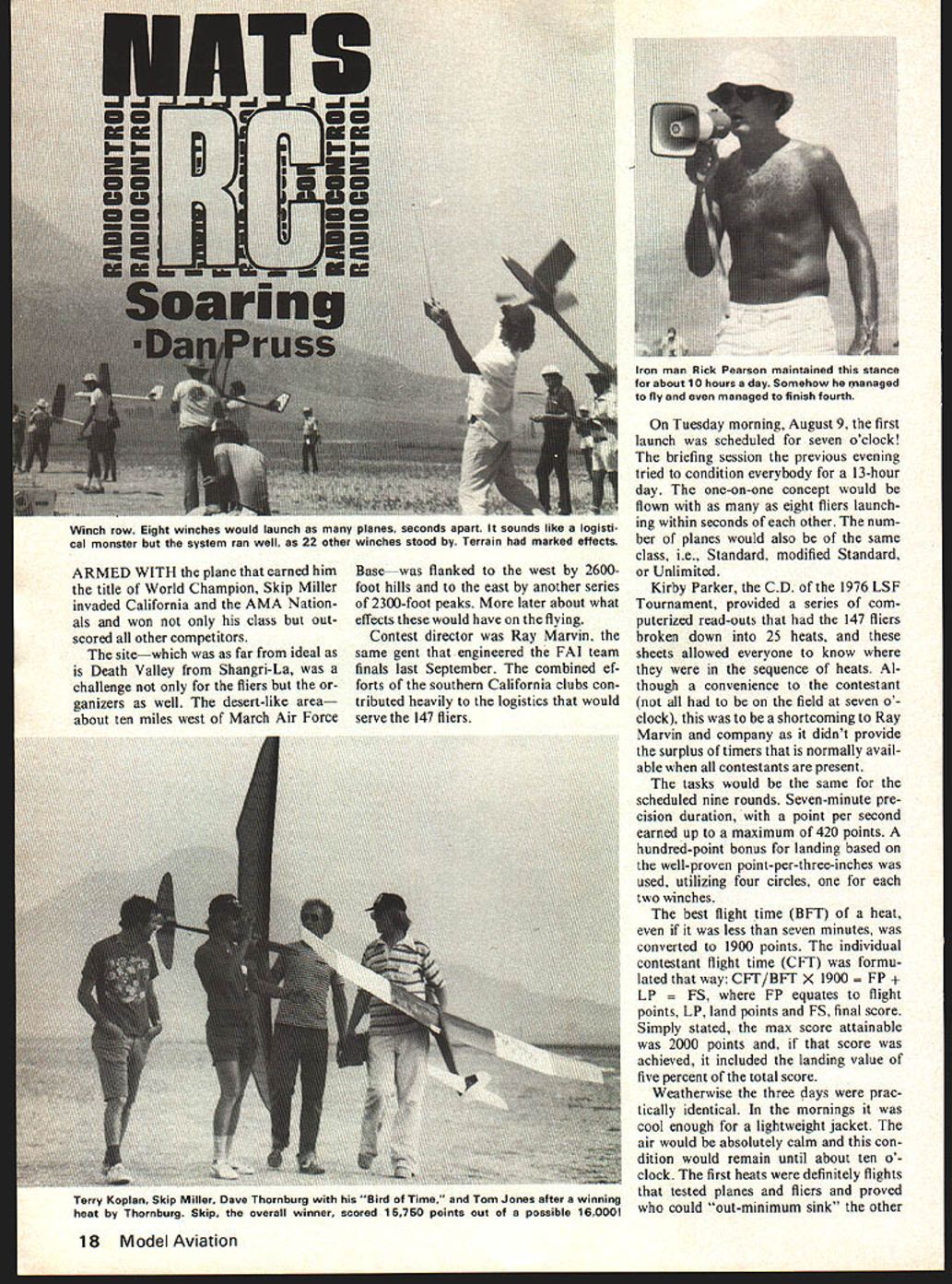
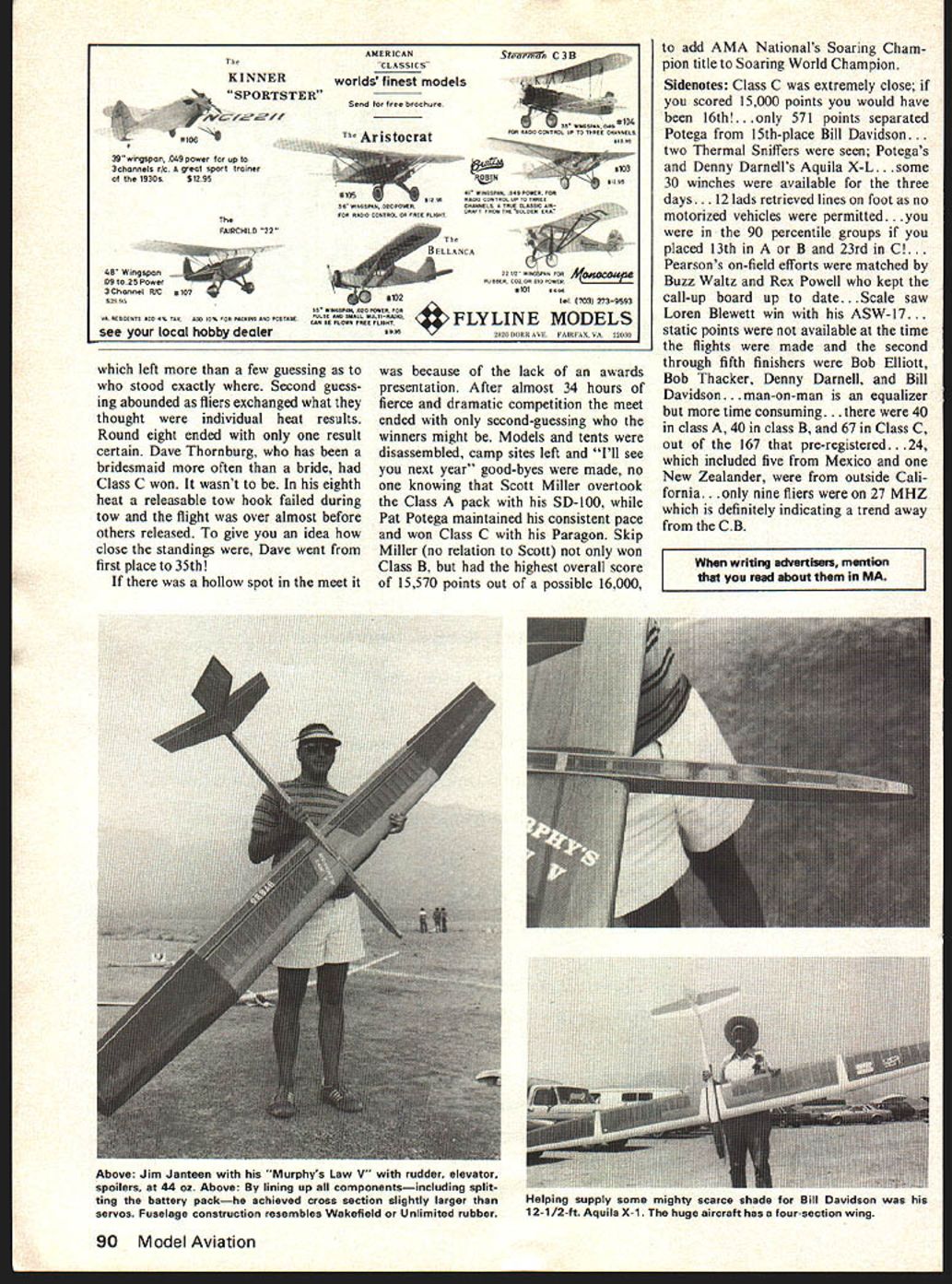
Winch row. Eight winches would launch as many planes seconds apart. It sounds like a logistical monster but the system ran well, as 22 other winches stood by. Terrain had marked effects.
ARMED WITH the plane that earned him the title of World Champion, Skip Miller invaded California and the AMA Nationals and won not only his class but outscored all other competitors.
The site—which was as far from ideal as is Death Valley from Shangri-La—was a challenge not only for the fliers but the organizers as well. The desert-like area—about ten miles west of March Air Force Base—was flanked to the west by 2600-foot hills and to the east by another series of 2300-foot peaks. More later about what effects these would have on the flying.
Contest director was Ray Marvin, the same gent that engineered the FAI team finals last September. The combined efforts of the southern California clubs contributed heavily to the logistics that would serve the 147 fliers.
On Tuesday morning, August 9, the first launch was scheduled for seven o'clock. The briefing session the previous evening tried to condition everybody for a 13-hour day. The one-on-one concept would be flown with as many as eight fliers launching within seconds of each other. The number of planes would also be of the same class, i.e., Standard, Modified Standard, or Unlimited.
Kirby Parker, the C.D. of the 1976 LSF Tournament, provided a series of computerized read-outs that had the 147 fliers broken down into 25 heats, and these sheets allowed everyone to know where they were in the sequence of heats. Although a convenience to the contestant (not all had to be on the field at seven o'clock), this was to be a shortcoming to Ray Marvin and company as it didn't provide the surplus of timers that is normally available when all contestants are present.
The tasks would be the same for the scheduled nine rounds. Seven-minute precision duration, with a point per second earned up to a maximum of 420 points. A hundred-point bonus for landing based on the well-proven point-per-three-inches was used, utilizing four circles, one for each two winches.
The best flight time (BFT) of a heat, even if it was less than seven minutes, was converted to 1900 points. The individual contestant flight time (CFT) was formulated that way: CFT/BFT x 1900 = FP + LP = FS, where FP equates to flight points, LP land points and FS, final score. Simply stated, the max score attainable was 2000 points and, if that score was achieved, it included the landing value of five percent of the total score.
Weatherwise the three days were practically identical. In the mornings it was cool enough for a lightweight jacket. The air would be absolutely calm and this condition would remain until about ten o'clock. The first heats were definitely flights that tested planes and fliers and proved who could "out-minimum sink" the other Seven. These heats were definitely of best interest to the observer, as some of the country's best fliers pitted their nerves against one another.
By 10 a.m. the lightest of thermals began to generate and the original concept of one-on-one was at its best. Strategies varied. The simplest was if lift was found to circle in it, and if those whose luck was less came and "piggy-backed," so be it. Your hope then was to out-land them.
If psyching out the competition is a ploy of most of the more experienced competitors, then respect for these same fliers' prowess is also displayed by the less experienced. Looking down the flight line to see if it included a Mark Smith, a Rick Pearson, or last year's top trophy winner Don Edberg, was often an indirect compliment to these fliers. However, to look down the line-up of winches and see Skip Miller, Dave Thornburg, or the LSF's most recent level-V honor holder, Neil Nolte, was also enough to get the adrenaline flowing. flowing of the otherwise most relaxed Sunday flier. To outscore these aforementioned in just one heat would be enough of a euphoria for at least a day, if not the contest.
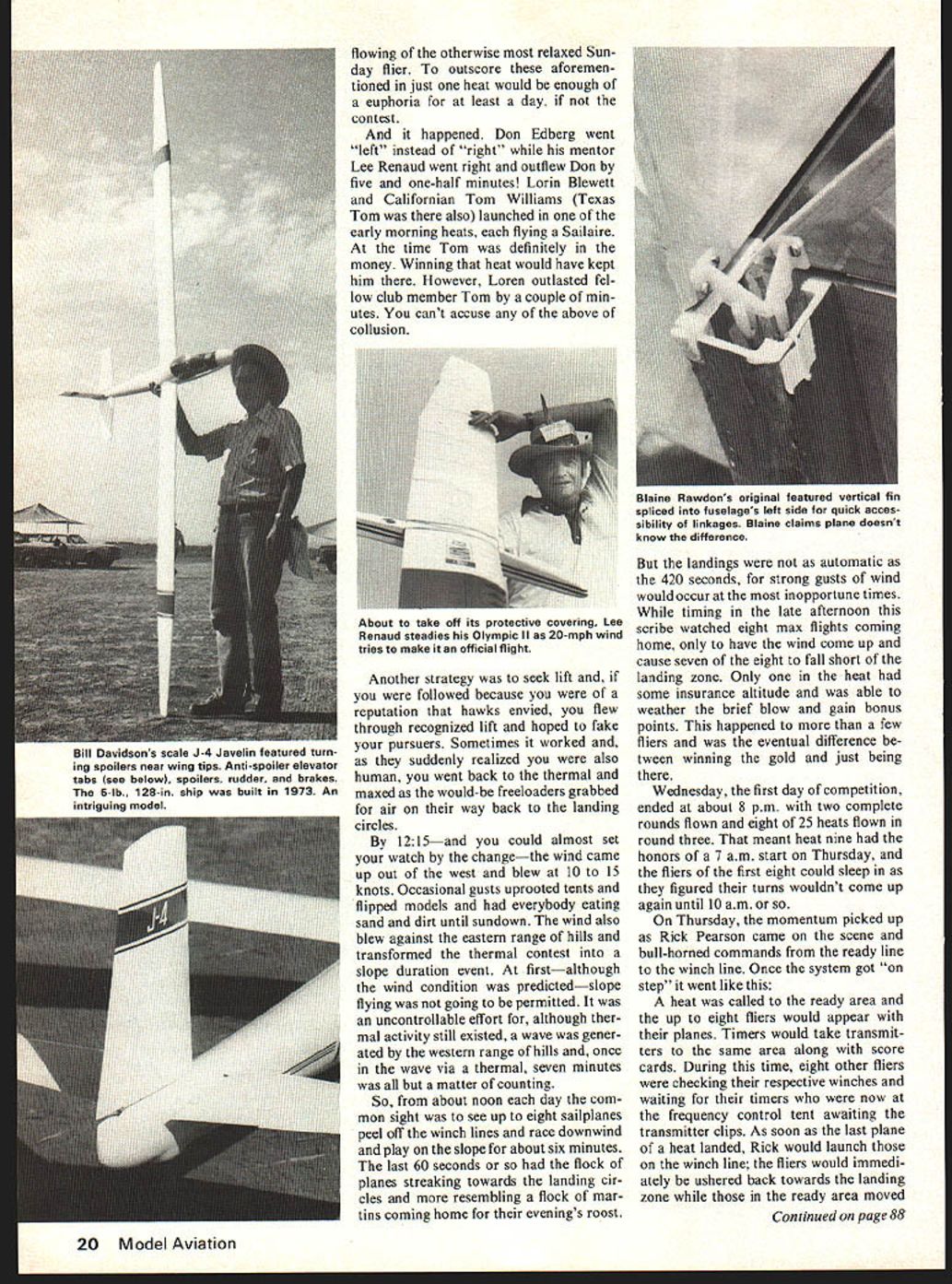
And it happened. Don Edberg went "left" instead of "right" while his mentor Lee Renaud went right and outflew Don by five and one-half minutes! Lorin Blewett and Californian Tom Williams (Texas Tom was there also) launched in one of the early morning heats, each flying a Sailaire. At the time Tom was definitely in the money. Winning that heat would have kept him there. However, Lorin outlasted fellow club member Tom by a couple of minutes. You can't accuse any of the above of collusion.
Another strategy was to seek lift and, if you were followed because you were of a reputation that hawks envied, you flew through recognized lift and hoped to fake your pursuers. Sometimes it worked and, as they suddenly realized you were also human, you went back to the thermal and maxed as the would-be freeloaders grabbed for air on their way back to the landing circles.
By 12:15—and you could almost set your watch by the change—the wind came up out of the west and blew at 10 to 15 knots. Occasional gusts uprooted tents and flipped models and had everybody eating sand and dirt until sundown. The wind also blew against the eastern range of hills and transformed the thermal contest into a slope duration event. At first—although the wind condition was predicted—slope flying was not going to be permitted. It was an uncontrollable effort for, although thermal activity still existed, a wave was generated by the western range of hills and, once in the wave via a thermal, seven minutes was all but a matter of counting.
So, from about noon each day the common sight was to see up to eight sailplanes peel off the winch lines and race downwind and play on the slope for about six minutes. The last 60 seconds or so had the flock of planes streaking towards the landing circles and more resembling a flock of martins coming home for their evening's roost.
But the landings were not as automatic as the 420 seconds, for strong gusts of wind would occur at the most inopportune times. While timing in the late afternoon this scribe watched eight max flights coming home, only to have the wind come up and cause seven of the eight to fall short of the landing zone. Only one in the heat had some insurance altitude and was able to weather the brief blow and gain bonus points. This happened to more than a few fliers and was the eventual difference between winning the gold and just being there.
Wednesday, the first day of competition, ended at about 8 p.m. with two complete rounds flown and eight of 25 heats flown in round three. That meant heat nine had the honors of a 7 a.m. start on Thursday, and the fliers of the first eight could sleep in as they figured their turns wouldn't come up again until 10 a.m. or so.
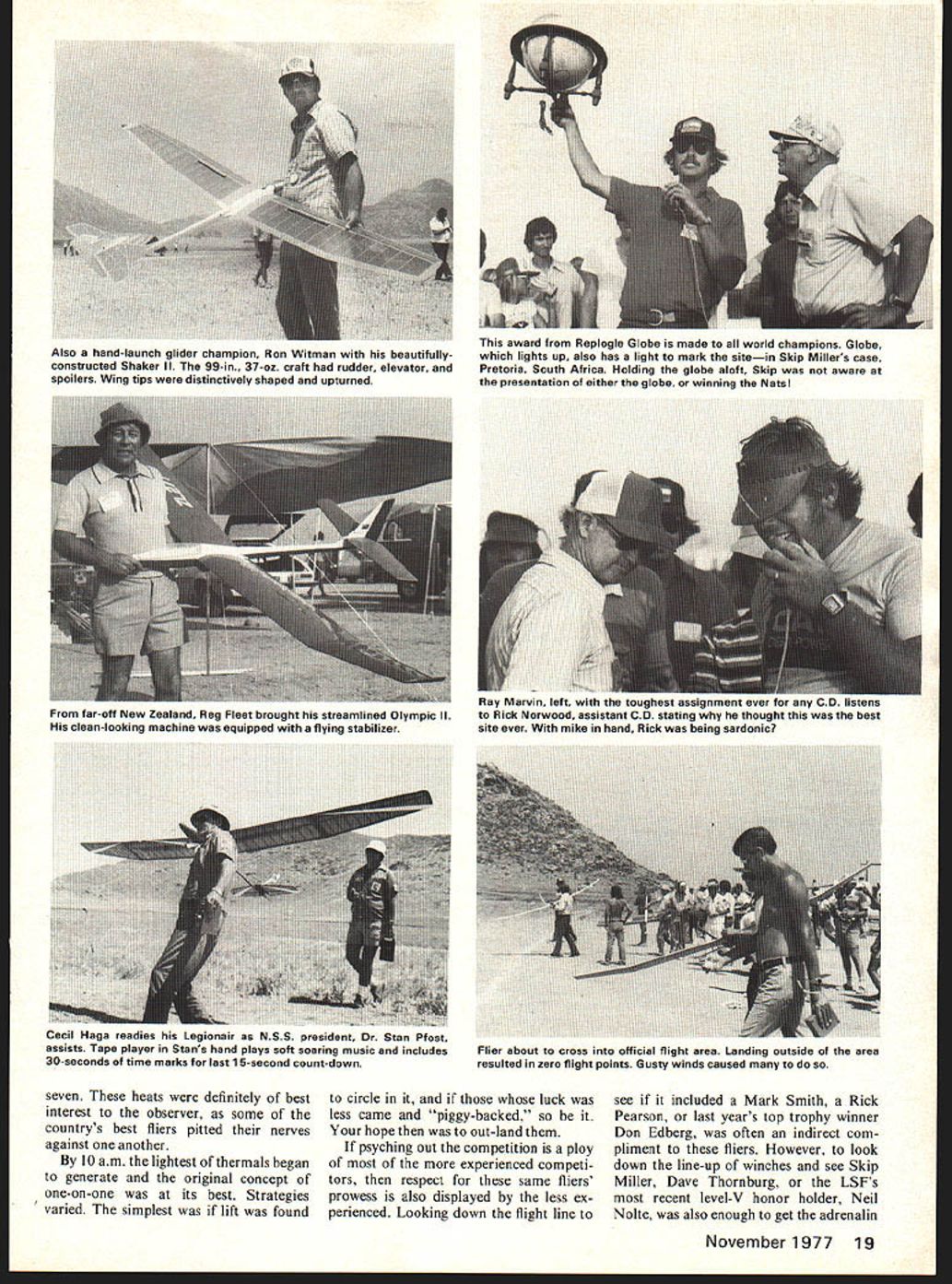
On Thursday the momentum picked up as Rick Pearson came on the scene and bull-horned commands from the ready line to the winch line. Once the system got 'in step' it went like this:
A heat was called to the ready area and the up to eight fliers would appear with their planes. Timers would take transmitters to the same area along with score cards. During this time, eight other fliers were checking their respective winches and waiting for their timers who were now at the frequency control tent awaiting the transmitter clips. As soon as the last plane of a heat landed, Rick would launch those on the winch line; the fliers would immediately be ushered back towards the landing zone while those in the ready area moved at the line.
Formula One is still a two-engine event almost evenly split between Supertigre and K & B. I don't believe there were any front rotor K & B's at the Nats.
The variety of aircraft was down to only about eight different types. The most popular type was Terry Prather's Toni. There were several Jeff Bertken Brown Bag Minnows and Bob Violett's Polecat, and a few Stegal Minnows. The boys from Canada were flying a modified Peletts. Bob Brogdon flies a Funderbuck Bandit with modified wing which makes it look more like a Miss Cosmic Wind. Bob Root was flying his own design Stinger which he is considering kitting. Dan McCann showed up with an old Miss Dara that he flew before he went into the Air Force a couple of years ago. Dan is now flying F-4 Phantoms.
Ed Hotelling finished the three days of F-1 racing with a near perfect score of 43 out of 44 possible points for 11 rounds. Rusty Van Baren was second with 40 points after outlasting Tom Christopher in a fly-off for second place. Gary Hover finished fourth all by his lonesome with 38 points. Bob Smith (5), Dave Pearce (6), Clay Moncrief (7) and Dave Shadel (8) were all tied for fifth spot with 37 points. After the smoke cleared Bob had put it on them and finished fifth. Bill Preis was 9th with 36 points and Whit Stockwell was 10th with 34 points.
I think everyone got in enough racing, especially those who raced both Q-M and F-1. Six days of the heat and smog combined with the noise was enough for the stoutest of heart.
With the exception of some minor problems, I think Mike Atzie, Sr., and his pylon crew did a commendable job in running the Pylon show for '77. It is hard to satisfy all of the people all of the time.
to the winch area. The next heat was called. This rotation went on for all of Thursday and Friday with Rick handing over the bullhorn only long enough to put his Paragon through its paces.
By mid-afternoon thermometers on the field were pegged at 120 degrees! This had to have an effect on some fliers, especially the workers/fliers. It was realized by many that Rick's short landing in round six had to be the result of his eight hours of standing in the middle of the field keeping the contest flowing. Rick earned the respect of all.
And that was the pattern for three grueling days. Heats were highlighted by seeing similar planes in the air, or by different ones that claimed through their ads they were better than others. You had a chance to draw your own opinion. One heat saw three Sailaires, three Legionaires and two Aquila X-Ls. That flight not only brought a smile to Sid Axelrod's face in seeing those acres of Monokote but it was the only shade provided in three days!
By the end of round four some familiar names were in the top 10: Blewett, Miller, Thornburg, Potega. Nolte was near the top as was Singelis and Pearson. By this time it was already evident that if you missed a landing you might just as well pack it up. Mishaps had occurred also. Dr. Stan Pfost had the only lift to be found in the contest's very first heat when someone turned on a transmitter and caused his Aquila to spin in. Entitled to a reflight, his back-up ship was readied and it went in for no apparent reason. It was a heckuva way to start the day after a 2600 mile trip.
This scribe was enjoying a thermal labeled max with one other Aquila when the two collided. Let the record show that two sailplanes with joined wings do not thermal half as well as one plane by itself. Both separated but failed to recover and spun in. Oh well, it's only a hobby.
As the competition was whittled to size, round six had the following fliers in the lead: Class A: Bob Freymuth with 11,609, and Scott Miller, 11,538. Class B: Skip Miller, 11,817, and P. Parszik, Jr., 11,677. Dave Thornburg led Class C with 11,738, a mere 17 points over Pat Potega. By this time it was evident that eight rounds would be flown and not the scheduled nine.
It looked like Skip Miller could win not only his class but be top winner overall. Only a mistake or bad luck would knock him off top spot and it didn't look like it was going to happen. His smoothness and consistency was just an extension of his Pretoria feat four months earlier.
A note about Miller's Aquila. It is modified. That has been no secret and wasn't meant to be. However, rumors did persist and by the time Skip went to California he wouldn't have recognized the model had it been built to the rumored specifications. It did not have a foam wing and the wing does not have a symmetrical airfoil. The modification, which can be done in an evening or two, is as follows. Peel the Monokote off from the bottom of the wing. Glue 1/16" sheeting over the cap strips from the main spar forward to the leading edge. This leaves a "step" at the main spar and where the cap strips now begin and, no doubt, leaves the pure aerodynamicists cringing.
From the leading edge and back 3/8 inch sand in a Phillip's entry—that is, a leading edge that is raised when viewed in profile. When re-Monokoting, bridge the step from the sheeting edge to the very rear of the trailing edge. And that dear reader is the modification that has caused the modeling world to rotate in the opposite direction. Incidentally, Skip was handing out sheets that included these changes. The sheets will also be included in upcoming Aquila kits.
Back to the desert.
Scores were not posted after each round which left more than a few guessing as to who stood exactly where. Second guessing abounded as fliers exchanged what they thought were individual heat results. Round eight ended with only one result certain. Dave Thornburg, who has been a bridesmaid more often than a bride, had Class C won. It wasn't to be. In his eighth heat a releasable tow hook failed during tow and the flight was over almost before others released. To give you an idea how close the standings were, Dave went from first place to 35th!
If there was a hollow spot in the meet it was because of the lack of an awards presentation. After almost 34 hours of fierce and dramatic competition the meet ended with only second-guessing who the winners might be. Models and tents were disassembled, camp sites left and "I'll see you next year" good-byes were made, no one knowing that Scott Miller overtook the Class A pack with his SD-100, while Pat Potega maintained his consistent pace and won class C with his Paragon. Skip Miller (no relation to Scott) not only won Class B, but had the highest overall score of 15,570 points out of a possible 16,000, to add AMA National's Soaring Champion title to Soaring World Champion.
Sidenotes:
- Class C was extremely close; if you scored 15,000 points you would have been 16th! Only 571 points separated Potega from 15th-place Bill Davidson.
- Two Thermal Sniffers were seen; Potega's and Denny Darnell's Aquila X-1. Some 30 winches were available for the three days.
- Twelve lads retrieved lines on foot as no motorized vehicles were permitted.
- You were in the 90 percentile groups if you placed 13th in A or B and 23rd in C!
- Pearson's on-field efforts were matched by Buzz Waltz and Rex Powell who kept the call-up board up to date.
- Scale saw Loren Blewett win with his ASW-17.
- Static points were not available at the time the flights were made and the second through fifth finishers were Bob Elliott, Bob Thacker, Denny Darnell, and Bill Davidson.
- Man-on-man is an equalizer but more time consuming.
- There were 40 in class A, 40 in class B, and 67 in class C, out of the 167 that pre-registered.
- Twenty-four, which included five from Mexico and one New Zealander, were from outside California.
- Only nine fliers were on 27 MHz which is definitely indicating a trend away from the C.B.
Transcribed from original scans by AI. Minor OCR errors may remain.

