
A Nats Tale of Two Cities
By Fred Berman
What the Dickens?
Though worlds away from the fabled European capitals of Dickens's great classic, the two cities of our title have their own stories to tell. Lawrenceville, Illinois, and Vincennes, Indiana—hosts for the 1990 Mid‑American Nats—are places I won't quickly forget. Anyone who attended this year's Nats went home with a passel of memories. Let me share some of mine with you.
One thing was lucky. While Lawrenceville and Vincennes straddle the boundary line between eastern and central time zones, the clocks in the two cities read the same. Scheduling might have turned into a nightmare otherwise!
How not to be a Nats contestant
To begin with, arrive late on the day of transmitter processing. Whether they're Gold‑stickered or not, transmitters must have their cardiogram read before being used at a Nats. I tumbled in a few minutes past the deadline at flying site headquarters (also known as the "White Whale"), only to learn that I was in the wrong place.
After 10 minutes of breakneck driving to Vincennes, I found the Holiday Inn—but no transmitter processing station. Evidently the busy spectrum analyzer crew had finished with the timelier contestants and struck its tent.
Not sure what to do, I was glad to see AMA President Don Lowe. He advised me to track down George Steiner, who had a room in the motel.
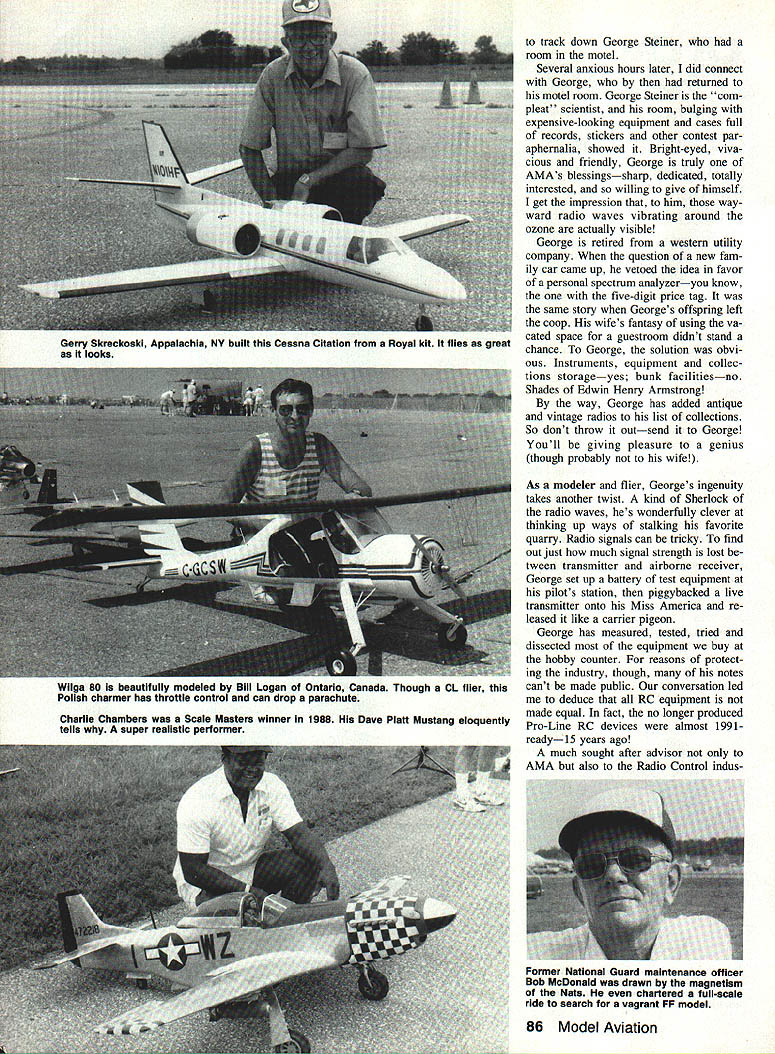
Several anxious hours later I did connect with George, who by then had returned to his motel room. George Steiner is the compleat scientist, and his room, bulging with expensive‑looking equipment and cases full of records, stickers and other contest paraphernalia, showed it. Bright‑eyed, vivacious and friendly, George is truly one of AMA's blessings—sharp, dedicated, totally interested, and so willing to give of himself that I get the impression that, to him, those wayward radio waves vibrating around the ozone are actually visible!
George is retired from a western utility company. When the question of a new family car came up, he vetoed the idea in favor of a personal spectrum analyzer—you know, the one with the five‑digit price tag. It was the same story when George's offspring left the coop. His wife's fantasy of using the vacated space for a guestroom didn't stand a chance. To George, the solution was obvious: instruments, equipment and collections storage—yes; bunk facilities—no. Shades of Edwin H. Armstrong!
By the way, George has added antique and vintage radios to his list of collections. So don't throw it out—send it to George! You'll be giving pleasure to a genius (though probably not to his wife).
As a modeler and flier, George's ingenuity takes another twist. A kind of Sherlock of the radio waves, he's wonderfully clever at thinking up ways of stalking his favorite quarry. Radio signals can be tricky. To find out just how much signal strength is lost between transmitter and airborne receiver, George set up a battery of test equipment at his pilot's station, then piggybacked a live transmitter onto his Miss America and released it like a carrier pigeon.
George has measured, tested, tried and dissected most of the equipment we buy at the hobby counter. For reasons of protecting the industry, though, many of his notes can't be made public. Our conversation led me to deduce that all RC equipment is not made equal. In fact, the no‑longer‑produced Pro‑Line RC devices were almost 1991‑ready—15 years ago!
A much sought‑after advisor not only to AMA but also to the radio control industry, he stayed at Vincennes two days beyond the contest closing just to help load the Nats properties for the return trip to storage at Reston. And believe me, helping hands are hard to come by, especially after the meet shuts down on Sunday.
Naturally, George willingly "radiographed" my transmitter with his 10‑grand analyzer, just as he had with hundreds of others all week.
Trials and tribulations (read: stupidity!)
Back to the perils of Pauline—er, trials and tribulations of your humble author. Notified by a sign at the headquarters tent that a pilots' meeting was scheduled for 10:00 a.m. the following morning, I arrived bright and shining with 15 minutes to spare. The only problem was that no one else was there. Though one of the ladies from headquarters confirmed that the meeting had indeed been scheduled, the appointed hour came and went with no other arrivals.
Contests Director Chip Smith finally enlightened me. The meeting was in progress, alright—at the Holiday Inn in Vincennes! And Betty Stream, all‑around "make‑it‑go" official, confirmed that she had noted the meeting locale on the sign. Evidently reading skills are an added but not always practiced contestant requirement. Too late, schmart, and too soon old!
About an hour later, preparations for my event category were under way. When flight assignment sheets were posted, my name was conspicuous by its absence.
"What! Didn't you check in with your event director?"
"No—I thought that picking up my badge and bumper sticker at the registration desk was enough!"
"You...! Go find Greg Froehreich!"
By now I was an experienced hunter, and the feet succeeded where the brain had failed. Busy Event Director Froehreich is a big man with a heart to match. Possibly because of compassion for a fellow Hun, Greg allowed my name to be added to the flight roster.
Home safely? Not by a long shot.
My transmitter, though it had nearly missed, was impounded, and I recruited a mechanic. Flying was under way, and after three hours of baking in the sun, it was my turn in the ready box.
I was on the three‑minute clock. The main engine started easily—but I had no throttle control! You can't do a quick fix if you don't know the problem, so there was nothing for it but to scratch the round one flight and haul everything back to the dugout.
Then it hit me like a sledgehammer. The radio I was using was a super‑reliable one that I'd borrowed from a semi‑retired helicopter pilot. With repeated handling of the transmitter, a little hold switch on top had been inadvertently tripped, killing normal throttle function. Ouch and double ouch!
The sultry afternoon wore on. Murphy was still around, but evidently scouting for fairer game.
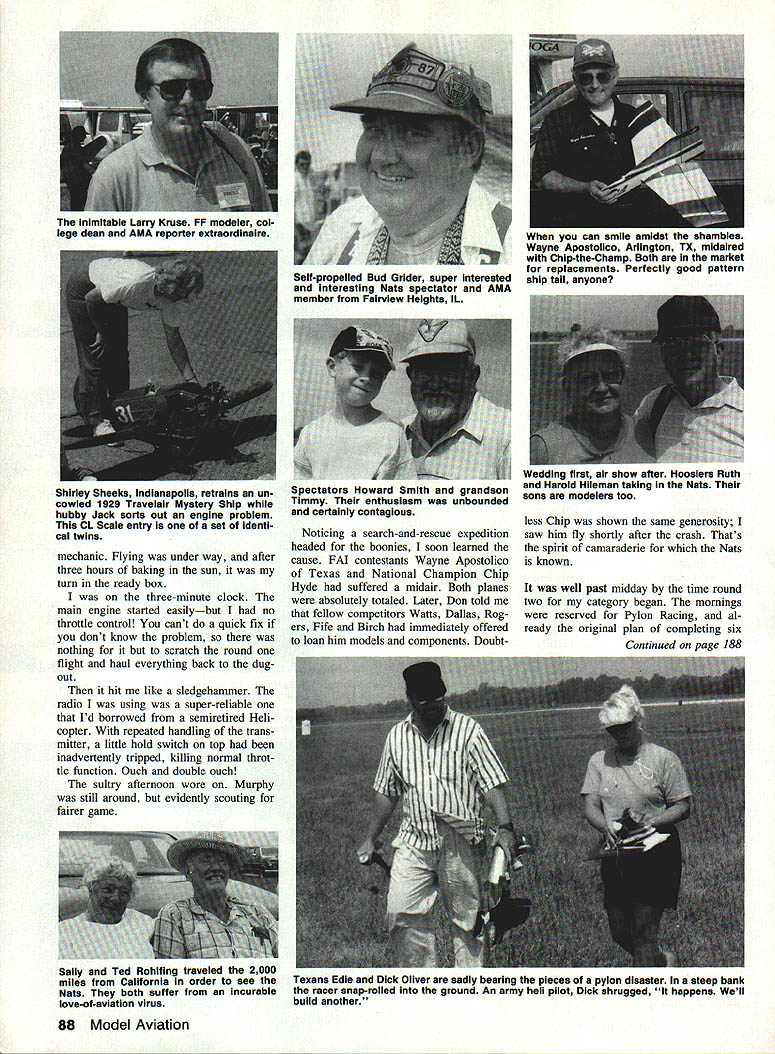
Noticing a search‑and‑rescue expedition headed for the boonies, I soon learned the cause. FAI contestants Wayne Apostolico of Texas and National Champion Chip Hyde had suffered a midair. Both planes were absolutely totaled. Later, Don told me that fellow competitors Watts, Dallas, Rogers, Fife and Birch had immediately offered to loan models and components. Doubtless Chip was shown the same generosity; I saw him fly shortly after the crash. That's the spirit of camaraderie for which the Nats is known.
It was well past midday by the time round two for my category began. The mornings were reserved for pylon racing, and already the original plan of completing six rounds in three afternoons looked logistically impossible—there were just too many contestants. Shadows grew long and the haze was close to IFR.
Just before the 8:00 p.m. curfew, my turn couldn't be put off any longer. Nerves thoroughly numbed by now, I executed the sequence without either incident or elegance. I think I used more ESP than visual tracking. Mercifully, I never caught up with the scoresheet.
After that, my long‑suffering wife and I made it back to our motel dining room 30 miles away a mere 10 minutes before they locked the door. So there, Murphy! You don't win all the time!
Thanks to the volunteers
Actually, with the patience, endurance and dedication of the judges, line officials and other contest personnel, that old demon chaos can't get a toehold at a Nats. Dry roasting in the sun all day, this varied crew did a splendid job. They deserve all the thanks and appreciation we can express, and then some!
How do they do it? Year after year, Vince Mankowski and his Nats search committee come up with a good site. It's amazing.
George Field and the region
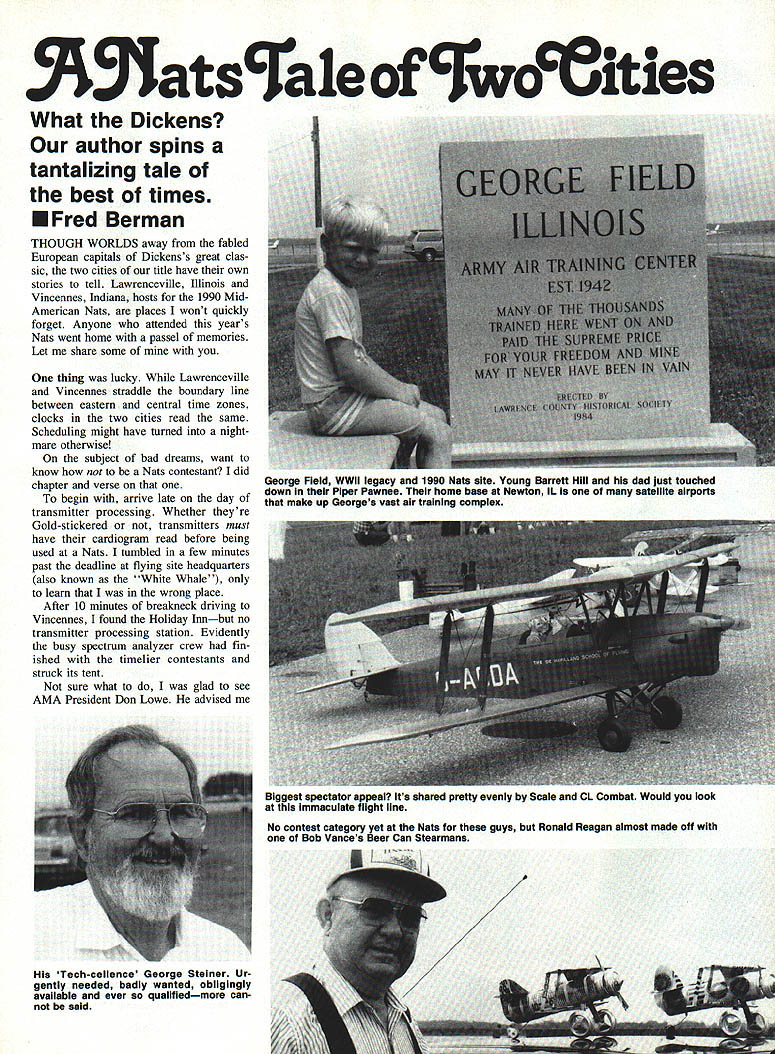
At the Mid‑American Air Center we flew off of George Field, a World War II Army Air Force training base named after the general who served as its first commander. It's a 3,000‑acre facility with mile‑long runways. Ray Pickering, the genial veteran service manager, recalled that hundreds of WACs as well as troop‑carrying gliders had been part of the scene at George Field during the forties.
As at many such air bases, grisly accidents sometimes occurred. One rookie pilot missed his approach and smacked into a house near the field, starting a fire in which both adult residents perished. When firemen reached the scene they found a three‑year‑old girl, unhurt, wandering outside in tears. She was raised by relatives in another state. When she visited Lawrenceville some 30 years later, local folks gave her a big party.
Forgetfulness also causes accidents in full‑scale flying. A pilot lost his life at George Field after failing to remove the locks from his airplane's tail surfaces.
Economic survival of a large government facility is difficult after Uncle Sam pulls out. A former military base with low population density, limited fixed base operations, a dearth of major industrial patronage, and without a scheduled airline stop is hardly destined for vigorous growth. Even maintaining a healthy status quo isn't assured. Already a shoe manufacturer and an oil refinery have ceased local operations at George Field.
The airfield is administered jointly by the states of Illinois and Indiana through an appointed commission. There's hope for revitalization. I was told that runway improvements are gradually being implemented as funds become available. And the area has one ingredient that is often in short supply elsewhere: space.
Rolling past lush, green and nearly flat midwestern farms with homesteads not less than a mile apart, I was struck by the contrast with my home state of Pennsylvania. Though my own town shows no identifiable symptoms of exploding into a megalopolis, Pennsylvania is dotted with mill towns (the mills, often as not, cold and silent), where houses lean on one another and yards are postage‑stamp size or nonexistent. Such population density breeds any number of ills. Like it or not, neighbors are unavoidably aware of each other's comings and goings.
The rugged, open expanse of the Midwest brings its own problems. A farmer's lot can be severe and ridden with hardship. Herds of buffalo seem ever more like cattle. Still, lifting my gaze above that limitless sweep of unsullied horizon, I gave mute thanks to the great Creator for this bountiful, tranquil land, so different from the sprawling developments, crowded cities and clunky monuments to commerce and technology of the eastern states.
Romance in aeromodelling
If we needed a reminder that there's romance in aeromodelling, going to a Nats would do it. Mankind's love affair with aerial vehicles, be they live or mechanical, probably began long before Daedalus tried gluing feathers to his arms; airplanes, whether full‑scale or model, are deep in the hearts of more people than is commonly imagined.
That fascination with things aeronautical is everywhere at a Nats. Maybe we don't need a stadium, as yet, to accommodate the spectators at these meets. But the Nats do draw a lot of folks who are enthusiastically committed to the hobby. So let's turn our backs to the shining stars of modeldom and meet some of their public.
Faces at the Nats
- Howard Smith (Arizona): A retired Bendix guided‑missile engineer. Though this was his first Nats, Howard was snared by model aviation early in life. He began building and flying as a young boy and got on the ground floor of RC with a little plane called a rudder bug (a twitching rudder was the only control available to the pilot). As RC matured Howard became an expert pattern flier, started a club, taught others to fly and even got into the hobby shop business as a sideline. He had several reasons for looking in on the Nats, not the least of which was to give a boost to fellow club member Chip Hyde.
- Bob McDonald (Princeton, IN): Lives only a little over an hour's drive from the Nats venue. Though his interest in modeling reaches way back, Bob's involvement has never been limited—he was a control‑line flier and a free‑flighter once. When a free‑flight model became a little too free, Bob chartered a full‑scale plane to try to capture the fugitive aircraft. Bob is the equivalent of most sports fans: he likes to watch rather than to compete himself. He's recently retired and expects to accelerate his modeling activities.
- Bud: Took a sabbatical from modeling while helping his wife raise a family of seven. His fascination with warbirds is back on track, and he's into pylon racing with military‑scale models. Bud once kept himself in the race by recycling slightly used Popsicle sticks as wing joiners. He belongs to the Spirit of St. Louis RC Club and never misses the Oshkosh Fly‑In. Now that he's tasted a Nats, he may never miss another.
- Harold and Ruth Milheim: Both model enthusiasts. Ruth had already built and flown rubber‑powered models when they married, so she didn't mind accompanying her husband for two weeks to a Fort Wayne area show. A corpsman with the U.S. Army Engineers, Hal has the heart of a master mechanic. He's skilled in electromechanical work and built his own RC radios. Hal is planning to retire soon and is looking forward to getting more time at the workbench. A Skylane 62 project begun a few years ago still isn't ready for debut; Hal is bullish about completing the Cessna. He and Ruth got a kick out of kibitzing at the Nats.
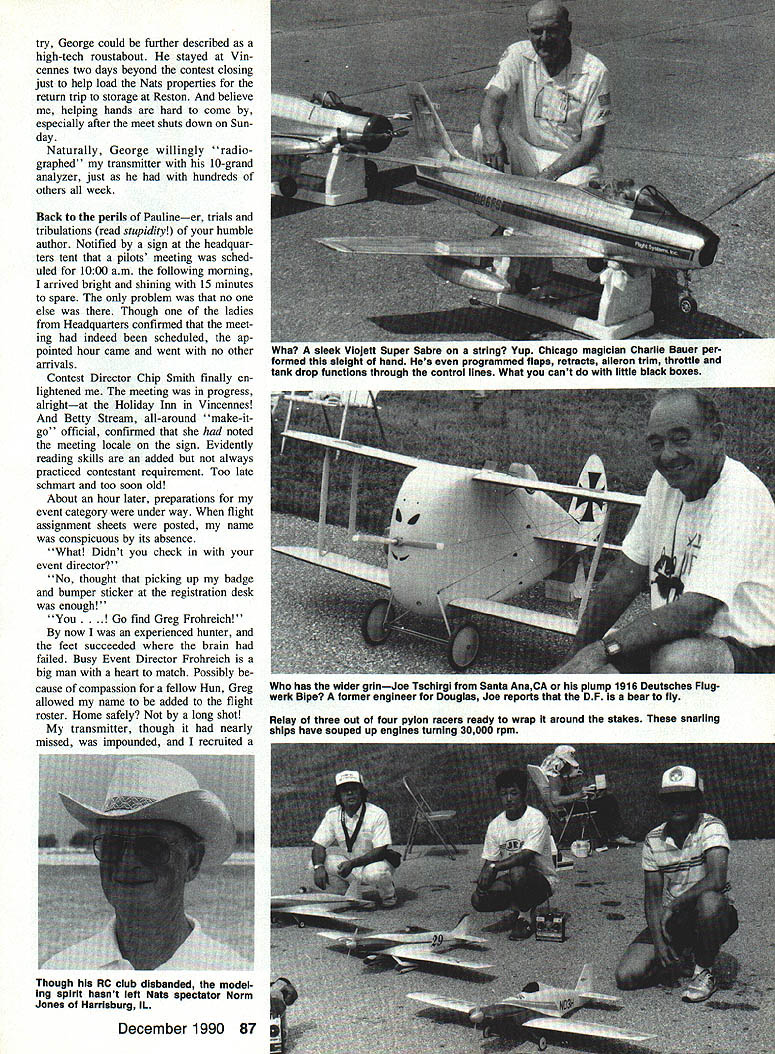
- Norm Jones (Harrisburg, IL): Has traveled more than a hundred miles to attend. Unfortunately, he has no easy access to a modeling club or fellow enthusiasts in his area.
- Larry Kruse (Liberal, KS): When he isn't flying in an event, this free‑flight builder and competitor puts on his press badge and does his best to keep the Model Aviation readership informed about happenings at the big meet. Away from the modeling scene, Larry serves as a college dean.
If you want to meet and fraternize with devotees of almost every kind of model flying, a Nats is the place to be. If you want to feel like part of a living mosaic of our hobby, a Nats is the place to be. Each time I've reported on the contest for Model Aviation I've considered it a privilege to get to know so many of these fascinating, enthusiastic people. If space permitted, I'd love to regale you with more of their unique stories and experiences. Alas, I'll have to limit myself to one final mention.
Final thoughts
As a footnote to this Nats diary, I want to second the view expressed by AMA President Don Lowe about a year ago. Our country has a vast reserve of modelers who haven't joined AMA—independents who build and fly on the fringe. If the AMA, the modeling clubs and the hobby industry were to provide appropriate incentives, America's organized modeling fraternity could easily triple in numbers. Growing membership rosters are just one piece of evidence that the interest is there.
Viva aeromodelling — viva the Nats!
Transcribed from original scans by AI. Minor OCR errors may remain.

