
NEAT
By Bob Kopski
The first Northeast Electric Aircraft Technology fair (NEAT) was held September 22–24, 2000 at the Peaceful Valley Campsite in Downsville, NY. This site is in a corner of the Catskill Mountains, along the East Branch of the Delaware River. It is located just off Route 30, approximately 10 miles north of the intersection of NY Routes 17 and 30 (Exit 90). It was very easy to find. (You will want these details for next year!)
The area in general is outdoorsy, with small towns and motels/cabins spread along Route 17. One nearby location is described as the "trout fishing capital of the world." Since this is a generally mountainous setting, one naturally wonders where one might fly there. Not to worry! The region has much to offer as a family vacation site (keep that in mind for next year). There were families with kids on-site, which is always nice to see.
The Meet and Purpose
The NEAT fair, presented by the Silent Electric Fliers of Long Island club (SEFLI), was intended as a revival, a follow-on, and a continuation of the spirit of the well-known KRC Electric Fly. The KRC meet was discontinued, much to the dismay of many, after an 18-year reign as the top electric meet anywhere. The good news is that the first-ever NEAT fair was one terrific E‑meet — it achieved the goal of a rebirth and it will continue in the future.
Since I was intimately associated with the KRC throughout its tenure, I can categorically declare that the 2000 NEAT gathering was a whopping meet-in-kind. This affair is certainly a candidate for "Greatest Electric Show on Earth." It had all the makings — superb and enthusiastic management, a great site, huge attendance, hundreds of electrics, good frequency and flight station control, extensive industry support, and vendor participation. It also featured raffle prizes, a prevailing atmosphere of friendliness and fun, many examples of electric craftsmanship, creativity, achievement, showmanship, on-site camping, food and rest facilities, and even early signs of overcrowding. This gathering outdid its predecessor in at least one important way: it was a three-day flying affair.
Field Layout and Site
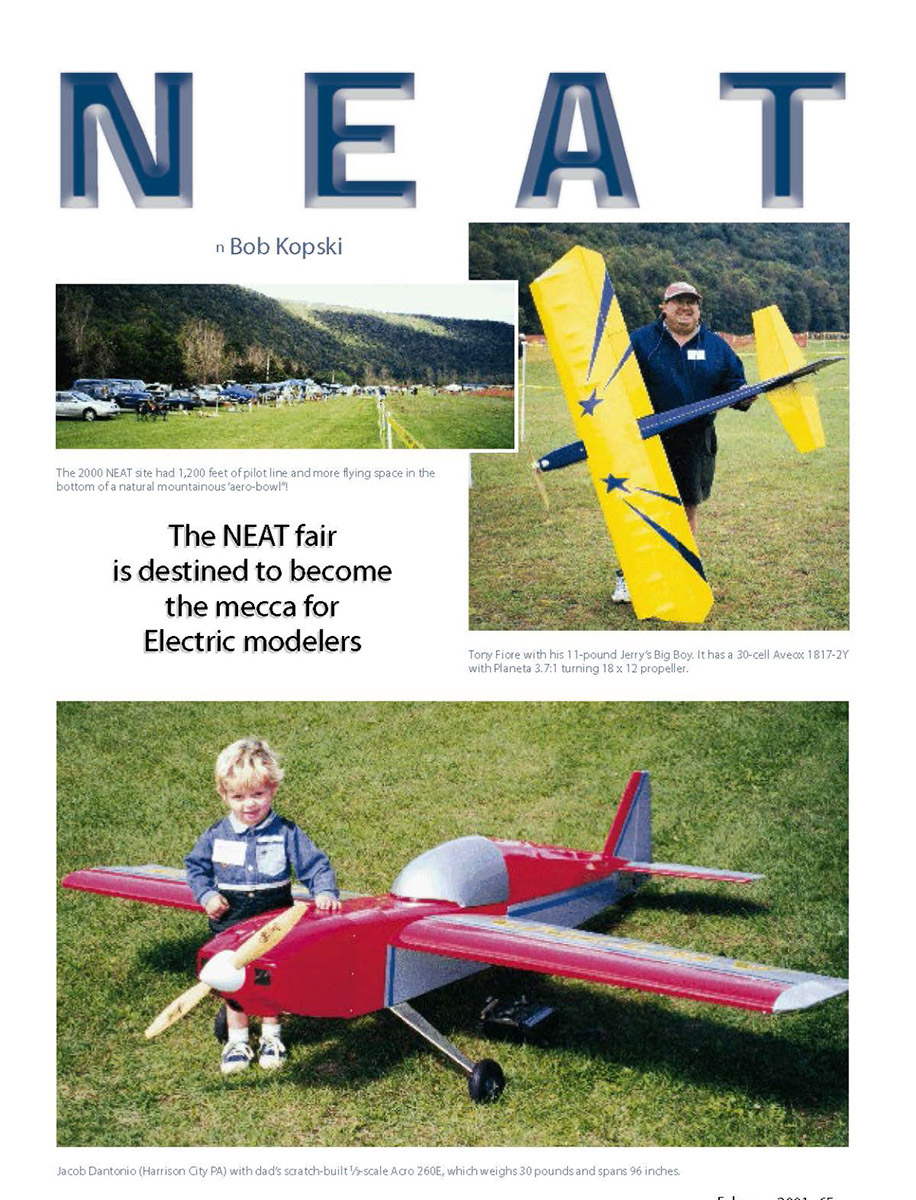
The "overcrowding" statement is a bit of a stretch. This first-ever field layout was nearly full with 195 registrants and hundreds of other attendees, but meet management is already adjusting it for next year. The 1,200-foot flightline, arranged roughly in the middle of a half-mile-long span of campgrounds and alongside the 100 x 600-foot runway, is not the limit of the site—it's the first attempt at setting it up. That is fortunate, because as the NEAT word spreads, interest will spread; I expect a quantum jump in attendance next year.
One clever aspect of the field layout was the designated spectator area. It was a sort of spectator promenade between the pit area and the active runway area. The arrangement made it easy for spectators to see. There was much to be seen, and the three days were insufficient to cover all I would have liked in detail.
The field lies in a gorgeous setting. Picture a huge, smooth, grassy flying field that forms the base of an enormous natural bowl—the sides of which are majestic mountains. This high-rise earthen perimeter was a bit intimidating at first, but in reality it was plenty far away. Pilots flew "in tight" at first, as if feeling bound, then gradually opened up as they realized the actual distance.
The mountains and the setting as a whole formed a spacious, awesome, and austere site, with an encompassing quietness consistent with the nature of electric flying. Meet activity was essentially casual, with an open-fly nearly all the time, and there were a few periods of demonstration flying.
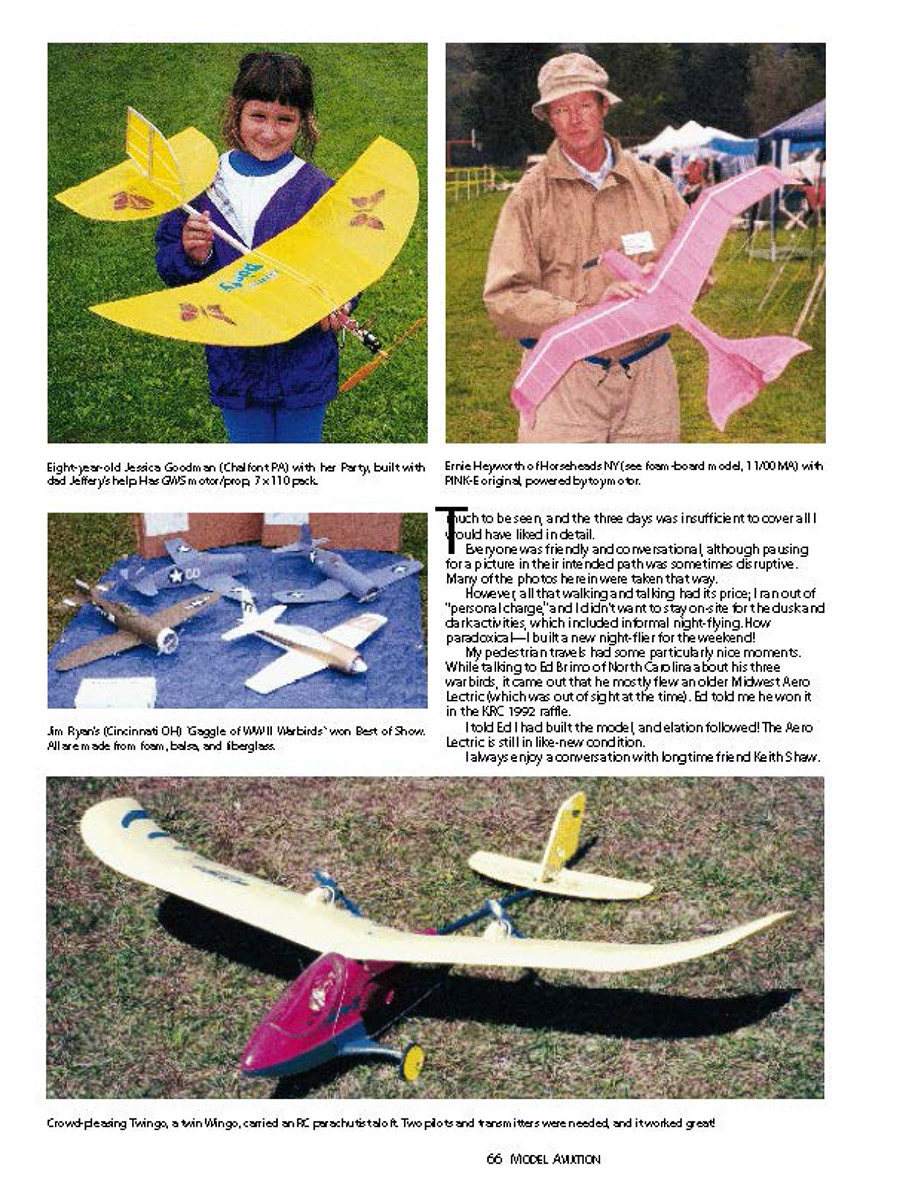
There were times of stiff wind and/or small amounts of precipitation during the three days, and early mornings and evenings had their own kind of chill. But overall, there was an abundance of flight opportunity and a nearly steady line behind the 10 flight stations. Although there were a few mishaps during the weekend, such incidents were minimal for a gathering this size. Competitive events were limited to judgment determinations and did not interfere with general flying.
Highlights and Notable People
- Everyone was friendly and conversational — though pausing for a picture in someone's intended path was sometimes disruptive. Many of the photos I took were made that way.
- I ran out of personal charge and didn't want to stay on-site for the dusk and dark activities, which included informal night-flying. How paradoxical — I built a new night-flier for the weekend!
- While talking to Ed Brimo of North Carolina about his three warbirds, it came out that he mostly flew an older Midwest Aero Lectric (which was out of sight at the time). Ed told me he won it in the KRC 1992 raffle. I told Ed I had built the model; elation followed! The Aero Lectric is still in like-new condition.
- I always enjoy a conversation with longtime friend Keith Shaw. We go way back; Keith had been a KRC regular in the early 1980s. Many modelers at NEAT were early — and recent — KRC attendees. Keith performed some demonstration flights. His crowd-pleasing airplanes and performance are highlights at any meet. Although Keith is known mostly for his large and powerful scale designs, he has joined the "star" fliers crowd with his Astro 01‑powered 1970s Formula I racer.
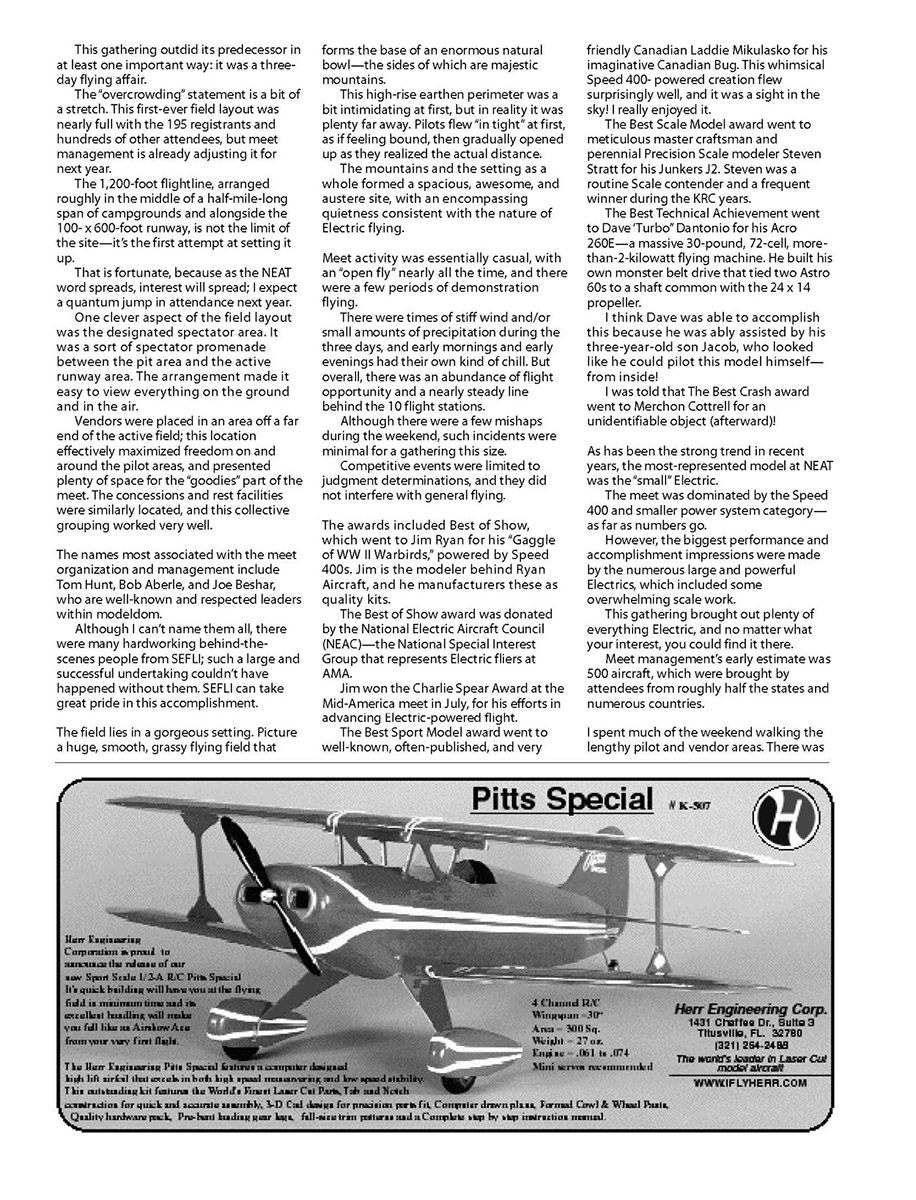
Probably the most touching conversations I had were with families, especially with the kids. Little ones can be a surprise source of glee. While setting up a picture of a Quaker belonging to Jeffery Goodman, his daughter Jessica arrived and asked if the picture could be with her plane instead of her father's. So be it, Jessica — and thank you very much! These kinds of encounters make even the largest gathering feel warm and personalized.
The easygoing and gentlemanly Jim Martin of Hobby Lobby put on a crowd-pleasing show with the Twingo family and an onboard radio-control parachutist. The Twingo is a two-motor version of the very popular Wingo. The Twingo was taken up high and flown to a high spot near the field. Then the parachutist was released and made a guided descent to the field. This took two pilots to orchestrate; it all worked very well and the crowd cheered! Hobby Lobby has been big on electrics for almost as long as anyone.
Awards
- Best of Show: Jim Ryan — "Gaggle of WWII Warbirds," powered by Speed 400s (award donated by the National Electric Aircraft Council, NEAC). Jim is the modeler behind Ryan Aircraft and manufactures these as quality kits. Jim had also won the Charlie Spear Award at the Mid-America meet in July for his efforts in advancing electric-powered flight.
- Best Sport Model: Laddie Mikulaszko — Canadian Bug (Speed 400–powered), an imaginative and whimsical design that flew surprisingly well.
- Best Scale Model: Steven Stratt — Junkers J2. Steven is a meticulous master craftsman and perennial precision-scale modeler.
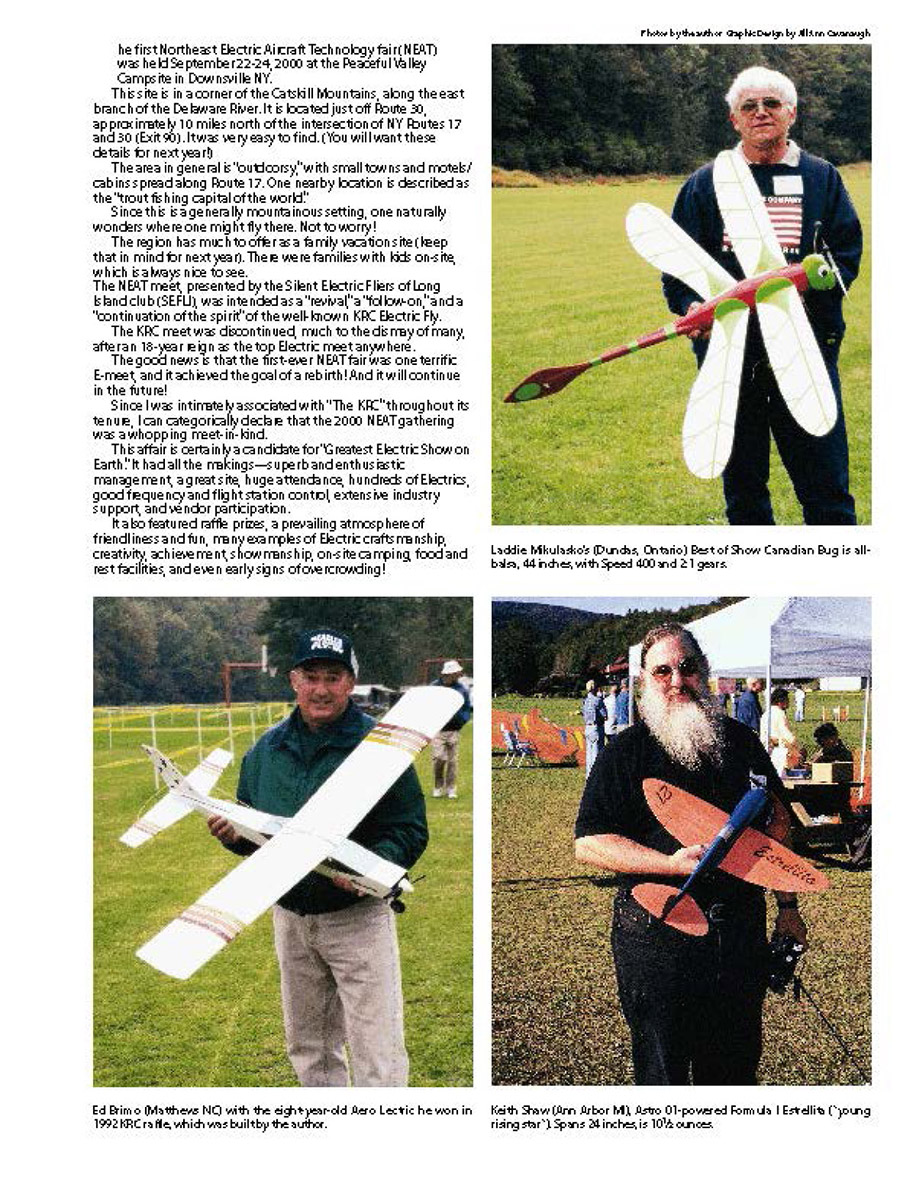
- Best Technical Achievement: Dave "Turbo" Dantonio — Acro 260E, a massive 30-pound, 72-cell, more-than-2-kilowatt flying machine. He built a monster belt drive tying two Astro 60s to a common shaft with a 24 x 14 propeller. Dave was ably assisted by his three-year-old son Jacob, who looked like he could pilot the model himself — from inside!
- Best Crash (humorous): Merchon Cottrell — unidentifiable object afterward.
Types of Aircraft and Attendance
As has been the strong trend in recent years, the most-represented model at NEAT was the "small" electric. The meet was dominated numerically by the Speed 400 and smaller power systems. However, the biggest performance and accomplishment impressions were made by the numerous large and powerful electrics, which included some overwhelming scale work. This gathering brought out plenty of everything electric, and no matter what your interest, you could find it there.
Meet management's early estimate was 500 aircraft, brought by attendees from roughly half the states and numerous countries.
I spent much of the weekend walking the lengthy pilot and vendor areas. There was a terrific showing of creativity, craftsmanship, and product support from manufacturers and hobby shops, and the camaraderie among attendees was outstanding.
Vendors and New Products
Since I mentioned one popular park flier in my column, I must note that many other products in kind were featured at this meet. Not only were many flown, but many were shown in the vendor area.
- Northeast Sailplane Products had many park fliers on display in its always-crowded booth.
- Glen Merritt of Hitec/San Diego brought some Sly Scooter Almost-Ready-to-Flys (ARFs). Hitec is promoting All Up/All Down and Pylon events for these models at the 2001 Silent Electric Fliers of San Diego meet. Look for an advanced version of the Sly Scooter in the near future.
- I got some stick time on a product-to-be — a simple two-channel, toy-like Rogallo design that offered serious performance. It is a foolproof, nearly crash-proof design that is very easy to fly and all fun. Watch for this ARF in coming months, as pricing and distribution plans are finalized. It's something I'd keep in the car for those occasions when youngsters happen by the field — any field!
Reflecting on all the "small stuff" at NEAT, I stand amazed at what electrics are bringing about within our hobby. The contemporary explosion in small RC aircraft is an easy path to the youth market and a genuine advance for aeromodeling. It's easier than ever to get someone into modeling, and this opportunity could not exist with any other power source.
Those foam toss-gliders promoted in mailings each spring are one thing; I can imagine the day when inexpensive, quality, unobtrusive RC electrics — and therefore more comfortable in a larger way — are promoted in the same manner.
These meets have been the electric showplaces and proving grounds. They are the interface with the rest of aeromodeling — and with the public. Just a few years ago, some suppliers wouldn't even talk electric; now they are electric suppliers, because more and more, they have to be. Electric is proving itself, and the retailer and supplier base have increased by a magnitude of orders during the past two decades. History will have electric as the biggest boost to aeromodeling since IC itself. I see electric as the future — always have.
Aftermath and Closing Thoughts
I have communicated with Tom Hunt since NEAT2000, and he had some post-meet comments to share:
"...we [SEFLI] accomplished our objective the first year — to continue the long-standing tradition of the KRC Electric Fly, which provided a place for electric modelers and vendors to mix and exchange ideas. We hope to continue this for many years, as KRC did!"
From the first club-sponsored KRC Electric Fly with three attendees in 1980 to this wonderful SEFLI/NEAT rebirth in 2000, and electric meets everywhere in between, it's been one grand electric flight!
Keep chargin'!
Bob Kopski 25 West End Dr. Lansdale, PA 19446
Transcribed from original scans by AI. Minor OCR errors may remain.

