
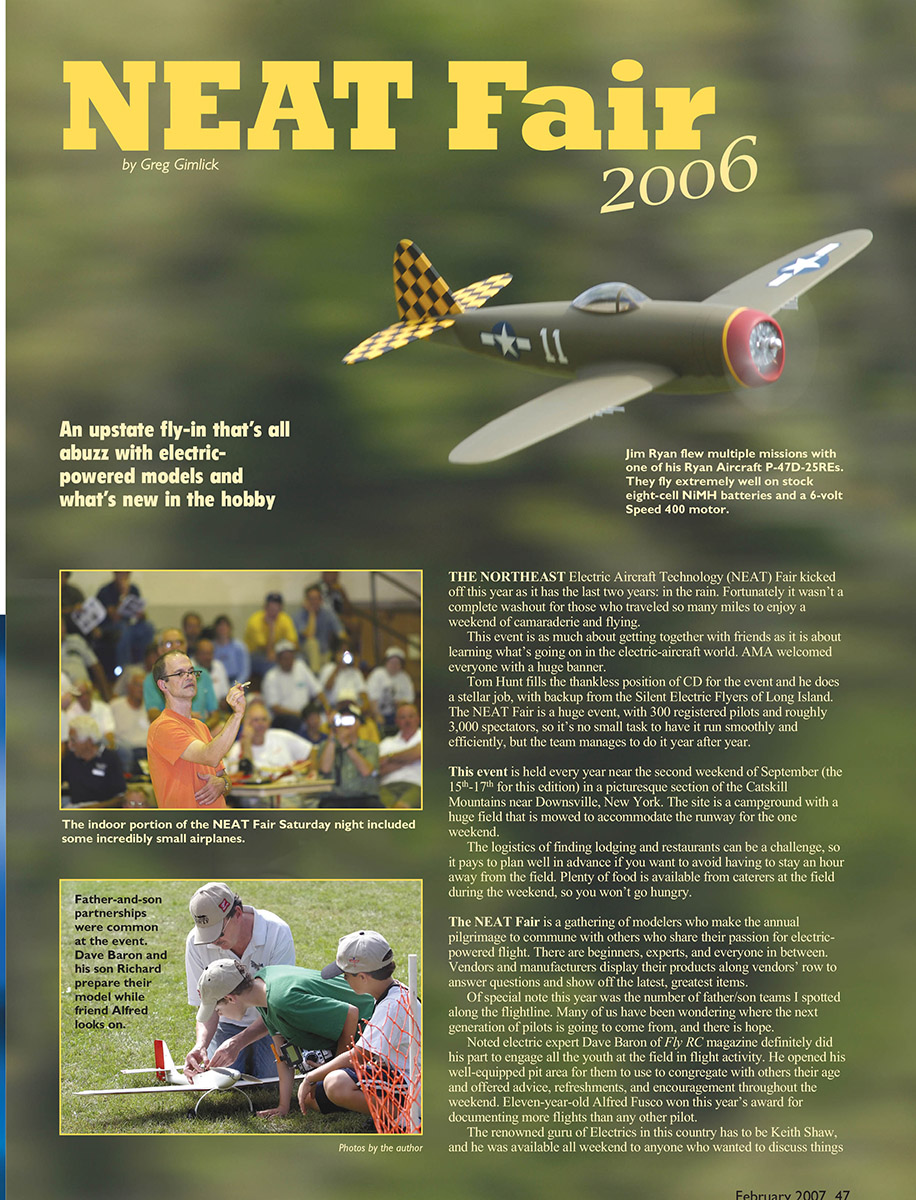
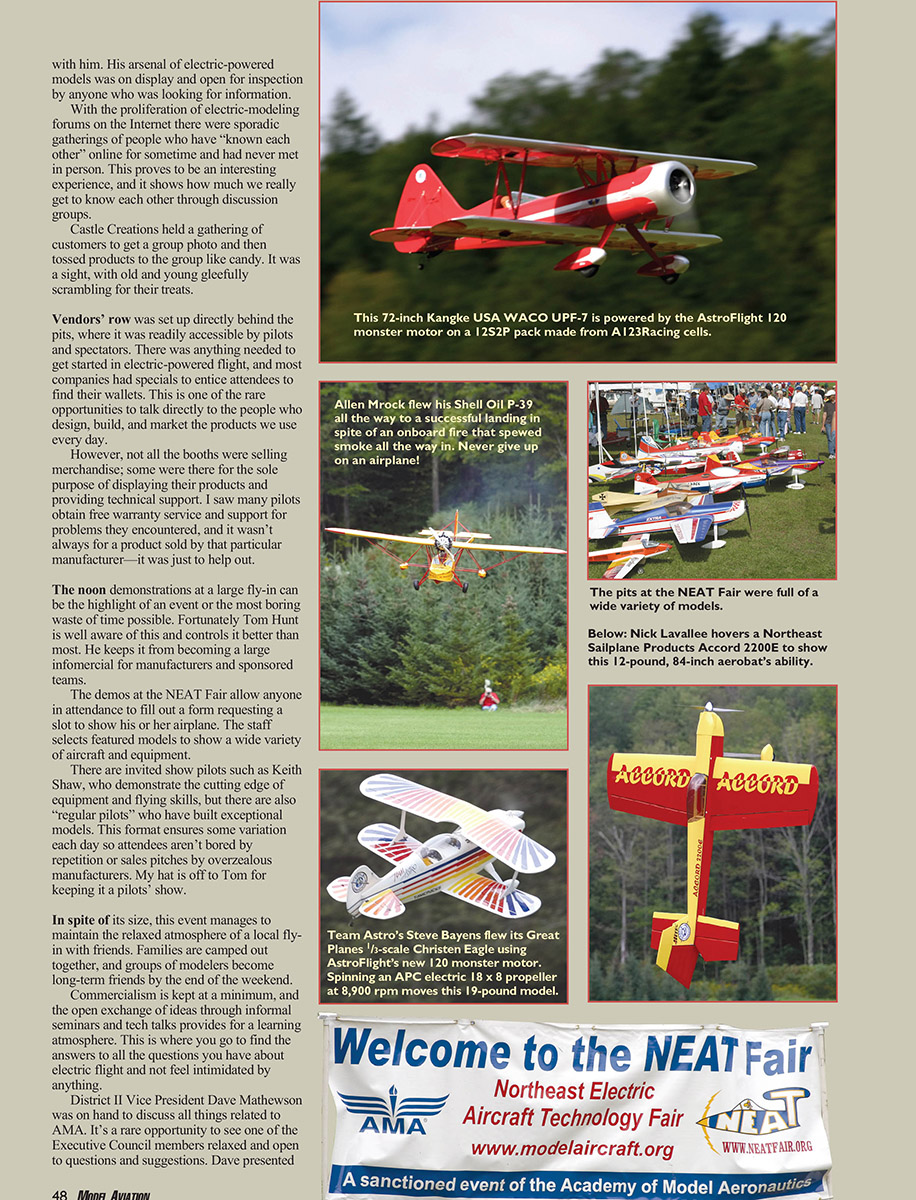
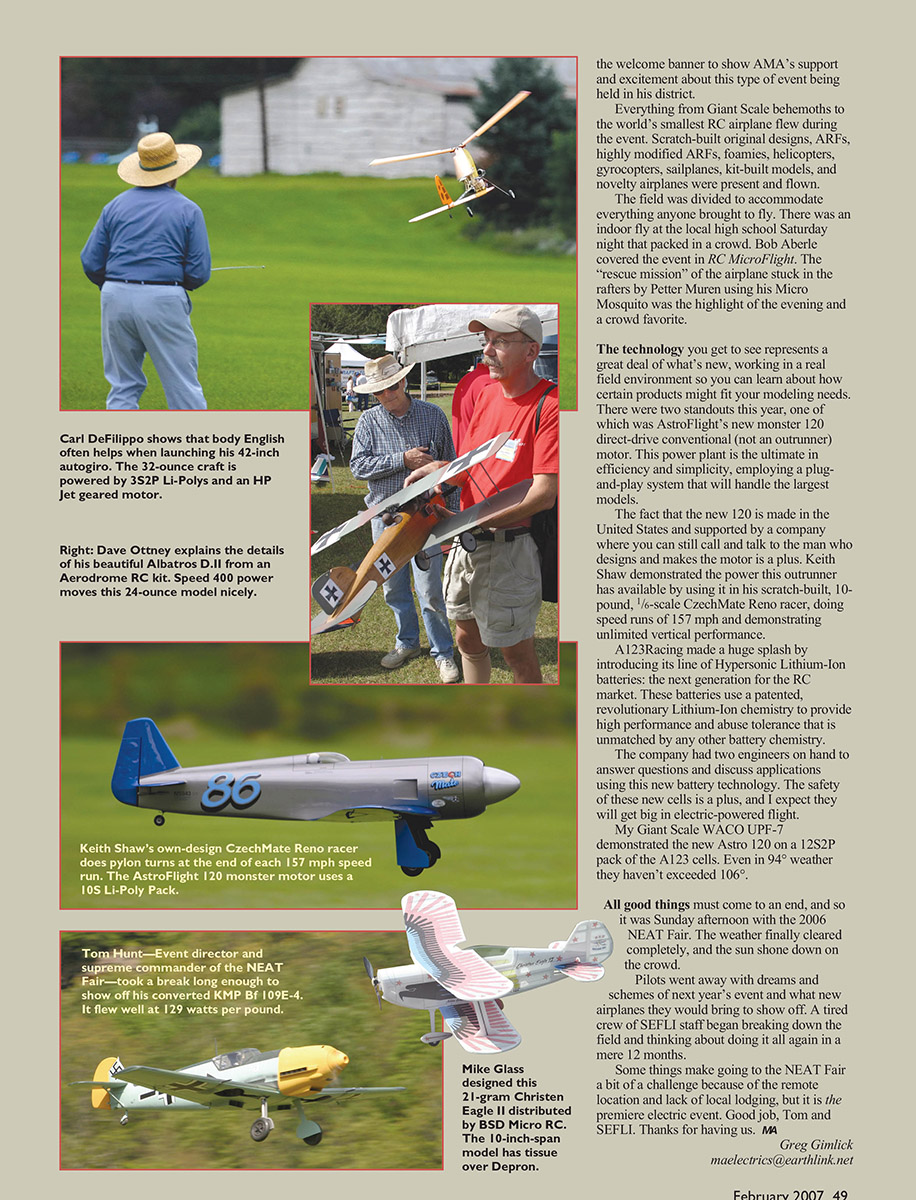
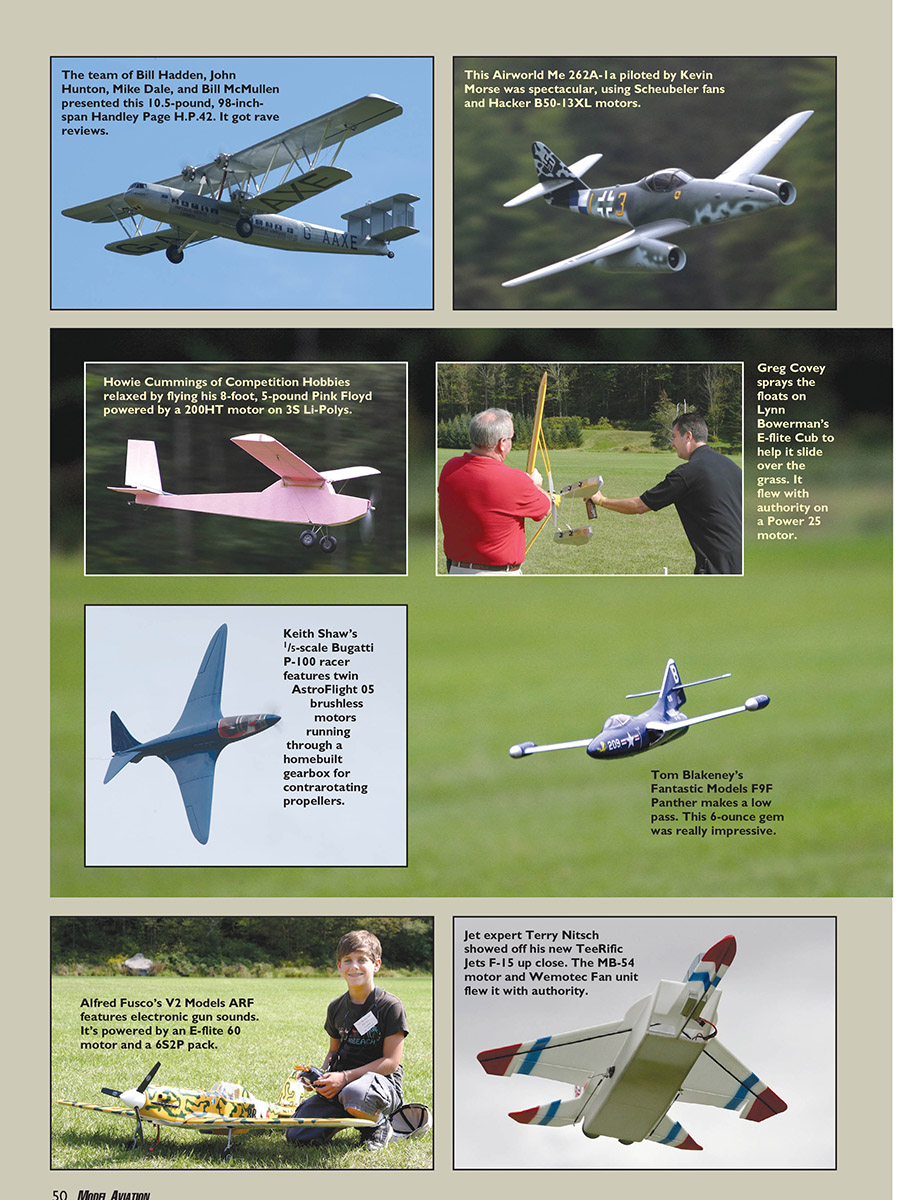
NEAT Fair 2006
by Greg Gimlick
Overview
The NORTHEAST Electric Aircraft Technology (NEAT) Fair kicked off this year as it has the last two years: in the rain. Fortunately it wasn't a complete washout for those who traveled so many miles to enjoy a weekend of camaraderie and flying.
This event is as much about getting together with friends as it is about learning what's going on in the electric-aircraft world. AMA welcomed everyone with a huge banner.
Tom Hunt fills the thankless position of CD for the event and does a stellar job, with backup from the Silent Electric Flyers of Long Island (SEFLI). The NEAT Fair is a huge event, with about 300 registered pilots and roughly 3,000 spectators. It is no small task to have it run smoothly and efficiently, but the team manages to do it year after year.
Location and logistics
The event is held every year near the second weekend of September (the 15th–17th for this edition) in a picturesque section of the Catskill Mountains near Downsville, New York. The site is a campground with a huge field that is mowed to accommodate the runway for the one weekend.
Finding lodging and restaurants can be a challenge, so it pays to plan well in advance if you want to avoid staying an hour away from the field. Plenty of food is available from caterers at the field during the weekend, so you won't go hungry.
Community and youth
The NEAT Fair is a gathering of modelers who make the annual pilgrimage to commune with others who share their passion for electric-powered flight. There are beginners, experts, and everyone in between. Vendors and manufacturers display their products along vendors' row to answer questions and show off the latest items.
Of special note this year was the number of father/son teams spotted along the flightline. Many have wondered where the next generation of pilots will come from, and there is hope.
Dave Baron of Fly RC magazine engaged youth at the field in flight activity. He opened his well-equipped pit area for them to congregate, offering advice, refreshments, and encouragement throughout the weekend. Eleven-year-old Alfred Fusco won this year's award for documenting more flights than any other pilot.
Keith Shaw, a renowned guru of electrics, was available all weekend to discuss electric flight and to display his arsenal of electric-powered models.
With the proliferation of electric-modeling forums on the Internet, there were sporadic gatherings of people who had "known each other" online and had never met in person. This proved an interesting experience and showed how much can be learned through discussion groups.
Vendors and demonstrations
Castle Creations held a gathering of customers to get a group photo and then tossed products to the group like candy, with old and young gleefully scrambling for treats.
Vendors' row was set up directly behind the pits, readily accessible by pilots and spectators. There was everything needed to get started in electric-powered flight, and many companies ran specials to entice attendees. This is one of the rare opportunities to talk directly to the people who design, build, and market the products we use every day. Not all booths were selling merchandise; some were there solely to display products and provide technical support. Many pilots obtained free warranty service and support, sometimes even from manufacturers whose product was not the one needing service—just to help out.
The noon demonstrations at a large fly-in can be either a highlight or a boring waste of time. Tom Hunt kept things in balance and prevented the demos from becoming infomercials for manufacturers and sponsored teams. Anyone could request a slot to show an airplane; the staff selected featured models to ensure a wide variety of aircraft and equipment were displayed. Invited show pilots such as Keith Shaw demonstrated cutting-edge equipment and flying skills, and "regular pilots" showed exceptional homebuilt models. This format ensured variety each day and kept the focus on pilots and their flying.
Events and activities
In spite of its size, the event maintained the relaxed atmosphere of a local fly-in with friends. Families camped together, and groups of modelers forged long-term friendships by the end of the weekend. Commercialism was kept at a minimum, and an open exchange of ideas through informal seminars and tech talks provided a strong learning atmosphere.
District II Vice President Dave Mathewson was on hand to discuss AMA-related matters and presented the welcome banner to show AMA's support and excitement about this type of event in his district.
There was an indoor fly at the local high school Saturday night that packed in a crowd. Bob Aberle covered the event in RC MicroFlight. The "rescue mission" of an airplane stuck in the rafters by Petter Muren using his Micro Mosquito was a highlight and a crowd favorite.
Technology highlights
The technology on display represented much of what's new and working in real field environments, allowing attendees to learn how certain products might fit their modeling needs. Two standouts this year were:
- AstroFlight's new monster 120 direct-drive conventional motor (not an outrunner). This power plant emphasizes efficiency and simplicity, employing a plug-and-play system capable of handling very large models. The fact that the new 120 is made in the United States and supported by a company where you can still call and talk to the designer/manufacturer is a plus. Keith Shaw demonstrated the power this motor offers in his scratch-built, 10-pound, 1/6-scale CzechMate Reno racer, doing speed runs of 157 mph and demonstrating unlimited vertical performance.
- A123 Racing introduced its line of Hypersonic Lithium-Ion batteries: the next generation for the RC market. These batteries use a patented Lithium-Ion chemistry to provide high performance and improved abuse tolerance. The company had two engineers on hand to answer questions and discuss applications. The safety of these new cells is a plus, and they are likely to gain popularity in electric-powered flight.
My Giant Scale WACO UPF-7 demonstrated the new Astro 120 on a 12S2P pack of A123 cells. Even in 94° weather the pack temperature did not exceed 106°.
Aircraft variety
Everything from Giant Scale behemoths to the world's smallest RC airplane flew during the event. Present and flown were:
- Scratch-built original designs
- ARFs and highly modified ARFs
- Foamies
- Helicopters
- Gyrocopters
- Sailplanes
- Kit-built models
- Novelty airplanes
The field was divided to accommodate everything attendees brought to fly.
Conclusion
All good things must come to an end, and Sunday afternoon marked the close of the 2006 NEAT Fair. The weather finally cleared completely, and the sun shone down on the crowd. Pilots left with dreams and plans for next year's event and the new airplanes they would bring. A tired SEFLI crew began breaking down the field and thinking about doing it all again in a mere 12 months.
Some aspects of the event—like its remote location and limited local lodging—make attendance a bit of a challenge, but the NEAT Fair remains the premiere electric event. Good job, Tom and SEFLI. Thanks for having us.
Greg Gimlick maelectrics@earthlink.net
Transcribed from original scans by AI. Minor OCR errors may remain.

