
New Comers
Bob Underwood
The May New Comers column contained a reference to pushrods that seemed to suggest that the "plastic rod-within-a-housing" type should not be used; this is incorrect. This pushrod type works great — I almost always use them on my models. The same reference also contained an editing error that called for pushrods to be supported by hinges; pushrods should be supported, but such support should be immovable — not by hinges!
WELCOME TO the 1997 New Comers issue! When I was asked to do this column a couple of years ago, I was approached to continue (or revive) a column that had used the term "beginner." I balked at using that word because many individuals who might be interested in reading the column are more along the lines of "returnees" as far as skills are concerned. Some 60-year-olds don't like to be referred to as novices, but they realize they are returning to a hobby that involves new materials and concepts. They need to adapt still-valid old skills to new things.
This subject is all semantics, much like the case of some purists who are concerned about grammatical usage, such as "Bring it to your mom" (who is in the next room) when you mean "Take it to your mom," or "My brother that lives in St. Louis" — perhaps your brother doesn't mind being a "that" instead of a "who."
As I get into the meat of this column, I trust you won't be upset if I'm redundantly repetitive and state that it's about déjà vu all over again!
Thingamabob Revisited
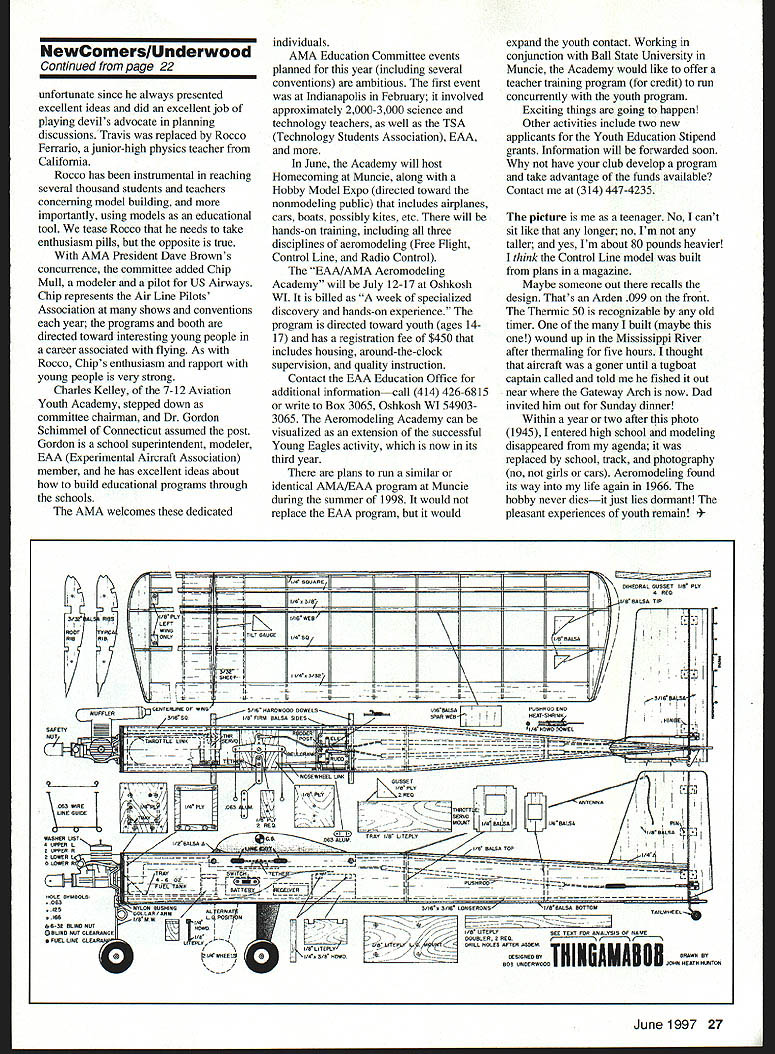
On page 62 in the April 1990 Model Aviation was an article about a multipurpose trainer I designed. Thingamabob, a name coined by a fellow St. Louis modeler, presents interesting flight options within one model. It can be flown as:
- a Radio Control trainer using a glow engine or an electric motor
- a tail-dragger or tricycle-gear format
- a pure Control Line model
- a tethered RC model
Some people think the model must be revised in the building process to accommodate the possible configurations, but when built from the plans the model can be converted at the flying site within five minutes.
The element requiring explanation is "tethered RC." The plans accompanying the article show a metal post extending through the left side of the fuselage at the center of gravity (CG). The line guide attached to the wingtip has a center loop to accommodate a single control line that is attached to a post device with a swivel top in the center of the circle.
For tethered RC setup:
- Remove the rudder pushrod from the servo control arm and attach it to a fixed metal rudder post, inducing a right turn to the rudder and nose wheel (if configured with trike gear).
- The model stays out on the line and flies in a circle in front of you.
- The center post is either firmly anchored to pavement with a couple of concrete blocks on its base or staked to the ground tent-like if it's dirt.
Why fly tethered RC? The main advantage is that the model won't fly away from you. Using a Mode II radio system, newcomers can get experience coordinating elevator and throttle without worrying about the model skating right or left, toward or above the horizon. Once the elevator feel is established, directional control can be developed. You are close to the model, outside the circle, and movements of the elevator control can be quickly confirmed.
The downside is that the tethered model cannot tolerate much wind. Unlike a Control Line model, if this one goes slack on the line while flying crosswind on the upwind side of the circle, you can't backpedal to pick up the slack.
The Thingamabob is designed to be a trainer and nothing more. It is ultra-simple to construct. Using cyanoacrylate (CyA) adhesives, plastic covering, etc., an experienced modeler can build one in 10–12 hours. No exotic materials are used, and the model can easily be adjusted during building to accommodate virtually any engine or motor combination up to a .25 glow.
Construction and power notes:
- The original used a K&B Sportster and a geared .05 electric.
- There is no sheeting to bend around the wing leading edge.
- The fuselage side is a simple 1/8" x 3" x 36" sheet with an angle sliced off the top.
- The power plant change incorporates the old ignition-era tray attached to the firewall. In the glow configuration, the tray contains the fuel tank and throttle servo; in the electric version, "fuel" in the form of batteries is located on the tray.
So far the dialogue about the Thingamabob has been directed at somewhat experienced modelers. It would be a good model for them to use for instruction in the building process. Most techniques involved in building are present in the model's construction.
If you are interested in trying this approach to learn the types of flying (except Free Flight, unfortunately), get a set of the plans; full-size ones (number 649) are available from AMA for $7.50. If you contact me, I can supply a copy of the April 1990 article; although it is not a detailed building outline, it does provide some "look-out-for" information.
If someone would like to kit the Thingamabob, arrangements can be made; however, in 1990 it was officially given to AMA with the provision that any profits be channeled directly to the promotion and support of youth activities within the Academy.
AMA Education Committee
The AMA Education Committee met during the California trade shows in January. Some committee membership changes were made and plans for the next two years were discussed.
- Travis McGinnis, an original committee member, stepped down because of business commitments. Travis was an excellent contributor and often played devil's advocate during planning discussions.
- Travis was replaced by Rocco Ferrario, a junior-high physics teacher from California. Rocco has been instrumental in reaching several thousand students and teachers concerning model building and, more importantly, using models as an educational tool. We tease Rocco that he needs "enthusiasm pills," but the opposite is true.
- With AMA President Dave Brown's concurrence, the committee added Chip Mull, a modeler and a pilot for US Airways. Chip represents the Air Line Pilots' Association at many shows and conventions each year; his programs and booth are directed toward interesting young people in careers associated with flying. Chip's enthusiasm and rapport with young people are strong.
- Charles Kelley, of the 7-12 Aviation Youth Academy, stepped down as committee chairman. Dr. Gordon Schimmel of Connecticut assumed the post. Gordon is a school superintendent, modeler, EAA (Experimental Aircraft Association) member, and has excellent ideas about how to build educational programs through the schools.
The AMA welcomes these dedicated individuals.
Events and Programs
AMA Education Committee events planned for the year (including several conventions) are ambitious:
- Indianapolis (February): Involved approximately 2,000–3,000 science and technology teachers, as well as TSA (Technology Students Association), EAA, and others.
- Homecoming at Muncie (June): Along with a Hobby Model Expo directed toward the nonmodeling public, including airplanes, cars, boats, possibly kites, etc. There will be hands-on training, including all three disciplines of aeromodeling (Free Flight, Control Line, and Radio Control).
- EAA/AMA Aeromodeling Academy (July 12–17 at Oshkosh, WI): Billed as "A week of specialized discovery and hands-on experience." Directed toward youth (ages 14–17). Registration fee is $450 and includes housing, around-the-clock supervision, and quality instruction. Contact the EAA Education Office for additional information: (414) 426-6815 or write to Box 3065, Oshkosh, WI 54903-3065.
The Aeromodeling Academy can be visualized as an extension of the successful Young Eagles activity, now in its third year. There are plans to run a similar or identical AMA/EAA program at Muncie during the summer of 1998. It would not replace the EAA program but would expand youth contact. Working with Ball State University in Muncie, the Academy would like to offer a teacher training program (for credit) to run concurrently with that youth program.
Other activities include two new applicants for the Youth Education Stipend grants. Information will be forwarded soon. Why not have your club develop a program and take advantage of the funds available? Contact me at (314) 447-4235.
A Personal Note
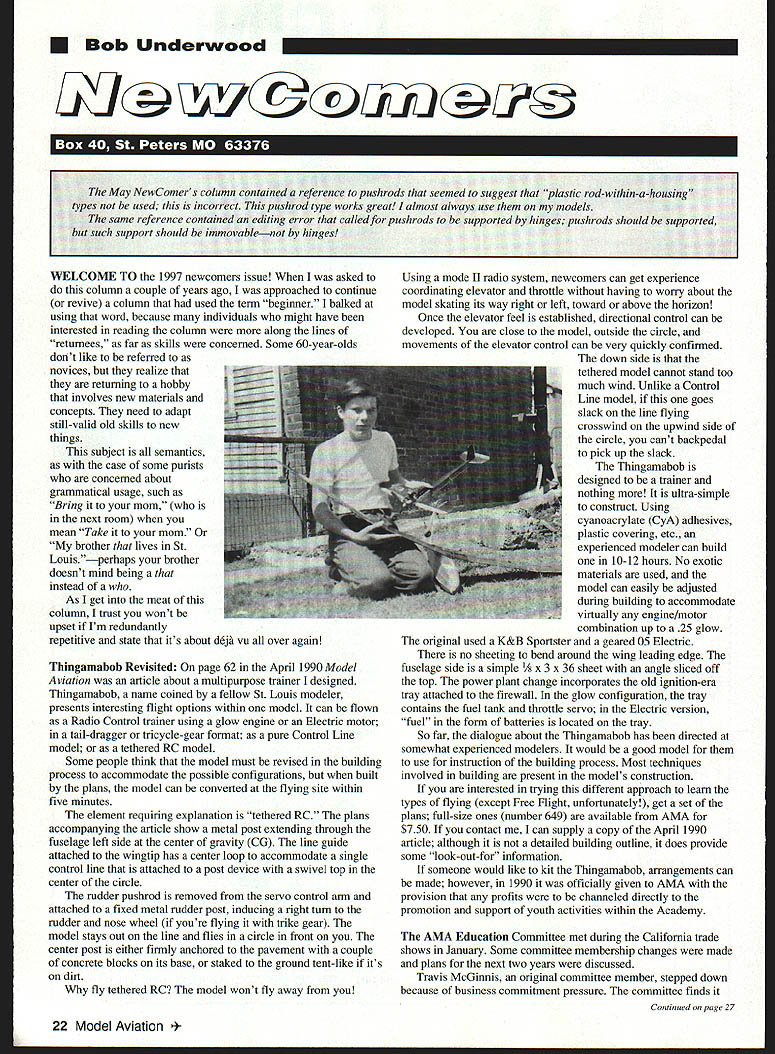
The picture is of me as a teenager. No, I can't sit like that any longer; no, I'm not any taller; and yes, I'm about 80 pounds heavier! I think the Control Line model was built from plans in a magazine. Maybe someone out there recalls the design. That's an Aeron .099 on the front. The Thermic .50 is recognizable by any old-timer. One of the many I built (maybe this winter) wound up in the Mississippi River after thermaling for five hours. I thought that aircraft was a goner until a tugboat captain called and told me he fished it out near where the Gateway Arch is now. Dad invited him out for Sunday dinner!
Within a year or two after this photo (about 1945), I entered high school and modeling disappeared from my agenda; it was replaced by school, track, and photography (no, not girls or cars). Aeromodeling found its way into my life again in 1966. The hobby never dies — it just lies dormant. The pleasant experiences of youth remain!
Transcribed from original scans by AI. Minor OCR errors may remain.

