
New Comers
By Bob Underwood
As you read this column, the flying season is in full swing across the country! A significant number of members will be chuckling softly because they know their season is year-round; then there are those hearty souls who enjoy donning layers of clothing and guesstimating where the runway is under a foot of snow; and an equally significant number "hangar fly" and build models during the winter.
At the four trade shows I have attended so far this year, manufacturers and dealers have commented that sales have been somewhat sluggish. Various reasons have been offered, and one wonders whether this is a general trend. On the other hand, AMA has been surprised by the number of new memberships accrued during these shows. Time will tell what the story really is.
Youth Education Stipend (YES) activity
Newcomer activity is picking up. The Youth Education Stipend (YES) program has produced two program applications and one second-year renewal.
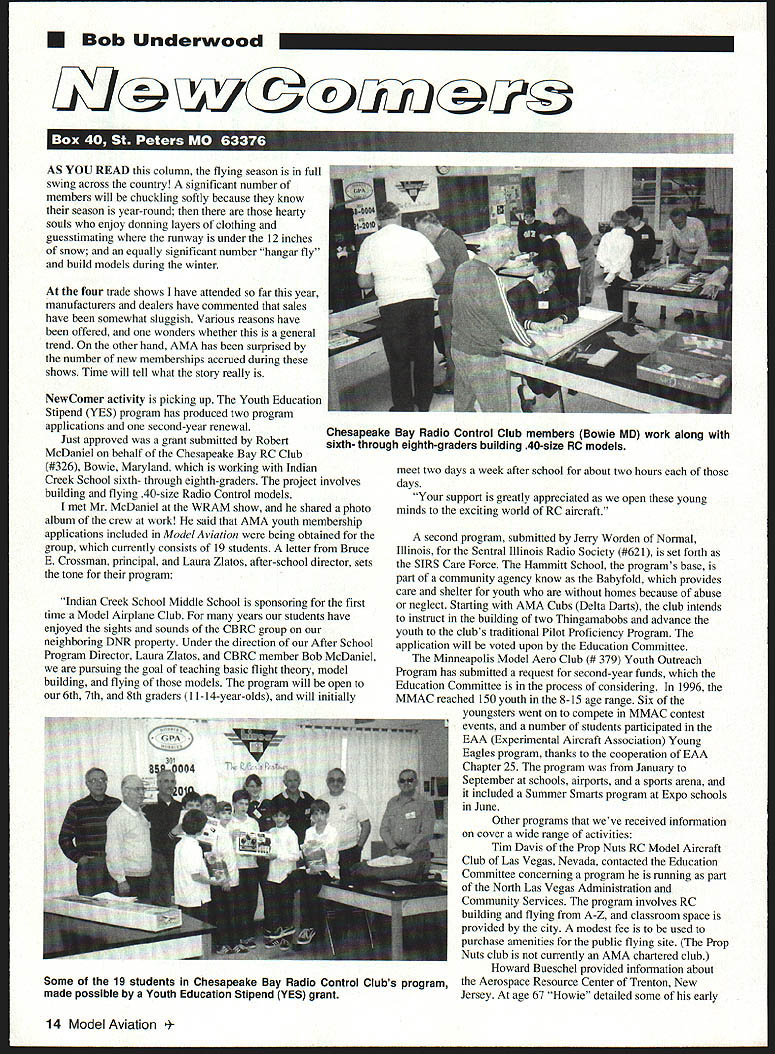
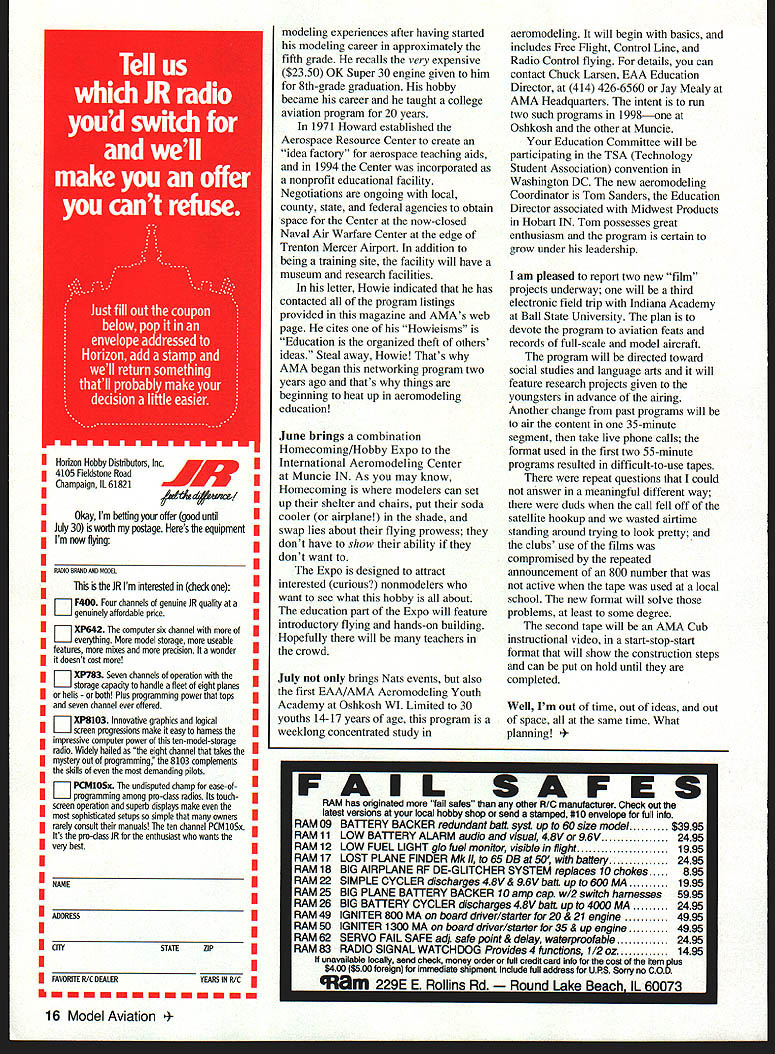
Just approved was a grant submitted by Robert McDaniel on behalf of the Chesapeake Bay RC Club (#326), Bowie, Maryland, which is working with Indian Creek School sixth- through eighth-graders. The project involves building and flying .40-size radio-control models.
I met Mr. McDaniel at the WRAM show, and he shared a photo album of the crew at work. He said that AMA youth membership applications included in Model Aviation were being obtained for the group, which currently consists of 19 students. A letter from Bruce E. Crossman, principal, and Laura Zlatos, after-school director, sets the tone for their program:
"Indian Creek School Middle School is sponsoring for the first time a Model Airplane Club. For many years our students have enjoyed the sights and sounds of the CBRC group on our neighboring DNR property. Under the direction of our After School Program Director, Laura Zlatos, and CBRC member Bob McDaniel, we are pursuing the goal of teaching basic flight theory, model building, and flying of those models. The program will be open to our 6th, 7th, and 8th graders (11–14-year-olds), and will initially meet two days a week after school for about two hours each of those days.
"Your support is greatly appreciated as we open these young minds to the exciting world of R/C aircraft."
A second program, submitted by Jerry Worden of Normal, Illinois, for the Central Illinois Radio Society (#621), is set forth as the SIRS Care Force. The Hammitt School, the program's base, is part of a community agency known as the Babyfold, which provides care and shelter for youth who are without homes because of abuse or neglect. Starting with AMA Cubs (Delta Darts), the club intends to instruct in the building of two Thingamabobs and advance the youth to the club's traditional Pilot Proficiency Program. The application will be voted upon by the Education Committee.
The Minneapolis Model Aero Club (#379) Youth Outreach Program has submitted a request for second-year funds, which the Education Committee is in the process of considering. In 1996, the MMAC reached 150 youth in the 8–15 age range. Six of the youngsters went on to compete in MMAC contest events, and a number of students participated in the EAA (Experimental Aircraft Association) Young Eagles program, thanks to the cooperation of EAA Chapter 25. The program ran from January to September at schools, airports, and a sports arena, and included a Summer Smarts program at Expo schools in June.
Other programs and initiatives
Other programs that we've received information on cover a wide range of activities:
- Tim Davis of the Prop Nuts RC Model Aircraft Club of Las Vegas, Nevada, contacted the Education Committee concerning a program he is running as part of the North Las Vegas Administration and Community Services. The program involves RC building and flying from A–Z, and classroom space is provided by the city. A modest fee is to be used to purchase amenities for the public flying site. (The Prop Nuts club is not currently an AMA-chartered club.)
- Howard Bueschel provided information about the Aerospace Resource Center of Trenton, New Jersey. At age 67, "Howie" detailed some of his early modeling experiences after having started his modeling career in approximately the fifth grade. He recalls the very expensive ($23.50) OK Super 30 engine given to him for 8th-grade graduation. His hobby became his career and he taught a college aviation program for 20 years.
In 1971 Howard established the Aerospace Resource Center to create an "idle factory" for aerospace teaching aids, and in 1994 the Center was incorporated as a nonprofit educational facility. Negotiations are ongoing with local, county, state, and federal agencies to obtain space for the Center at the now-closed Naval Air Warfare Center at the edge of Trenton-Mercer Airport. In addition to being a training site, the facility will have a museum and research facilities.
In his letter, Howie indicated that he has contacted all of the program listings provided in this magazine and AMA's web page. He cites one of his "Howieisms": "Education is the organized theft of others' ideas." Steal away, Howie! That's why AMA began its networking program two years ago and that's why things are beginning to heat up in aeromodeling education.
Events and educational outreach
June brings a combination Homecoming/Hobby Expo to the International Aeromodeling Center at Muncie, IN. As you may know, Homecoming is where modelers can set up their shelter and chairs, put their soda cooler (or airplane!) in the shade, and swap lies about their flying prowess; they don't have to show their ability if they don't want to.
The Expo is designed to attract interested (curious?) nonmodelers who want to see what this hobby is all about. The education part of the Expo will feature introductory flying and hands-on building. Hopefully there will be many teachers in the crowd.
July not only brings Nats events, but also the first EAA/AMA Aeromodeling Youth Academy at Oshkosh, WI. Limited to 30 youths 14–17 years of age, this program is a weeklong concentrated study in aeromodeling. It will begin with basics and include Free Flight, Control Line, and Radio Control flying. For details, you can contact Chuck Larsen, EAA Education Director, at (414) 426-6560 or Jay Mealy at AMA Headquarters. The intent is to run two such programs in 1998 — one at Oshkosh and the other at Muncie.
Your Education Committee will be participating in the TSA (Technology Student Association) convention in Washington, DC. The new aeromodeling coordinator is Tom Sanders, the Education Director associated with Midwest Products in Hobart, IN. Tom possesses great enthusiasm and the program is certain to grow under his leadership.
Film and instructional projects
I am pleased to report two new film projects underway:
- A third electronic field trip with Indiana Academy at Ball State University. The plan is to develop the program to aviation feats and records of full-scale and model aircraft. The program will be directed toward social studies and language arts and will feature research projects given to the youngsters in advance of the airing. Another change from past programs will be to air the content in one 35-minute segment, then take live phone calls. The format used in the first two 55-minute shows resulted in difficult-to-use tapes. There were repeat questions that I could not answer in a meaningfully different way; there were dubs when the call fell off of the satellite hookup and we wasted airtime standing around trying to look pretty; and the clubs' use of the films was compromised by the repeated announcement of an 800 number that was not active when the tape was used at a local school. The new format will solve those problems—at least to some degree.
- An AMA Club instructional video in a start-stop-start format that will show the construction steps and can be put on hold until they are completed.
Well, I'm out of time, out of ideas, and out of space, all at the same time. What planning!
— Bob Underwood
Transcribed from original scans by AI. Minor OCR errors may remain.

