
New Comers
Bob Underwood
The brain is an interesting thing. Seemingly unrelated bits of "stuff" somehow wind their way through the brain's recesses and grab hands with other bits, creating a series of thoughts and revelations that become meaningful.
At the Toledo show, a representative from one of the distributors was pondering a problem. During the last few years, sales of Radio Control (RC) Almost-Ready-to-Flys (ARFs) and kits have done a turnaround—kit sales have faltered and ARFs have soared. The rep's concern centered on the fact that the turnaround results not necessarily in a decrease in overall sales, but in a decrease in the sales of related products, such as covering materials and other accessories.
RC market and membership trends
When his statement hit one of my brain recesses, it linked up with thoughts I had expressed years ago about why the Academy of Model Aeronautics (AMA) loses members. Notice that I didn't say "loses modelers!" Some members were not modelers when they hung over the local safety fence and mused, "That looks like fun!" They weren't modelers when they bought an ARF; they weren't modelers when the local club taught them to fly; and most of them didn't want to become modelers—and they never will. They just wanted to enjoy some recreational weekend flying, and there's nothing wrong with that.
But those people were failed, in a way, since once they learned to bore holes in the sky, take off, land, etc., nothing further was provided for them. They could have gotten into competition, but the bulk of the membership just isn't interested in it.
Read (or reread) Dave Brown's column from last month, in which he explores the details of many of these thoughts. He and I shared similar ideas after I presented a program at the Johnson City Indoor Nats banquet. I feel that the discussion, which spilled over into the following day of competition, proved very valuable.
Dave's "read" is that you cannot turn back the clock; my spin is that the "youth issue" is not only that, but also a "motivational issue." New "modelers" are not being produced; instead, "recreational pilots" flying ARFs are being produced. Age is not the primary issue.
I don't have an answer to the problem. Maybe Dave does, or maybe you do, but it had better be found soon. Consider that 25% of AMA's membership changes each year. That means that, even if the membership remains static at 160,000, there will be 40,000 new faces in 1997. Many of the 40,000 who left did so because they no longer had a challenge—no mountain to scale.
Virtual reality, Jurassic Park, and similar media have helped create an instant‑gratification society where people can have "real" experiences without developing specific skills. We must learn to cope with it since, as Dave says, "We can't turn the clock back!"
Homecoming and the Hobby Expo
Homecoming and the Hobby Expo at AMA Headquarters in Muncie, Indiana, took place the first weekend in June. While Mother Nature determined that participants needed to be cool and damp, the public said, "What the heck?" and turned out in reasonable numbers.
One area featured three booths manned by Tom Sanders, Education Director of Midwest Products; Chip Mull, representing the Airline Pilots Association; and me, with printed material detailing programs available throughout the U.S. During this valuable and productive experience, I was surprised by the significant number of homeschoolers with whom the three of us talked. After 30 years in public education, I was not prepared for the level of interest. It should send a message to school systems everywhere!
Remaining 1997 educational activities
The remaining educational activities for 1997 include:
- Attendance at the TSA convention in Washington, D.C.
- The EAA/AMA Modeling Academy at Oshkosh, Wisconsin
- Preparation of two programs with Ball State University, Muncie, in September/October
- Finalization of activities for the Smithsonian model airplane two‑year tour
I will report on those ambitious programs later.
Smithsonian exhibit: "On Miniature Wings"
The Smithsonian exhibit "On Miniature Wings" is taking shape. More than 25 models will be on exhibit for about eight weeks in each of the 10–12 city museums scheduled. Most of the models on display will not be of a flying variety; recreational models, such as those we fly, will be included. The aircraft will be metal, plastic, and wood creations, and some will be wind‑tunnel test or drop‑test models.
The plan is to dovetail educational activities in each location the display visits. Possible activities during each eight‑week period include:
- One or more Saturday AMA Cub (Delta Dart) building sessions for 4th–7th graders
- A projected building program during the eight weeks, with the hope that local club(s) can culminate the program with flying activities
- Teacher resource packages for field trips and in‑school activities
These ambitious projects will hinge on the individual contracts the Smithsonian works out with each museum.
Funding for the exhibit is an issue in which the AMA has minimal involvement. Our basic concern will be coordination and getting people power to achieve the goals. As soon as the schedule is available, we will begin contacting local groups; however, the educational activity content will be established by the time the Smithsonian finalizes the individual museum contracts. Stand by!
Indoor Nats — youth church group
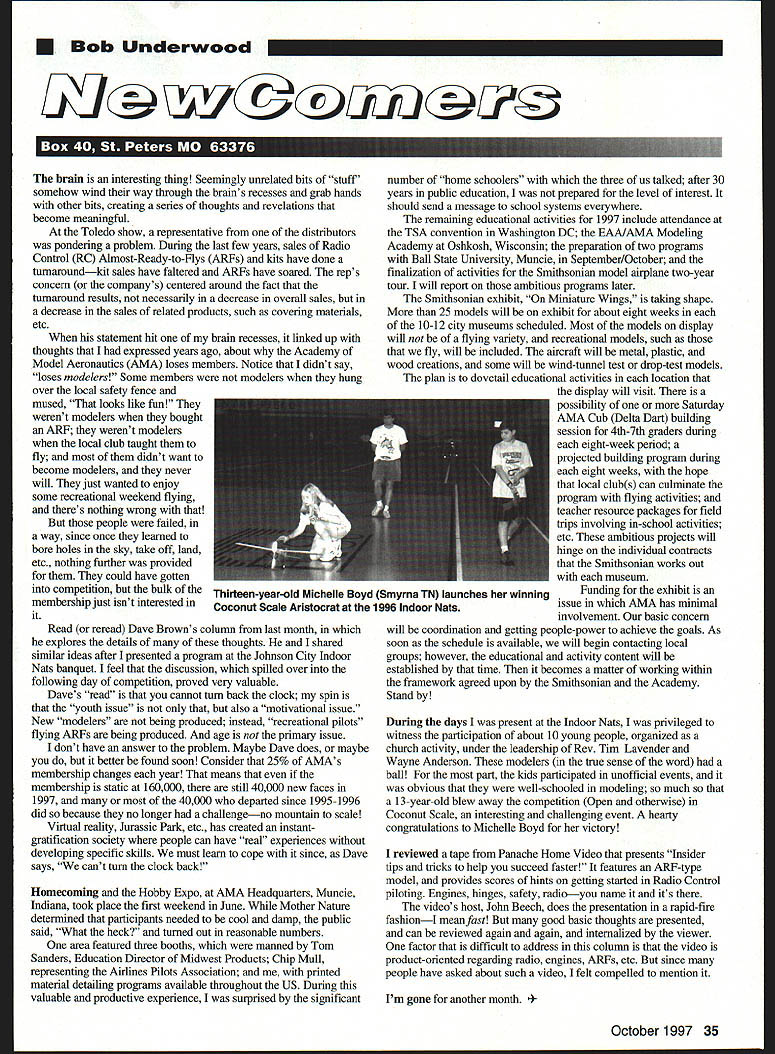
During the days I was present at the Indoor Nats, I was privileged to witness the participation of about 10 young people organized as a church activity under the leadership of Rev. Tim Lavender and Wayne Anderson. These modelers (in the true sense of the word) had a ball. For the most part, they were very well schooled in modeling—so much so that a 13‑year‑old blew away the competition (Open and otherwise) in Coconut Scale, an interesting and challenging event. A hearty congratulations to Michelle Boyd for her victory!
Video review
I reviewed a tape from Panache Home Video that presents "Insider tips and tricks to help you succeed faster!" It features an ARF‑type model and provides scores of hints on getting started in radio control piloting. Engines, hinges, safety, radio—you name it and it's in there. The video's host, John Beech, does the presentation in a rapid‑fire fashion—very fast! But many good basic ideas are presented and can be reviewed again and again and internalized by the viewer. One factor difficult to address in this column is that the video is product‑oriented regarding radios, engines, ARFs, etc. But since many people have asked about such a video, I felt compelled to mention it.
I'm gone for another month.
Transcribed from original scans by AI. Minor OCR errors may remain.

