
New Comers
Bob Underwood
NEVER FLY the model until it's finished!
While that seems like a logical statement, everyone has a different view of what "finished" means — including me.
I recently took a just-completed Thingamabob to my local club field for its maiden voyage. I had checked all those necessary things, like center of gravity (CG); which way the rudder and nose wheel wagged when I gave it right (or left); whether the elevator and transmitter agreed on what up or down was; and if the throttle was going to throttle the engine when I moved the stick toward the bottom of the box. The hinges were subjected to a tug; the screws on the servo arms were checked. Right down the line, everything looked fine. So-o-o, I threw it in the van, remembering fuel and other essential stuff, and trundled off to the field.
There were several fellows there, and since AMA business keeps me away quite a bit, only one really knew me — thank heaven! My club card was on the impound board, and the model was fueled up. Time to fly — right? Well, right it was! The model broke ground and started right. I went for left rudder trim (remember, this is a non-aileron model!). Still going right; more trim. Still going right — no "left" left! Land. It became Hmmm!! time.
I mechanically cranked in several turns of left by moving the clevis; still not correct! Landed. Began checking. Everything lined up: tail, wing, etc. Sight down the right wing panel — straight as a board. Sight down the left panel — it looked like a prop with about four pitch! How embarrassing! I have no excuse.
Do I have an excuse? No, because I should have seen that when I finished covering the wing. I seldom use plastic covering, and most of my scale models have much more rigid structure; I failed to notice that as I shrank the covering I induced a beautiful warp in the left panel. It was easy to fix when I got home by twisting the panel and running the heat gun over it.
Back to the field the next day, and it flew great, with no rudder trim required. Unfortunately, the club member who was present when I made the discovery wasn't at the field then!
No matter how long you've been building and how thorough you think you've been in checking things out, it's always important to do it again! Better yet, hand the model off to someone else and let them check it out before you put it in the air. It's like proofreading something you've written; chances are, you won't find all the errors — the other person will. And the cardinal rule? Never — that's N-E-V-E-R — rush the model into the air. If the model's not right, and you don't have the right helper or instructor, then wait.
Years ago a newcomer asked me to help him fly his new model. The ailerons were hooked up backward! (This was in the days before reversing switches on the transmitter.) He suggested that maybe I could just remember that when I flew it. My suggestion was to take the model home and redo the linkage. Unfortunately, he found another flier who felt he could remember that "right" really produced "left" and vice versa. They flew the model — for a while, anyway. (For every takeoff, there is at least one landing.) The newcomer learned what the phrase "rekkitted" really means!
YES (Youth Education Stipend) Grant Reports
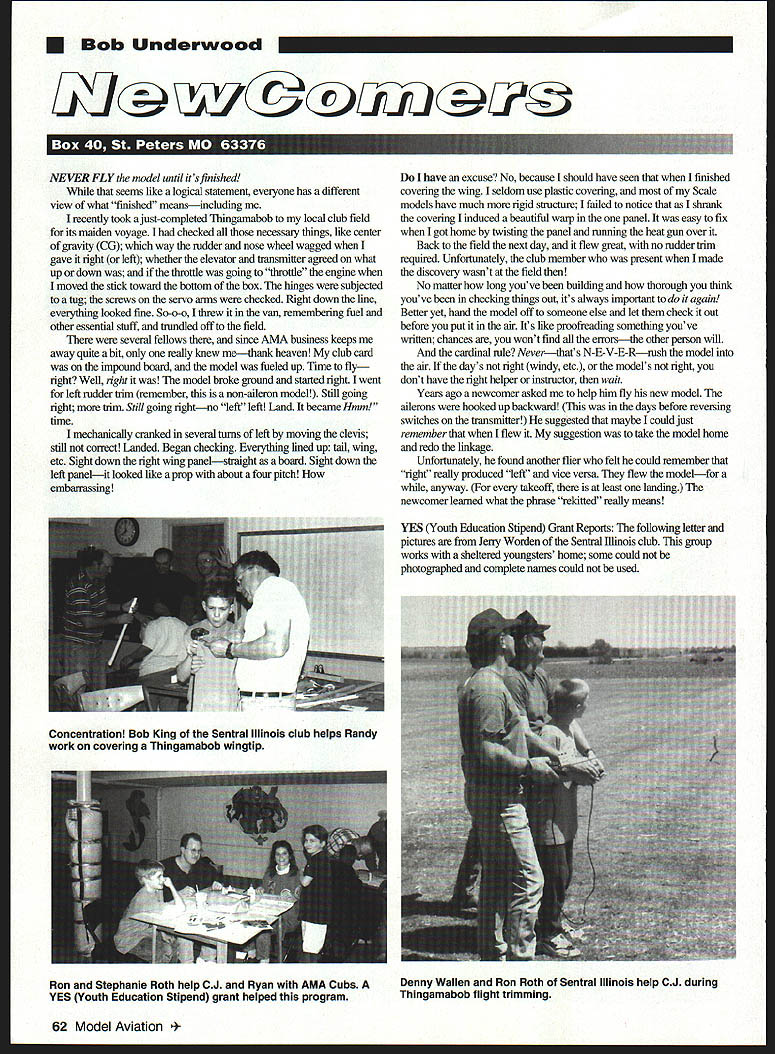
The following letter and pictures are from Jerry Worden of the Sentral Illinois club. This group works with a sheltered youngsters' home; some could not be photographed and complete names could not be used.
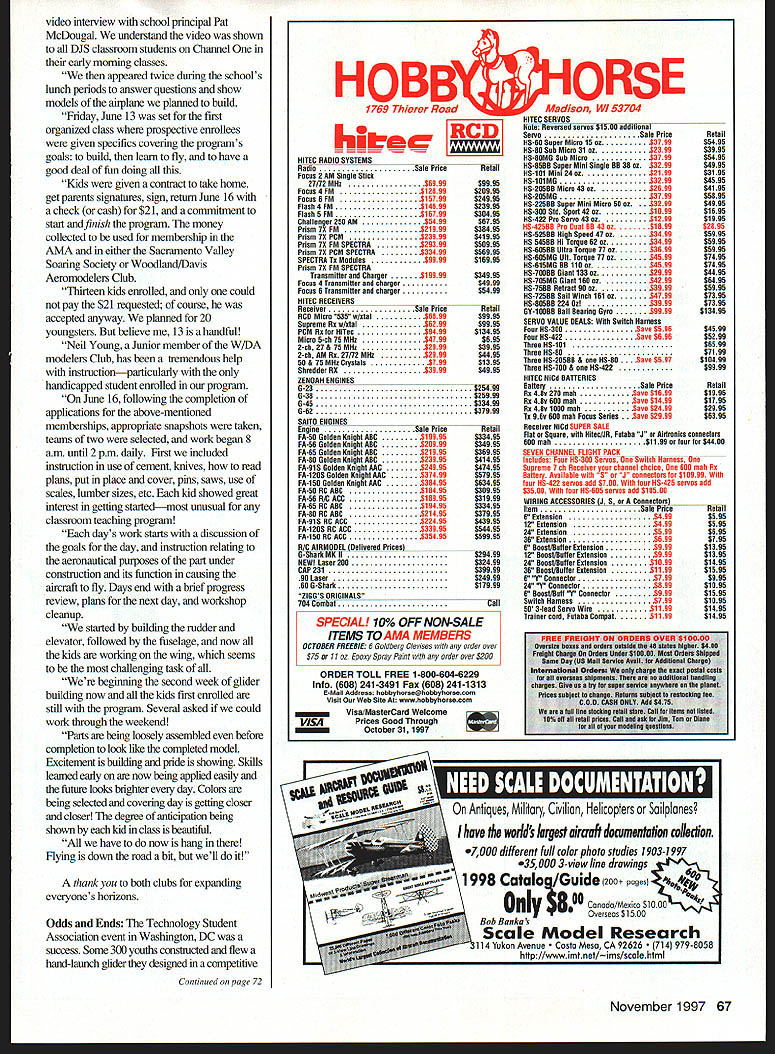
Jerry Worden writes that the Sentral Illinois club has been working with the youngsters, helping them build Delta Darts and Thingamabobs. The YES grant helped with materials, and the modest amount of $500 suggested by the club was included. The program has already brought much happiness and satisfaction to the kids and club members. We have built Delta Darts; three Thingamabobs have proven airworthy and up to the task of training kids in building and flying. The kids are now official AMA members and have had two sessions at the flying field. The boys are almost capable of keeping the Thingamabob in the air with assistance. During flying sessions the club furnished a hot dog lunch. The children and staff plan to continue sessions throughout the summer and, in addition, plan to explore area model rocketry and small control-line flying. Give thanks to the Academy for helping secure the grant.
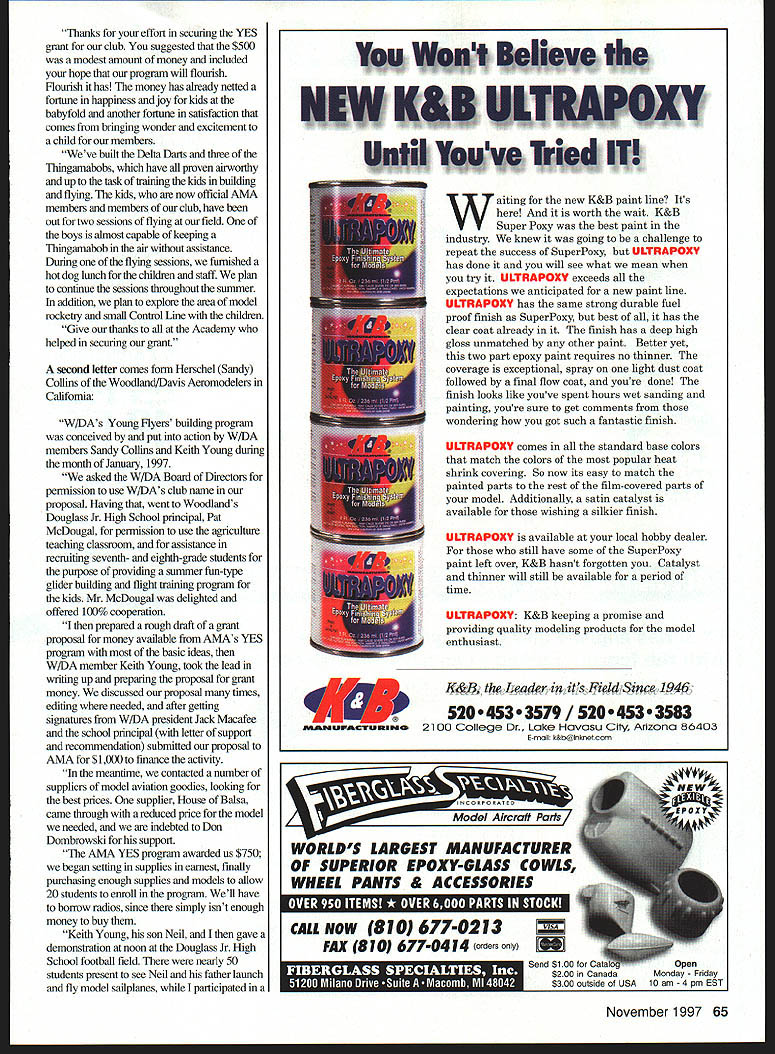
A second letter comes from Herschel (Sandy) Collins of the Woodland/Davis Aeromodelers (W/D/A) in California. W/D/A's Young Flyers building program was conceived and put into action by W/D/A members Sandy Collins and Keith Young. During January 1997 they asked the W/D/A Board of Directors' permission to use the club name on the proposal. Having gone to Douglass Jr. High School, Principal Pat McDougal gave permission to use the agriculture teaching classroom for assistance in recruiting seventh- and eighth-grade students for the purpose of providing a summer fun-type glider building and flight training program for the kids. Mr. McDougal was delighted, offered 100% cooperation, and prepared a rough draft of a grant proposal for money available from AMA's YES program with most of the basic ideas. W/D/A member Keith Young took the lead in writing up and preparing the proposal for grant money. We discussed our proposal many times, edited where needed, and after getting signatures from W/D/A president Jack Macafee and the school principal (with letter of support and recommendation) submitted our proposal to AMA for $1,000 to finance the activity.
In the meantime, we contacted a number of suppliers of model aviation goodies, looking for the best prices. One supplier, House of Balsa, came through with a reduced price for the model we needed, and we are indebted to Don Dombrowski for his support.
The AMA YES program awarded us $750; we began setting up supplies in earnest, finally purchasing enough supplies and models to allow 20 students to enroll in the program. We'll have to borrow radios, since there simply isn't enough money to buy them.
Keith Young, his son Neil, and I then gave a demonstration now at the Douglass Jr. High School football field. There were nearly 50 students present to see Neil and his father launch and fly model sailplanes, while I participated in a video interview with school principal Pat McDougal. We understand the video was shown to all DJS classroom students on Channel One in their early morning classes.
We then appeared twice during the school's lunch periods to answer questions and show models of the airplane we planned to build.
Friday, June 13 was set for the first organized class where prospective enrollees were given specifics covering the program's goals: to build, then learn to fly, and to have a good deal of fun doing all this.
Kids were given a contract to take home, get parents' signatures, sign, return June 16 with a check (or cash) for $21, and a commitment to start and finish the program. The money collected is to be used for membership in the AMA and in either the Sacramento Valley Soaring Society or Woodland/Davis Aeromodellers Club.
Thirteen kids enrolled, and only one could not pay the $21 requested; of course, he was accepted anyway. We planned for 20 youngsters. But believe me, 13 is a handful!
Neil Young, a Junior member of the W/D/A Modelers Club, has been a tremendous help with instruction — particularly with the only handicapped student enrolled in our program.
On June 16, following the completion of applications for the above-mentioned memberships, appropriate snapshots were taken, teams of two were selected, and work began 8 a.m. until 2 p.m. daily. First we included instruction in use of cement, knives, how to read plans, put in place and cover, pins, saws, use of scales, lumber sizes, etc. Each kid showed great interest in getting started — most unusual for a classroom teaching program!
Each day's work starts with a discussion of the goals for the day, and instruction relating to the aeronautical purposes of the part under construction and its function in causing the aircraft to fly. Days end with a brief progress review, plans for the next day, and workshop cleanup.
We started by building the rudder and elevator, followed by the fuselage, and now all the kids are working on the wing, which seems to be the most challenging task of all.
We're beginning the second week of glider building now and all the kids first enrolled are still with the program. Several asked if we could work through the weekend!
Parts are being loosely assembled even before completion to look like the completed model. Excitement is building and pride is showing. Skills learned early on are now being applied easily and the future looks brighter every day. Colors are being selected and covering day is getting closer and closer! The degree of anticipation being shown by each kid in class is beautiful.
All we have to do now is hang in there! Flying is down the road a bit, but we'll do it!
A thank you to both clubs for expanding everyone's horizons.
Odds and Ends
The Technology Student Association event in Washington, DC was a success. Some 300 youths constructed and flew a hand-launch glider they designed in a competitive scenario, under the tutelage of Tom Sanders, Midwest Products Education Director. He had sterling help from a dozen local Free Flighters, mostly (or all?) belonging to the Maxecuters. Education Committee member Charlie Bauer and I also lent a hand.
Charlie also helped man the booth during the exhibition portion. Fortunately, the number of teachers taking units dropped off in the afternoon, when the building session started. As it was, we talked with about 300 teachers and ran ourselves out of materials. We were pleased to hear that several of the individuals we talked to in Louisville in 1996 were now working on programs similar to those found on our web page or in the YES programs.
At the Indoor Nats in Johnson City, Tennessee, I was pleased to meet Jim Lavender and Wayne Anderson from Smyrna (TN) Church of Christ. Jim is the minister there and the church sponsors a group of young people building many types of models. Ten youth, along with Jim and Wayne, journeyed to the Nats to learn (and in some cases, to fly) in unofficial events flown in conjunction with the Nats.
One of the greatest moments for all of us, and certainly for the church group, was when Michelle Boyd won the Coconut Scale event. Unfortunately, more of the youngsters did not participate in the official event due to cost factors. By the time you read this, a proposal being put forth in the July Executive Council Education Report may help alleviate this problem. More later!
In the July issue you were "treated" to a photo of a younger, less horizontally enhanced (but still vertically challenged!) Bob Underwood. I stated that I couldn't remember what the Control Line model was I was holding (that was more than 50 years ago!).
Bert Striegler of Rochelle, Texas knew! In fact, he sent plans from page 64 of Air Trails and Science Frontiers, March 1947, and it's called The Flounder by Louis Garman — an excellent trainer that can be built in a few hours — and that was before cyanoacrylate (CYA) glue.
Bert's note tells about a recent experience:
"Here's your Control Liner that you couldn't remember. I built one of these for the old Wards Vintage Contest in England about seven years ago. Powered it with a Mills 1.3 diesel and flew it in the Mills speed contest. It turned out I was the only entrant that actually flew a Mills in the speed event. I found I had to tighten the motor mount considerably to stop the Mills from throwing the prop and wrecking the mounting. The winner flew a Midge with a G.P. .049 and turned out 103 mph — but they gave me the 'Best Construction' ribbon for workmanship. I think they were embarrassed that a Yank flew the only real Mills entered."
Now why would I ever choose a model called The Flounder?
Next month's Model Aviation will contain a nifty extended report by Dr. Gordon Schimmel, the Education Committee Chairman, of the EAA/AMA aeromodelling activity in Oshkosh — just a few days away as I write this. Can't wait!
Transcribed from original scans by AI. Minor OCR errors may remain.

