
New Comers
Box 40, St. Peters, MO 63376
Design Intervention
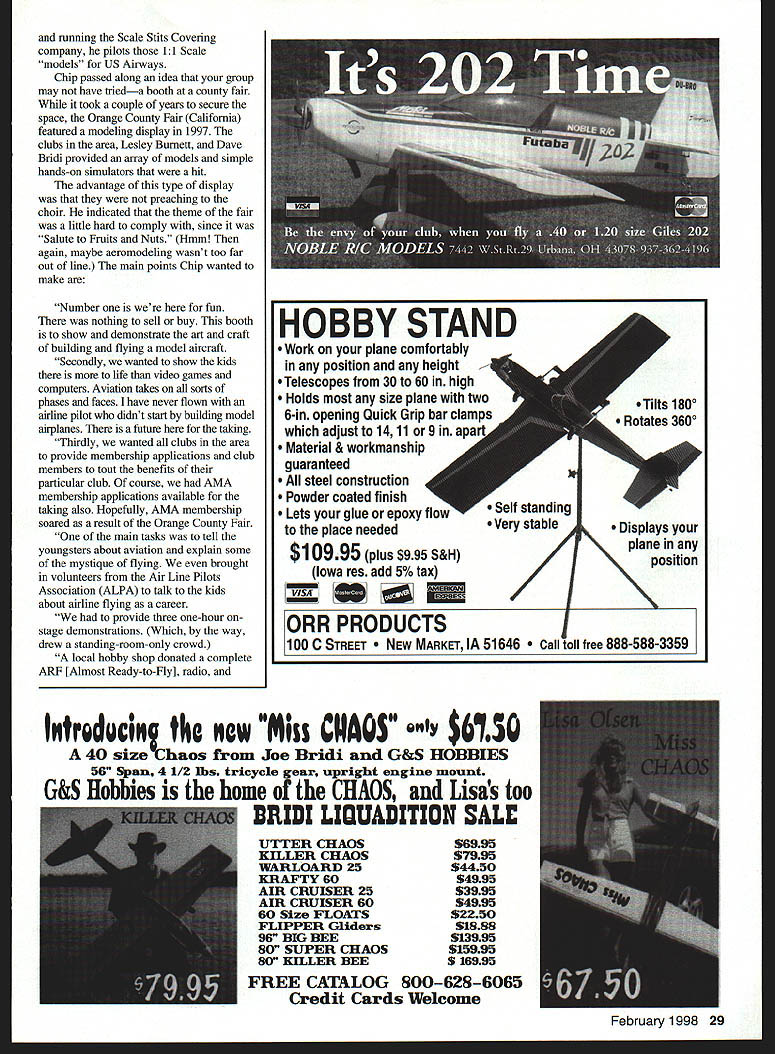
Virtually every modeler has seen one, and most have built one, but few know the genesis of the AMA Delta Dart — a simple rubber-powered model constructed on the covering material that also serves as the plans. In the model's 30+-year lifespan, the industry has produced millions of them in an effort to introduce individuals to model aviation; last year alone, Midwest Products provided 250,000!
Delta Darts have been distributed and copied worldwide; Frank Garcher of Midwest followed 250,000 to South Africa for a special program developed there, and most countries tied in with the FAI (Fédération Aéronautique Internationale) have used them. The Dart was a divine design intervention!
The same design (or almost) is known by various names, such as Delta Dart, AMA Cub, and AMA Racer.
The concept of the Dart came from the fertile mind of a man known as the master of the rule loophole — Frank Ehling. Born in 1912, he became enamored with models through the efforts of a shop teacher. When the teacher tied a twin-pusher to the ceiling, Frank was not impressed, until later when he saw it fly. The phrase "hooked on models" seems appropriate.
Frank was frustrated, however, when he couldn't get his model to fly as far or as high as the other kids, who were using compressed-air motors for power, so he devised a plan involving a next-door neighbor who raised homing pigeons. Following is Frank's story about his participation in a contest called "A Boy's Day Out of Doors."
"I asked him (the neighbor with pigeons) if I could borrow one. He agreed, as long as no harm came to it. I punched some holes in a shoebox and put the pigeon in it. Then I went to my shop and made a one-inch model. I tied one end of a piece of string to the model's nose. The other end was to be tied to the pigeon's leg.
"The next morning, I woke up early and went to the contest. When I arrived, I could see all of the models flying. I approached the judges' table and asked to be entered. They took my name and said I would be called when it was my turn.
"I waited a very long hour. Finally, they called my name and I walked to the table. They asked what I wanted to enter — a boat, kite, or model plane. I said it was a model plane. 'Where is your model?' they asked. I pointed to the little one-inch model dangling out of the shoebox. They looked at it and told me I could fly when I was ready.
"I told them I was ready, and took the lid off the box. The startled pigeon took off! The judges didn't know what to do. The pigeon flew in wide circles, then, seeing the pond where the model boats were sailing, landed and took a long drink, took off, circled again, and flew home!
"The judges talked among themselves. The other modelers were pretty upset. Out came the rules for the contest; the compressed-air-motor boys had been very clever, getting the wording in the rules to read, 'any power for the model.' The judges had no choice. The first-place certificate bore my name, Frank V. Ehling. I'm not even sure the judges could see the one-inch model, but they sure could see the pigeon!"
One could attach several results to this story, not the least of which is that Frank went on to become AMA's Technical Director, create the Dart, and give it to AMA and the industry. At least now you know why he has always been known as a master rule-loophole finder! You can also understand why, a few million Darts later, he must be chuckling to himself when he remembers all of those "experts" who said that the Dart wouldn't work. It has, and still does!
If you can locate an April 1967 American Modeler magazine, you will find the original plans and an interesting article on page 21. While the Dart underwent a slight metamorphosis, those sold today incorporate the same techniques, nose pieces, and reasons for the design.
For instance, do you know why the wings and tails are pointed? Because it helps eliminate the ill effect produced by warps in the surfaces. In fact, the Dart can be assembled almost in a haphazard manner and it will still fly. The one error that will make it nearly unflyable is placing the slanted portion of the motor stick where the stab is glued on the top instead of the bottom.
A variety of sources sell Delta Darts. Try them with a group of nonmodeling adults sometime — they'll love it! I did it with 20 adults a year ago, and we had a terrible time getting them to leave the church gym!
Frank told me he's designing a model with black covering on the top and chrome on the bottom. The theory is that the black will cause the sun to heat the air inside the wing to a greater degree, producing greater lift. If you want to suggest to him that it won't work, tell him! I don't want to be added to the group of 1960s "experts" who said the Dart wouldn't fly!
Quick Shots
- First Shot: A letter from Ken Marler of Idaho Falls, Idaho corrected a faux pas that I made, attributing the phrase "What hath God wrought" to the wrong U.S. inventor; I credited it to A. G. Bell, when S. F. B. Morse actually said it.
Ken even provided the information in American Morse, then he admonished me to check that against radio code, which he stated is an illegitimate offspring (he used another word) of American Morse. I guess he'd know, since he spent 40 years as a telegrapher and freight and passenger agent for the Union Pacific Railroad. His first model success was a Megow Stinson Reliant in 1938, but he became a newcomer to Indoor in 1996! Everybody's a newcomer!
- Second Shot: Chip Mull is a member of the AMA Education Committee. In between doing important things such as helping kids, serving on the committee, manning a booth for the Airline Pilots (ALPA) group to interest high-schoolers in an aviation career, and running the Scale Stits Covering company, he pilots those 1:1-scale "models" for US Airways.
Chip passed along an idea that your group may not have tried — a booth at a county fair. While it took a couple of years to secure the space, the Orange County Fair (California) featured a modeling display in 1997. The clubs in the area, Lesley Burnett, and Dave Bridi provided an array of models and simple hands-on simulators that were a hit.
The advantage of this type of display was that they were not preaching to the choir. He indicated that the theme of the fair was a little hard to comply with, since it was "Salute to Fruits and Nuts." (Hmm! Then again, maybe aeromodeling wasn't too far out of line.) The main points Chip wanted to make are:
- We're here for fun. There was nothing to sell or buy. This booth is to show and demonstrate the art and craft of building and flying a model aircraft.
- We wanted to show the kids there is more to life than video games and computers. Aviation takes on all sorts of phases and faces. I have never flown with an airline pilot who didn't start by building model airplanes. There is a future here for the taking.
- We wanted all clubs in the area to provide membership applications and club members to tout the benefits of their particular club. Of course, we had AMA membership applications available for the taking also. Hopefully, AMA membership soared as a result of the Orange County Fair.
One of the main tasks was to tell the youngsters about aviation and explain some of the mystique of flying. We even brought in volunteers from the Air Line Pilots Association (ALPA) to talk to the kids about airline flying as a career.
"We had to provide three one-hour on-stage demonstrations." (Which, by the way, drew a standing-room-only crowd.)
A local hobby shop donated a complete ARF (Almost Ready-to-Fly), radio, and engine for demonstration. We practically wore the wings out putting them together and taking them apart for the public to see how easy it can be. The hobby shop had a landslide business that Sunday too.
To sum it up, Chip said that the interest was overwhelming and that the volunteers were astonished at the public interest. In light of the recent problems retaining the public flying site at Mile Square Park, just maybe...!
- Last Shot: Next month I'll bring you details of the recent Education Committee meeting, a presentation to the Radio Control Hobby Trade Association, progress with the Smithsonian traveling exhibit, and other happenings.
In the meantime, the first two programs presented via satellite by Indiana Academy at Ball State University will be broadcast to another 60,000 youngsters. Using the magic of modern technology, the youngsters will be able to participate by calling in questions live.
On November 11, a third new program in the series was aired from the Museum. The title was "Higher, Farther, Faster," and it focused on social studies and language arts. Featured were Charles Lindbergh, Chuck Yeager, the round-the-world flight of the Voyager, and many model records.
Next month's column will feature the introduction of a new Muncie staff member! Activities in education have far exceeded this old man's part-time capacity; therefore, a full-time Education Coordinator has been hired, and I will retire a little more. Somehow I've got to figure out how that will work!
Transcribed from original scans by AI. Minor OCR errors may remain.

