
New Comers
Bob Underwood
Box 40, St. Peters, MO 63376
It's truly amazing to have lived this long and find out that "once a month" comes more than twelve times a year. At least it sure seems that way when it comes to writing a column! Throw in a bunch of mail, a trade show or three, and bingo! — another one is due.
You will find a new feature this month called "Help Wanted." I will place requests for information in this space in an effort to help New Comers locate some specific help we're not able to generate from this end. If you can help, please do so, and copy this column with your responses so we can keep them on file. Every answer has a hundred questions and they are usually spaced in such a way that you can't remember exactly when you provided it the last time.
One letter had 23 questions covering a multitude of areas. Please understand that I just don't have enough time to provide a personal letter for those. What I will try to do is incorporate the needs into future columns. Please try to be patient.
In an early column, we said we'd jump around a bit and cover New Comers in general and youth specifically. I'm pleased to report that we have some specific information relative to the 7-12 Model Aviation Youth Academy in California. This program has been featured twice in this magazine with an article and pictures; the most recent can be found in the January 1995 issue. The package we now have available is a draft syllabus containing details of how the program operates. We are adding it to our list of documents we can provide to help others get started. Just drop a card to Box 40, St. Peters, MO 63376 and ask for "7-12 MAYA."
Please understand that the 7-12 MAYA program is a very ambitious undertaking. Our talks with Charles Kelley and others involved reveal the need for considerable time and effort to make it work. While the load is heavy, the rewards are great! This is true not only for the students, who receive knowledge and school credits, but the instructors as well.
More often than not, there is a significant hurdle to be cleared before getting a program into schools on a permanent basis: the ability to convince the school leaders that the program has merit. As we work to accomplish this goal, almost without exception the key to such acceptance lies in having someone in the school system to lead the way. It is especially helpful if the person is a teacher.
Quite frankly, other teachers are more receptive to additions to the curriculum if they are promoted by a fellow teacher than if they come from above. Teachers now are often beleaguered by having more and more dumped into their available time. In short, don't just try to sell the administrators or board on the idea; find sympathetic teachers who will help.
One area of school activity that is often easy to become part of is enrichment programs. These may be structured all the way from a single day of presentations to a series of classes over a period of time. The example above was one such program. While we lived in Virginia, we had a program called "Horizons." This week-long activity featured a variety of topics presented by knowledgeable, interested parties.
During those sessions I presented an hour program called "Only Birds Can Fly" and a second hour taught flight classes. I used everything from a folded paper airplane to complicated models to interest the students. It didn't "teach modeling" but it did create an appetite for more information.
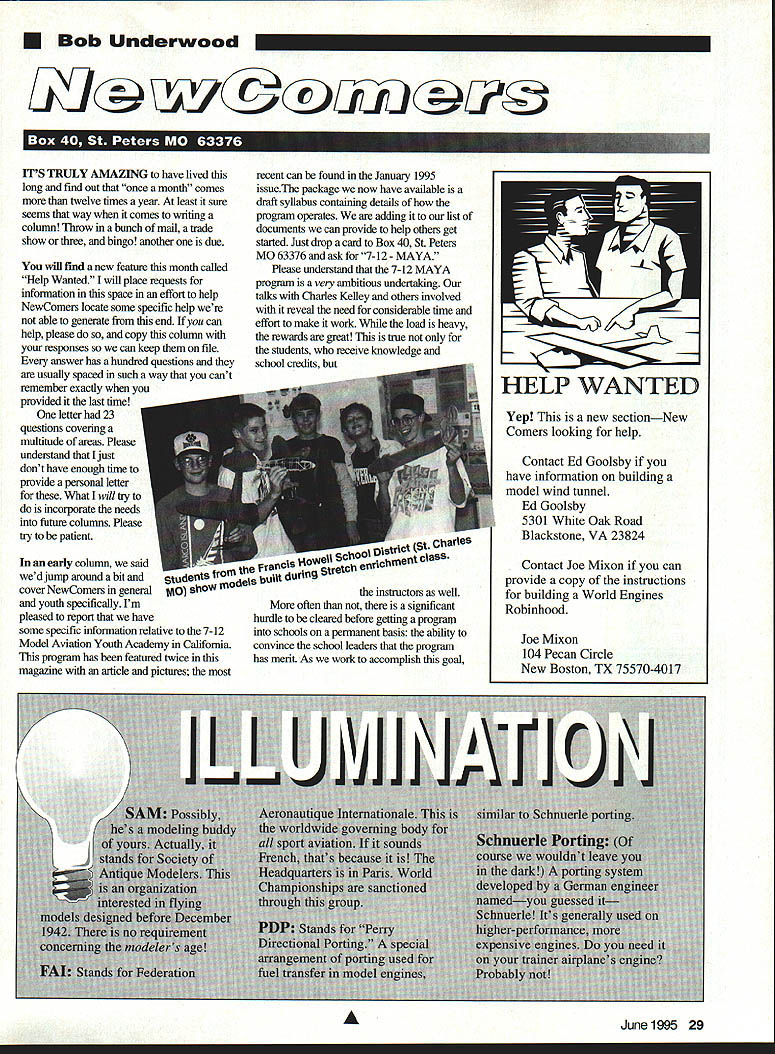
Other enrichment programs can actually involve building. The Francis Howell School District in St. Charles County, Missouri has a program called "Stretch." A member of the McDonnell-Douglas R/C club became involved with that program last November. The letter from George Appel reports his experience:
"During the month of November, I was involved in a Stretch enrichment program for all interested students. This was sponsored by the Francis Howell Spectra Parent Support Team from the Francis Howell School District in St. Charles, MO. I volunteered to teach a class in model airplane building and flying, and was assigned to a class of five boys, ages 11–13.
"These boys were very interested in learning about model aircraft, even though none had ever flown or built an airplane before. I decided to help them build a simple free flight model, using stick balsa and tissue paper. The power source would be a rubber band. The model I selected was the Cruiser, taken from an Air Trails plan of May 1949.
"We had three classes (three Saturdays at 1-1/2 hours) to complete this project, and I am enclosing a photograph of our progress. Even though all the boys did not complete the model, they had progressed enough that they could complete the plane at home.
"During these building sessions, I also talked about the theory of flight, various building materials, and the variety of aircraft (FF, CL, and RC) to be built."
The boys in the photograph are Ian Ballman, David Guntorius, Heath Borders-Wing, Joe Sainz, and Michael Rehagen.
I am pleased to say that this was a very rewarding experience and hope to continue this class in the spring.
"I also wish to thank AMA for the material sent to me to hand out in the class."
You are encouraged to check with your local school districts to see if such programs exist. The only admonition I will pass along is that you exercise caution. Once you become involved with programs of this type you will discover they are habit-forming! You may well find a delay in the completion date of that scratch-built Widget 10 you've started!
A nice letter from Dick Baxter of Laguna Niguel, California supports the concept of looking for an "inside man" when it comes to schools. He also includes some questions you need to consider:
- The inside man list should include the name, address, and phone of people who would like to start some kind of modeling activity and a short note about resources available.
- Does the school have a gym or indoor flying area?
- Is there a suitable flying field nearby?
- Is there space available for classes and materials storage between sessions?
- What times and days would be acceptable?
- Is there any funding available or does the activity have to pay for itself?
- What is the minimum participation needed to justify starting or continuing?
We'll polish off this section with a letter from Allen Bame, Associate Professor, Technology Education at Virginia Tech. In it you'll find a bit of a challenge for all of us:
"I was very interested in your new series, New Comers, now appearing in Model Aviation magazine. I am a professor in the Technology Education Program at Virginia Tech, where we are graduating about 20 teachers to go into the secondary schools in Virginia and surrounding states.
"In recent years, there has been growing interest in transportation as one of the major curriculum organizers in technology education. The Delta Dart (AMA Cub) is now being used quite heavily in middle-school technology education programs across the country. This is often the first (and, unfortunately, the only) experience students have with model airplane building. However, there is a growing interest in aerodynamics as content in our curriculum. Several vendors in our field are selling tabletop wind tunnels for use in our classrooms.
"I have a particular interest in developing curriculum materials for transportation as a part of the larger transportation organizer. In my first attempt to develop materials and teach our students, I have developed a course including lecture on basic principles of aerodynamics and lab activities built around the Delta Dart, the Sierra from Fred Reese's article in the February 1994 issue of Model Aviation, and an Easy B plan. I also have a computer-interfaced wind tunnel I have constructed, and the students test wing sections they have built.
"Most technology education teachers will be novices in model airplane building, and certainly most of the students will be novices. Your New Comers series seems to hold great potential for use by our teachers."
Now for the reason for writing this letter, other than to say, "keep up the effort": there are people out here who need this kind of helpful information. I think there is great potential for introducing youngsters to model aviation through middle-school technology education programs across the country. You mention that AMA has found it difficult to muster a prolonged and meaningful program to hold young people's attention. Maybe AMA's effort could be expanded by supporting efforts underway in technology education programs.
"For example, I will be making a presentation about my aerodynamics teaching efforts at the annual Conference of the International Technology Education Association in March in efforts with AMA, and in fact will copy this letter along with a letter to Jay Mealy at AMA asking for AMA materials to distribute at my presentation.
"I would be interested in your reaction to the above comments if you have time to share them. Anyway, keep up the effort."
(Technology Education, 144 Smyth Hall, Blacksburg, VA 24061)
HELP WANTED
Yep! This is a new section — New Comers looking for help.
- Contact Ed Goolsby if you have information on building a model wind tunnel.
Ed Goolsby 5301 White Oak Road Blackstone, VA 23824
- Contact Joe Mixon if you can provide a copy of the instructions for building a World Engines Robinhood.
Joe Mixon 104 Pecan Circle New Boston, TX 75570-4017
Lastly, a letter from Ed Goolsby of Blackstone, Virginia provides evidence of a family headed the modeling way:
"I have a twelve-year-old nephew, Zac, whom I have introduced to RC flying. He is a new AMA Junior member and I have managed to provide him with a healthy outlet for his curiosity about anything that even looks like it would be capable of flight. We have built a Piece-o-Cake for Zac and one for my six-year-old son Chad. We are now building a Dynaflite Butterfly for Zac.
"Both boys are interested in learning why and how things fly. Zac and I have discussed starting him on a long-term science project to explore basic aerodynamics. Zac would like to construct a wind tunnel and test flight surfaces.
"We are having some difficulty in finding enough information to get this project started on the right track. We need basic information or sources of information in order to:
- build a suitable wind tunnel;
- build test instruments;
- build test model surfaces; and
- learn how to mount test objects for testing.
"Any information or sources that you could send our way would be most appreciated."
P.S. While I was looking through a picture list of available model aircraft plans, Chad asked if he could help pick out a plan that I might like to build. He pulled up a chair and began to browse the plans. He started to go through a list, "Dad," he began, and an excited voice called, "I found one you will like!"
As I came back into the room I found Chad pointing to a picture of an aircraft, saying, "This one, Dad, I think it's from the Civil War!"
Ed, please let me know what that Civil War aircraft was. I'll build a scale model of almost anything! Incidentally, did you catch Professor Bame's letter earlier? He thinks there’s wind tunnel info!
Transcribed from original scans by AI. Minor OCR errors may remain.

