
New Comers
Bob Underwood
Well, it's been a while since we've done a potpourri of "stuff" associated with the goals of this column. Since I'm writing this for an April 10 deadline, now would be a great time. How's that, you say? Aw, you know—the buds are budding; flowers are flowering; dandelions are getting a running start; it's the time for renewal; Spring has sprung; whatever!
Last month we brought you something of a picture story revolving around the presentation of "Why Does It Fly?" over the Ball State University, Indiana Academy Distance Learning Network. Since the program occurred right on top of the publication deadline, we had no opportunity to assess the overall quality of the production. We knew that Indiana Academy was happy with the outcome, but...
Having viewed all four segment tapes, it looks like we have some good material for overall AMA use, as well as for clubs. The call-in questions in the morning museum session tended to be somewhat redundant compared to the afternoon; however, the overall presentation seemed better, with fewer glitches.
Hopefully, through the miracle of editing, we can incorporate the strong points of each session. Perhaps we can take care of a few minor technical mistakes made by yours truly, the so-called resident "expert." Quite frankly, I never began to anticipate the level of full-scale airplane questions. On one occasion, I noted that when I waxed eloquently about the speed of sound, somehow it magically had increased about 100 mph. Ah, such life! Heck, it won't be the first time a student has discovered the teacher is wrong—and it won't be the first time this one has admitted it!
We reached more than 32,000 youngsters and teachers in one big gulp! That's more than the Academy has accomplished in quite a while. The important factor is that this is just a beginning. Our association with Ball State and the Indiana Academy suggests that important things will happen in the months to come.
Tape segments and availability
The immediate goal is to make the edited tapes available. While the details are not yet completed, it would seem that we will be able to make a tape available to individuals and clubs that will contain three segments:
- A 15-minute "teaser" presentation designed for use with school and community groups in an effort to generate interest.
- The 50-minute museum/live call-in program.
- A 50-minute segment on building the AMA Cub (Delta Dart).
We should be able to make this tape available for a very nominal amount ($10–15?) or possibly even free! Watch for details.
The next segment underway is devoted to the forces of flight and controls. Still later, we intend to include portions devoted to other subject areas such as history, language arts, etc.
Outreach, events, and partnerships
About the time you read this, the Academy will be represented at the Technology Student Association's (TSA) convention in Louisville, KY. The TSA is a 140,000-member association devoted to the sciences. One portion of their competitive program is devoted to designing and building a hand-launch glider. Each entry is presented in a given set package of materials. From these, with no additions, the student designs and builds the model. It is then flown competitively.
For several years now, Tom Sanders, a modeler formerly from Pennsylvania, has acted as a coordinator or resource person to improve the designs used by the students. Tom is now employed by Midwest Products as their Education Director. We are pleased to be able to assist Tom by providing personnel as well as having a booth at the convention.
Later this summer, AMA will be presenting a forum at the EAA convention dealing with the subject of "Modeling as an Educational Tool." If you are going to be in the Oshkosh area for the fly-in, drop by the AMA booth and spend an hour at the forum tent with us.
As an aside and a parting thought, since the inception of this column and the formulation of the Education Committee, some wonderful things have begun to happen concerning the involvement of youth in modeling. It must be stated that these happenings are not necessarily the direct result of this column. Indeed, many of the activities and individuals have been toiling for some time.
What has happened is that through this column and other means, we have begun a network that spotlights these activities and provides an impetus for others to become involved. We've become sort of a catalyst in the chemical reaction of youth activity!
Training programs and shared resources
A few months ago we mentioned a flight-training program provided to us by a club in Harrisburg, PA. We indicated that a copy would find its way to you if your club wanted to follow the admonition that all clubs should have a formal training program. That offer was followed by a blizzard of requests via phone, fax, and letter. Actually, we not only provided the Harrisburg offering, but one from Saginaw, MI as well. We're pleased that so many clubs were interested, and we thank the Harrisburg Area Flying Societies and Saginaw Valley Radio Control Club for sharing their excellent work with many others.
Don Bekins, President of the Society of Antique Modelers, and I talked at length recently about youth activity. His local chapter in California, SAM 27, has been working closely with Rocco Ferrario. We've mentioned Rocco in this column before. In fact, the June Model Aviation listed Rocco as a resource for middle-school (Junior High) level activities.
Don indicated that SAM has established a website devoted to providing information about Rocco's classroom modeling activities. This information can be accessed via the Internet at: http://www.napanet.net/~nedn
We have received a number of drawings for simple types of models that can be used for an introduction to modeling. Most of these are either hand-launch or rubber powered. We are working to develop a list of these models. While we would love to be able to provide the information and drawings in Model Aviation, we just don't have the space.
Products, pamphlets, and contacts
We recently received information from longtime modeler Don Jehlick. He and his son are marketing a series of models that can best be described as free-flight ARFs. (Remember your acronym: ARF = Almost Ready to Fly!) These models range from hand-launch/catapult and non-scale rubber powered to scale-like rubber models and a helicopter with counter-rotating blades. The models are colorful and well-designed, with spare parts and accessories available. Prices for these models were not provided. For further information, contact Don Jehlick, Box 547, Crestline, CA 92325.
The Academy has a new pamphlet to distribute at trade shows and for other promotional affairs. Its very colorful design and information will appeal to the nonmodeler. A strong effort has been made to provide general information about our hobby/sport and the Academy and to feature youth in its presentation. These pamphlets will be available as part of our mail-show package. Contact Julie Evans in the Marketing department at AMA Headquarters if your club is going to participate in a show or program. Each AMA district also has a table-top display booth available. You need to contact your district Vice President for details.
Closing — a photo and an appeal
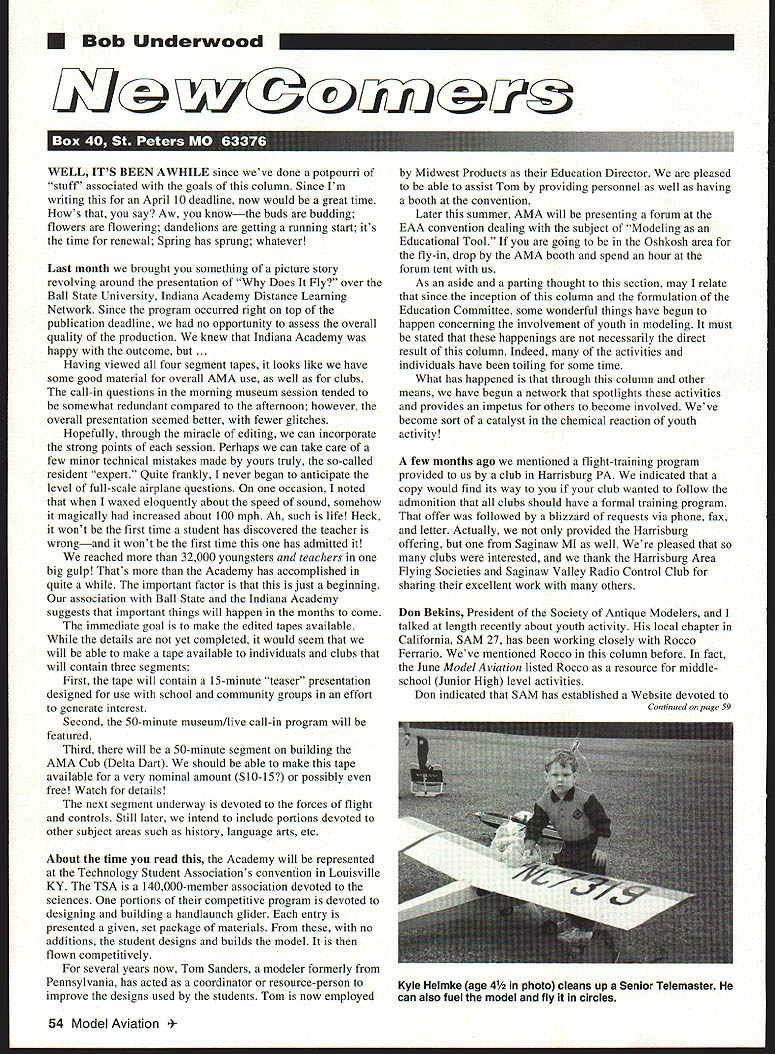
I'll close this month with a photo and an appeal. The young man in the photo is Kyle Helmke, grandson of Henry Helmke. Henry wrote:
"My grandson, Kyle Helmke (age 4½, AMA 525045) is shown cleaning up his Hobby Lobby Senior Telemaster after another successful flight. This plane, powered by an older O.S. .90FS and guided by an Airtronics radio, is, in my opinion, the ideal model for a fledgling flier. At half-throttle, the plane is very docile and gives the young pilot a sense of ability to succeed as an RC pilot.
"Although Kyle is admittedly a bit young to get into RC, he really gets excited at the prospect of going flying with me and his Uncle Rick (an accomplished Pattern flier) and does quite well at flying in big lazy circles. As the attached photo shows, he is learning how to take care of his model. He also knows how to fuel it, but for the time being, he is relegated to a position behind the wing when the engine is running."
My point in all this? Many of you who are the age of grandparents will remember the days when a lad with a measly allowance could spend time at a small local grass strip near the Cubs and Stearmans. A little interest went a long way and often you were allowed to clean the dust off those large "models." That's not easy to do in this day and age. The small grass strips are fenced off, both by regulations and insurance requirements. As a club or individual, you can get the Kyles of this time involved. The easy way to improve community relations and a healthy hobby/sport is to make your flying site the grass strip of the '90s.
Transcribed from original scans by AI. Minor OCR errors may remain.

