
New Life For Old: Four-Wire Servos
By Pete Carr
There may be gold in that old dusty workshop drawer. Some of the servos of yesteryear perform admirably for today's needs when rebuilt as described here.
For those who look for a frustration index of 11 on a scale of 1–10, with a side order of eye strain and a sore neck, working on servos rates high marks. Why, then, would anyone want to rebuild an old servo, especially as the price of a new one with all the latest features is so reasonable? One reason is that some older units had tighter gears and stronger motors than some of the "economy" servos of today. More important, when someone asks what rig you use, you can say, "just bits and pieces of this and that," and they will think you are the original eccentric genius.
Project need: the Dodgson Megan sailplane
Some projects call for a servo of such special qualities that a custom-built unit is the only way to go. Such was the case with the Dodgson Megan sailplane I built. This 140‑in. span bird had top and bottom spoilers so big that a standard servo nearly stalled when opening them. At best it was slow to operate, and the standard servo was a great drain on the airborne pack. Additionally, the average contest landing called for quick deployment and retraction of the spoilers, so it appeared that a Quarter-Scale–type servo would be needed. As fliers of sailplanes know, space is always a problem; the Megan was no exception. Smaller servos weren't faster or strong enough, and big servos wouldn't fit. What to do?
The old four-wire servos
One of the old proportional sets from Japan, the O.S., was imported by World Engines back in the late 1960s and was a first-quality item for its day. The rigs of that era used a center-tapped battery to feed the amplifier of the servos — a disaster if one battery cell failed. The servos of that old rig (designated SP-260) had four wires:
- plus battery
- minus battery
- signal from the decoder
- the white battery center tap
All the new rigs use three leads — no battery center tap. A bad cell may make the servo run slowly, but it won't make it run to one end as the center-tapped ones did.
This servo was very strong and also the same size as the KPS-15s which were stalling in the Megan. All I needed was an amplifier which would handle motor current, use the same 5,000‑ohm feedback pot that the O.S. had, and be inexpensive.
Choosing the electronics
Ace Servos made just the unit I needed: electronics for their servos, shown on page 14 of the catalog. The available amplifiers were:
- Kit amplifier: Part Number 14G25
- Wired unit: Part Number 14G25-W
Both units use the Signetics 544 chip with two outboard transistors (which will handle the servo motor). As the circuit was designed to fit the case of the Ace Bantam servo, there is no worry about fitting it into the larger O.S. case.
I called Ace to order an amplifier and was told that it does not normally come with paperwork or a wiring diagram, so be sure to ask for the kit instructions when you order. At the same time, it is wise to order a connector which will plug into your radio.
Mechanical fitting and assembly
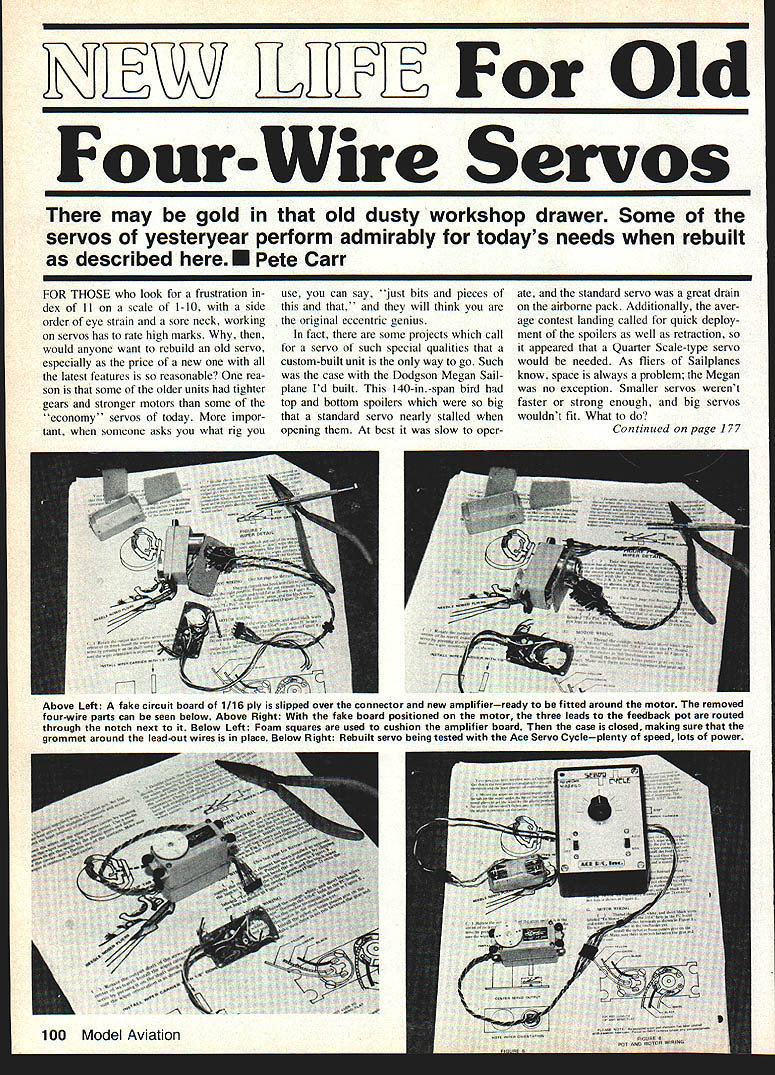
Before getting much into the rebuild, I discovered one mechanical problem. The amplifier was so large that it would not lie flat in the case; it actually stuck out flush with the sides. Removing the old board left a 1/16‑in. gap in the case. To get the case to close, I glued a 1/16‑in. piece of ply to the shape of the old one and then centered it around the motor and pot. There was still plenty of room for the new amplifier and wiring to the motor and pot. With some foam padding in place for vibration protection, the servo was ready to close.
Murphy's Law is well known in model circles, but only those who work on servos can fully understand its meaning. That law, in this instance, states that a servo will always work perfectly until all four inch‑long, fine‑thread screws are tightened down on the case. Then it quits.
Testing and results
In this case, Murphy was somewhat kinder — the servo worked well the first time it was tested on the Ace Servo Cycle. The centering was a bit off but was corrected by sticking a very thin screwdriver down into the output shaft and turning the feedback pot. When installed in the Megan, it was possible to move the transmitter trim for spoilers from high to low and not have the spoilers droop from the stick. Even with the added weight of the mechanical upgrade and being held down with No. 8 rubber bands, the servo hardly showed any sag under the load. Now it is possible to precisely control the descent rate of the ship instead of just waiting for the spoilers to open.
Conclusion and recommendations
While many older servos would be unusable with new Ace electronics, ones like the O.S. SP-260 are worth the effort. Old servo units such as E.K. and Proline had very good mechanics and would make excellent Quarter-Scale servos for today's big birds.
Your next club meeting might be a good time to survey the local pack rats who never throw anything away to see if some of these old jewels can be had.
Transcribed from original scans by AI. Minor OCR errors may remain.

