
New in the Sky
Don Berliner
Traveling at well over Mach 3 (about 2,250 mph) and nearly invisible to radar or infrared detection systems, the newest USAF fighters combine the best of three generations of stealth technology.
Overview
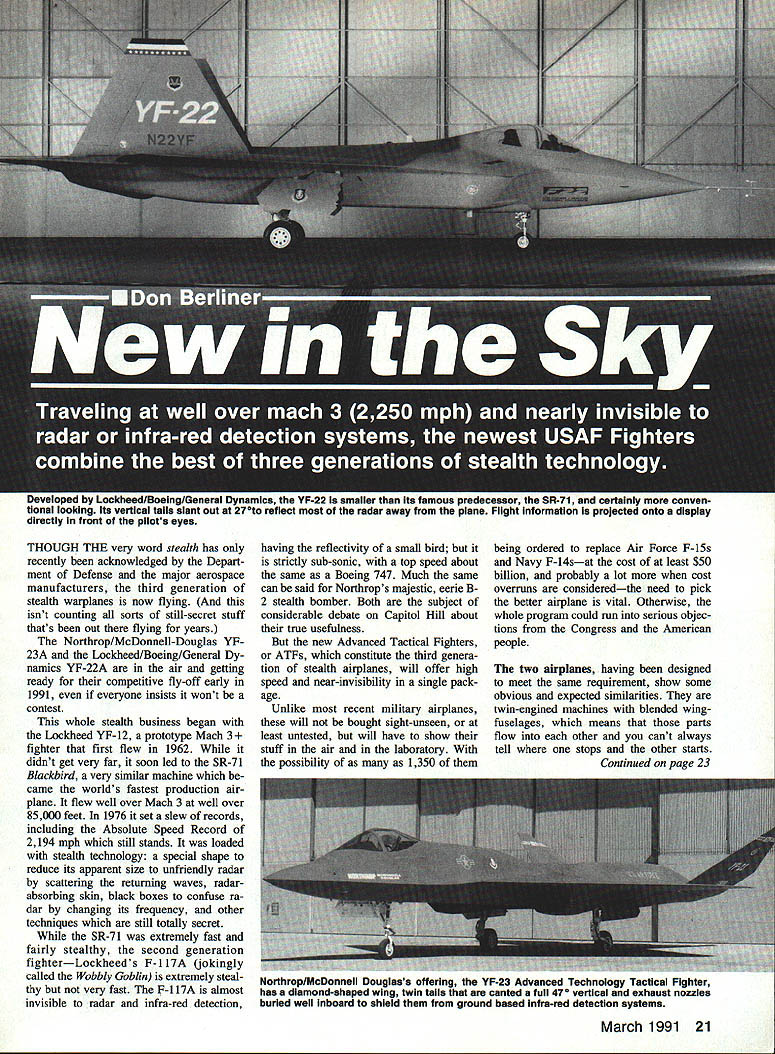
Though the very word "stealth" has only recently been officially acknowledged by the Department of Defense and major aerospace manufacturers, the third generation of stealth warplanes is now flying. The Northrop/McDonnell-Douglas YF-23A and the Lockheed/Boeing/General Dynamics YF-22A are airborne and preparing for their competitive fly-off early in 1991, even if everyone insists it won't be called a contest.
Generations of stealth aircraft
- First generation: Early efforts began with the Lockheed YF-12, a prototype Mach 3+ fighter that first flew in 1962. The YF-12 led to the SR-71 Blackbird, which flew well over Mach 3 at more than 85,000 feet and in 1976 set the absolute speed record of 2,194 mph. These aircraft incorporated special shaping, radar-absorbing materials, and other classified techniques to reduce detectability.
- Second generation: Lockheed's F-117A (nicknamed the "Wobbly Goblin") and Northrop's B-2 bomber are extremely stealthy but not high-speed. The F-117A is almost invisible to radar and infrared detection yet is subsonic, with a top speed comparable to a Boeing 747. The B-2 and F-117A have prompted debate over their operational usefulness.
- Third generation: The Advanced Tactical Fighters (ATFs) aim to combine high speed, maneuverability, and near-invisibility in a single package.
The Advanced Tactical Fighters (ATF)
With the possibility of as many as 1,350 ATFs being ordered to replace Air Force F-15s and Navy F-14s—at a program cost of at least $50 billion—picking the better airplane is vital. The two prototypes must demonstrate performance both in flight and in testing, rather than being bought sight-unseen.
Design similarities
Both ATF contenders were designed to meet the same requirement and therefore share several features:
- Twin-engine configurations.
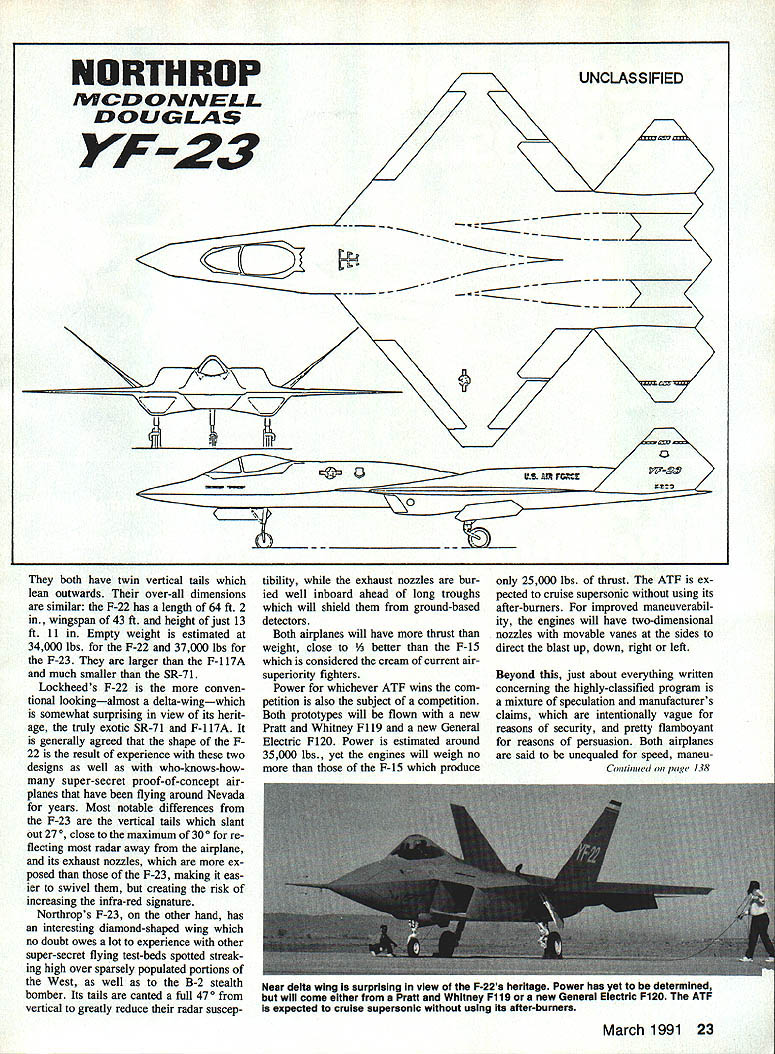
- Blended wing–fuselage designs, where wing and fuselage flow together.
- Twin vertical tails that lean outward (canted).
- Similar overall dimensions: the F-22 measures 64 ft. 2 in. in length, has a wingspan of 43 ft., and a height of 13 ft. 11 in. Estimated empty weights are about 34,000 lbs for the F-22 and 37,000 lbs for the F-23. Both are larger than the F-117A and much smaller than the SR-71.
Differences between the F-22 and F-23
Lockheed/Boeing/General Dynamics YF-22 (F-22)
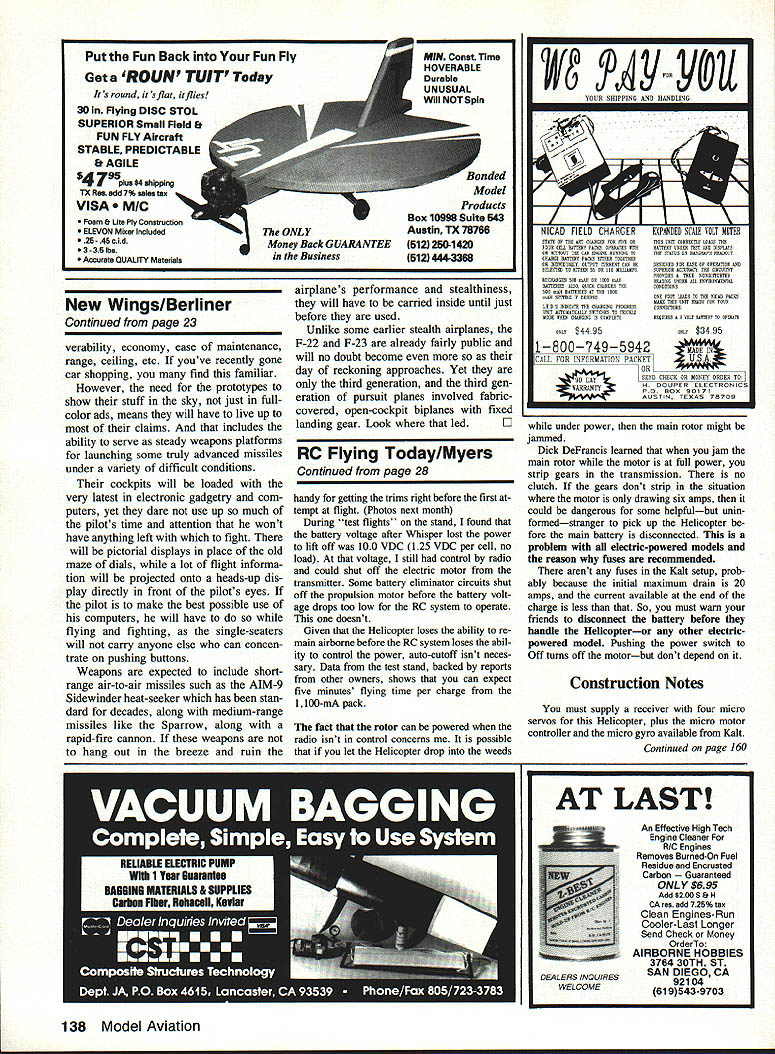
- Appearance: More conventional-looking, nearly a delta wing; its shape reflects experience from the SR-71, the F-117A, and classified test aircraft.
- Vertical tails: Slant out about 27° (close to a practical maximum of about 30°) to reflect radar energy away from the airplane.
- Exhaust nozzles: More exposed, making them easier to swivel for improved maneuverability but increasing infrared signature risk.
Northrop/McDonnell-Douglas YF-23 (F-23)
- Appearance: Diamond-shaped wing influenced by stealth test-beds and the B-2 bomber.
- Vertical tails: Canted about 47° from vertical to reduce radar susceptibility.
- Exhaust nozzles: Buried well inboard ahead of long troughs to shield them from ground-based detectors.
Both aircraft are designed for high thrust-to-weight ratios—close to 1.5—considerably better than the current F-15, which is considered the benchmark of contemporary air-superiority fighters.
Engines and performance
- Engine competition: Both prototypes are being tested with two engine candidates—the Pratt & Whitney F119 and the General Electric F120.
- Estimated thrust: Around 35,000 lbs of thrust per engine is reported, yet engine weight should be no greater than the engines on the F-15, which produce about 25,000 lbs.
- Supersonic cruise: The ATF is expected to cruise supersonically without using afterburners.
- Maneuverability: Engines will feature two-dimensional nozzles with movable vanes to vector thrust up, down, left, or right for improved agility.
Classified program and public visibility
Much of the ATF program is highly classified; public information mixes manufacturer claims, speculation, and intentional vagueness for security reasons. Both prototypes are touted for exceptional speed, maneuverability, and stealth. Unlike earlier stealth aircraft that were secret for long periods, the F-22 and F-23 are already fairly public and will likely become more visible as testing progresses.
Conclusion
The F-22 and F-23 represent the third generation of stealth fighters, aiming to unite the high speed of early designs like the SR-71 with the low observability of aircraft such as the F-117A and B-2. As testing continues and one design is selected, these aircraft could significantly shape the future of air superiority.
Transcribed from original scans by AI. Minor OCR errors may remain.

