
New in the Sky: Jaffe SA-32T Turbotrainer
— L.D. Bookbinder
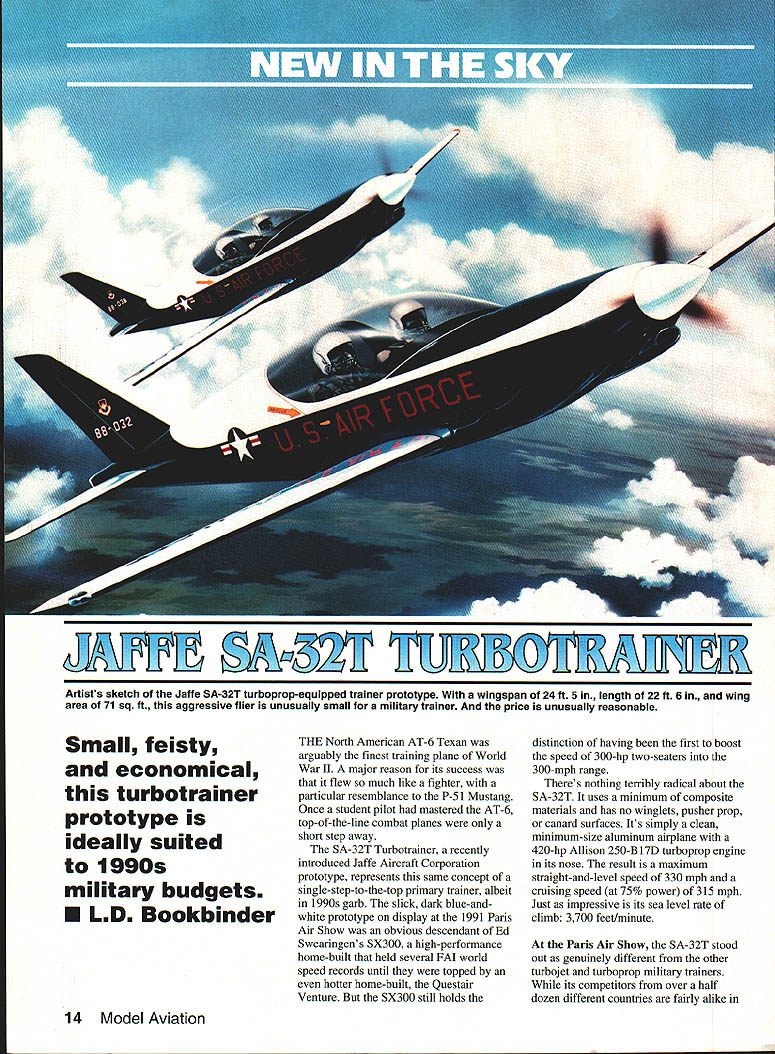
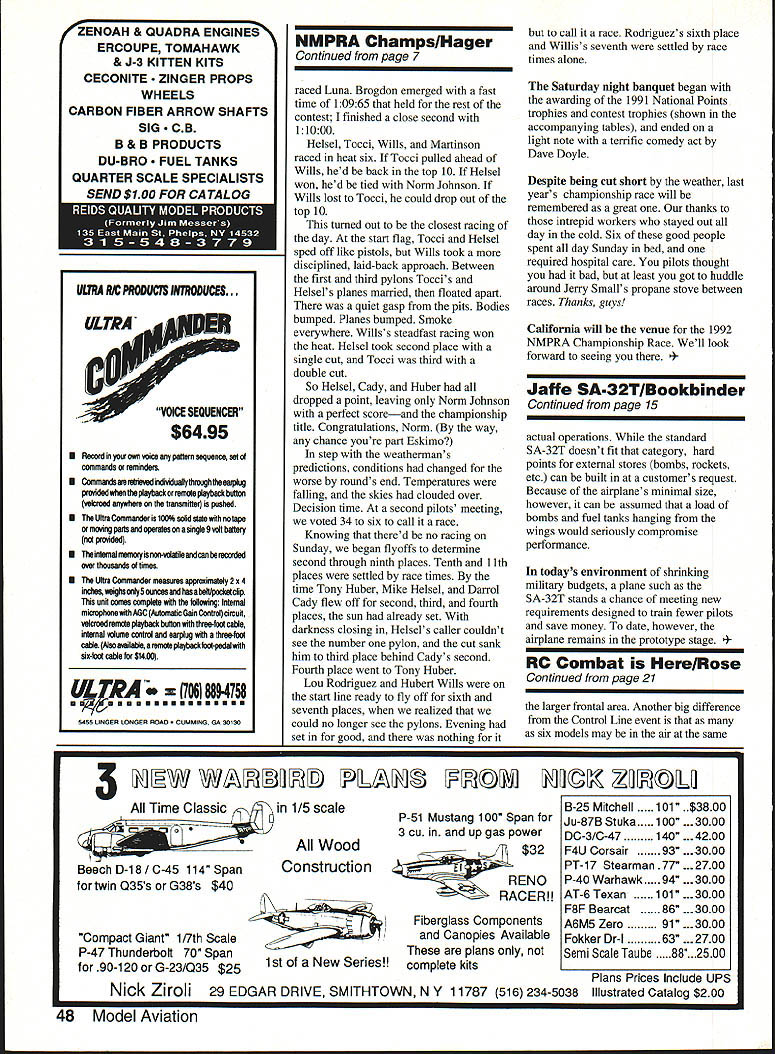
The SA-32T Turbotrainer, a prototype from Jaffe Aircraft Corporation shown at the 1991 Paris Air Show, is a small, economical primary trainer intended to prepare pilots for high-performance combat aircraft. A clean, minimum-size aluminum design powered by a 420-hp Allison 250-B17D turboprop, the SA-32T emphasizes fighterlike handling, low operating cost, and a low purchase price suitable for shrinking 1990s military budgets.
Lineage and purpose
The dark blue-and-white prototype displayed in Paris is an obvious descendant of Ed Swearingen’s SX300 homebuilt — a high-performance two-seater that once held several FAI speed records. Like the North American AT-6 Texan of World War II, the SA-32T follows the “single-step-to-the-top” trainer concept: train pilots in an aircraft that closely reproduces the feel and characteristics of frontline fighters so the transition to combat types is short and direct.
Design and construction
Airframe and materials
- Primarily aluminum construction: full-span main spar, integral fuel tanks, basic fuselage, tail, and control surfaces are aluminum.
- Limited composite use: wing and tail tips, wing fillets, tail cone, and engine cowling are composite.
- Airfoil: NASA NLF 0416 laminar-flow wing section to reproduce high-performance handling.
Cockpit and controls
- Side-by-side seating to facilitate instructor-student communication and reduce instrument duplication.
- Stick control (rather than a wheel) for rapid, fighterlike response.
- Large one-piece canopy with excellent visibility; canopy can be jettisoned in an emergency.
- Basic instrument panel includes clock, rate-of-climb indicator, airspeed, altimeter, compass, outside air temperature, turn-and-bank indicator, and engine instruments.
- Space remains for optional avionics and equipment beyond a standard radio fit.
Performance
Powerplant and general performance
- Engine: Allison 250-B17D turboprop, 420 hp.
- Maximum straight-and-level speed: 330 mph.
- Cruise speed (75% power): 315 mph.
- Sea-level rate of climb: 3,700 ft/min.
Handling and flight characteristics
- Designed to emulate fast, high-stall-speed combat airplanes rather than docile trainers.
- Stall speeds: 99 mph (gear and flaps up); 84 mph (gear and flaps down).
- Wing loading: about 36 lb/sq. ft., similar to that of a larger high-performance aircraft.
- Airframe stressed to +9 Gs; ultimate load capability exceeds that of many rivals.
Dimensions and weights
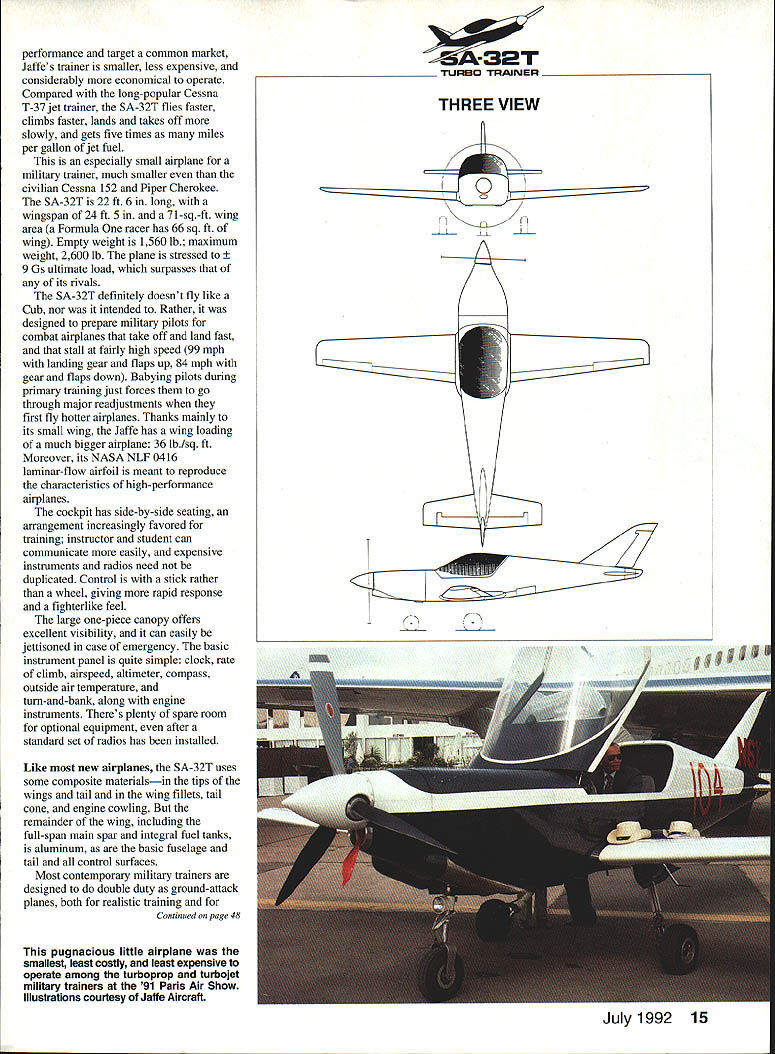
- Length: 22 ft. 6 in.
- Wingspan: 24 ft. 5 in.
- Wing area: 71 sq. ft. (for comparison, a Formula One racer has about 66 sq. ft.)
- Empty weight: 1,560 lb.
- Maximum weight: 2,600 lb.
Operational role and economy
- Smaller and less expensive than many contemporary turbofan and turboprop military trainers.
- Compared with the long-popular Cessna T-37 jet trainer, the SA-32T:
- Flies faster and climbs faster,
- Takes off and lands in less distance,
- Achieves significantly better fuel economy (reported at about five times the miles per gallon of jet fuel).
- Much smaller than typical civil trainers such as the Cessna 152 or Piper Cherokee, reflecting its emphasis on higher wing loading and fighterlike behavior.
Armament and mission flexibility
- The standard SA-32T is a pure trainer, not a dedicated ground-attack aircraft.
- Hard points for external stores (bombs, rockets, drop tanks) can be fitted at customer request, but the airplane’s minimal size means external loads would seriously compromise performance.
Conclusion
The SA-32T Turbotrainer is a compact, high-performance turboprop designed to give trainee pilots an authentic fighterlike experience at low acquisition and operating cost. Suited to tighter defense budgets and programs that emphasize economical, realistic training, the aircraft remains at prototype stage, but it demonstrates a promising niche: a small, economical trainer that bridges the gap between basic instruction and high-performance combat types.
Transcribed from original scans by AI. Minor OCR errors may remain.

