
New in the Sky: Pond Racer
— L. D. Bookbinder
Overview
This high-technology, twin-boom work of art from the endlessly innovative Burt Rutan is scarcely larger than a Formula One, yet it is designed purely for speed. If the Pond Racer succeeds in tromping the big Unlimited-class warbirds at Reno, it will have made air-racing history.
Design and propulsion
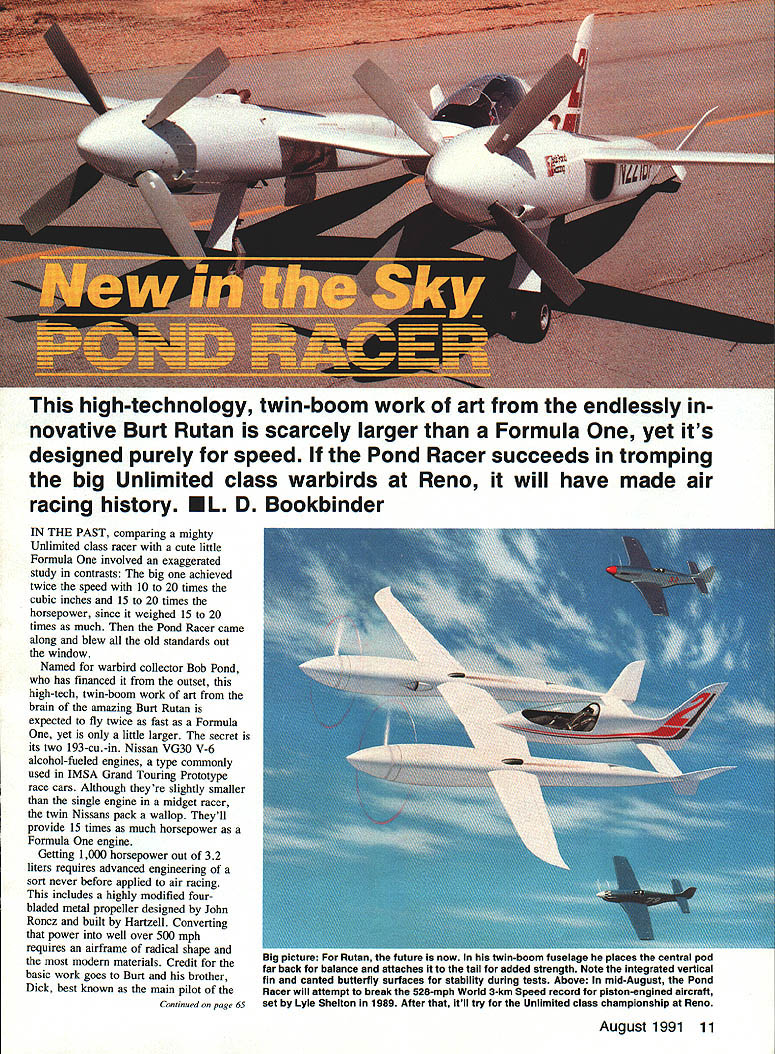
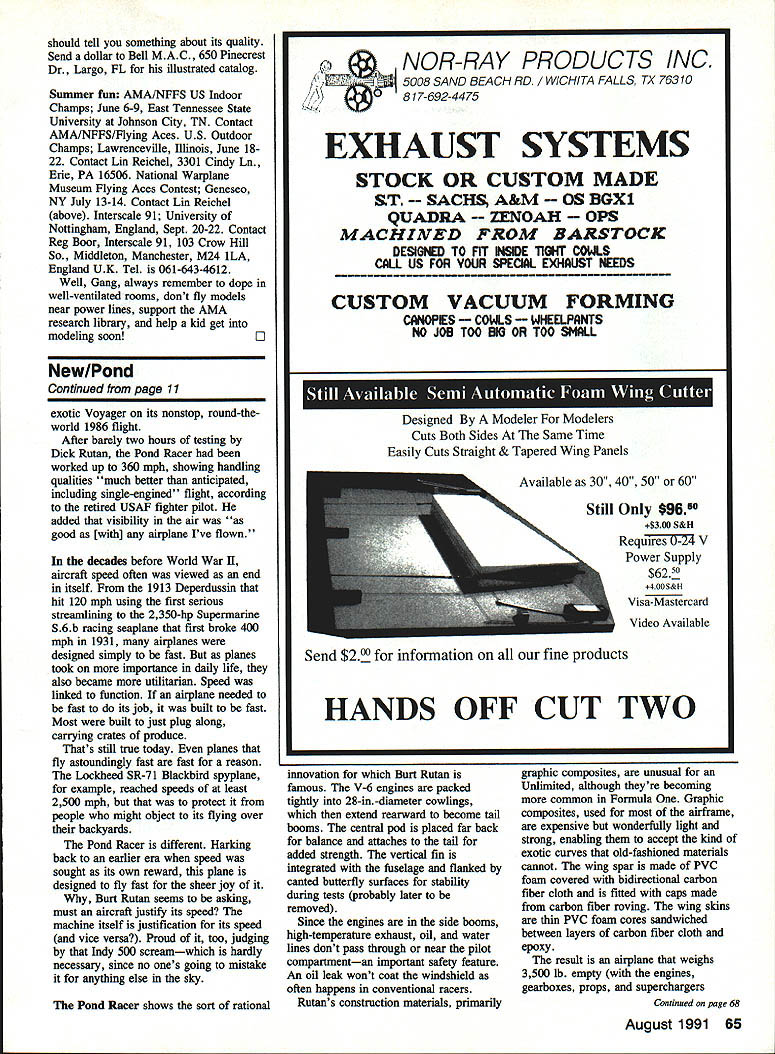
Named for warbird collector Bob Pond, who financed it from the outset, the Pond Racer is a high-tech, twin-boom airplane from the brain of Burt Rutan. It is expected to fly roughly twice as fast as a Formula One while being only a little larger. The secret lies in its two 193-cu.-in. Nissan VG30 V-6, alcohol-fueled engines — the same type commonly used in IMSA Grand Touring Prototype race cars. Although each engine is slightly smaller than the single engine in a midget racer, the twin Nissans together produce enormous power: getting about 1,000 horsepower out of 3.2 liters requires advanced engineering never before applied to air racing.
Key propulsion and powertrain notes:
- Two 193-cu.-in. Nissan VG30 V-6 alcohol-fueled engines.
- Approximately 1,000 total horsepower from 3.2 liters.
- Highly modified four-bladed metal propeller designed by John Roncz and built by Hartzell.
Converting that power into well over 500 mph requires an airframe of radical shape and the most modern materials. The basic design credit goes to Burt Rutan and his brother Dick Rutan, best known as the main pilot of the Voyager.
Handling and testing
After barely two hours’ testing, Dick Rutan had the Pond Racer worked up to 360 mph, showing handling qualities much better than anticipated, including single-engine flight capability. The plane is proud and loud — judging by the Indy 500–style scream — which is hardly necessary since no one will mistake anything else in the sky.
Harking back to an era when speed was sought for its own reward, the Pond Racer is designed to fly fast for the sheer joy of it. Burt Rutan seems to be asking whether an aircraft must always justify its speed; in this case, the machine itself is its own justification.
Structure and materials
The Pond Racer shows the sort of rational innovation for which Burt Rutan is famous. The V-6 engines are packed tightly into 28-in.-diameter cowlings that extend rearward to become the tail booms. The central pod is placed far back for balance and attaches to the tail for added strength. The vertical fin is integrated with the fuselage and flanked by canted butterfly surfaces for stability during tests (probably to be removed later).
Because the engines are in the side booms, high-temperature exhaust, oil, and water lines do not pass through or near the pilot compartment — an important safety feature. An oil leak won’t coat the windshields as often happens in conventional racers.
Rutan’s primary construction materials are graphite (carbon) composites, unusual for an Unlimited but increasingly common in Formula One. These materials are expensive but wonderfully light and strong, enabling exotic curves that old-fashioned materials cannot achieve. Construction details include:
- Wing spar: PVC foam core covered with bidirectional carbon-fiber cloth, with caps made from carbon-fiber roving.
- Wing skins: thin PVC foam cores sandwiched between layers of carbon-fiber cloth and epoxy.
Specifications
- Empty weight: about 3,500 lb. (engines, gearboxes, props, and superchargers account for much of the weight)
- Racing weight: about 4,150 lb.
- Wingspan: 25 ft. 5 in. (longer than most Formula Ones)
- Wing area: about 70 sq. ft. (slightly larger than the 66 sq. ft. of a 500-lb. midget racer)
- Central pod length: 16 ft.; overall length matches the wingspan
Records and racing plans
In mid-August, at Las Vegas, New Mexico, the Pond Racer will attempt to overturn the 528-mph World 3-km Speed Record for piston-engined aircraft set by Lyle Shelton in 1989. To succeed, Dick Rutan will have to fly at least one percent faster than Shelton, or over 533.6 mph. If successful, the Pond would become the first custom-built airplane to hold this classic record since 1937, when a prototype Messerschmitt Bf 109 broke Howard Hughes’s mark.
After the record attempt, the Pond will go to Reno, where race pilot Rick Brickert will attempt to show that big airplanes and their huge engines can still be true race planes. That hasn’t happened since souped-up warbirds first entered the Unlimited class in 1945. If the Pond Racer wins the Unlimited championship, it will be as significant as Doug Davis’s triumph in his custom-built Travel Air Mystery that launched the Golden Age of air racing in 1929.
The crowd will go nuts watching this one-of-a-kind little screamer whomp the big bullies. Individuality and creativity could return to big-plane racing for the first time since the 1930s, and racing fans everywhere would revel in the triumph of the new over the old. Sketch pads may fill with ideas for experimental shapes and engines as imaginations are loosed on the challenge of yet more speed.
Implications for the Unlimited class
Does all this point to a new Golden Age of air racing? That is uncertain. The Unlimited Class is already facing a depletion in its ranks: modified warbirds are being restored to original configurations to increase resale value, and few new warbird-based racers are in the works. The sudden emergence of a seemingly unbeatable design could accelerate the exodus, leaving the class with fewer competitive race planes and further jeopardizing hopes for a circuit of Unlimited races around the country.
Still, experimentalism is essential for progress. To discourage development of new racers would be self-defeating. If new racers do succeed, they could stimulate enough projects to carry the class to greater heights.
Transcribed from original scans by AI. Minor OCR errors may remain.

