
New in the Sky: SSBJ
By L.D. Bookbinder
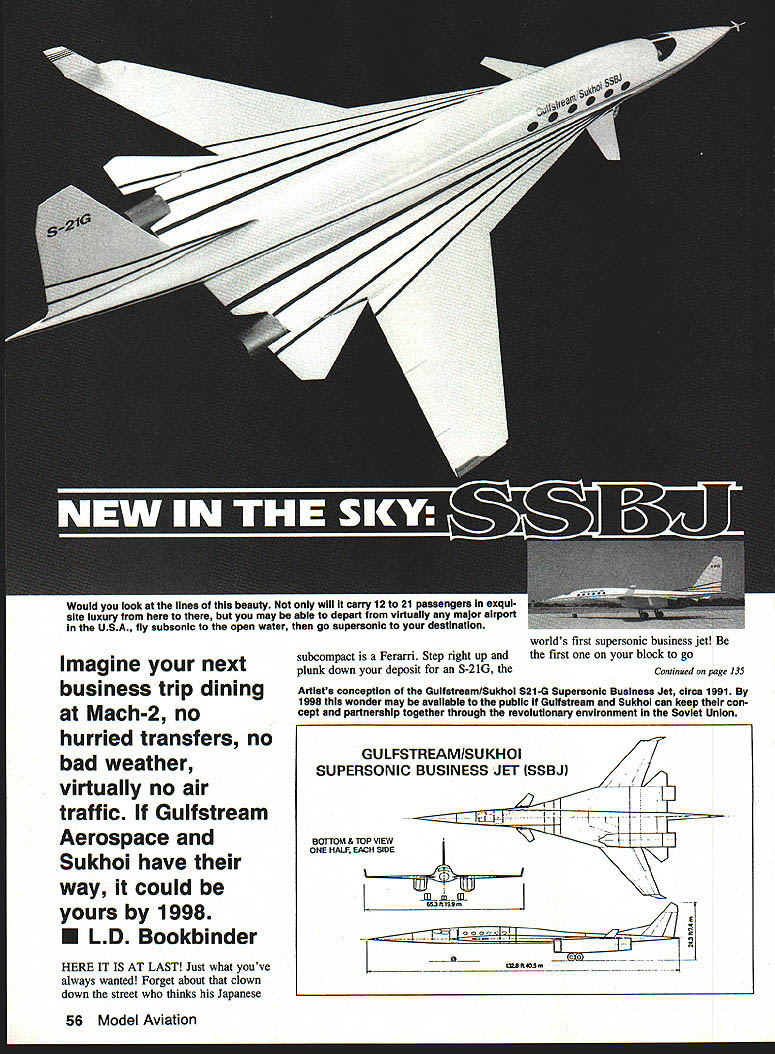
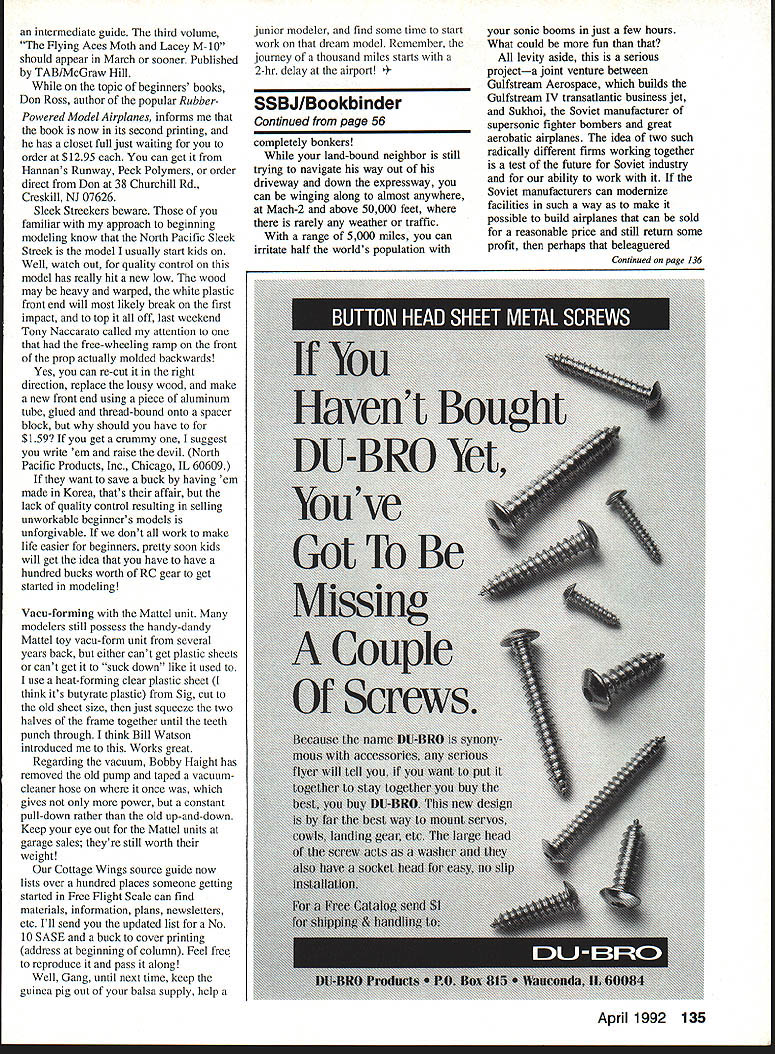
Would you look at the lines of this beauty? Not only will it carry 12 to 21 passengers in exquisite luxury from here to there, but you may be able to depart from virtually any major airport in the U.S.A., fly subsonic to the open water, then go supersonic to your destination.
Imagine your next business trip dining at Mach 2 — no hurried transfers, no bad weather, virtually no air traffic. If Gulfstream Aerospace and Sukhoi have their way, it could be yours by 1998.
Here it is at last!
Just what you've always wanted! Forget about that clown down the street who thinks his Japanese subcompact is a Ferrari. Step right up and plunk down your deposit for an S-21G, the world's first supersonic business jet! Be the first one on your block to go.
By 1998 the wonder may be available to the public if Gulfstream and Sukhoi can keep their concept and partnership together through the revolutionary environment in the Soviet Union.
While your land-bound neighbor is still trying to navigate his way out of his driveway and down the expressway, you can be winging along to almost anywhere at Mach 2 and above 50,000 feet, where there is rarely any weather or traffic.
With a range of 5,000 miles, you can irritate half the world's population with your sonic booms in just a few hours. What could be more fun than that?
All levity aside, this is a serious project — a joint venture between Gulfstream Aerospace, which builds the Gulfstream IV transatlantic business jet, and Sukhoi, the Soviet manufacturer of supersonic fighter-bombers and great aerobatic airplanes. The idea of two such radically different firms working together is a test of the future for Soviet industry and for our ability to work with it. If Soviet manufacturers can modernize facilities to build airplanes that can be sold at a reasonable price and still return some profit, then perhaps that beleaguered country has a future.
Origins and development
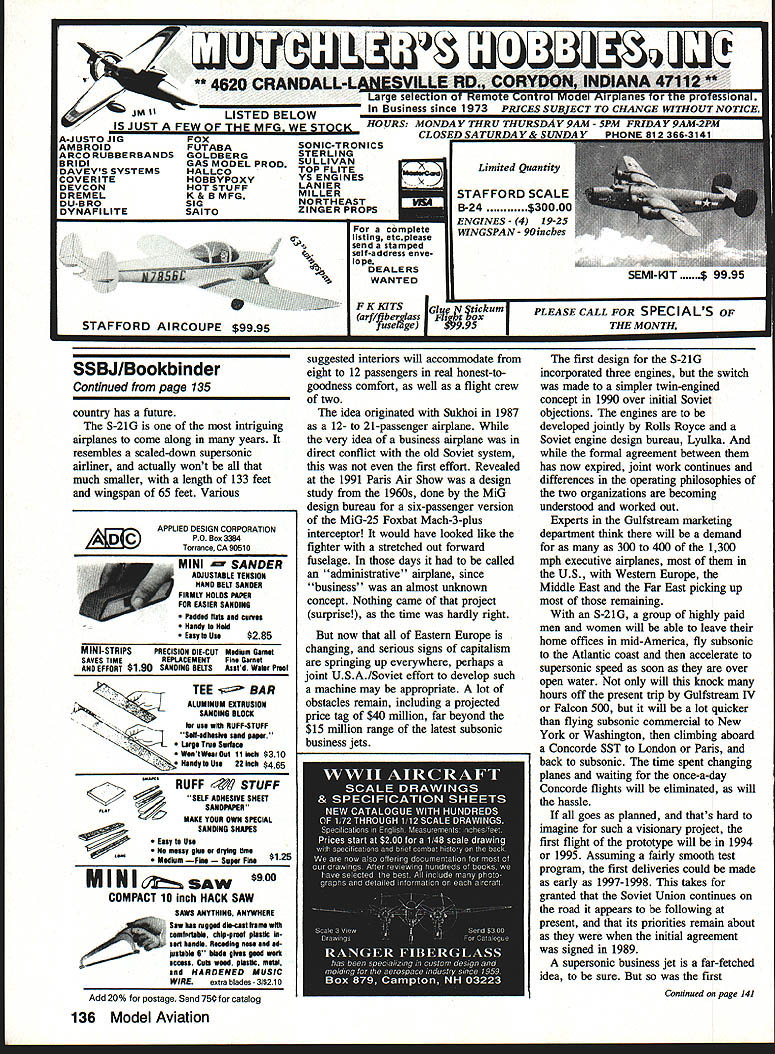
The S-21G is one of the most intriguing airplanes to come along in many years. It resembles a scaled-down supersonic airliner, and actually won't be all that much smaller, with a length of 133 feet and a wingspan of 65 feet. The original idea originated with Sukhoi in 1987 as a 12- to 21-passenger airplane. Various suggested interiors would accommodate from eight to 12 passengers in real, honest-to-goodness comfort, along with a flight crew of two.
While the very idea of a business airplane was in direct conflict with the old Soviet system, this was not even the first effort. Revealed at the 1991 Paris Air Show was a design study from the early 1960s, done by the MiG design bureau for a six-passenger version of the MiG-25 Foxbat Mach-3-plus interceptor. It would have looked like the fighter with a stretched-out forward fuselage. In those days it had to be called an "administrative" airplane, since "business" was an almost unknown concept. Nothing came of that project, as the time was hardly right.
But now that all of Eastern Europe is changing and serious signs of capitalism are springing up everywhere, perhaps a joint U.S./Soviet effort to develop such a machine may be appropriate. A lot of obstacles remain, including a projected price tag of $40 million — far beyond the $15 million range of the latest subsonic business jets.
Design choices and propulsion
The first design for the S-21G incorporated three engines, but the switch was made to a simpler twin-engined concept in 1990 over initial Soviet objections. The engines are to be developed jointly by Rolls-Royce and a Soviet engine design bureau, Lyulka. While the formal agreement between them has now expired, joint work continues and differences in the operating philosophies of the two organizations are becoming better understood and worked out.
Experts in Gulfstream's marketing department think there will be demand for as many as 300 to 400 of the 1,300-mph executive airplanes, most of them in the U.S., with Western Europe, the Middle East and the Far East picking up most of the other orders.
Operational advantages
With an S-21G, a group of highly paid men and women will be able to leave their homes or offices in mid-America, fly subsonic to the Atlantic coast and then accelerate to supersonic speed as soon as they are over the ocean. Not only will this knock many hours off the present trip by Gulfstream IV or Falcon 500, but it will be a lot quicker than flying subsonic commercial to New York or Washington, then climbing aboard a Concorde SST to London or Paris and back to subsonic. The time spent changing planes and waiting for the once-a-day Concorde flights will be eliminated, as will the hassle.
Key specifications and timeline
- Speed: ~1,300 mph (Mach 2 range)
- Service altitude: above 50,000 feet
- Range: about 5,000 miles
- Length: 133 feet
- Wingspan: 65 feet
- Passenger configurations: original concept 12–21; suggested interiors 8–12
- Engines: twin-engine design, jointly developed by Rolls-Royce and Lyulka
- Projected price: ~$40 million
- Estimated market demand: 300–400 units
- Prototype first flight: targeted 1994–1995
- Possible first deliveries: as early as 1997–1998 (assuming continued Soviet priority and a smooth test program)
Conclusion
A supersonic business jet is a far-fetched idea, to be sure. But so was the first supersonic airliner. And the first business jet was looked upon by many people as a guaranteed flop. For that matter, how many people thought the airplane would fly when those bicycle mechanics started getting serious about it?
The SSBJ may not get off the ground. But it's worth trying.
Transcribed from original scans by AI. Minor OCR errors may remain.

