


New Twist to Old: Compressed Air Power
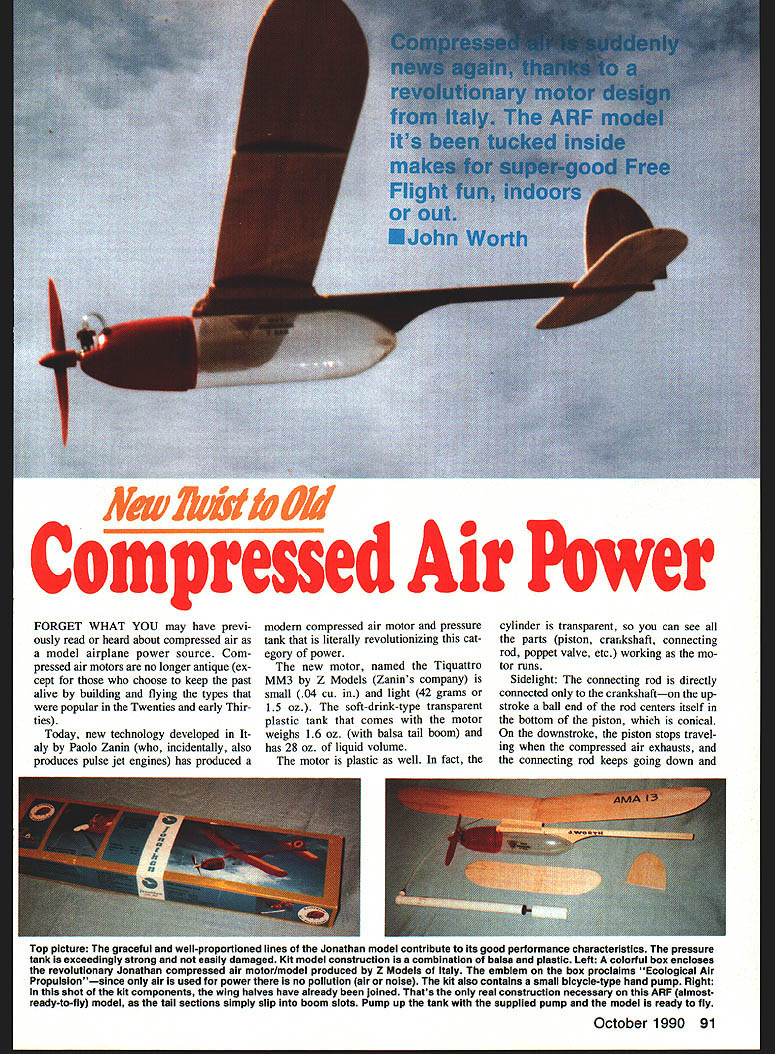
Forget what you may have previously read or heard about compressed air as a model airplane power source. Compressed-air motors are no longer antique (except for those who choose to keep the past alive by building and flying the types that were popular in the Twenties and early Thirties). Today, new technology developed in Italy by Paolo Zanin (who also produces pulse-jet engines) has produced a modern compressed-air motor and pressure tank that is literally revolutionizing this category of power.
The motor and tank
The new motor, named the Tiquattro MM3 by Z Models (Zanin's company), is small and light:
- Displacement: 0.04 cu. in.
- Motor weight: 42 grams (1.5 oz.)
- Tank weight: 1.6 oz. (with balsa tail boom)
- Tank volume: 28 oz.
The motor is plastic, and the cylinder is transparent so you can see all the parts (piston, crankshaft, connecting rod, poppet valve, etc.) working as the motor runs.
Sidelight: the connecting rod is directly connected only to the crankshaft. On the upstroke a ball end of the rod centers itself in the bottom of the piston, which is conical. On the downstroke, the piston stops traveling when the compressed air exhausts, and the connecting rod keeps going down and then up again. This reduces internal drag by the piston — a neat trick to avoid wasting power through unnecessary friction.
Motor materials have been selected to avoid lubrication problems, so no lubrication is required. Because the “fuel” is compressed air, the moving parts operate in a clean atmosphere and are compatible. Also, without a motor–fuel combination that causes high temperatures, no significant heat problem can occur. Helping that situation is the relatively low motor speed — typically about 4,000 rpm at highest (initial) power.
Operation and performance
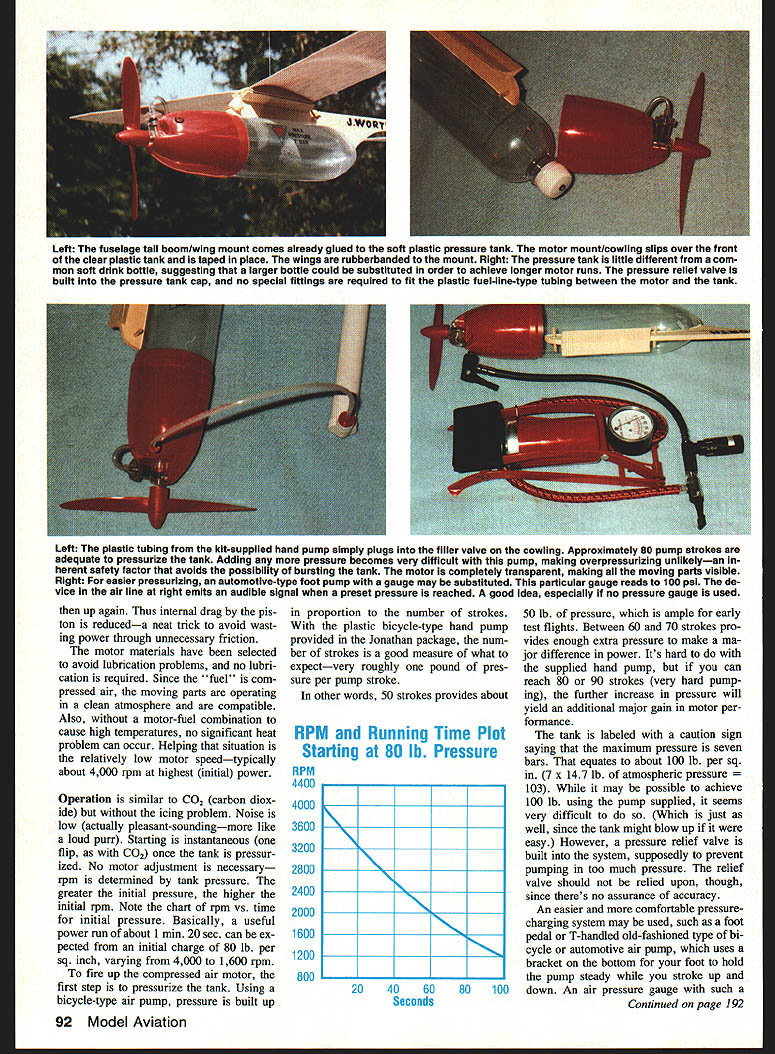
Operation is similar to CO2 but without the icing problem. Noise is low (a pleasant-sounding purr). Starting is instantaneous (one flip, as with CO2) once the tank is pressurized. No motor adjustment is necessary — rpm is determined by tank pressure: the greater the initial pressure, the higher the initial rpm.
Note the chart of rpm vs. time for initial pressure: basically, a useful power run of about 1 minute 20 seconds can be expected from an initial charge of 80 lb. per sq. in., with rpm varying from about 4,000 down to 1,600.
Pressurizing the tank
To fire up the compressed-air motor, the first step is to pressurize the tank. Using a bicycle-type air pump, pressure is built up in proportion to the number of strokes. With the plastic bicycle-type hand pump provided in the Jonathan package, the number of strokes is a good rough measure — very roughly one pound of pressure per pump stroke. In other words:
- 50 strokes ≈ 50 lb./sq. in. (psi) — ample for early test flights
- 60–70 strokes — noticeably more power
- 80–90 strokes — difficult with the supplied pump but yields a major gain in performance
The tank is labeled with a caution sign saying the maximum pressure is seven bars (about 103 lb./sq. in.). While it may be possible to achieve 100 lb./sq. in. using the supplied pump, it seems very difficult to do so. A pressure relief valve is built into the system to help prevent overpressurizing, but it should not be solely relied upon, since accuracy is not guaranteed.
A more comfortable pressurizing system may be used, such as a foot-pedal or T-handled bicycle/automotive pump that uses a foot bracket for stability. An air-pressure gauge in the air line (especially one that emits an audible signal when a preset pressure is reached) is a good idea if no built-in gauge is used.
Flight tests (Jonathan)
Initial flights of the Jonathan model were indoors at the large Mini‑Dome of East Tennessee State University during the Indoor National Championships. The building interior height (to the bottom of the girders) is 116 ft., with a ground floor area 420 by 208 ft. (plus another 100 ft. on each side for seats).
Jonathan easily climbed to about 80 ft. in roughly 50-ft.-diameter circles, taking about 40 seconds to reach that height and another 30 seconds to gradually circle down to a smooth landing. About 80 pump strokes were used (≈80 psi) to deliver this performance — approximately one foot of altitude per pump stroke. The author’s impression was that with 90–100 strokes Jonathan would have reached at least 100 ft.
Performance “out of the box” is fine for small-field outdoor flying (a football field is plenty), provided the field is not surrounded by tall trees. The model weighs about 4.6 oz. ready to fly, which is heavy enough to make out-of-sight flights unlikely, so a dethermalizer usually isn’t necessary.
Modifications and construction suggestions
The supplied all‑balsa wing and tail assembly plus a heavier-than-necessary tail boom leave room for performance improvement. Using built-up wing and tail construction would allow the builder to increase lifting surface area by 50% or even double it. The expected result would be a major performance increase, which might call for adding a dethermalizer.
On the other hand, the stock model is rugged, easily repaired, and fun to fly. It will give repeated flights without much risk of flying away. For those who fly from small fields, this airplane lets you enjoy Free Flight without the complications of higher-performance competition types.
Portability
Compressed-air-powered model flying is clean and quiet, with just enough motor “buzz” to sound pleasant and indicate power output. The Jonathan design, if modified by a simple means of joining the wing halves for flying and disassembling for carrying, fits in a box only 27 in. long, 7 in. wide, and 3 in. deep (including supplies and hand pump). Even without disassembly the model is compact and easily carried in a car. Its wingspan is just under three feet, making it convenient to carry and use at schoolyards or sports fields.
Availability and pricing
Availability at present is severely limited but could change quickly if demand grows. Current sources:
- Manufacturer: Z Models, Via Solferino 41, 31020 Frescada, Treviso, Italy.
- English importer: Mega Models, Ltd., Caster House, Repenbeck St., Farnworth, Bolton BL4 7EP, England. Fax: 204-792-922.
Prices in England:
- Complete package: 38 pounds (about $61 U.S.)
- Motor and pressure bottle alone: 25 pounds (about $41 U.S.)
(These prices include postage for mailing in England; extra cost for airline shipment not quoted.)
U.S. availability (as of press time): Bert Powell and Tom Nallen will manufacture this motor/model combination for sale in the U.S. Contact:
- Bert Powell, 128 Warren Street, Longmeadow, MA 01106.
Introduction prices (U.S.):
- Package A (complete kit with motor): $67.95 + $5.50 postage & handling
- Package B (motor, prop, and tank): $44.95 + $3.50 p&h
- Package C (motor and prop): $27.95 + $2.75 p&h
Conclusion
The Jonathan compressed-air-powered motor is practical and fun. It opens up a whole new world of simple, clean, quiet power. Although created and sold as a toy, it’s also a well-engineered model design that may rival and challenge CO2 and electric power. Larger, radio-controlled versions seem likely in the future.
Transcribed from original scans by AI. Minor OCR errors may remain.

