
New York City: Schools' Fly-In
Bill Boss
For almost two decades the New York City public schools program has shown that model building can spark a lifelong passion for aviation while teaching technological skills. On May 17, 1990, more than 150 junior and senior high school students from across New York City converged on the Blue Hangar at Floyd Bennett Field in Brooklyn for the 18th annual New York City Board of Education Fly-In and Model Aircraft Competition. The fly-in is the culminating event of the aerospace education program, part of a citywide technology curriculum for intermediate through senior high school students administered by the New York City Board of Education.
Event and location
Floyd Bennett Field, now part of the Gateway National Recreation Area of the National Park Service, provided ample space for the contest. Old-timers recall the Blue Hangar as the scene of the New York Mirror meets of the 1950s and early 1960s, contests in which winners sometimes took home prizes as spectacular as full-scale aircraft and boats.
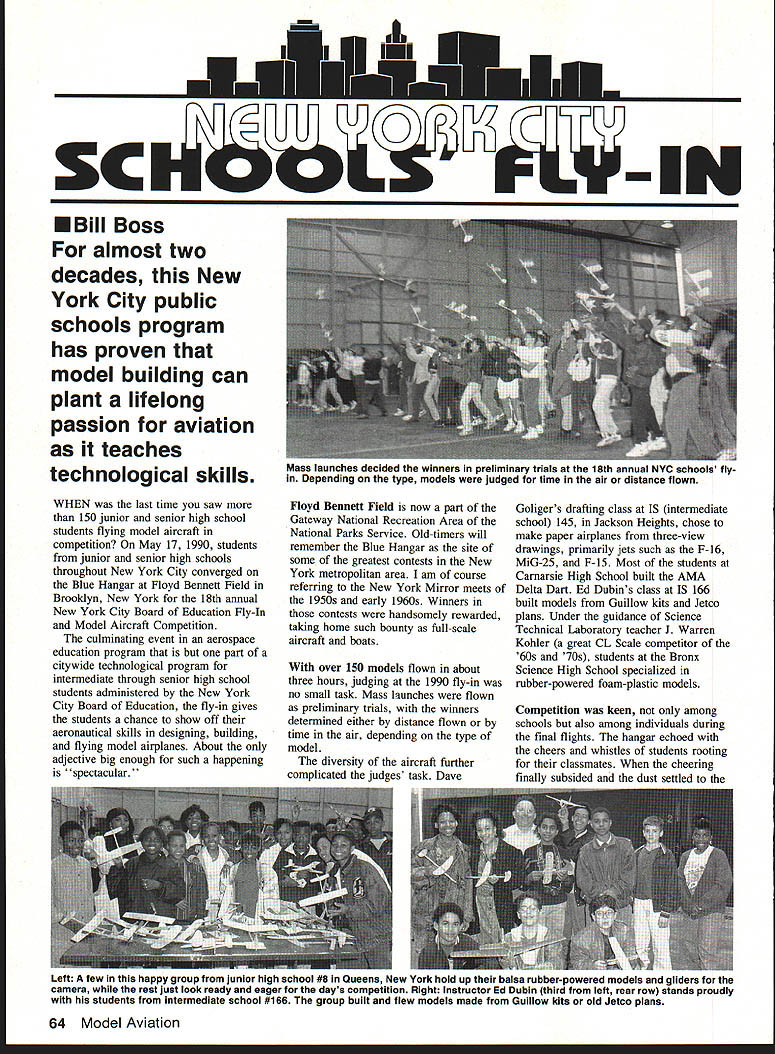
Over 150 models were flown during the 1990 fly-in. Judging took about three hours. Mass launches and preliminary trials determined winners; models were scored by time aloft or distance flown depending on model type. The hangar echoed with cheers and whistles as students rooted for classmates during the final flights. When the dust settled, trophies — including those sponsored by the Triborough Bridge and Tunnel Authority — were awarded in the various categories.
Participating schools and models
The diversity of aircraft entered complicated judging and highlighted different classroom approaches:
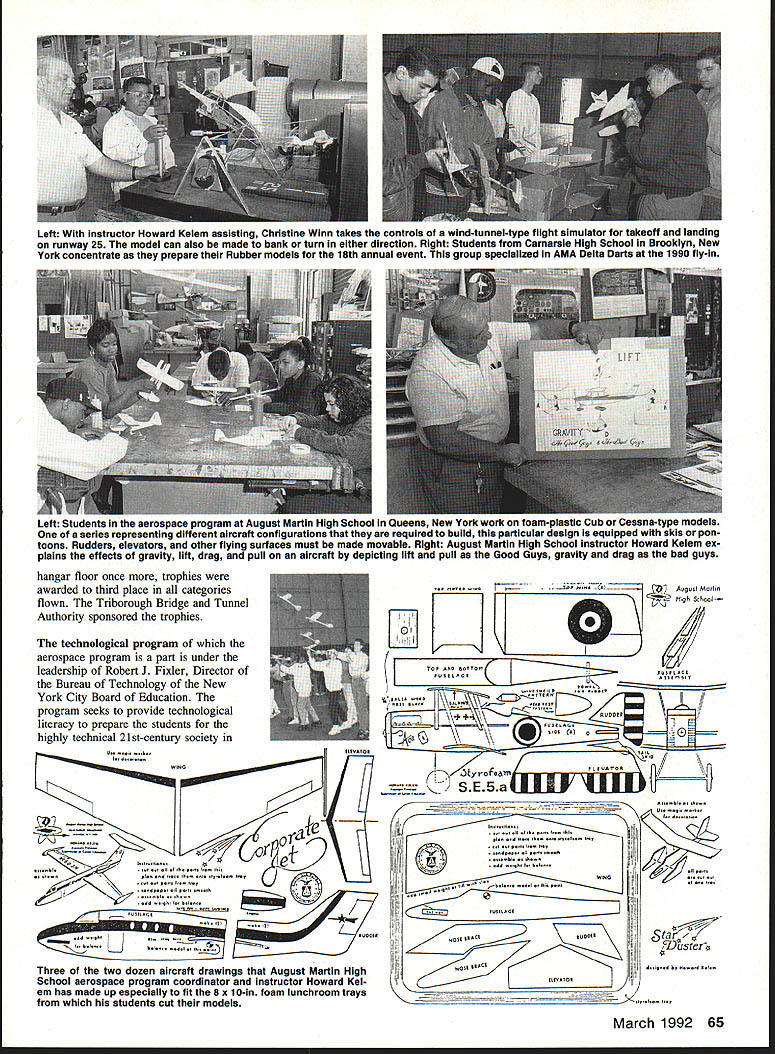
- Intermediate School (IS) 145, Jackson Heights: drafting class built paper airplanes from three-view drawings, mainly jets such as the F-16, MiG-25, and F-15.
- Canarsie High School: most students built the AMA Delta Dart.
- IS 166: Ed Dubin's class built models from Guillow kits and Jetco plans.
- Bronx Science High School: under Science/Technical Laboratory teacher J. Warren Kohler (noted CL scale competitor in the 1960s–70s), students specialized in rubber-powered foam-plastic models.
Competition was keen both among schools and among individuals.
Program structure and goals
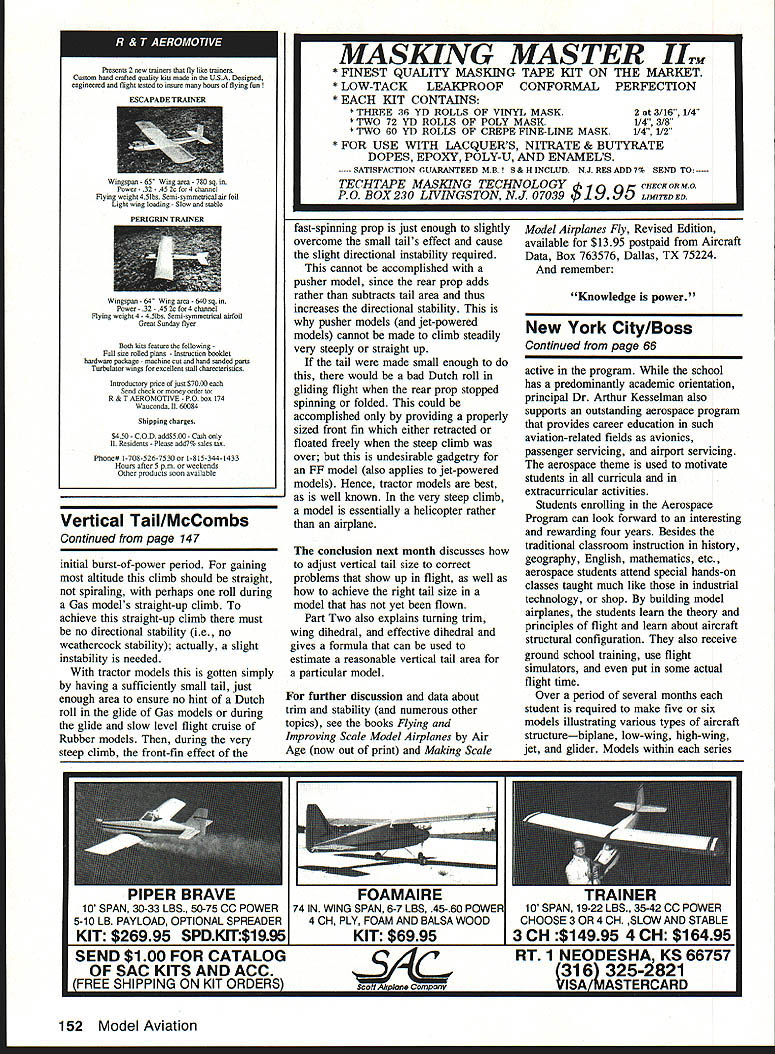
The aerospace program is part of the citywide technological program under Robert J. Fixier, Director, Bureau of Technology, New York City Board of Education. Its aim is to provide technological literacy and prepare students for a highly technical 21st-century society.
Mr. Marvin Fisher, Bureau of Technology Supervisor and fly-in contest director, described the program at both school levels:
"The middle-school program starts with a look at the evolution of technology, examining how many of the technologies we take for granted today evolved. Students learn about the seven resources of technology, their proper selection, processing, and conservation. Study progresses to problem-solving technology learning activities that also teach systems theory, control of technology, and its impact.
"At the high school level the students may take courses such as transportation systems, communications systems, manufacturing and construction systems, technical drawing, and any of 17 elective areas of technology.
"The fly-in serves as a culminating activity as part of the intermediate/junior high school program and in some high school programs, since it ties together the study of resources, problem solving, and systems as they apply to an aircraft.
"Schools that use model aircraft building as a thematic approach for studying technology have found it to be a very richly rewarding method of motivation for the students."
August Martin High School — an example program
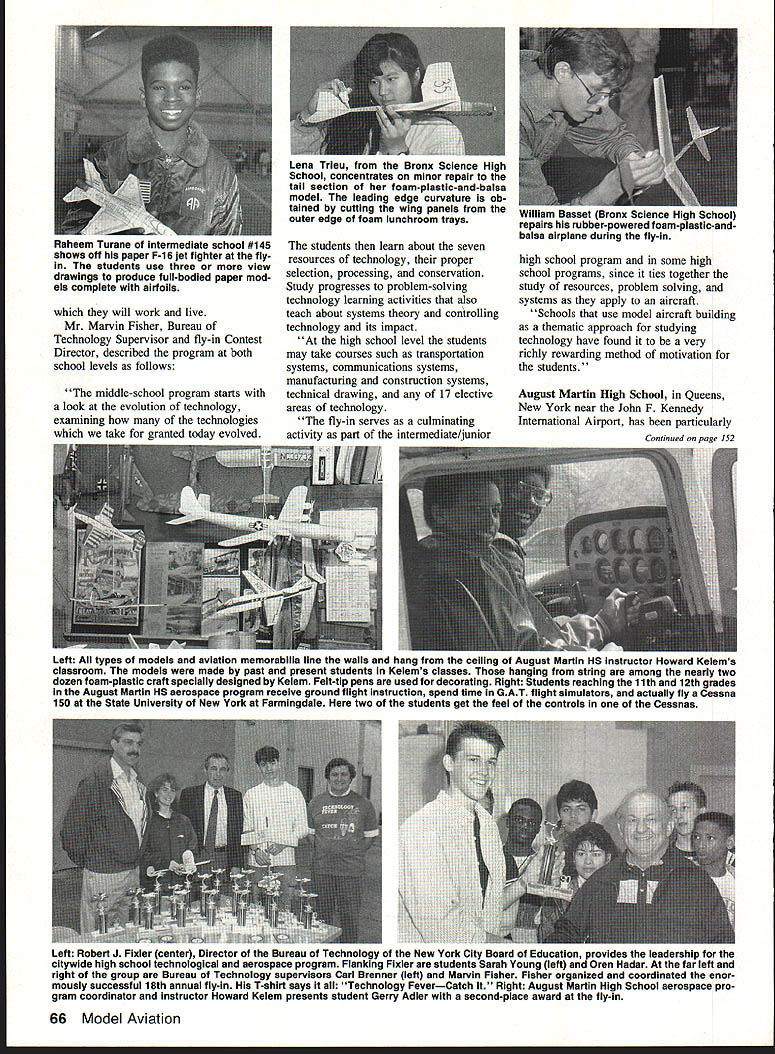
August Martin High School in Queens, near John F. Kennedy International Airport, has been particularly successful and active in the program. Although the school maintains a predominantly academic orientation, Principal Dr. Arthur Kesselman supports an outstanding aerospace program that provides career education in aviation-related fields such as avionics, passenger servicing, and airport servicing. The aerospace theme is used to motivate students across curricula and extracurricular activities.
Aerospace students follow a four-year sequence that combines traditional classroom instruction (history, geography, English, mathematics) with hands-on classes taught like industrial technology/shop. By building model airplanes, students learn flight theory and aircraft structural configuration. They receive ground school training, use flight simulators, and log actual flight time. Over several months each student is required to build five or six models illustrating various aircraft structures — biplane, low-wing, high-wing, jet, and glider. When scheduling permits, students also fly actual aircraft; before the school year ended on June 30, 1990, each August Martin student had logged between eight and 12 hours at the controls.
Acknowledgements
The program depends on substantial cooperation among many organizations. Grateful appreciation is extended to:
- The local Aviation Development Council for liaison efforts between the State University and the school administration.
- The New York City Board of Education for securing funds to support student flight instruction.
- The State University at Farmingdale for permitting free use of its aircraft.
- Pan American Airlines and American Airlines for donating flight physicals for students.
- Gloria Shepard, Director at the Federal Aviation Administration, for support and assistance in obtaining program funds.
- Dr. Arthur Kesselman, Principal of August Martin High School, and Mr. Jack Shelley of the Industry-Community Advisory Commission for their unwavering support of the program.
Transcribed from original scans by AI. Minor OCR errors may remain.

