
NewComers
Bob Underwood
P.O. Box 40, St. Peters, MO 63376
Satisfying the needs of the newcomer to the world of aeromodeling is an exciting and frustrating challenge. The phrase "8 to 80" sums up the thrust of that challenge. Indeed, we find that all ages are drawn to aeromodeling — bringing with them skill levels ranging from little to extensive!
One interesting set of differences represented by these age extremes seems to be the reasons they are attracted to the hobby/sport. The adult newcomer's interest is often part of a delayed reaction from earlier years. Typically, he or she dabbled a bit with models as a youngster or was associated with someone who imparted a strong level of interest that was retained through the formative years. We find high levels of motivation and available resources with the adult newcomer.
The youngster often comes from a different direction. A natural curiosity for things that fly (or even move) is a key issue. But in recent years, the AMA has found it difficult to muster a prolonged and meaningful program to hold young people's attention. Various reasons have been given, ranging from the interesting activities that compete with modeling to a lack of "stick-to-it-iveness" in youngsters.
Fortunately, through persistence, a number of established modelers have overcome the perceived hurdles and created new modelers.
Schools, clubs, and three core activities
Schools can play a very important role in bringing a modeling experience to young people. Every club ought to have a minimum of three concurrent activities happening.
First: clubs can fund, for a very small sum, one or more subscriptions to model airplane magazines to be placed in school libraries. If it is not possible to fund such a program, clubs will almost always have households that receive multiple copies that can be passed to the school.
Second: contact can be made through a teacher, resulting in direct classroom contact. This can range from a highly structured, formalized program to what might be considered a one-time PR shot.
Third: the club activity is a vital link — the club should present training sessions on a regular basis.
Experience suggests one evening a week classes, limited to 15 participants and conducted over an eight-week period, work very well. Sessions can accommodate newcomers of various ages. A later column will provide an outline of such sessions. Separating these sessions from club meetings is important; it gives the sessions a special meaning of their own while they dovetail to create a meaningful program.
Let's suppose a few things. First, the club must be interested in presenting aeromodeling as a challenging experience and be assured some will wish to spread the word. Fortunately, a majority of clubs have:
- Created newcomer classes
- Provided magazine subscriptions to school libraries
- Contacted individual teachers/school districts
- Made literature available in hobby shops and at the field (business cards/contact neat fit in wallet/pocket)
- Created a series of promotional devices such as mall shows, programs for scouts and adult service groups, air shows, etc.
- Investigated participation in local scholarship programs
- Developed a speaker/instructor list of people well suited to carry through plans
- Identified 10% of club membership willing to implement a program
The following information outlines two approaches to interesting newcomers. Bear in mind these interest programs are designed to enfold individuals in aeromodeling information and provide pleasant experiences, in the case of youth, to help lead to future activity.
Example: Southwest Florida Aeromodelers and Gateway Magnet Elementary
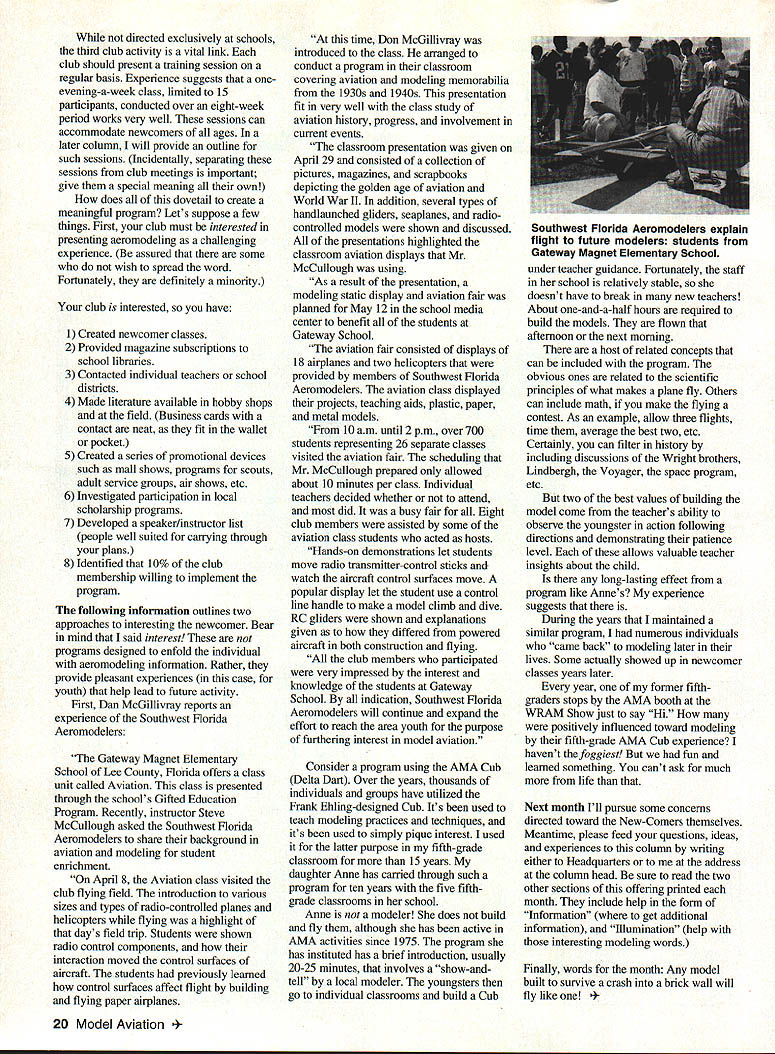
Don McGillivray reports the experience of the Southwest Florida Aeromodelers. Gateway Magnet Elementary School, Lee County, Florida, offers a class unit called "Aviation" presented through the school's Gifted Education Program. Recently, instructor Steve McCullough asked the Southwest Florida Aeromodelers to share background in aviation modeling for student enrichment. On April 8 the Aviation class visited the club flying field for an introduction to various sizes and types of radio-controlled planes and helicopters. Flying was the highlight of the day's field trip. Students were shown radio control components and how interaction moves control surfaces of aircraft. The students had previously learned how control surfaces affect flight by building and flying paper airplanes.
Don McGillivray arranged and conducted a classroom program covering aviation and modeling memorabilia from the 1930s and 1940s. The presentation fit very well with the class study of aviation history, progress, and involvement in current events. Several types of hand-launched gliders, seaplanes, and radio-controlled models were shown and discussed. All of the presentations highlighted the classroom aviation displays that Mr. McCullough was using.
As a result of the presentation, a modeling static display and aviation fair was planned for May 12 in the school media center to benefit all of the students at Gateway School.
The aviation fair consisted of displays of 18 airplanes and two helicopters provided by members of Southwest Florida Aeromodelers. The aviation class displayed their projects, teaching aids, plastic, paper, and metal models.
From 10 a.m. until 2 p.m., over 700 students representing 26 separate classes visited the aviation fair. The scheduling that Mr. McCullough prepared only allowed about 10 minutes per class. Individual teachers decided whether or not to attend, and most did. It was a busy fair for all. Eight club members were assisted by some of the aviation class students who acted as hosts.
Hands-on demonstrations let students move radio transmitter control sticks and watch the aircraft control surfaces move. A popular display let the student use a control line handle to make a model climb and dive. RC gliders were shown and explanations given as to how they differed from powered aircraft in both construction and flying.
All the club members who participated were very impressed by the interest and knowledge of the students at Gateway School. By all indication, Southwest Florida Aeromodelers will continue and expand the effort to reach the area youth for the purpose of furthering interest in model aviation.
Example: AMA Cub (Delta Dart) classroom program
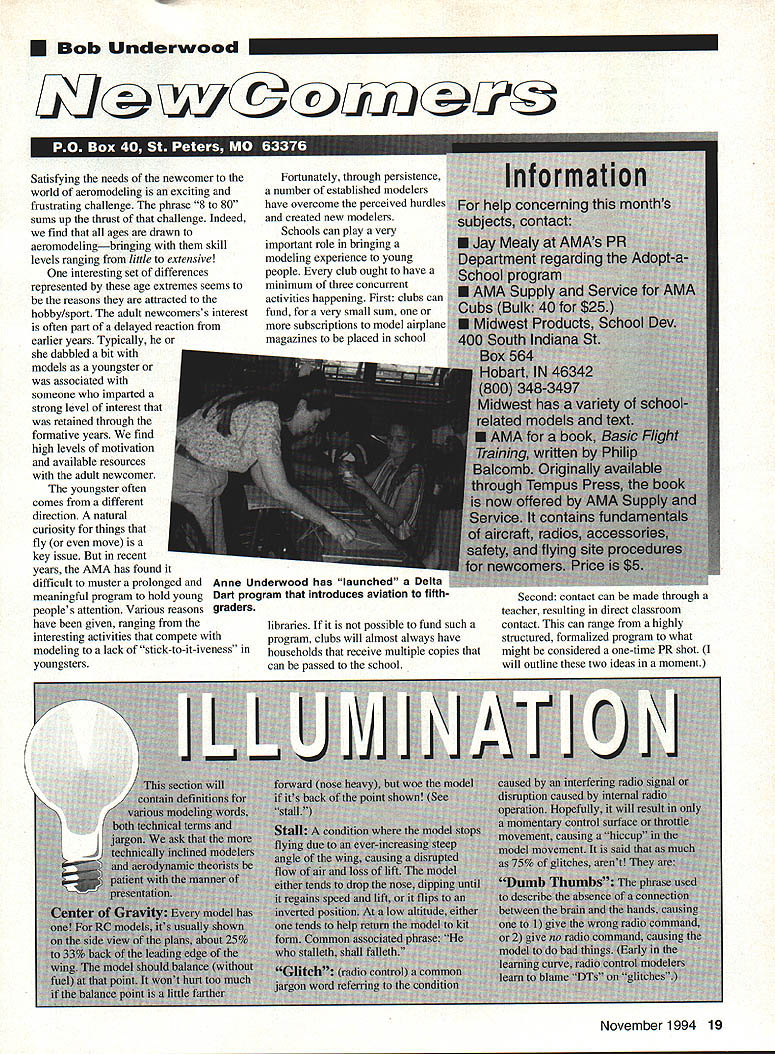
Consider a program using the AMA Cub (Delta Dart). Over the years, thousands of individuals and groups have utilized the Frank Ehling–designed Cub. It's been used to teach modeling practices and techniques, and it's been used to simply pique interest. I used it for the latter purpose in my fifth-grade classroom for more than 15 years. My daughter Anne has carried through such a program for ten years with the fifth-grade classrooms in her school.
Anne is not a modeler. She does not build and fly them, although she has been active in AMA activities since 1975. The program she has instituted has a brief introduction, usually 20–25 minutes, that involves a "show-and-tell" by a local modeler. The youngsters then go to individual classrooms and build a Cub under teacher guidance. About one-and-a-half hours are required to build the models. They are flown that afternoon or the next morning.
There are a host of related concepts that can be included with the program. The obvious ones are related to the scientific principles of what makes a plane fly. Others can include math, if you make the flying a contest. As an example, allow three flights, time them, average the best two, etc.
You can also include history by discussing the Wright brothers, Lindbergh, the Voyager, the space program, and so on.
Two of the best values of building the model come from the teacher's ability to observe the youngster following directions and demonstrating patience and pride of accomplishment. These observations are often what lead to further modeling interest.
Is there any long-lasting effect from a program like Anne's? My experience suggests that there is. During the years I maintained a similar program, I had numerous individuals "come back" to modeling later in their lives. Some actually showed up in newcomer classes years later. Every year, one of my former fifth-graders stops by the AMA booth at the WRAM Show just to say "Hi." How many were positively influenced toward modeling by their fifth-grade AMA Cub experience? I haven't the foggiest! But we had fun and learned something. You can't ask for much more than that.
Closing
Next month I'll pursue some concerns directed toward the newcomers themselves. Meantime, please feed me your questions, ideas, and experiences to the address at the head of the column. Be sure to read the two other sections of this offering printed each month. They include help in the form of "Information" (where to get additional materials) and "Illumination" (help with those interesting modeling words).
Finally, words for the month: Any model built to survive a crash into a brick wall will fly like one!
Transcribed from original scans by AI. Minor OCR errors may remain.

