
NewComers
Bob Underwood
P.O. Box 40, St. Peters, MO 63376
Letters and first response
A writer will sometimes announce in jest that in response to what was written, a letter poured in. In response to the first NewComers column, 'tain't so! A significant volume of reading matter settled in Box 40 of the St. Peters, MO post office. Unfortunately, what appeared only confirmed that putting this column together is going to be difficult.
There were letters telling about youth-related projects; there were letters from the older NewComers. The latter comprised two groups: individuals looking for specific help about building or flying, and another that simply announced, "I'm here and having fun, but I need general information."
Ken Gamet — equipment and shop
Ken Gamet of Indianapolis asked, "Is your column going to be just about flying or is it going to be about all aspects of model flying, like building as well as flying? It is like swimming. If you don't get in the water, you aren't going to swim."
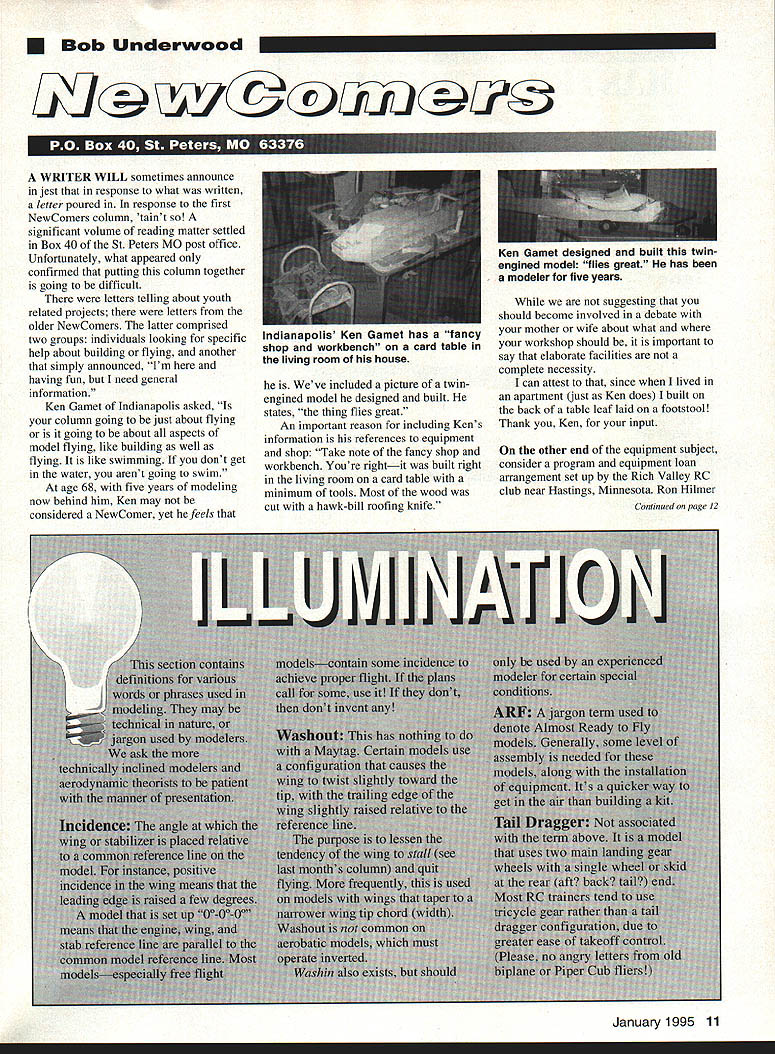
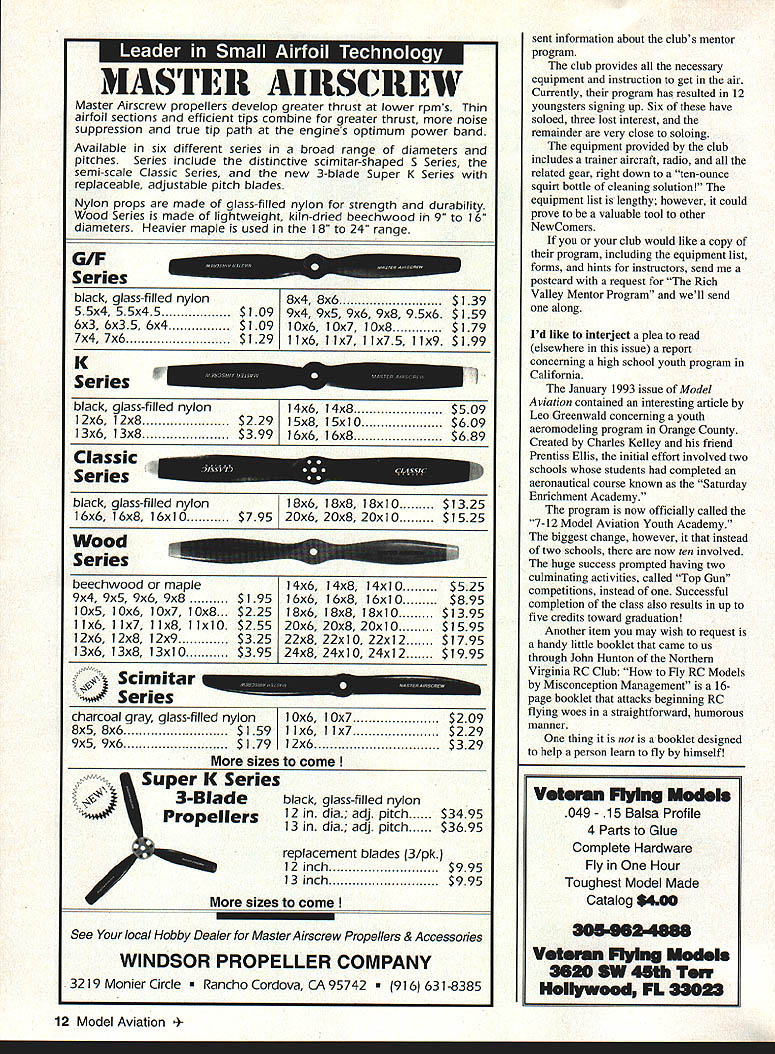
At age 68, with five years of modeling now behind him, Ken may not be considered a NewComer, yet he feels that he is. We've included a picture of a twin-engined model he designed and built. He states, "the thing flies great."
An important reason for including Ken's information is his references to equipment and shop: "Take note of the fancy shop and workbench. You're right — it was built right in the living room on a card table with a minimum of tools. Most of the wood was cut with a hawk-bill roofing knife."
While we are not suggesting that you should become involved in a debate with your mother or wife about what and where your workshop should be, it is important to say that elaborate facilities are not a complete necessity. I can attest to that, since when I lived in an apartment (just as Ken does) I built on the back of a table leaf laid on a footstool. Thank you, Ken, for your input.
Mentor programs and equipment loans
Consider a program and equipment-loan arrangement set up by the Rich Valley RC Club near Hastings, Minnesota. Ron Hilmer sent information about the club's mentor program. The club provides the necessary equipment and instruction to get a youngster in the air. Currently the program has resulted in 12 youngsters signing up: six have soloed, three lost interest, and the remainder are very close to soloing.
Equipment provided by the club includes:
- Trainer aircraft
- Radio-related gear
- Miscellaneous supplies, down to a ten-ounce squirt bottle of cleaning solution
The equipment list is lengthy; however, it could prove a valuable tool to other NewComers clubs that would like a copy of the program, including equipment list, forms, and hints for instructors. Send a postcard request to Rich Valley Mentor Program and we'll send along the material.
High school youth program (California)
I'd like to interject a plea to read (elsewhere in this issue) a report concerning a high school youth program in California.
The January 1993 issue of Model Aviation contained an article by Leo Greenwald concerning a youth aeromodelling program in Orange County. Created by Charles Kelley and Prentiss Ellis, the initial effort involved two schools whose students had completed an aeronautical course known as the "Saturday Enrichment Academy." The program is now officially called the "7–12 Model Aviation Youth Academy." The biggest change, however, is that instead of two schools, there are now ten involved. The huge success prompted having two culminating activities, called "Top Gun" competitions, instead of one. Successful completion of the class also results in up to five credits toward graduation.
"Misconception Management" — a how-to booklet
Another item: a handy little booklet that came to us through John Hunton of the Northern Virginia RC Club. How to Fly RC Models by Misconception Management is a 16-page booklet that attacks racing RC flying woes in a straightforward, humorous manner. One thing it is not is a booklet designed to help a person learn to fly by himself — that point is made clear on the first page.
There are numerous sketches, definitions, and good stuff. The last "misconception" listed is a beauty:
"Misconception: This book has been written and that is it."
The explanation: "A book is written, it is printed, it is read. A book may live for a brief while in the mind of the reader, then it is dead. Please help this book come to life. As you read through the misconceptions, edit them as you see fit. Add other misconceptions that have affected you."
In brief, the authors wish to "make it a living and viable instrument for the betterment of model aviation." If you would like a copy, send us a postcard and request "Misconception Management." A thank you to John Hunton and NVRC.
Meridian, Mississippi — intergenerational project
A communication from Jack Dveirin contained a newspaper article about the activities of a club in Meridian, Mississippi.
Jack's father Buddy and another retired friend, Bennie Campbell, worked with a third-grade class in the Talented and Gifted program at Poplar Springs Elementary School. They helped the class build and fly rubber-powered models and then launched a joint R/C building project.
While we have not received full details of the program, the newspaper indicated that the $500 that funded the project came from parent donations, profit from a booth at the school's fall festival, etc. The gentlemen involved are enthusiastic about continuing the program. Can you think of a better way to bring modeling, senior citizens, and youth together? We'll try to provide more details later.
Questions from readers — buddy box systems
Bob Loesch of New Jersey wrote that at the age of 57 he found that he had a lot more questions than answers. For instance: "How does a 'buddy box' system work?"
Basically, there is a cable connecting the two transmitters. The primary transmitter (Tx) "talks" to the receiver (Rx) in the model. By activating a switch on the primary Tx, the student or instructor can have control. The instructor's transmitter can override the student's if necessary. There are several variations on this basic idea, including systems that cut power to the student transmitter. If you want more technical details, write to the manufacturer or check articles in Model Aviation.
A "slave" or "student" transmitter will manipulate the signal when the control switch is engaged. If the student gets into trouble, the instructor simply releases the switch and control returns to the primary Tx.
Generally, the "slave" or buddy-box transmitter does not have to be on the same channel; you should check the instruction manual for the specific brand of radio you intend to purchase. Many models have been saved by using buddy boxes, as opposed to instructors and students having to transfer the transmitter back and forth.
RC engines — ringed, ABC, and ABC with pump
"On RC engines, what is the difference between 'ringed,' 'ABC,' and 'ABC with pump'?"
- Ringed: The piston has one (or more) compression rings, like an automobile engine. These aid the combustion process by forming a seal between the piston and cylinder wall.
- ABC: The letters denote combinations of materials used in the piston and cylinder. They are selected for their expansion properties and combined so that, as the engine heats up, the parts maintain a good sealing relationship. Other letters indicate other metal combinations.
- ABC with pump: Some type of fuel pump, other than just carburetor suction, is used to get fuel to the engine.
Yes, the ABCs are generally more expensive and are usually found on higher-performance engines.
Bob has a couple of other questions, one of which we'll pass on to Jim Haught, dealing with free flight. We'll cover the other in a separate letter.
Upcoming and closing
To end this month, we'd love to be able to include a complete letter from Robert Near of Wataga, Illinois. His three-page letter is beautifully written, filled with anecdotes familiar to us all. It relates the experiences of an over-50 person who modeled as a kid, got out of it (sound familiar?), and found an old McCoy .35 while cleaning the basement. We'll try to run his letter in an upcoming issue.
Until next month, remember, when the model's upside down, down is up — and up is plane expensive!
Transcribed from original scans by AI. Minor OCR errors may remain.

