
Newcomers
Bob Underwood Box 40, St. Peters MO 63376
Where Do Newcomers Come From?
Sometimes I think that we envision them as appearing in a puff of smoke, or falling from a tree like an apple—red, ripe, and ready to be a newcomer.
If any of you are newcomers, perhaps between gluing or fueling you could scribble a few sentences on a postcard and send it off to me. Let me know how you became interested in being a pilot with your feet on the ground. Such information could be of great value to AMA, clubs, manufacturers, etc.; we could serve you (and those to come) better.
For those of us individually interested in helping newcomers, sometimes our part of the "plan" is just being in the right place at the right time. We strike up a conversation with a seatmate on an airline flight, or the AMA bumper sticker on our automobile prompts a question. Many times it's at an air show, mall show, or contest. There are a zillion ways to tickle a fancy.
Part of the offering this month centers around what is clearly recruitment, or at least a taste of what we do. While it leans toward the education end, what we do really is more public relations, or a motivational nudge.
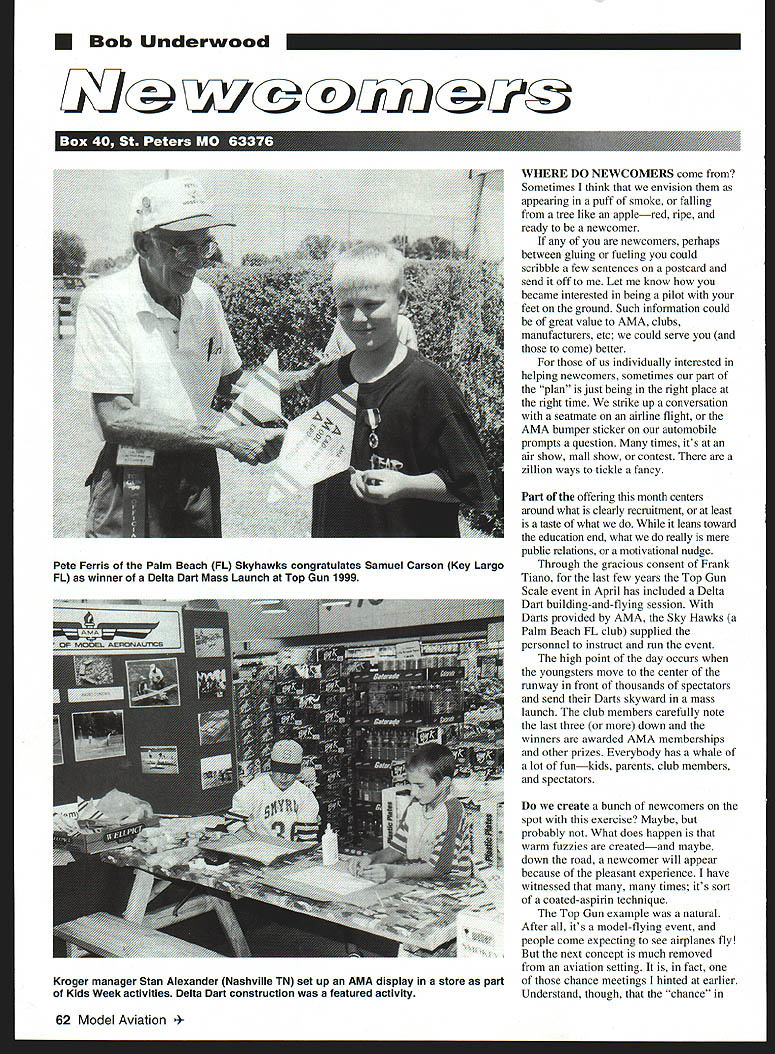
Through the gracious consent of Frank Tiano, for the last few years the Top Gun Scale event in April has included a Delta Dart building-and-flying session. With Darts provided by AMA, the Sky Hawks (a Palm Beach, FL club) supplied the personnel to instruct and run the event.
The high point of the day occurs when the youngsters move to the center of the runway in front of thousands of spectators and send their Darts skyward in a mass launch. The club members carefully note the last three (or more) down and the winners are awarded AMA memberships and other prizes. Everybody has a whale of a lot of fun—kids, parents, club members, and spectators.
Do we create a bunch of newcomers on the spot with this exercise? Maybe, but probably not. What does happen is that warm fuzzies are created—and maybe, down the road, a newcomer will appear because of the pleasant experience. I have witnessed that many, many times; it's sort of a coated-aspirin technique.
The Top Gun example was a natural. After all, it's a model-flying event, and people come expecting to see airplanes fly! But the next concept is much removed from an aviation setting. It is, in fact, one of those chance meetings I hinted at earlier. Understand, though, that the "chance" in this case was carefully planned and excellently executed.
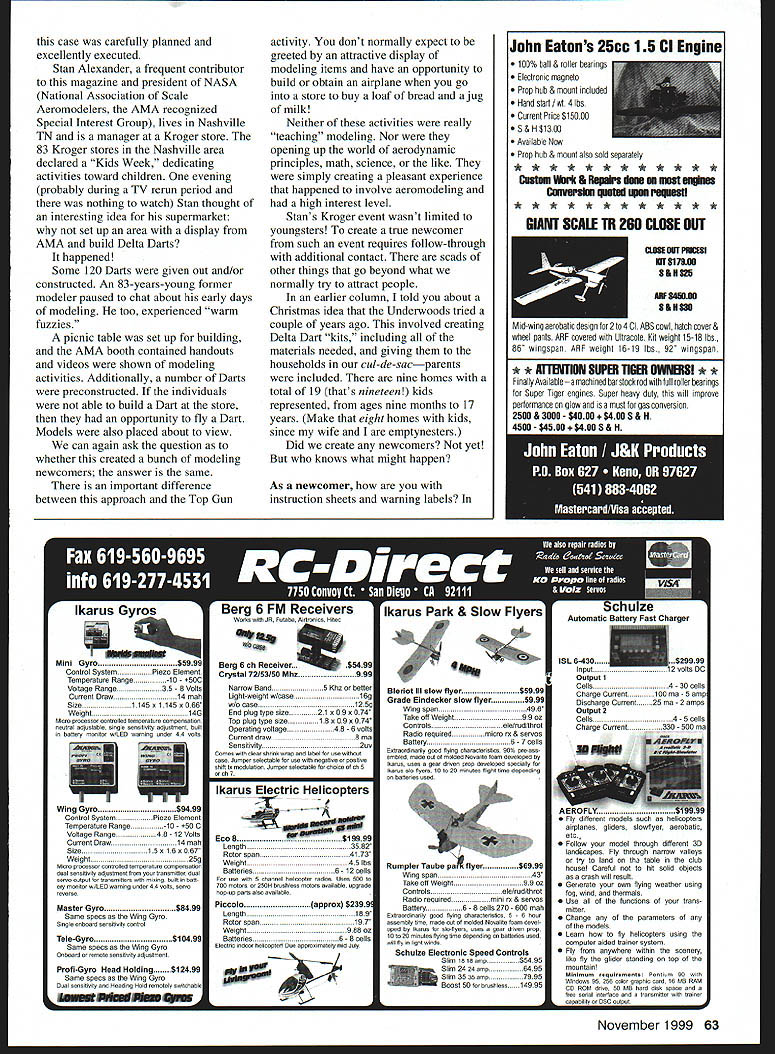
Stan Alexander, a frequent contributor to this magazine and president of NASA (National Association of Scale Aeromodelers), the AMA-recognized Special Interest Group, lives in Nashville, TN and is a manager at a Kroger store. The 83 Kroger stores in the Nashville area declared a "Kids Week," dedicating activities toward children. One evening (probably during a TV rerun period and because there was nothing to watch) Stan thought of an interesting idea for his supermarket: why not set up an area with a display from AMA and build Delta Darts?
It happened! Some 120 Darts were given out and/or constructed. An 83-year-old former modeler paused to chat about his early days of modeling. He, too, experienced "warm fuzzies."
A picnic table was set up for building, and the AMA booth contained handouts and videos of modeling activities. Additionally, a number of Darts were preconstructed. If the individuals were not able to build a Dart at the store, then they had an opportunity to fly a Dart. Models were also placed about to view.
We can again ask the question as to whether this created a bunch of modeling newcomers; the answer is the same.
There is an important difference between this approach and the Top Gun activity. You don't normally expect to be greeted by an attractive display of modeling items and have an opportunity to build or obtain an airplane when you go into a store to buy a loaf of bread and a jug of milk!
Neither of these activities were really "teaching" modeling. Nor were they opening up the world of aerodynamic principles, math, science, or the like. They were simply creating a pleasant experience that happened to involve aeromodeling and had a high interest level.
Stan's Kroger event wasn't limited to youngsters! To create a true newcomer from such an event requires follow-through with additional contact. There are scads of other things that go beyond what we normally try to attract people.
In an earlier column, I told you about a Christmas idea that the Underwoods tried a couple of years ago. This involved creating Delta Dart "kits," including all of the materials needed, and giving them to the households in our cul-de-sac—parents were included. There are nine homes with a total of 19 (that's nineteen!) kids represented, from ages nine months to 17 years. (Make that eight homes with kids, since my wife and I are empty-nesters.)
Did we create any newcomers? Not yet! But who knows what might happen?
As a newcomer, how are you with instruction sheets and warning labels? In the past, we've written about instructions that come with products; in most cases, they are the first thing put aside as the shiny new gimmick is taken from the box.
What a pity!
Often it becomes, "What a waste!" when the item is improperly assembled, used, or abused. You hear the phrase, "When all else fails..." so often! But it is true, and you really ought to read and reread the instructions before heading into that dark tunnel—leaving enlightenment at the portal.
Warning labels are another product feature that seem to bore many of us to tears. They drape around the package, hang from tags attached to the product, or scream at us on a black-outlined, bold-printed instruction sheet—which we've already discarded!
I love the instructions that come with medicines. They not only contain words (at least 50% by volume) that no human could begin to pronounce (let alone understand), but they do print small enough to make an eye doctor squint. The unfortunate part of this is that there is a very real cause for concern in these matters.
While all of us (I hope) realize that plugging in a drill while standing in six inches of water may be hazardous to our well-being, we blithely overlook the ingredients and warnings on some of the products that we use.
Fortunately, the bulk of newcomers who build models utilize plastic heat-shrinkable coverings. This helps to eliminate the harmful fumes from some paints. If you do use certain types of paints, it is important that you read the warnings and instructions carefully. In some cases, it isn't simply the breathing of the fumes or spray mist that is a problem, but that the material may be absorbed through the skin as well! And some chemical effects are cumulative and are not dispelled, continuing to build up over a period of time.
It's a no-no to use certain products in a confined, closed, nonventilated area. Even if you are using some types outside, you still should be using a proper mask, along with skin protection. If you have a lot of sanding to do, you need to filter out the dust. What could be finer, and stay in the air longer, than good old ultralight balsa dust?
Want proof? If you have a television in your workshop, take a look at the screen after a sanding session!
You would be well-served to check out adhesives, too. Fortunately, we've seen the creation of some very safe products in this area. The old "glue sniffing" days, engaged in by earlier generations, are more difficult now. However, it is important to note that individuals react to things in different ways. Years ago, I could sleep in poison ivy and not be troubled. Now all I have to do is stare at it and it's got me!
All of this is not meant to scare you. Rather, I would hope you treat your newfound activity with respect.
There are every obvious safety factors involved with aeromodeling: things such as spinning props at 10,000 rpm come to mind. But it's the more subtle factors we so often forget about.
I suppose part of the problem centers around two dramatically opposing factors. We've seen a concerted effort to create safer products, especially in the paint and adhesive arenas, while we have been inundated to the point of numbness with warning labels. This is vastly compounded by the ever-increasing knowledge that science and medicine have accumulated.
The admonition is simple: read carefully, choose carefully, and prepare carefully. When all else fails...
PS
I don't often do this, but how about a postscript this month?
Just as I finished this column, the July 1999 issue of Smithsonian Magazine made its way into the mailbox. On page 80 is a lengthy article, "Piloting Pint-size Planes," written by Richard Woolcom. The text clearly reflects a view of model aviation through the eyes of a person peering through a window for the first time. If you have access to a copy, check out the article. It provides some interesting insights that fit neatly within the first part of this month's column.
Transcribed from original scans by AI. Minor OCR errors may remain.

