
Ni-Cd Batteries
George Wilson
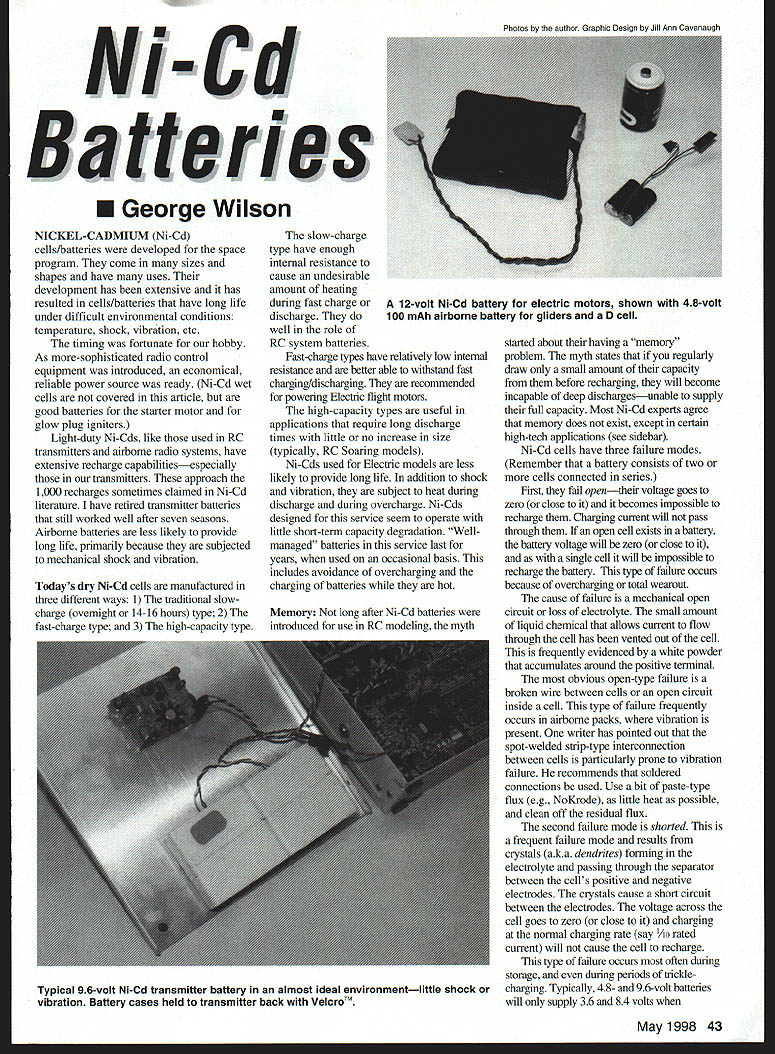
Nickel-Cadmium (Ni-Cd) cells and batteries were developed for the space program. They come in many sizes and shapes and have many uses. Their development has been extensive and has resulted in cells and batteries that have long life under difficult environmental conditions: temperature, shock, vibration, etc.
The timing was fortunate for our hobby. As more sophisticated radio-control equipment was introduced, an economical, reliable power source was ready. (Ni-Cd wet cells are not covered in this article, but are good batteries for the starter motor and for glow plug igniters.)
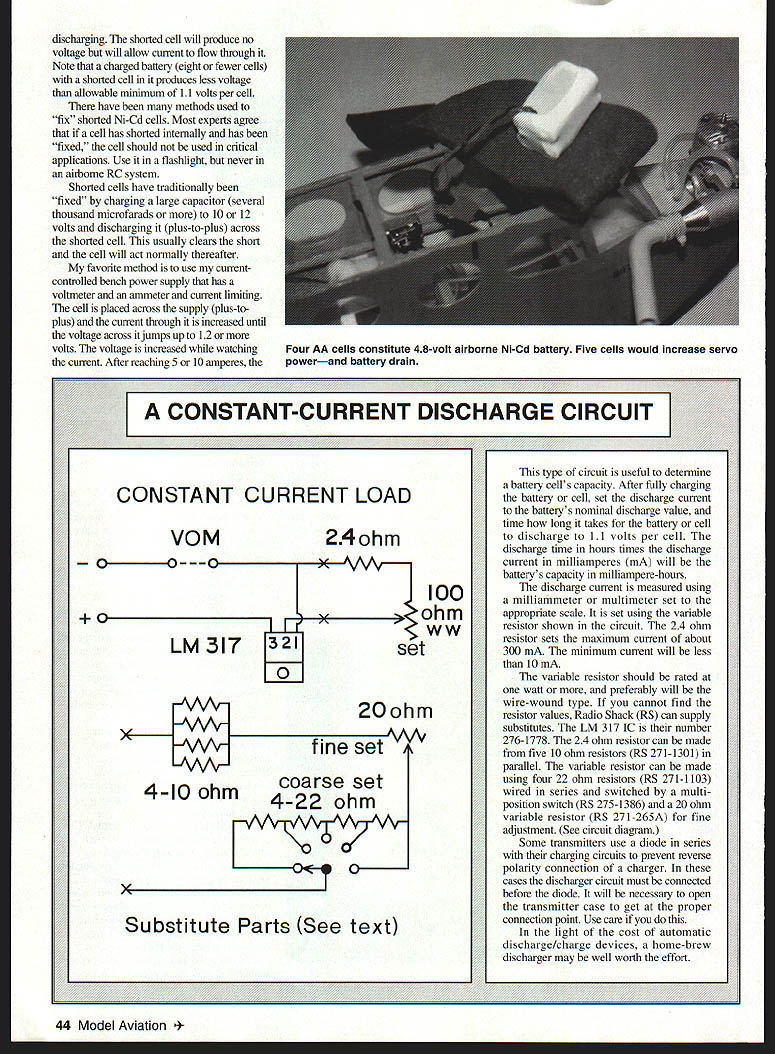
Light-duty Ni-Cds, like those used in RC transmitters and airborne radio systems, have extensive recharge capabilities—especially those in our transmitters. These approach the 1,000 recharges sometimes claimed in Ni-Cd literature. I have retired transmitter batteries that still worked well after seven seasons.
Airborne batteries are less likely to provide long life, primarily because they are subjected to mechanical shock and vibration.
Today's dry Ni-Cd cells are manufactured in three different ways:
- The traditional slow-charge (overnight or 14–16 hours) type.
- The fast-charge type.
- The high-capacity type.
The slow-charge type have enough internal resistance to cause an undesirable amount of heating during fast charge or discharge. They do well in the role of RC system batteries.
Fast-charge types have relatively low internal resistance and are better able to withstand fast charging and discharging. They are recommended for powering electric flight motors.
The high-capacity types are useful in applications that require long discharge times with little or no increase in size (typically, RC soaring models). Ni-Cds used for electric model motors are less likely to provide long life. In addition to shock and vibration, they are subject to heat during discharge and during overcharge. Ni-Cds designed for this service seem to operate with little short-term capacity degradation. Well-managed batteries in this service last for years when used occasionally. This includes avoidance of overcharging and the charging of batteries while they are hot.
Memory
Not long after Ni-Cd batteries were introduced for use in RC modeling, the myth started about their having a "memory" problem. The myth states that if you regularly draw only a small amount of their capacity before recharging, they will become incapable of deep discharges—unable to supply their full capacity. Most Ni-Cd experts agree that memory does not exist, except in certain high-tech applications (see sidebar).
Failure Modes
Ni-Cd cells have three failure modes. (Remember that a battery consists of two or more cells connected in series.)
- Open failure
- The cell's voltage goes to zero (or close to it) and it becomes impossible to recharge the cell. Charging current will not pass through it. If an open cell exists in a battery, the battery voltage will be zero (or close to it), and with a single cell it will be impossible to recharge the battery. This type of failure occurs because of overcharging or total wear-out.
- The cause of failure is a mechanical open circuit or loss of electrolyte. The small amount of liquid chemical that allows current to flow through the cell has been vented out of the cell. This is frequently evidenced by a white powder that accumulates around the positive terminal.
- The most obvious open-type failure is a broken wire between cells or an open circuit inside a cell. This type of failure frequently occurs in airborne packs, where vibration is present. One writer has pointed out that the spot-welded strip-type interconnection between cells is particularly prone to vibration failure. He recommends that soldered connections be used. Use a bit of paste-type flux (e.g., NoKorode), as little heat as possible, and clean off the residual flux.
- Shorted cell
- This is a frequent failure mode and results from crystals (a.k.a. dendrites) forming in the electrolyte and passing through the separator between the cell's positive and negative electrodes. The crystals cause a short circuit between the electrodes. The voltage across the cell goes to zero (or close to it) and charging at the normal charging rate (say 1/10 rated current) will not cause the cell to recharge.
- This type of failure occurs most often during storage, and even during periods of trickle charging. Typically, 4.8- and 9.6-volt batteries will only supply 3.6 and 8.4 volts when one cell is shorted.
- There have been many methods used to "fix" shorted Ni-Cd cells. Most experts agree that if a cell has shorted internally and has been "fixed," the cell should not be used in critical applications. Use it in a flashlight, but never in an airborne RC system.
- Shorted cells have traditionally been "fixed" by charging a large capacitor (several thousand microfarads or more) to 10–12 volts and discharging it (plus-to-plus) across the shorted cell. This usually clears the short and the cell will act normally thereafter.
- A preferable method is to use a current-controlled bench power supply with a voltmeter, ammeter, and current limiting. Place the cell across the supply (plus-to-plus) and increase the current until the voltage across it jumps up to 1.2 volts or more. Increase the voltage while watching the current. After reaching 5–10 amperes, the current will usually drop and the cell will behave normally.
- Wear-out (leakage)
- Here a cell becomes "leaky" and discharges itself rapidly; it becomes partially shorted. The appearance of grayish powder around the positive terminal is an indicator of this condition. Time to retire the cell or battery.
- A cell that is new and/or in good condition will hold its charge for an extended period (typically, a week or two); an old and/or well-used cell may lose its charge in a day or so. The mechanism appears to be that the barrier between the electrodes becomes partially conductive. Cells in this condition do not appear to accept a full charge.
- When checked with a constant-current load and voltmeter and timed to determine how long it takes them to discharge to 1.1 volts per cell, they will have less than their rated capacity. A good cell will have its rated capacity, and sometimes more. When a cell will produce only 80 percent of its rated capacity, it is time to get a new cell or battery if all of the cells are of the same age.
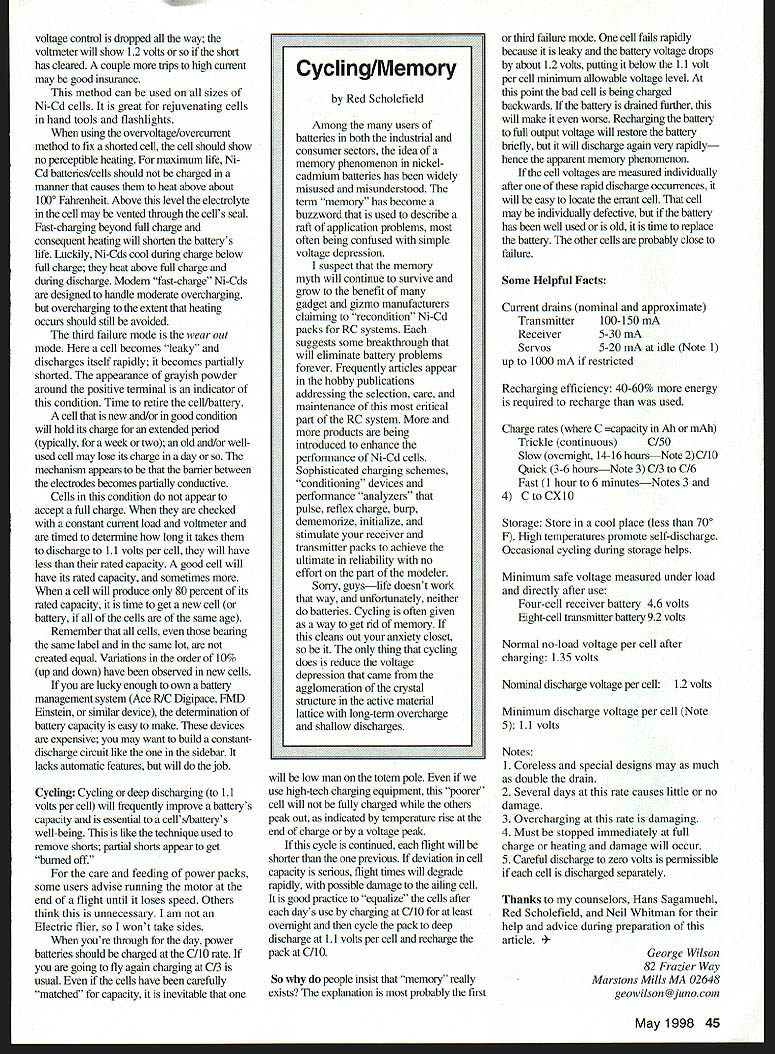
Remember that all cells, even those bearing the same label and in the same lot, are not created equal. Variations in the order of ±10 percent have been observed in new cells. If you are lucky enough to own a battery management system (Ace R/C Digipace, FMD Einstein, or similar device), the determination of battery capacity is easy to make. These devices are expensive; you may want to build a constant-discharge circuit like the one in the sidebar. It lacks automatic features but will do the job.
A CONSTANT-CURRENT DISCHARGE CIRCUIT
This type of circuit is useful to determine a battery cell's capacity. After fully charging the battery or cell, set the discharge current to the battery's nominal discharge value, and time how long it takes for the battery or cell to discharge to 1.1 volts per cell. The discharge time in hours times the discharge current in milliamperes (mA) will be the battery's capacity in milliampere-hours (mAh).
The discharge current is measured using a milliammeter or multimeter set to the appropriate scale. It is set using the variable resistor shown in the circuit. The 2.4-ohm resistor sets the maximum current at about 300 mA. The minimum current will be less than 10 mA.
The variable resistor should be rated at one watt or more, and preferably should be the wire-wound type. If you cannot find the resistor values, Radio Shack (RS) can supply substitutes. The LM317 IC is RS number 276-1778. The 2.4-ohm resistor can be made from five 10-ohm resistors (RS 271-1301) in parallel. The variable resistor can be made using four 22-ohm resistors (RS 271-1103) wired in series and switched by a multi-position switch (RS 275-1386) and a 20-ohm variable resistor (RS 271-265A) for fine adjustment. (See circuit diagram.)
Some transmitters use a diode in series with their charging circuits to prevent reverse-polarity connection of a charger. In these cases the discharger circuit must be connected before the diode. It will be necessary to open the transmitter case to get at the proper connection point. Use care if you do this.
In light of the cost of automatic discharge/charge devices, a home-brew discharger may be well worth the effort.
When using the overvoltage/overcurrent method to fix a shorted cell, the cell should have no perceptible heating. For maximum life, Ni-Cd batteries and cells should not be charged in a manner that causes them to heat above about 100° Fahrenheit. Above this level the electrolyte in the cell may be vented through the cell's seal. Fast-charging beyond full charge and consequent heating will shorten the battery's life. Luckily, Ni-Cds cool during charge below full charge; they heat above full charge and during discharge. Modern fast-charge Ni-Cds are designed to handle moderate overcharging, but overcharging to the extent that heating occurs should still be avoided.
Cycling
Cycling or deep discharging (to 1.1 volts per cell) will frequently improve a battery's capacity and is essential to a cell or battery's well-being. This is similar to the technique used to remove shorts; partial shorts appear to get "burned off."
For care and feeding of power packs, some users advise running the motor at the end of a flight until it loses speed. Others think this is unnecessary. I am not an electric flier, so I won't take sides.
When you're through for the day, power batteries should be charged at the C/10 rate. If you are going to fly again, charging at C/3 is usual. Even if the cells have been carefully matched for capacity, it is inevitable that one will be the low man on the totem pole. Even with high-tech charging equipment, this poorer cell will not be fully charged while the others peak out, as indicated by temperature rise at the end of charge or by a voltage peak.
If this cycle is continued, each flight will be shorter than the previous one. If deviation in cell capacity is serious, flight times will degrade rapidly, with possible damage to the ailing cell. It is good practice to equalize the cells after each day's use by charging at C/10 overnight and then cycling the pack to deep discharge at 1.1 volts per cell and recharging the pack at C/10.
So why do people insist that "memory" really exists? The explanation is most probably the first or third failure mode. One cell fails rapidly because it is leaky and the battery voltage drops by about 1.2 volts, putting it below the 1.1 volt per cell minimum allowable voltage level. At this point the bad cell is being charged backwards. If the battery is drained further, this will make it worse. Recharging the battery to full output voltage will restore the battery briefly, but it will discharge again very rapidly—hence the apparent memory phenomenon.
If the cell voltages are measured individually after one of these rapid discharge occurrences, it will be easy to locate the errant cell. That cell may be individually defective, but if the battery has been well used or is old, it is time to replace the battery. The other cells are probably close to failure.
Some Helpful Facts
Current drains (nominal and approximate):
- Transmitter: 100–150 mA
- Receiver: 5–30 mA
- Servos: 5–20 mA at idle (Note 1), up to 1000 mA if restricted
Recharging efficiency: 40–60% more energy is required to recharge than was used.
Charge rates (where C = capacity in Ah or mAh):
- Trickle (continuous): C/50
- Slow (overnight, 14–16 hours—Note 2): C/10
- Quick (3–6 hours—Note 3): C/3 to C/6
- Fast (1 hour to 6 minutes—Notes 3 and 4): C to C×10
Storage: Store in a cool place (less than 70° F). High temperatures promote self-discharge. Occasional cycling during storage helps.
Minimum safe voltage measured under load and directly after use:
- Four-cell receiver battery: 4.6 volts
- Eight-cell transmitter battery: 9.2 volts
Normal no-load voltage per cell after charging: 1.35 volts
Nominal discharge voltage per cell: 1.2 volts
Minimum discharge voltage per cell (Note 5): 1.1 volts
Notes
- Coreless and special designs may have as much as double the drain.
- Several days at the slow-charge rate causes little or no damage.
- Overcharging at quick or fast rates is damaging.
- Fast charging must be stopped immediately at full charge or heating and damage will occur.
- Careful discharge to zero volts is permissible if each cell is discharged separately.
Thanks to my counselors Hans Sagamuel, Red Schofield, and Neil Whitman for their help and advice during preparation of this article.
George Wilson 82 Frazier Way Marstons Mills, MA 02648 geowilson@juno.com
Transcribed from original scans by AI. Minor OCR errors may remain.

