
Nieuport
As aviation has grown from infancy to maturity, the means by which airplanes are identified has grown more complicated, more precise, and, unfortunately, more impersonal. The Wright brothers called their first successful airplane simply the 1903 Flyer, and that said all there was to be said. Today Boeing identified one of many versions of its jumbo airliner as a 747-121, which means it is a type 747-100B powered by Pratt & Whitney JT9D-7A engines and is operated by Pan Am.
The new way tells so much more than the old that sometimes one wishes people had been as conscientious in bygone eras, so that a lot of confusion could have been avoided. Take the Nieuport 13, for example. There really wasn't any such animal. It was the Nieuport 11, but it had 13 sq. meters of wing area, and for some reason it was sometimes called the Type 13, even in official records.
But please don't blame the nice little Nieuport for such mixups. It was one of the first truly useful pursuit/scout ships to appear on the Allied side in the First World War, and through steady improvements it became one of the most significant airplanes of the time.
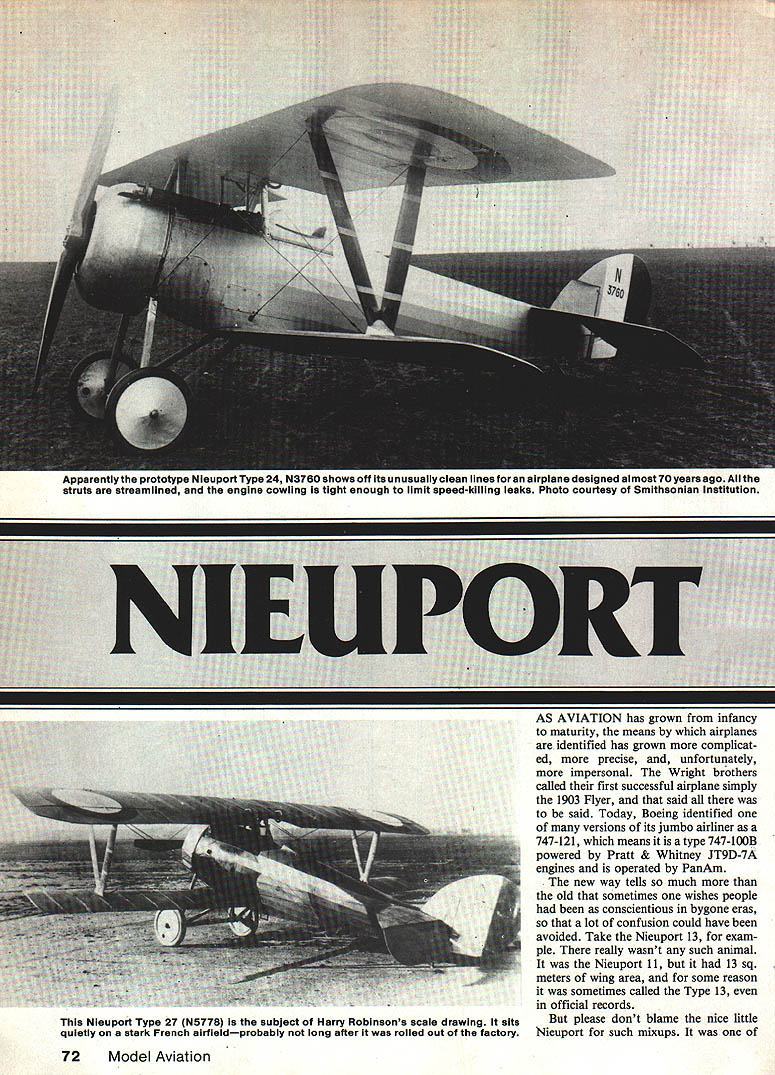
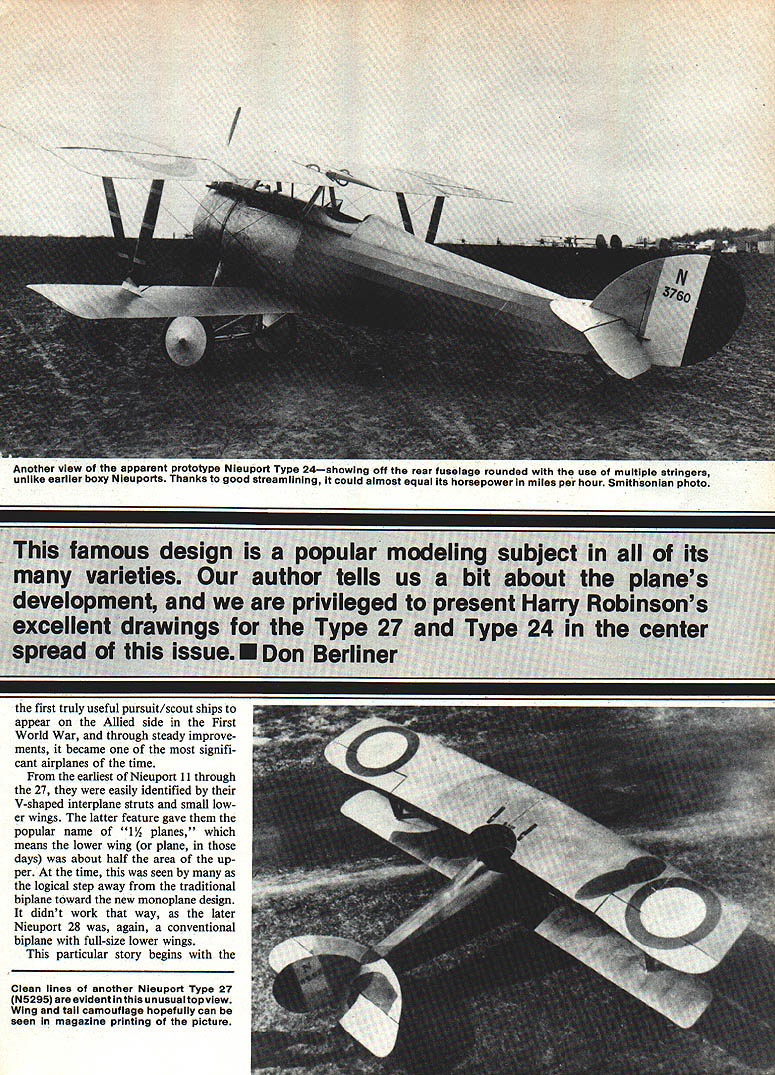
This famous design is a popular modeling subject in all of its many varieties. Our author tells us a bit about the plane's development, and we are privileged to present Harry Robinson's excellent drawings for the Type 27 and Type 24 in the center spread of this issue.
- Don Berliner
Design characteristics
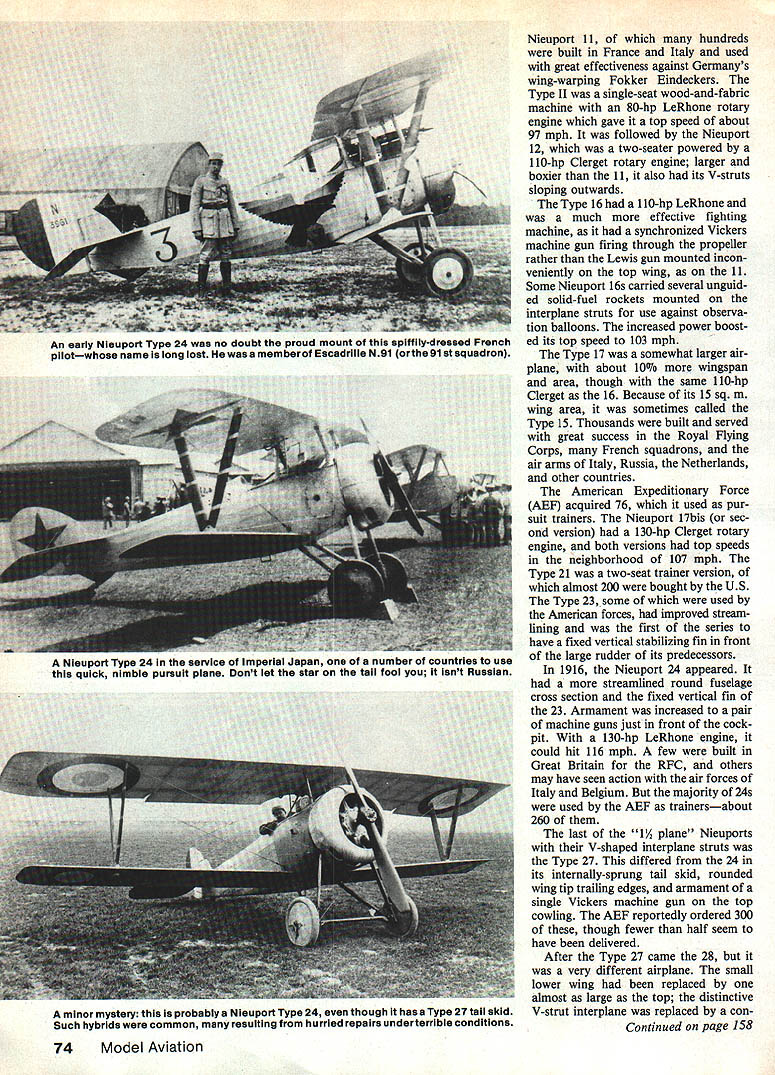
From the earliest Nieuport 11 through the 27, these machines were easily identified by their V-shaped interplane struts and small lower wings. The latter feature gave them the popular name of "1½ planes," meaning the lower wing (or "plane," in those days) was about half the area of the upper. At the time, this was seen by many as the logical step away from the traditional biplane toward the new monoplane design. It didn't work out that way, however, as the later Nieuport 28 was again a conventional biplane with full-size lower wings.
Construction of the Nieuport "1½ planes" was typical for small airplanes of the era. Fuselages were built up of ash and spruce longerons and cross braces, with some forward struts and engine mounts of steel. The wings had box spars, with ribs made of ash and some limewood. All surfaces and the fuselage, except for the forward part, were covered with doped fabric, while cowling parts were sheet metal.
The elevators and rudder were controlled by cables. The ailerons were operated by push-pull tubes, an idea that would spread as speeds increased and the dangers of flutter became better known. The landing gear struts were of aluminum with rubber shock absorbers, and the axle was an ordinary steel tube.
Development and variants
The story begins with the Nieuport 11, of which many hundreds were built in France and Italy and used with great effectiveness against Germany's wing-warping Fokker Eindeckers. The Type 11 was a single-seat wood-and-fabric machine with an 80-hp Le Rhône rotary engine, which gave it a top speed of about 97 mph.
- Nieuport 12: A two-seater powered by a 110-hp Clerget rotary engine; larger and boxier than the 11, it also had V-struts sloping outwards.
- Nieuport 16: Fitted with a 110-hp Le Rhône; more effective in combat because it carried a synchronized Vickers machine gun firing through the propeller rather than a Lewis gun mounted on the top wing. Some carried unguided solid-fuel rockets on the interplane struts for use against observation balloons. Top speed about 103 mph.
- Nieuport 17: Somewhat larger, with about 10% more wingspan and area, though using the same 110-hp Clerget as the 16. Because of its 15 sq. m. wing area it was sometimes called the Type 15. Thousands were built and served successfully with the Royal Flying Corps, many French squadrons, and the air arms of Italy, Russia, the Netherlands, and others. The American Expeditionary Force (AEF) acquired 76 for use as pursuit trainers.
- Nieuport 17bis: A second version with a 130-hp Clerget rotary engine; both versions had top speeds near 107 mph.
- Nieuport 21: Two-seat trainer version; almost 200 were bought by the U.S.
- Nieuport 23: Some used by American forces; improved streamlining and the first of the series to have a fixed vertical stabilizing fin in front of the large rudder of its predecessors.
- Nieuport 24 (1916): More streamlined round fuselage cross-section and the fixed vertical fin of the 23. Armament increased to a pair of machine guns just in front of the cockpit. With a 130-hp Le Rhône engine, it could reach about 116 mph. A few were built in Great Britain for the RFC; others served with Italy and Belgium. The majority—about 260—were used by the AEF as trainers.
- Nieuport 27: The last of the "1½ planes" with V-shaped interplane struts. Differences from the 24 included an internally sprung tail skid, rounded wing tip trailing edges, and armament of a single Vickers machine gun on the top cowling. The AEF reportedly ordered 300, though fewer than half seem to have been delivered.
- Nieuport 28: A very different airplane. The small lower wing was replaced by one almost as large as the upper; the distinctive V-strut interplane was replaced by a conventional pair of I-struts. It was a very nimble biplane but suffered from the serious unreliability of its Gnome Monosoupape engine. Almost all Nieuport 28s that saw combat were with American squadrons, as the French and British preferred SPADs and Sopwiths.
German assessments (wartime)
To get a better picture of any military airplane's true worth, it often pays to listen to what its opponents have to say. The Germans captured quite a few Nieuport sesquiplanes, and descriptions appeared in wartime German aviation magazines. Two articles were translated and published by the British magazine Flight in the summer of 1917; the following reflects German opinion during the war.
From Flugsport:
- "Of all the French aeroplanes, the Nieuport has been the most important of the fighting machines. Before the advent of the modern SPAD it was the machine most sought after by pilots."
From Zeitschrift für Flugtechnik und Motorluftschiffahrt / Motorluftschiffahrt:
- "A great number of single-seater Nieuports, and also some two-seaters have been captured. These machines are not uniformly built, however, and it appears that the Nieuport machines are built by several firms, some of which carry out the detail construction differently. This is a great drawback from the point of view of upkeep and repair of the machines in the field. Besides, improvements of the Nieuport types are constantly being made, and considerable variation in the types is caused by the employment of different types of motors.
- "It can be stated that for chasers (translated into German from the French 'chasseurs,' meaning pursuit aircraft) the rotary engine has absolutely supplanted the stationary. This is probably due to the fact that at present the light single-seat chaser predominates, and for this type the rotary engine with its light weight and short overall length is the most suitable. Evidently the aim of the present leaders of French aviation is to provide as many aircraft units as possible, and undoubtedly this view has much to recommend it. The loss of a small aircraft is of no great importance, and small, fast, handy aeroplanes are more difficult to shoot down (especially when flying high) than are large aeroplanes.
- "On account of their greater climbing power, speed and maneuverability they are superior to the larger machine, not only as regards attack from the ground, but also in case of attack by hostile aircraft. The fighting value of a small single-seater is about equal to that of a larger two-seater, even when the latter is fitted with two machine guns, one fixed and the other worked by the observer.
- "The fittings of the various types indicate that, in spite of the extensive use of these machines, quantity production and standardization have not been attained. Altogether, the French aeroplanes give an impression of being hand-made, rather than machine-made, and many parts appear to be, to the German constructor, rather a makeshift sort of job.
- "The main loads of the machine are concentrated in a narrow space near the front. That is to say, the motor, fuel tanks and pilot's seat are placed very closely together. This good centralization is, of course, only possible when a rotary motor is employed, and increases the maneuverability of the aeroplane."
Performance
According to one of the German magazines, the Nieuport 11 could climb to:
- 1,000 meters (3,281 feet) in 4 minutes,
- 2,000 meters in 7 minutes,
- 3,000 meters in 11 minutes,
- 4,000 meters (13,125 feet) in 16 minutes.
At that altitude, the performance of the pilot and of the unsupercharged engine began to fall off.
Transcribed from original scans by AI. Minor OCR errors may remain.

