
NMPRA Championships
The pylon racing season for 1986 has wound down, and it has been a very busy one. Highlights of the year were the Team Selection Finals for the World Championships to be held in Australia next spring and the first Quickie 500 Championship Race. The pinnacle of the season for pylon fliers, though, is the NMPRA Championship Race. It's an invitation-only event: to be a contestant you must be an NMPRA member and meet one of the following eligibility requirements:
- Finish in the top 20% of your NMPRA district, or be one of the top 10 fliers in the district, whichever is greater. Two out-of-district races may be included in the six races allowed.
- Be one of the top 10 finishers at the AMA Nationals or one of the top five finishers at the Canadian Nationals.
- Be an officer of the NMPRA, including the chief corporate officer.
- Be a past winner of the NMPRA Championship Race who has maintained continuous NMPRA membership.
- Finish in the top 50 in the country based on NMPRA national points.
Each NMPRA district vice president is allowed to grant two special-case qualifications as he sees fit, but no person can qualify two years in a row by this method.
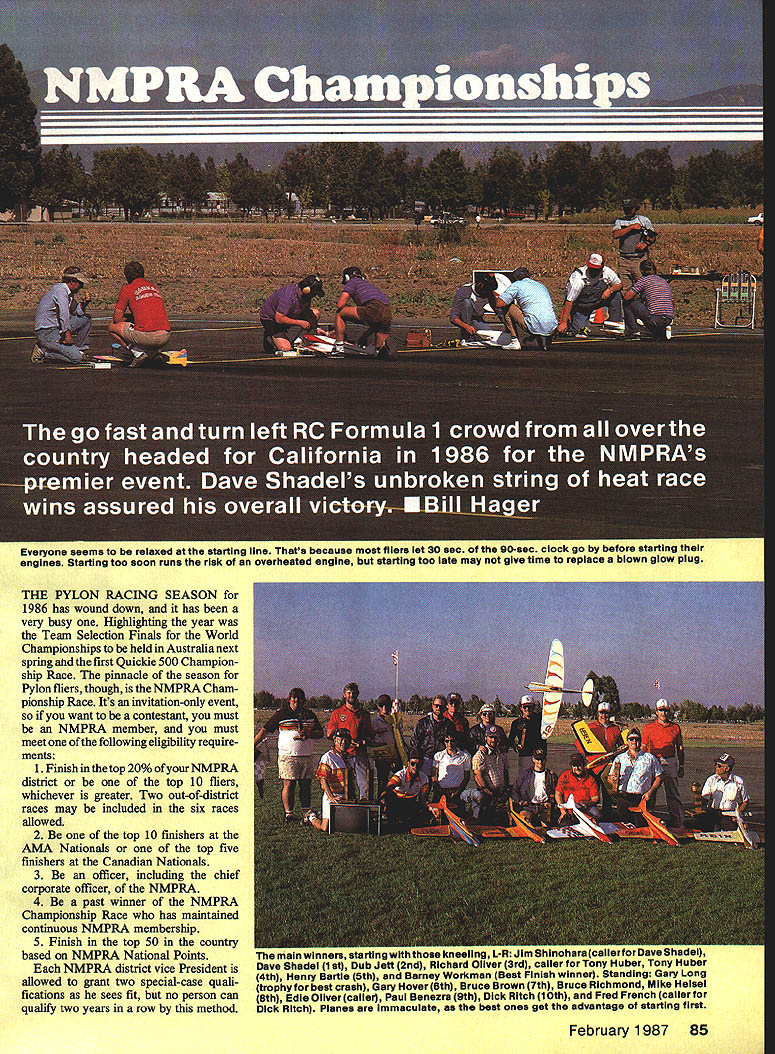
Just qualifying means you are among the hottest pylon pilots in the country. Winning the big race puts you among the top competitive peer groups in the world for years. The Championship Race was held at Sepulveda Basin, Burbank, CA, October 18–19. California weather at this time of year is usually very good, encouraging fast times. Combined with the large number of competitors living on the West Coast, the organizers expected a good turnout and highly competitive racing.
Fifty-eight entrants showed up—the organizers were right. Two contestants crashed while test flying Thursday and Friday, which still left the event with 56 entrants, the largest turnout in several years. Aside from the large groups from California and Texas, fliers came from Florida, Arkansas, Oklahoma, Washington, Utah, South Dakota, and Connecticut.
Deserving special mention is Bill Miller of South Dakota, 73, probably the oldest competitor, who finished 23rd in this year's event.
No additional primary-article text appears on this scanned page beyond the material already provided on the prior page. This page contains photographs, captions, and result lists (Top 20 NMPRA Form 1 and Championship engine points) but no new running-article paragraphs to extract.
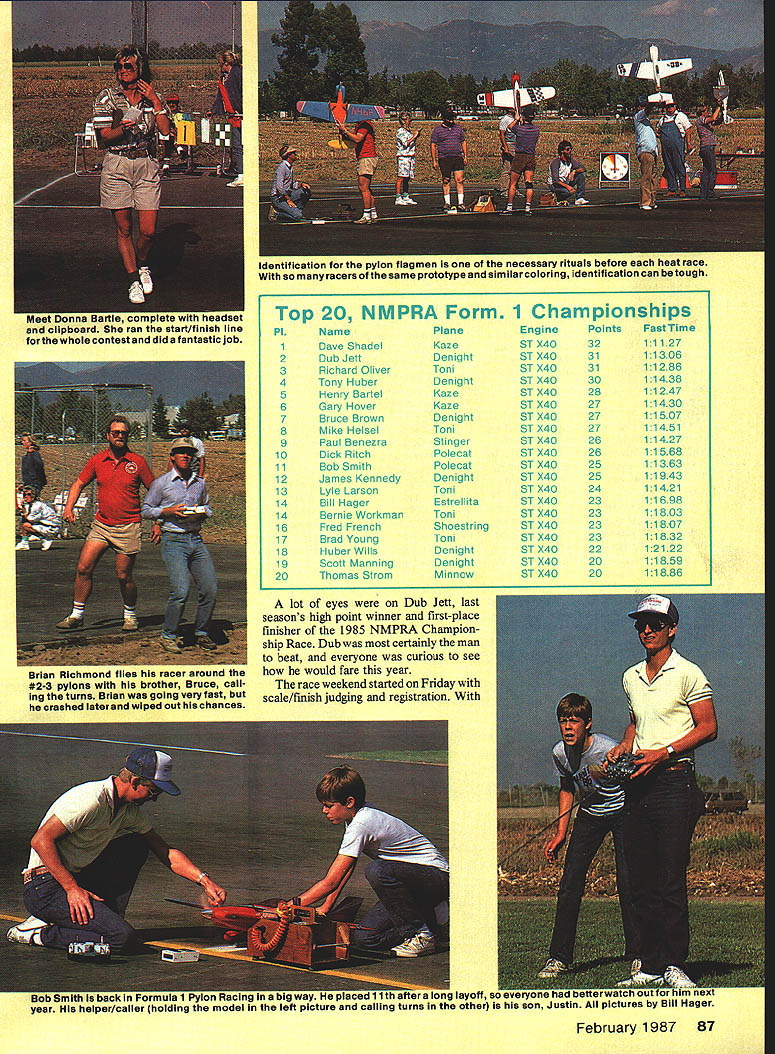
Top 20, NMPRA Form 1 Championships
- 1. Dave Shadel — Kaze — Supertigre ST X40 — 32 — 1:11.27
- 2. Dub Jett — Denight — Supertigre ST X40 — 31 — 1:13.06
- 3. Richard Oliver — Toni — Supertigre ST X40 — 31 — 1:12.86
- 4. Tony Huber — Denight — Supertigre ST X40 — 30 — 1:14.38
- 5. Henry Bartel — Kaze — Supertigre ST X40 — 28 — 1:12.47
- 6. Gary Hover — Kaze — Supertigre ST X40 — 27 — 1:14.30
- 7. Bruce Brown — Denight — Supertigre ST X40 — 27 — 1:15.07
- 8. Mike Helsel — Toni — Supertigre ST X40 — 27 — 1:14.51
- 9. Paul Benezra — Stinger — Supertigre ST X40 — 26 — 1:14.27
- 10. Dick Ritch — Polecat — Supertigre ST X40 — 26 — 1:15.63
- 11. Bob Smith — Polecat — Supertigre ST X40 — 25 — 1:19.43
- 12. James Kennedy — Denight — Supertigre ST X40 — 24 — 1:14.21
- 13. Lyle Larson — Toni — Supertigre ST X40 — 23 — 1:16.98
- 14. Bill Hager — Estrellita — Supertigre ST X40 — 23 — 1:18.03
- 15. Bernie Workman — Toni — Supertigre ST X40 — 23 — 1:18.07
- 16. Fred French — Shoestring — Supertigre ST X40 — 23 — 1:18.32
- 17. Brad Young — Toni — Supertigre ST X40 — 22 — 1:21.22
- 18. Huber Wills — Denight — Supertigre ST X40 — 20 — 1:18.59
- 19. Scott Manning — Denight — Supertigre ST X40 — 20 — 1:18.86
- 20. Thomas Strom — Minnow — Supertigre ST X40 — 20 — 1:18.86
Race recap
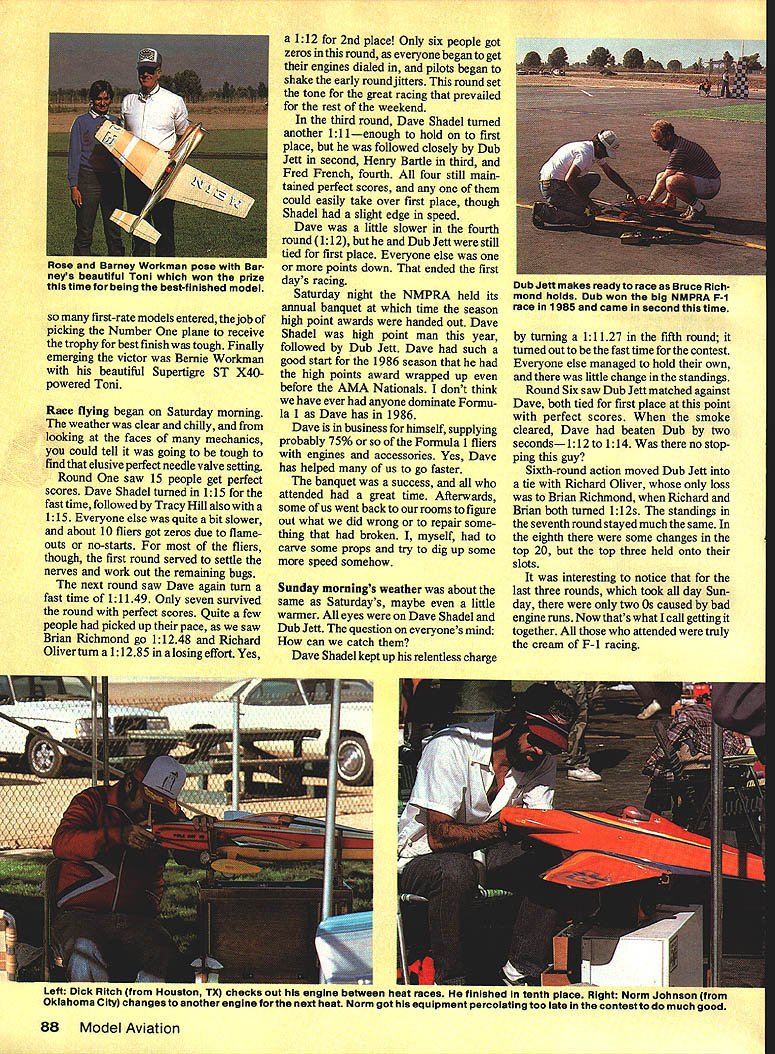
So many first-rate models entered that picking the number-one plane to receive the trophy for best finish was tough. Finally, Bernie Workman emerged the victor with his beautiful Supertigre ST X40–powered Toni.
Race flying began on Saturday morning. The weather was clear and chilly, and from the looks on many mechanics' faces you could tell it was going to be tough to find that elusive perfect needle-valve setting.
Round One saw 15 people get perfect scores. Dave Shadel turned in 1:15 for the first time, followed by Tracy Hill also with a 1:15. Everyone else was quite a bit slower, and about 10 fliers got zeros due to flameouts or no-starts. For most competitors, the first round served to settle the nerves and work out remaining bugs.
In Round Two Dave again turned a fast time of 1:11.49. Only seven survived the round with perfect scores. Quite a few people had picked up their pace: Brian Richmond went 1:12.48 and Richard Oliver turned a 1:12.85 in a losing effort—yes, a 1:12 for second place! Only six people got zeros in this round, as engines were getting dialed in and pilots shook off early jitters. This round set the tone for the great racing that prevailed for the rest of the weekend.
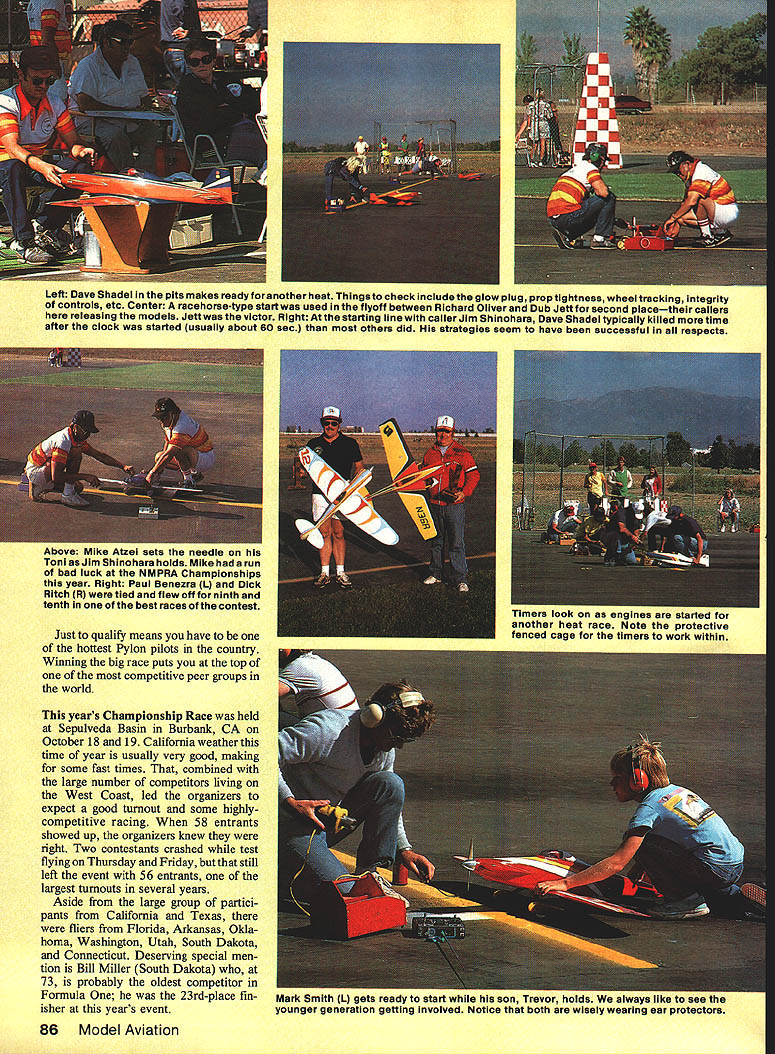
In Round Three, Dave Shadel turned another 1:11—enough to hold on to first place, followed closely by Dub Jett in second, Henry Bartel in third, and Fred French fourth. All four maintained perfect scores; any one of them could easily have taken over first place, though Shadel had a slight edge in speed.
Dave was a little slower in Round Four (1:12), but he and Dub Jett were still tied for first. Everyone else was one or more points down. That ended the first day's racing.
Saturday night the NMPRA held its annual banquet, at which the season high-point awards were handed out. Dave Shadel was the high-point winner that year, followed by Dub Jett. Dave had such a good start to the 1986 season that he had the high-points award wrapped up even before the AMA Nationals. I don't think we have ever had anyone dominate Formula 1 as Dave did in 1986.
Dave is in business for himself, supplying probably 75% or so of the Formula 1 fliers with engines and accessories. He has helped many of us go faster.
The banquet was a success, and all who attended had a great time. Afterwards some of us went back to our rooms to figure out what we did wrong or to repair something that had broken. I had to carve some props and try to dig up a little more speed myself.
Sunday morning's weather was about the same as Saturday's, maybe a little warmer. All eyes were on Dave Shadel and Dub Jett. The question on everyone's mind: How can we catch them?
Dave kept up his relentless charge by turning a 1:11.27 in the fifth round; it turned out to be the fast time for the contest. Everyone else managed to hold their own, and there was little change in the standings.
Round Six saw Dub Jett matched against Dave; both were tied for first at that point with perfect scores. When the smoke cleared, Dave had beaten Dub by two seconds—1:12 to 1:14. Was there no stopping this guy?
Sixth-round action moved Dub Jett into a tie with Richard Oliver, whose only loss was to Brian Richmond, when Richard and Brian both turned 1:12s. The standings in Round Seven stayed much the same. In Round Eight there were some changes in the top 20, but the top three held their slots.
It was interesting to notice that for the last three rounds, which took all day Sunday, there were only two losses caused by bad engine runs. Now that's what I call getting it together. All those who attended were truly the cream of F-1 racing.
Dave Shadel went on to win the NMPRA Championship. His first time of the contest, 1:15, was his slowest of the meet; all his other times were either 1:11 or 1:12. That's great flying.
Flyoffs, awards, and thanks
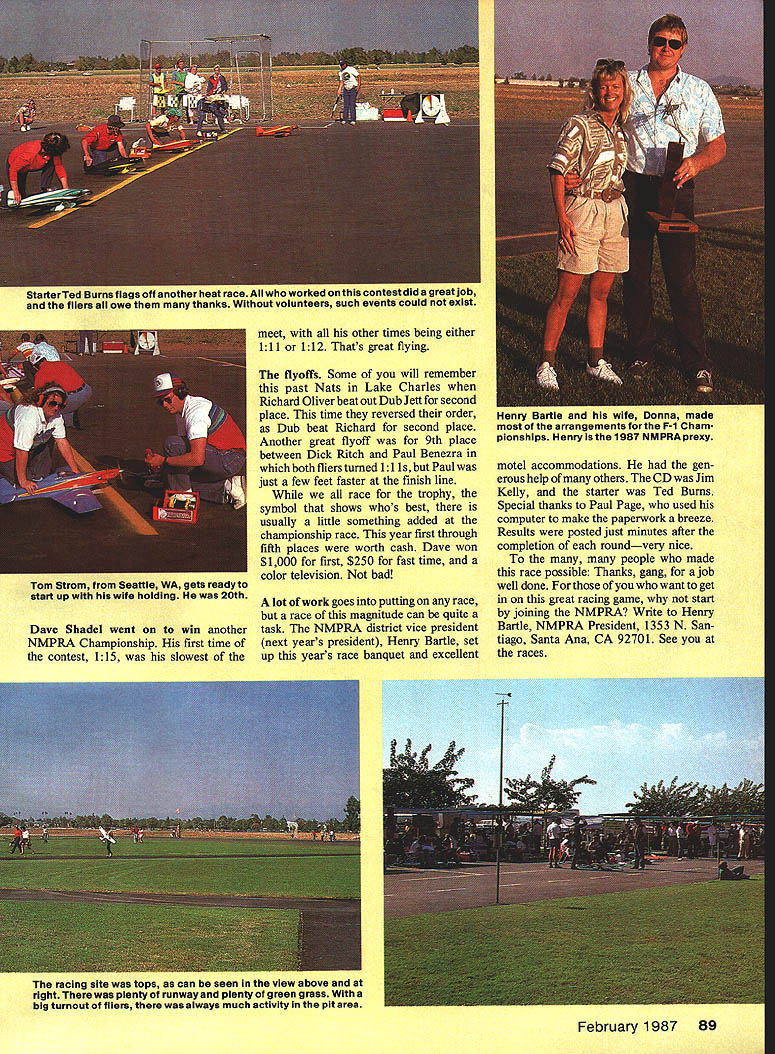
In the flyoffs, Dub Jett beat Richard Oliver for second place (reversing their order from the recent Nats in Lake Charles, where Richard beat Dub). Another great flyoff was for ninth place between Dick Ritch and Paul Benezra: both fliers turned 1:15, but Paul was just a few feet faster at the finish line.
While we all race for the trophy—the symbol that shows who's best—there is usually a little something extra at the championship race. This year first through fifth places paid cash. Dave won $1,000 for first, $250 for fast time, and a color television. Not bad!
A lot of work goes into putting on any race, but a race of this magnitude is quite a task. The NMPRA district vice president (next year's president), Henry Bartel, set up this year's race banquet and excellent motel accommodations. He had the generous help of many others. The contest director was Jim Kelly, and the starter was Ted Burns. Special thanks to Paul Page, who used his computer to make the paperwork a breeze—results were posted just minutes after the completion of each round.
To the many people who made this race possible: thanks again for a job well done. For those who want to get in on this great racing game, why not start by joining the NMPRA? Write to Henry Bartel, NMPRA President, 1353 N. Santiago, Santa Ana, CA 92701.
See you at the races.
Transcribed from original scans by AI. Minor OCR errors may remain.

