
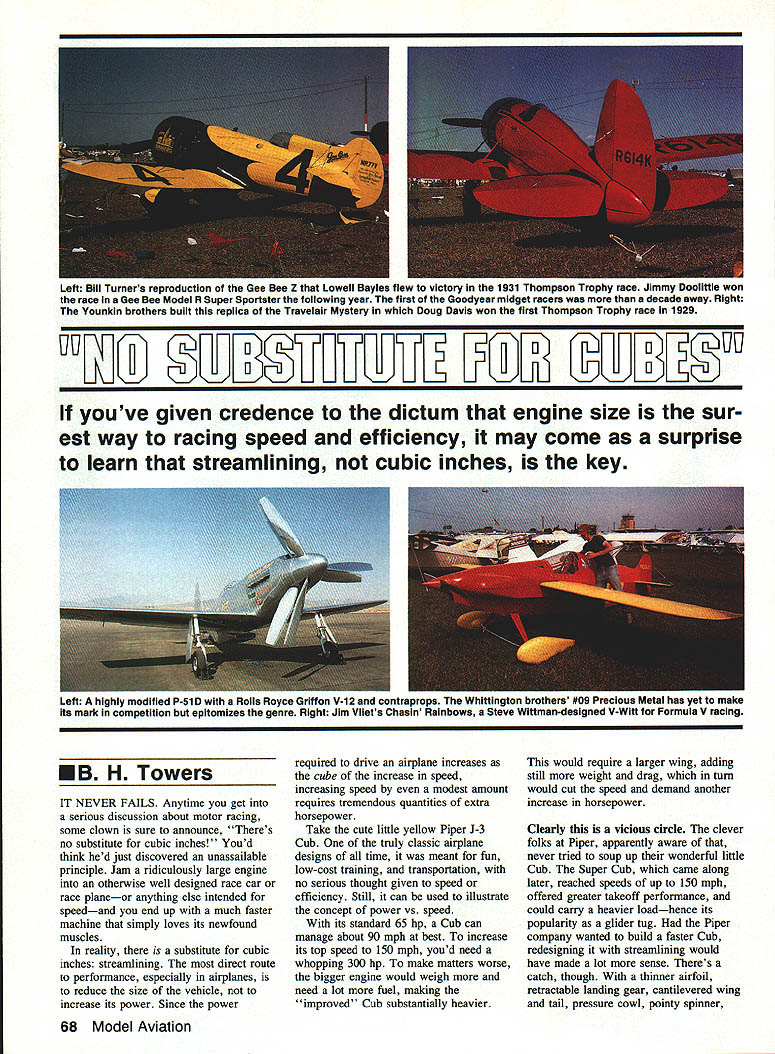
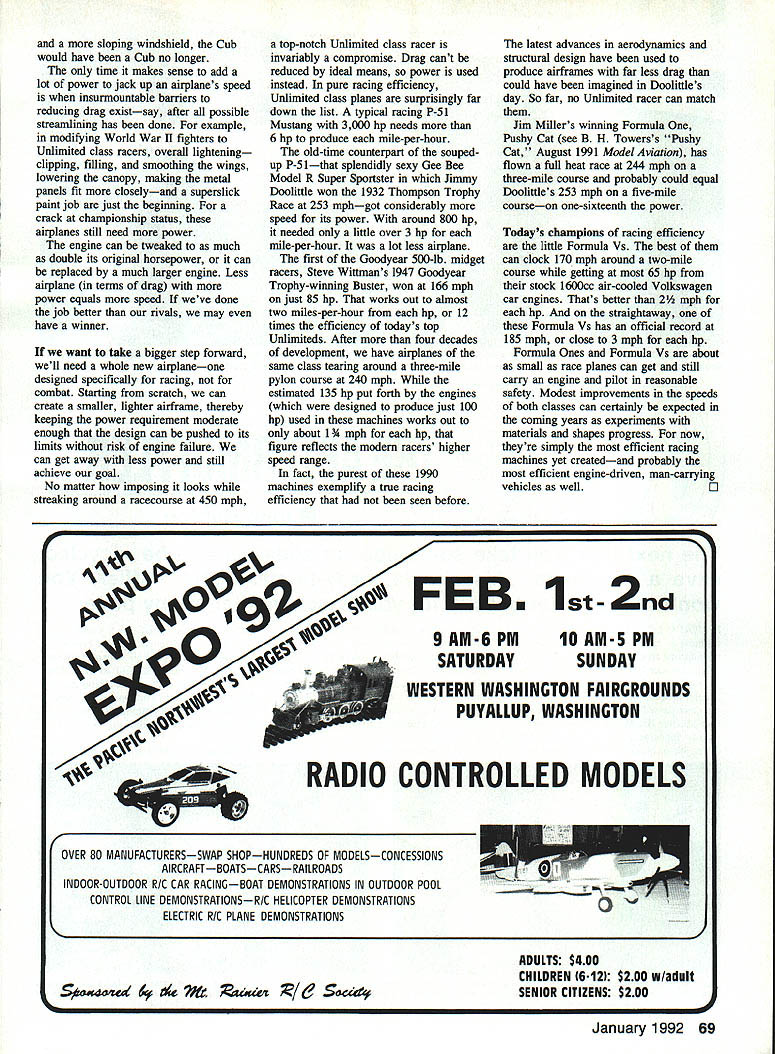
NO SUBSTITUTE FOR CUBES
By B. H. Towers
If you've given credence to the dictum that engine size is the surest way to racing speed and efficiency, it may come as a surprise to learn that streamlining, not cubic inches, is the key.
It never fails. Anytime you get into a serious discussion about motor racing, some clown is sure to announce, "There's no substitute for cubic inches." You'd think he'd just discovered an unassailable principle. Jam a ridiculously large engine into an otherwise well-designed race car or race plane—or anything else intended for speed—and you end up with a much faster machine that simply loves its newfound muscles.
In reality, there is a substitute for cubic inches: streamlining. The most direct route to performance, especially in airplanes, is to reduce the size of the vehicle, not to increase its power. Since the power required to drive an airplane increases as the cube of the increase in speed, increasing speed by even a modest amount requires tremendous quantities of extra horsepower.
Take the cute little yellow Piper J-3 Cub. One of the truly classic airplane designs of all time, it was meant for fun, low-cost training and transportation; no serious thought was given to speed or efficiency. Still, it can be used to illustrate the concept of power vs. speed.
With its standard 65 hp, a Cub can manage about 90 mph at best. To increase its top speed to 150 mph you'd need a whopping 300 hp. To make matters worse, the bigger engine would weigh more and need a lot more fuel, making the "improved" Cub substantially heavier.
This would require a larger wing, adding still more weight and drag, which in turn would cut the speed and demand another increase in horsepower. Clearly this is a vicious circle. The clever folks at Piper, apparently aware of that, never tried to soup up their wonderful little Cub.
The Super Cub, which came along later, reached speeds of up to 150 mph, offered greater takeoff performance, and could carry a heavier load—hence its popularity as a glider tug. Had the Piper company wanted to build a faster Cub, redesigning it with streamlining would have made a lot more sense. There's a catch, though. With a thinner airfoil, retractable landing gear, cantilevered wing and tail, pressure cowl, pointy spinner, and a more sloping windshield, the Cub would have been a Cub no longer.
Typical streamlining changes that would alter the Cub's character:
- Thinner airfoil
- Retractable landing gear
- Cantilevered wing and tail
- Pressure cowl and spinner
- More sloping windshield
The only time it makes sense to add a lot of power to jack up an airplane's speed is when insurmountable barriers to reducing drag exist—say, after all possible streamlining has been done. For example, in modifying World War II fighters to Unlimited class racers, overall lightening—clipping, filling, and smoothing the wings, lowering the canopy, making the metal panels fit more closely—and a superslick paint job are just the beginning. For a crack at championship status, these airplanes still need more power.
Typical modifications for Unlimited class racers include:
- Clipping and reshaping wings
- Filling gaps and smoothing surfaces
- Lowering the canopy
- Improving fit of metal panels
- Superslick paint finishes
The engine can be tweaked to as much as double its original horsepower, or it can be replaced by a much larger engine. Less airplane (in terms of weight) with more power equals more speed. If we've done the job better than our rivals, we may even have a winner.
If we want to take a bigger step forward, we'll need a whole new airplane—one designed specifically for racing, not for combat. Starting from scratch, we can create a smaller, lighter airframe, thereby keeping the power requirement moderate enough that the design can be pushed to its limits without risk of engine failure. We can get away with less power and still achieve our goal.
No matter how imposing it looks while streaking around a racecourse at 450 mph, a top-notch Unlimited class racer is invariably a compromise. Drag can't be reduced by ideal means, so power is used instead. In pure racing efficiency, Unlimited class planes are surprisingly far down the list. A typical racing P-51 Mustang with 3,000 hp needs more than 6 hp to produce each mile-per-hour.
The old-time counterpart of the souped-up P-51—that splendidly sexy Gee Bee Model R Super Sportster in which Jimmy Doolittle won the 1932 Thompson Trophy Race at 253 mph—got considerably more speed for its power. With around 800 hp, it needed only a little over 3 hp for each mile-per-hour. It was a lot less airplane.
The first of the Goodyear 500-lb. midget racers, Steve Wittman's 1947 Goodyear Trophy-winning Buster, won at 166 mph on just 85 hp. That works out to almost 2 miles per hour for each horsepower, or 12 times the efficiency of today's top Unlimiteds. After more than four decades of development, we have airplanes of the same class tearing around a three-mile pylon course at 240 mph. While the estimated 135 hp put forth by the engines (which were designed to produce just 100 hp) used in these machines works out to only about 1.75 mph for each hp, that figure reflects the modern racers' higher speed range.
In fact, the purest of these 1990 machines exemplify a true racing efficiency that had not been seen before. The latest advances in aerodynamics and structural design have been used to produce airframes with far less drag than could have been imagined in Doolittle's day. So far, no Unlimited racer can match them.
Jim Miller's winning Formula One, Pushy Cat (see B. H. Towers's "Pushy Cat," August 1991 Model Aviation), has flown a full heat race at 244 mph on a three-mile course and probably could equal Doolittle's 253 mph on a five-mile course—on one-sixteenth the power.
Today's champions of racing efficiency are the little Formula Vs. The best of them can clock 170 mph around a two-mile course while getting at most 65 hp from their stock 1600cc air-cooled Volkswagen car engines. That's better than 2.25 mph for each hp. And on the straightaway, one of these Formula Vs has an official record at 185 mph, or close to 3 mph for each hp.
Formula Ones and Formula Vs are about as small as race planes can get and still carry an engine and pilot in reasonable safety. Modest improvements in the speeds of both classes can certainly be expected in the coming years as experiments with materials and shapes progress. For now, they're simply the most efficient racing machines yet created—and probably the most efficient engine-driven, man-carrying vehicles as well.
Transcribed from original scans by AI. Minor OCR errors may remain.

