
Norfolk Aeromodelers' Program for Success
Cam Martin Pics: S. H. Ringo
Background
Dwindling numbers, waning interest, and suddenly the flying site is lost forever. That happened to the Norfolk Aeromodelers. Our 30-member club lost its weekend flying site — complete with Control Line circles — when Norfolk International Airport used the area for a temporary parking lot. A local newspaper headline captured the immediate problem: "LOCAL HOBBY CLUB'S weekly dogfight grounded by airport's parking plans." But the headline hinted little of the prolonged quest for a new flying site and the lessons learned. Fifteen months after we first met with city planners, we were still looking.
City planners assumed the solution would be as simple as contacting the Department of Parks and Recreation to review alternative sites. It wasn't. Local ordinances prohibited model flying in many city-owned recreational areas, and we found ourselves competing with organized youth sports and family activities for scarce fields. Facility managers prioritized activities that served larger numbers of youngsters, so a model club of a few dozen mostly middle-aged fliers might get a field only if another group's game was rained out.
After many months we received permission to fly at a distant parking lot that was vacant on Sunday afternoons; we shared half the lot with a motorcycle club. The difficulties in obtaining a place to fly forced us to rethink how the club operated. Rather than conclude nothing could change, we set out to demonstrate that a few organizational changes could make a difference and make the hobby fun.
Key facts that drove change
- If we wanted people to appreciate flying and competing, we needed a reliable place to fly — not a year without a field.
- Our club was shrinking; Control Line supplies were becoming harder to obtain locally; and few new members were joining.
- We could change how the club operated to increase visibility, recruit newcomers, and strengthen community support.
Goals and approach
We established straightforward goals to redirect club activities into an effective program to increase community awareness and support, and to bring new activity into the club. Specific goals included:
- Educate the general public about Control Line modeling.
- Build membership within the club.
- Encourage spectators by making activities visible and accessible.
- Assist newcomers entering the hobby.
- Improve access to Control Line kits, engines, and hardware in local hobby shops.
We adopted a consistent, year-round, integrated promotion program so each activity reinforced follow-up efforts. After three years the results were excellent: the number of active fliers doubled, most gains came from new modelers, hobby shop support improved, and community colleges and shopping malls allowed us to fly in parking lots with minimal ongoing effort. The combination of tactics had a synergistic effect — each action boosted the others.
Club trainer
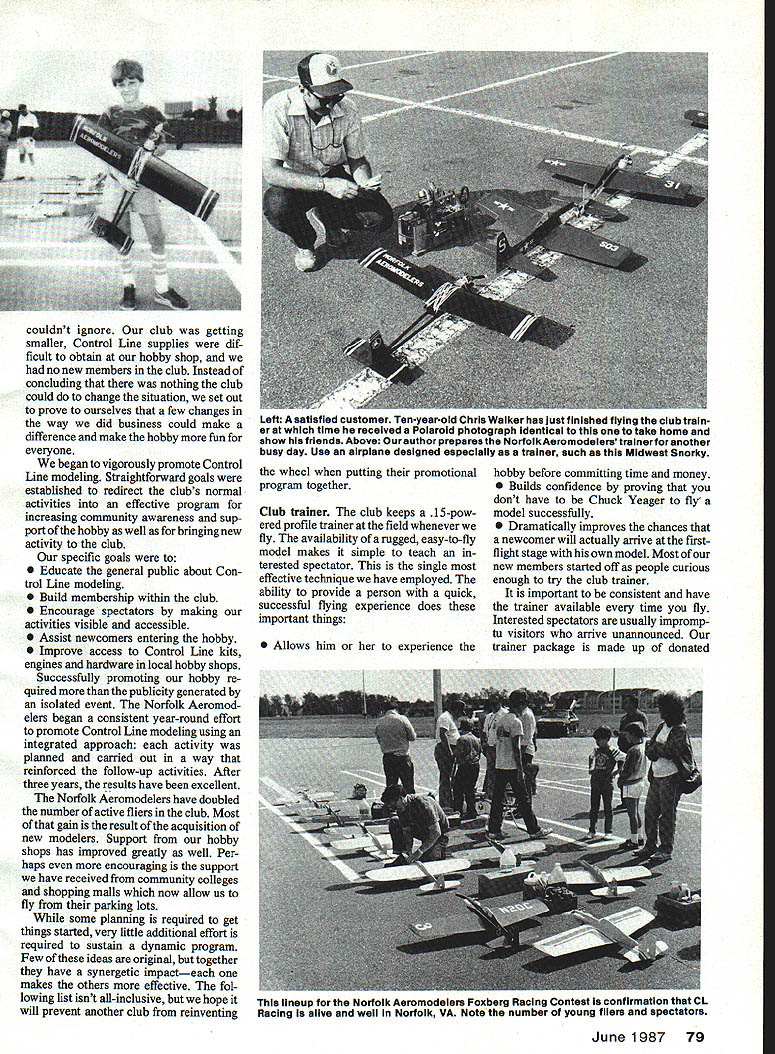
The club keeps a .15-powered profile trainer at the field whenever we fly. A rugged, easy-to-fly club trainer makes it simple to teach an interested spectator. This is the single most effective technique we have employed. Giving someone a quick, successful flying experience does three important things:
- Lets him or her experience the hobby before committing time and money.
- Builds confidence by proving you don't have to be an expert to fly successfully.
- Dramatically improves the chances the newcomer will arrive at the first-flight stage with his own model.
Consistency is important: have the trainer available every time you fly. Interested spectators are usually impromptu visitors who arrive unannounced without equipment or fuel. Since we began keeping a trainer at the field, nearly a hundred people (fathers, sons, daughters, wives, girlfriends, grandparents, etc.) have flown successfully.
A word of caution: use a dedicated trainer as the instructional model. Newcomers will be devastated if they feel they've destroyed your favorite Sunday flier or contest plane. Our trainers "look the part," which helps overcome fear of breaking a "pretty" airplane.
Consider creating a Solo Certificate for young pilots who fly the trainer unassisted. We mark the achievement by giving the pilot a Polaroid photograph of himself holding the club trainer. Recognize the milestone, reinforce a good experience, and introduce the new pilot to friends who will help him get started.
Club instructors
Having an instructor in the center of the flying circle is essential to making someone's first flight on the club trainer successful. We have a couple of fliers who regularly serve as instructors with the club trainer.
Instructors improve with practice. Ideally they should be experienced fliers comfortable sharing the circle with another person's feet. Patience, tact, and a positive attitude round out the qualifications. An AMA Instructor emblem on the sleeve helps newcomers identify whom to approach.
Recruiting junior and family members
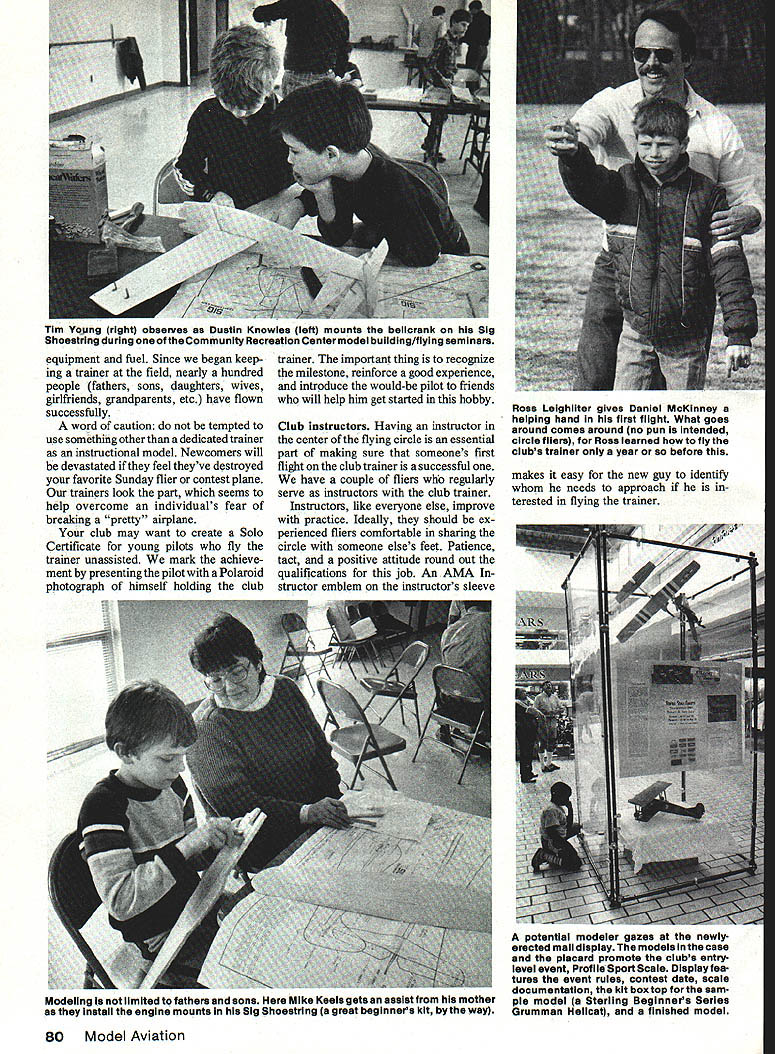
A club can reach out to families in several ways. Our most successful approach has been running model building/flying seminars at community recreation centers, schools, and malls. The seminars are low-cost, short, and fun. We bring trainers, fuel, tools, engines, and a few inexpensive kits. Participants assemble, trim, and fly the models during the program. Most people enjoy the hands-on building experience, and flying is the best part.
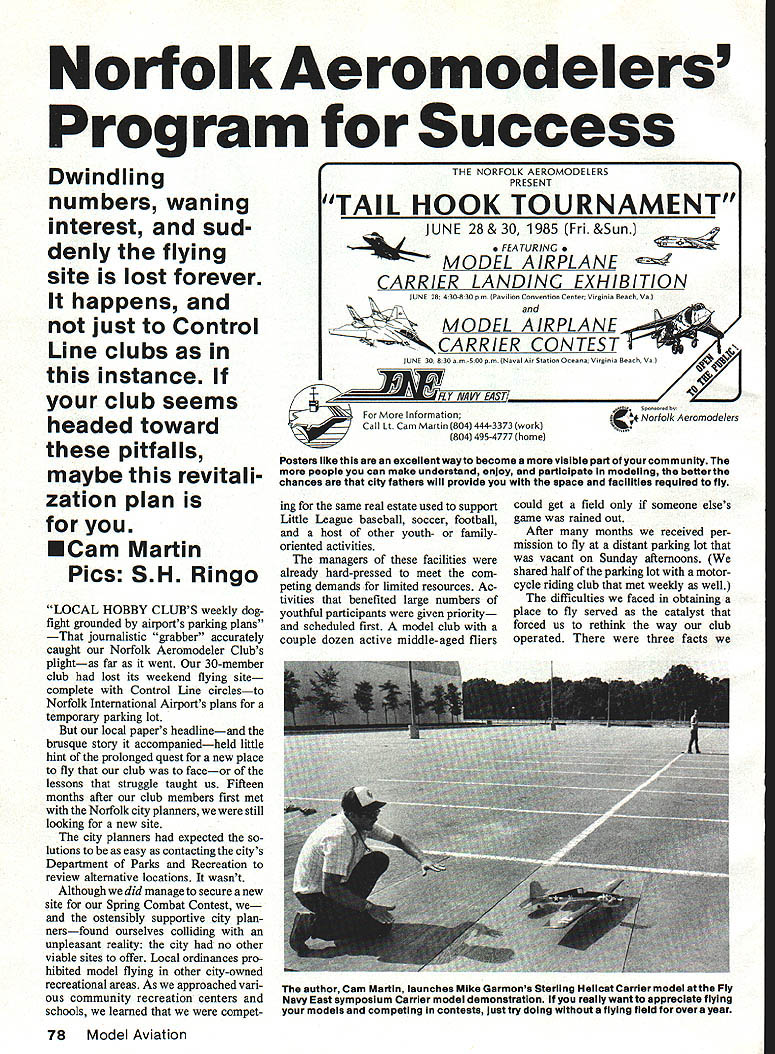
Posters are an excellent way to become visible in the community. If people can be made to understand, enjoy, and participate in modeling, there's a better chance city officials will provide space and facilities. Keep in mind that recreation facility managers are already hard-pressed to meet competing demands; demonstrating broad community interest helps.
Club information sheets
A simple typewritten 8 1/2 x 11 sheet with basic background material is a valuable communication tool. At a minimum include:
- Name of the club.
- When and where the club meets.
- When and where the club flies (include a map and directions).
- Names and phone numbers of contacts for more information.
Photocopy or print as needed. Use them as handouts at the field and mall shows, display them on bulletin boards, and ask the hobby shop owner to include one with every Control Line purchase.
Postcards
Keep blank postcards in the field box. Ask a potential member to jot his name and address on a card; mail it later as a reminder of a meeting or contest date. This simple reminder reinforces interest and shows appreciation for the newcomer's attention.
Hobby shop business cards
Carry a few hobby shop business cards in your wallet. When someone asks where to get materials, give them a card. The hobby shop will appreciate the support, and the inquirer will find it easier to locate supplies. A well-stocked shop is the keystone of educating potential modelers — being able to receive advice or examine a kit firsthand is invaluable to a beginner.
Shopping list
We compiled a bill of materials identifying all items needed to start Control Line flying. We prepared three lists categorized by engine size (.049, .15, .35) matching flying lines, fuel, and propeller to application. The lists also categorize types of Control Line kits so newcomers can distinguish a trainer from a more advanced model.
We provided a copy to the hobby shop owner. He supports many hobbies and can't keep current on everything. Our list helps him stock basics and assemble a starter package. Our hobby shop offers a special discount to beginners who buy a complete starter package. Starting with the right glue and paint makes everything easier and more enjoyable.
Club newsletter
A periodic newsletter helps members stay in touch. It informs them about upcoming events, contest results, introduces new modelers, and relays other club news. Sending copies to outsiders increases value: hobby shops will stock recommended items before contests, other clubs and the AMA district VP stay informed, and your activities reach a wider audience.
Sponsoring a seminar
Sponsoring a seminar proved to be one of the most rewarding activities. Community recreation centers often welcome a Control Line building and flying seminar as a multi-week program. Goals are to teach sound craftsmanship and safe flying habits. Hands-on teaching lets experienced modelers pass proven techniques to beginners and avoid common pitfalls. Seminars attracted families; parents enjoyed the activity as much as youngsters.
Our seminar included:
- An indoor show-and-tell to acquaint people with club members and favorite models.
- The AMA Control Line videotape, Wired for Excitement.
- An outdoor flying demonstration by club members.
- Flying the club trainer.
- Classroom lectures and field demos on basics and specific topics like "How to cover a wing," "How to break in a model engine," and "Control Line Model Safety."
- Troubleshooting sessions to answer questions and correct problems.
- Contest and awards presentation for the seminar's best-looking model.
Special event press releases
We prepare a basic "who, what, when, and where" press release for special events such as contests or seminars. Use layman's language (e.g., "model dogfight" instead of "Combat event"). A photograph from a past event helps communicate what to expect.
Contests seldom attract TV news crews, but freelance photographers and community calendars in newspapers and radio stations provide free publicity. Our local TV station filmed members and models for a community program. Use press releases and community calendars to spread the word and increase spectator attendance.
Special event flyers
Produce a spectator-oriented announcement written in layman's terms to invite people to watch a contest or participate in a seminar. Include a contact name and phone number. Post these flyers on bulletin boards in high-traffic areas such as shopping malls, libraries, and hobby shop windows.
Display window exhibits
Obtain permission to put a Control Line model exhibit and information placards in a mall display case. Our exhibit ran for two weeks to promote an upcoming contest and attracted so much attention that merchants wanted continued use of the space. A window exhibit can give exposure to far more people than a manned mall show.
Entry-level Control Line events
When a modeler masters a trainer, contest participation can seem out of reach. To bridge the gap, include an entry-level event at each contest. The event should be flyable using simple, off-the-shelf items.
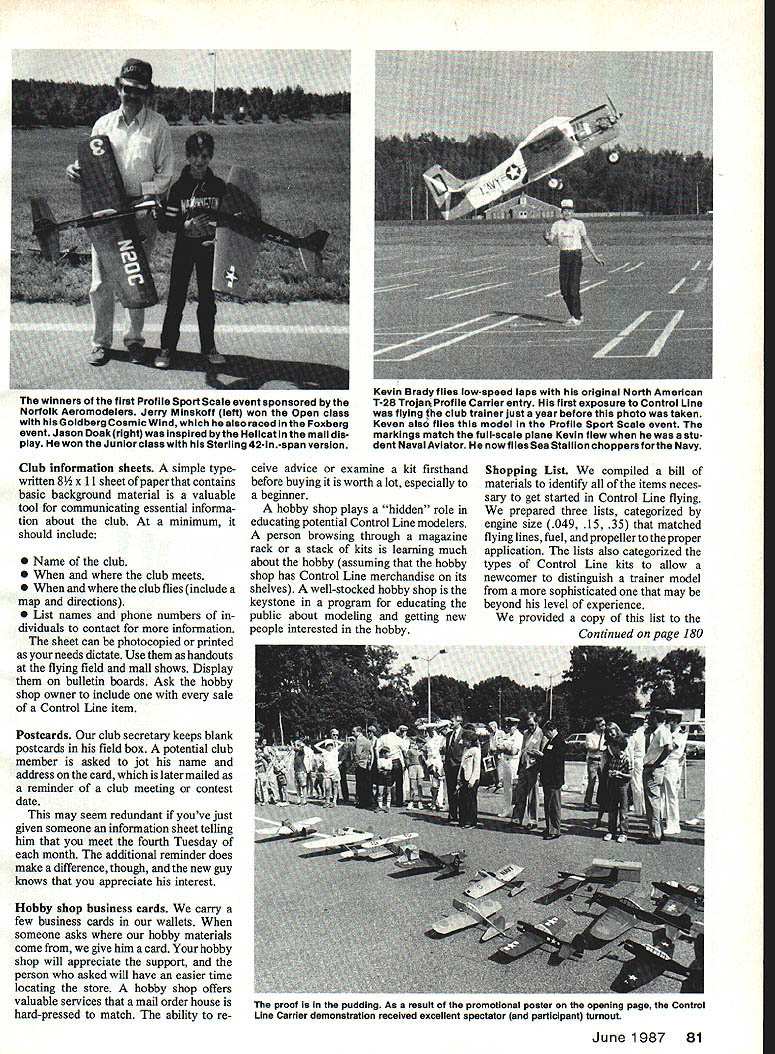
Our most popular entry-level event is Profile Sport Scale. Anyone who can fly a profile replica of a full-scale aircraft for 10 laps can compete. Many profile Control Line kits are patterned after full-scale prototypes; some, like the Sig Shoestring or Sterling's Beginner Series, make good trainers. Featuring an entry-level event gives new fliers something to look forward to, bridges sport and contest flying, and builds confidence.
Results and closing
Our efforts produced the intended results. Club membership continues to grow; the number of active fliers has doubled. The father-and-son team that first flew the club trainer two years ago are now among our most aggressive Combat fliers. Some people who built their first model at a recreation center are now Sunday regulars. The local hobby shop carries Control Line merchandise and highlights new kits.
Promotion is ongoing. Everything we put into action got us to where we are now, and we want to keep it that way. Promoting the sport is evolutionary: there is always a refinement to add — for example, organizing a car pool to get junior modelers to the field. That's a challenge the Norfolk Aeromodelers will gladly take on.
Transcribed from original scans by AI. Minor OCR errors may remain.

