
Northwest Expo
"Going to Puyallup?" An in-depth report of the 12th annual trade show. - Joe Just
In the Northwest, one often hears the following question: You goin' to Puyallup? Now Puyallup (pronounced pew-al-up) is a moderate-sized city south of Seattle, Washington, but for most modelers, the phrase "going to Puyallup" means attending the annual Northwest Radio Control Model Exposition.
The dates for the 12th annual affair were January 30 and 31 of this year. It was held at the Western Washington Fairgrounds, the traditional location for this trade, demonstration, and exhibition show, and was rated the eighth-largest fair in the U.S.A. Planning, running, and responsibility for this show were the tasks of the Mount Rainier R/C Society. This year Puyallup was bigger and better than ever.
Model Aviation magazine telephoned one cool, gray day and asked if I would like to attend and report on this trade show from the typical modeler's viewpoint. Noting that I had epoxied my hand to the phone during this conversation convinced me that I was at least partly typical. I agreed to attend and pursue what this show had to offer the modeler and the exhibitor.
So, with tape recorder, pad, and camera in hand, my wife and I made the 200-mile trip to Puyallup.
Our first impression was how huge the free parking lots were, which made it fairly easy for a tremendous number of cars to move quickly into the area. In the lot, we spied license plates from Oregon, Utah, Montana, Idaho, Nevada, California, and British Columbia.
Walking the short distance toward the exhibition halls, we noted a large contingent of burly, backwoods types carrying some impressive hardware — muzzle loaders, pistols, and other assorted firearms. My wife raised a questioning eyebrow in spite of my assurances that there must be a firearms show in one of the exhibition halls. I doubted that they were there to express dissatisfaction with our AMA vice presidents. Somewhat to my surprise, I was correct.
The 1993 Puyallup was located in two new buildings, one using the ground and second floors, the other completely taken up with an RC car racetrack and swap meet booths.
Our visit commenced on the upper level of the main building. Area clubs had set up booths along the outer walls, leaving a vast area for static model displays. Boats, cars, and aircraft of all sizes and disciplines filled table after table with some of the most impressive models I've ever seen. The setup gave us an opportunity to see these beauties up close at waist level.
Each model was presented with labels indicating owner/builder, type of model, and pertinent information. It never ceases to amaze me how much building talent a show like this brings out — the very best of the best!
There were about 130 exhibitors to review, so we cast our ballots for the Best of Show award and returned to the main floor.
We checked out the AMA booth, where a good crowd had specific questions answered with dispatch and accuracy. My questions would have to wait, as it was time to become a typical modeler: What was new? Who had it? Why? In what direction was my favorite hobby headed?
Our next stop of interest was the Miller R/C Products booth. Hap Miller was showing a series of belt reduction systems for electric starters. Providing a 4:1 ratio, these devices give greater torque for large engines, such as the SuperTigre 3000 and similar power plants. Hap indicated this product was used as the primary unit for starting the engines at the Madera races.
I asked him how he viewed the future of our hobby, and he graciously answered, "Oh, it's growing. It's growing by leaps and bounds. No new trends. It's still power." Airplanes, gliders, free flight — all-around enthusiasm!
We continued wedging our way through the crowd to the Feather Cut Company where a complete line of hot-wire cutting and support equipment was displayed and demonstrated. From the activity of a large group of modelers, it was apparent that this company's line was successful and accepted.
Hacking and slashing our way, we stopped at McDaniel's, the makers of the Ni-Starter. A large selection of handy Glo-Drivers was on display. Personnel were busy showing the products, and we noted that they were set up to provide on-site service and repair if needed. This provided a nice "we back up our product" feeling to the booth. McDaniel's navigation lights struck my eye as a great feature for a classy project.
We went on to the Minimax Enterprise booth, where I became enraptured with the Minimax-700 two-meter sailplane. Trying to hide and play mouse, I was totally impressed with the evident quality of this kit.
All parts are machine cut, not die cut. This kit was designed by Ron Parcells, a machinist by trade. As we watched, it was clearly evident how easily and perfectly the kit could be built. This economically priced kit would be a great way to enter into silent flight.
I seized the opportunity during a demonstration lull to ask about the future of RC sailplane activity. In reply, Ron stated, "I believe the growth of RC gliders will become what it should be. It's a beginner's point of getting started in the RC hobby. It's your opportunity to build and be able to fly successfully because it's slow. You don't have as much money invested as you would with a power plane. For example, you could build a glider and fly it with a radio and everything for about $120. With a power plane, you're at about $300." Noting the size of the crowds at this booth, he may be right.
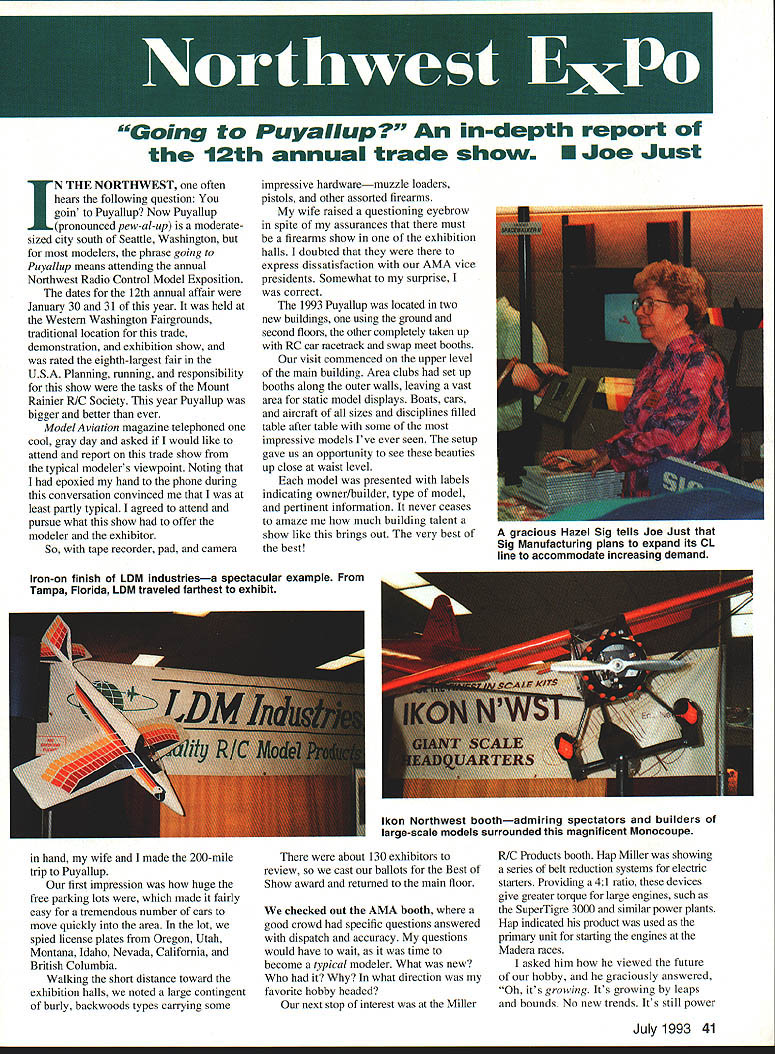
Pondering the above, we traveled to the Sig booth. This company features everything an average modeler could possibly want — from peanut to giant scale and all between. I was viewing the Ninja and Samurai sailplanes when the crowd parted. I had a chance to pop my recorder into Hazel Sig's face. Hazel politely answered all my questions as we chatted about the future of the hobby. She also observed an increasing demand for control-line equipment.
Sig has plans for some new kits to fill the expanding popularity of this phase of our hobby. Noting Sig's success with the Ninja and Samurai sailplane kits, she feels that sailplanes will continue to be a large part of the RC market. We wandered along and away from the Sig booth feeling the overall state and future of our hobby was healthy.
Our next stop (speaking of health) was at the KDI Company. KDI offers the Hush Puppy rubber muffler to keep your hearing in good shape. Of special interest to me was the Mr. Klean power chamber and extension tube. The KDI folks claim lower exhaust note frequency and tuned-pipe-like power gain, as well as the added benefit of keeping messy exhaust residue off your plane.
An added feature — Mr. Klean is easily installed on existing engine mufflers. I feel this could be a low-cost, easy approach to control-line stunt tuned-pipe experimentation. I plan to give it a try.
Increasing in popularity are the unlimited R/C Air Races at Madera, California. The folks behind the scenes of Madera '93, including David Bird, were on hand and were undaunted by my questions.
When asked what he thought about the show, David said, "This is a real good show, particularly on a nice weekend like this one. It really brings down the Canadian modellers."
David went on to comment on more exciting changes in unlimited R/C racing. A 42cc-size class of Formula I aircraft will be the pace planes at Madera in '93 with a full racing class of this type for 1994. He also noted that the AT-6 class will be very popular, with four separate race dates and sites in 1993.
We then followed the crowd to the Byron Originals booth. Known worldwide, the large impressive line of Byron Originals speaks for itself. However, I was pleased to find that the average modeler, like me, can find Byron quality in a smaller plane.
The .60-size version of the Russian Sukhoi should be a big hit! Modestly priced, this Sukhoi will provide Byron quality and pleasure to those modelers not inclined to try the company's giant-scale fleet.
Turning the corner, I spied the Klotz Lubricant display and noted that along with a number of oil additives, Klotz was offering pure nitro in gallon cans. For those of you who relish the home-brew approach, it's good to know that pure nitro is available from a major quality source.
Swept away by the throng, I stepped out of the flow of spectators and settled into the AMS Import, Inc. dock. Pretending to be Mr. Average RC modeler, I was enthralled by the vast selection of imported ARF kits. All these captivating planes are prefabricated of balsa and ply and come finished with attractive trim. The kits come with tank, wheels, and all necessary accessories.
Mr. Arnold Wratschko of AMS Imports of Reno, Nevada, a charming Austrian gentleman, graciously ignored the phone still exposed to my hand and agreed to talk about these kits. He noted their popularity with beginners as well as their use as everyday workhorses. The kits are made in Taiwan, and he recommends them for sport flying in particular.
If I'd had my druthers, I would have picked the Sky Hunter .40H to take home. It has a 55 1/2-inch wingspan, takes a .40-.45-size engine and weighs, completed, about 5 3/4 pounds. My second choice in this line is AMS's semiscale Cherokee with about the same specs.
Stealing my heart as the "kit of the show" was the Messerschmitt Me 262. The completed kit in AMS's booth spans 82 inches with a body length of 69 1/2 inches. The wing area is a staggering 1,085 square inches and is balsa-skinned foam. The twin nacelles are fiberglass reinforced and in this model are a pair of Pico .90s in power. This is all available from AMS for a mere $999. When the construction is done, the box it comes in could be rented as a fair-income residence.
The next stop was my wife's favorite, the International Paper Model booth. Lou Dausey, the manager, and I spent a good length of time discussing his extensive line of not only models but castles, animals, birds, and structures like the Statue of Liberty.
Lou was pleased about the show's growth and was adamant that modelers' views really made the show lucrative for his company. Lou's company has grown from 40 models to more than 1,100 in just 15 years, and he credits his success to this type of show. As I moved away, I looked back to find my wife gathering up a bunch of model birds, proving Lou's point.
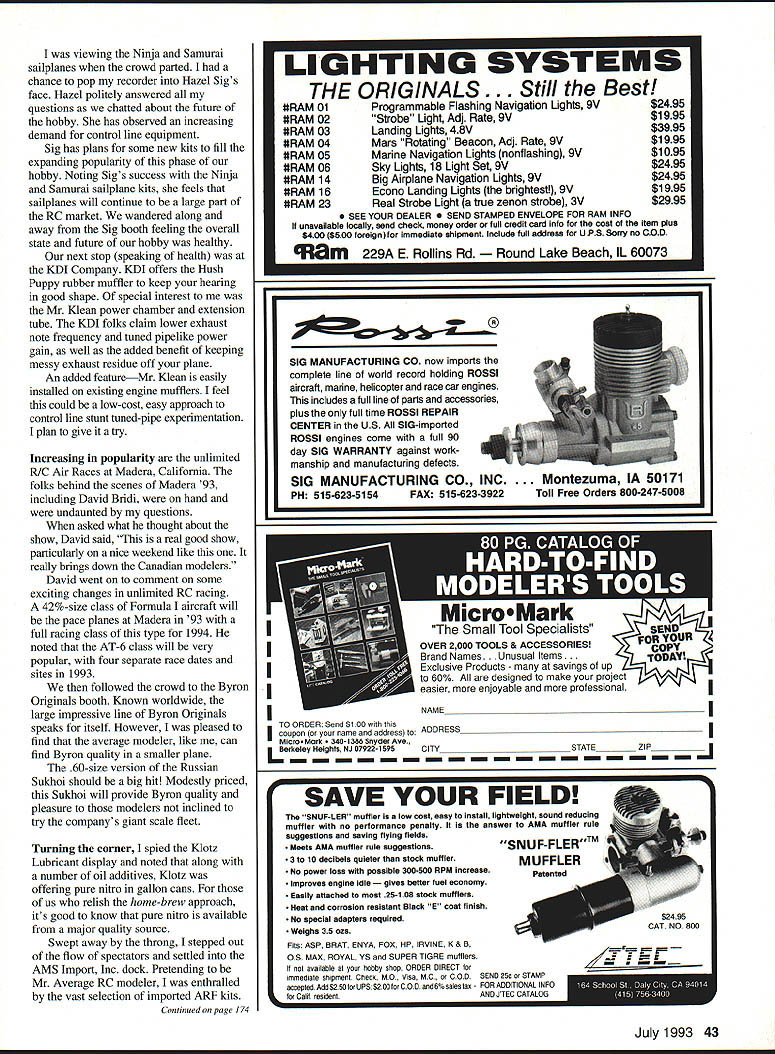
Ikon Northwest's booth was surrounded by lovers of large-scale kits, in this case admiring the fabulous Monocoupe that was on display.
By now, we had traversed about half of the available booths. We decided to take a look at the swap meet building, which is always a big, busy draw at Puyallup.
We interrupted our short walk between buildings to grab a snack, and we watched an excellent demonstration of helicopter flight. From the looks of wonder on most faces, it was easy to see why the Mount Rainier R/C Society had decided to have outdoor demonstrations as part of this show.
Just a step or two away from the helicopter demo was a raised artificial pond. Nearly 100 kids of all ages were enraptured with the buzzing, darting action of R/C electric boats. Another nice touch.
I believe that a lot can be learned about the success of any endeavor by observing faces of the people as they leave an event. From my vantage point, it was obvious that modelers and their families leaving the swap meet building were more than happy. Many, if not most, were carrying away their prized purchases.
Entering the swap meet at Puyallup is an experience difficult to describe. A huge room, dominated by table after table covered with modeling equipment of every description, was filled with eager buyers. Our time was limited, but we made a quick tour, drooling at every step.
Our overall impression — very desirable items at fair prices — a big draw and a big hit!
On our way back to the main building, we watched some exciting control-line flying that drew another big crowd, cheering for the pilots after each maneuver.
We reentered the primary building and were struck with Dynaflite's 1/4-scale Me-109E, 60-size Corsair, Warhawk, and Spitfire, which were, as the sign proclaimed, lightweight.
Proctor kits need little introduction to the modeling public. Until you've had a chance to visit a show like this and view the lineup close in the "bones," you'll really can't comprehend what near-perfection is. An appreciative group of fans milled around the display of the company's many planes of museum quality. The craft are nearly mystical in their miniature perfection.
A consumer show is a great place to find out what's new, perhaps to find out what's ahead for our hobby, and why it might be coming.
We spent considerable time at the Lanier R/C booth, where Bubba Spivey discussed what possibly is wrong with youth involvement. Bubba contends that with all the pressure today, youth needs someone in his position to give them some attention. His company will be expanding its ARF line to lend a hand to the novice RC participant.
On another tack, Bubba's father has obtained the original dies of the Veco/Dumas free flight and control-line kits. Using these dies, he is now producing new kits under the company title of Aero Engineering. I mentally set aside a few dollars to pick up a FF Dakota. This will broaden not only its product line but also overall model availability and involvement.
For years, I have used McCoy Series 21 engines for sport flying, and Cox and K&B Conquest .15s in carrier, but if I ever build either an RC or FF old-timer, I'm convinced I'll try a replica Forster .99 from RJL Products. The acceptance of this fine replica is outstanding, and the example we fondled was exceptional.
Hayes Products displayed most of its fine accessories at its booth. Its management and I talked about the possibility of increased demand for 1/3-scale planes. If the prediction holds true, Hayes promised it would be at the forefront with product availability, including motor mounts and an excellent line of fuel tanks.
However big the operation, the staff from Ace R/C was homey and helpful and willing to show me exactly what I wanted to see. They were more than pleasant in answering all my questions.
For the beginner or the casual RC modeler, Ace offers a two-channel 1/2A-powered delight called the Grasshopper. It features a 5 1/2-inch foam wing, weighs 20 ounces, and uses a fiberglass arrow shaft boom with rudder and elevator pushrods enclosed in the hollow shaft.
Another neat feature is a breakaway motor mount rubber-banded in place to allow for damage control on those less-than-perfect landings. The dural landing gear also is rubber-banded supported. Anyone who is heavy-handed in R/C flying attempts will find these features indispensable.
For a list price of $29.95, this one is another of my must-have items.
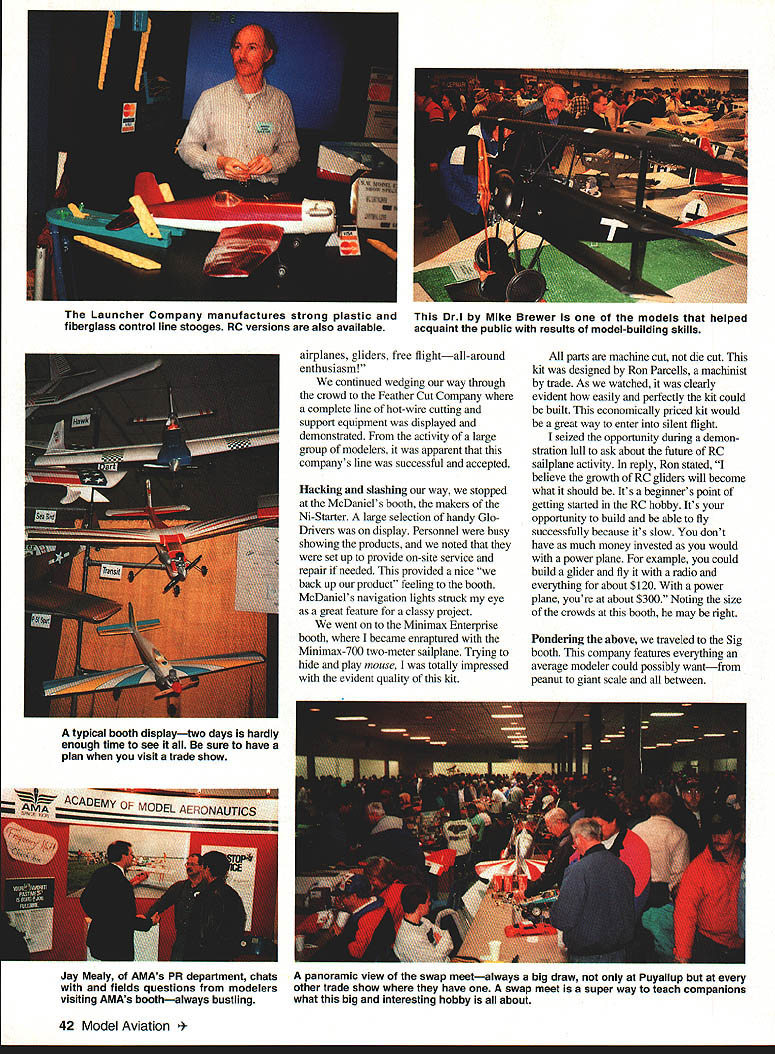
The unofficial prize for the exhibitor traveling the farthest distance to Puyallup goes to LDM Industries of Tampa, Florida. Its primary offering is a line of ball-bearing servo kits to convert servos for better life and performance.
No Heat Trim solvent is a product after my own heart. This handy little melt removes the adhesive on trim patches and allows perfect permanent repairs without using heat, which usually and invariably creates bubbles in my best attempts. Using this solvent appears to eliminate this problem. I think I should have purchased a gallon!
The radiant distaff side of our team steered me to her best-idea product — the Radio Glove Company's offering of a hooded padded affair to keep your hands and radio warm and protected when flying or boating in cold weather.
One aspect we often overlook in our hobby is that most model manufacturers are basically enthusiasts who started their companies to supply what they felt was needed. Fourmost Products is such a company. The founder is a lifelong modeler and is more than happy to listen to what is wanted and needed.
Taking your thoughts back to the R&D department is one way Fourmost comes up with those neat little aftermarket products we love to use.
Fourmost's owner and I had a nice chat, particularly about the increasing use of electric power plants, which he predicts is the wave of the future to help keep flying sites.
The latest item, the demountable hinge, caught my eye. I also like the recoil tubing and cockpit coaming, but what I really want for Christmas is the Mark II Fuselage Fixture.
Noting that my wife ignored that request, I moved on to Ernst Manufacturing, where I found the exact item I need. Ernst must have had me in mind when it developed its Ni-Cd-type starting battery that allows the cap to always remain attached to the battery instead of your pocket, or — in my case — somewhere never discovered.
Regional companies, such as Northwest Hobby Technologies of Auburn, Washington, were on hand at this year's Puyallup. For the highest-quality car or plane flight boxes, this company's products satisfied the most demanding modeler. The boxes are well designed and exceptionally well built.
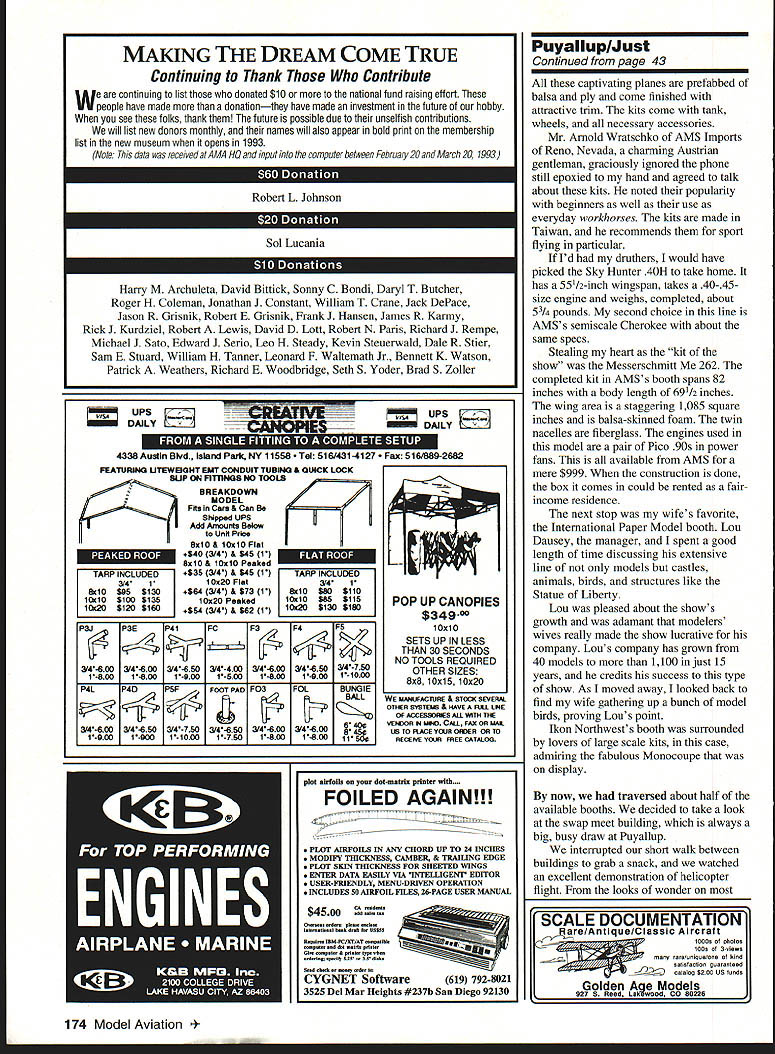
Next was a company booth with the motto "Designed to change the way people fly." The company name is Launcher Company. It builds a series of "stooge" devices. Made with very strong plastic and fiberglass, the devices are sold for either RC or control-line use.
Attending a trade show is the perfect way to learn. After viewing Pacer Tech's (Zap Products) and Robart's booths and listening to many modelers' questions, I picked up some of their literature. After reviewing this free material, I have a much better understanding of how to epoxy glass to wings, use hinging, point hinges, and, finally, I have learned why an incidence meter works and why I should have one.
During this two-day show I attempted to wedge my way into the constant crowd at the Futaba display. I did manage to pick up the 1993 catalog. Although I am familiar with its radio equipment, I was stunned to find out that I had been overlooking its line of YS Futaba engines. Where had I been? Despite my hurried pace and the crush of many, I found some time to look over several items.
This led to some interesting reactions and suggestions for new products. Another reason for all of us to attend a trade show.
Unless your hands are very handy — and I'm not — hand-launching your RC craft while holding your transmitter in the other hand can be cumbersome at best. Synchronized Sungs, Incorporated, has the answer to this problem. The company's Omni-Stand holds your transmitter in a belt stand. This just might be a great answer for the handicapped pilot or car or boat driver.
Finally, I ran across a good idea for your pit work. Roger's Custom Products has an extensive line of boat and plane cradles featuring adjustable padded tubing. Here is a solution to the knotty problem of where to handily park your pride and joy. Also included in its line is a nifty Radio Rack. Since I hate to bend over, my choice is the Tall Boys series, which folds up for easy travel and storage.
We left Puyallup with a great many new projects in mind, a sense of wonderment, and a quiet pledge to return. It was nearly impossible to spend quality time at every booth and display in just two days; however, we did manage to pick up catalogs, brochures, and other available materials at each booth where provided. I plan to spend many quiet hours reviewing these.
I am no stranger to trade shows. Before I entered into semi-conscious, for many years I was the national sales manager for two different sporting goods companies and was responsible for trade and consumer shows in Syracuse, New York; New York City; Chicago; Harrisburg, Pennsylvania; and Seattle.
I've got some ideas for both modelers and exhibitors that I feel should be passed on.
Suggestions for modelers and exhibitors
- Mr. Average Model Enthusiast: Go to any model exposition you can get to. Your input to manufacturers is vital. Any show vendor worth his entry fee wants to hear from you. Go with a plan, go with an open mind, and spend most of your time listening.
- Be sure to take in the swap meet if one is offered, and be sure to say thanks to the manufacturers, the host club, and the entire staff. It won't go unnoticed. Take your wife and family or friends — there is no better way to show how big and interesting our hobby is than to show it off at a "Puyallup."
- Mr. Manufacturer, particularly the smaller, newer, or cottage-type business: Exhibit! Exhibit! Exhibit! I can't think of a more exciting way to show off your wares. It's cost-effective with a captive audience at hand. It's a positive reinforcement of printed advertising, and it can be lucrative.
- One minor suggestion — if you plan to use visual aids, such as a VCR monitor, please try to place them well above eye level in your booth, perhaps at about eight feet. This will provide a viewable platform for your product and will still allow showgoers to get to your display. In several cases at Puyallup, I found it impossible to talk with you because of the gridlock at your booth.
Finally, my personal thanks to all who took the time to talk with me. I'll be doing my best to return to Puyallup in future years.
Transcribed from original scans by AI. Minor OCR errors may remain.

